Brewing
Gongfu brewing
- Water temperature
- 80 °C
- Tea amount
- 5 g
- Water volume
- 100 ml
- First steep
- 10 s
- Time added per infusion
- 5 s
- Infusions
- 3


Xīhú lóngjǐng
Choose a brewing method. Start with the recommended quantities and time, then adjust to taste.
Brewing
Brewing
Taste
Explore the tea's aroma, flavor and aftertaste.
Click or tap a note to filter matching teas when interaction is enabled.
Tea encyclopedia
Category: Heads the list of "Ten Famous Teas of China" (中国十大名茶, Zhōngguó shí dà míngchá). Geographical indication product (地理标志产品, dìlǐ biāozhì chǎnpǐn). In 2008, its production technology was included in the Second Registry of National-Level Intangible Cultural Heritage Objects of the PRC, and in 2022 — in the UNESCO Representative List of the Intangible Cultural Heritage of Humanity as part of the nomination "Traditional tea processing techniques and associated social practices in China."
Category: Heads the list of "Ten Famous Teas of China" (中国十大名茶, Zhōngguó shí dà míngchá). Geographical indication product (地理标志产品, dìlǐ biāozhì chǎnpǐn). In 2008, its production technology was included in the Second Registry of National-Level Intangible Cultural Heritage Objects of the PRC, and in 2022 — in the UNESCO Representative List of the Intangible Cultural Heritage of Humanity as part of the nomination "Traditional tea processing techniques and associated social practices in China."
Coordinates: Approximately 30°15′ North latitude, 120°10′ East longitude.
Origin: China, Zhèjiāng Province (浙江, Zhèjiāng), Hángzhōu City (杭州, Hángzhōu), vicinity of West Lake (西湖, Xīhú). The production territory covers the Xihu, Xiaoshan, Yuhang districts and 18 other counties of Hangzhou City, divided into three major zones: Xīhú (西湖), Qiantang (钱塘) and Yuèzhōu (越州). Only tea from the Xihu zone has the right to the full name "Xi Hu Longjing."
Type: Green tea (non-oxidized). Belongs to the category of pan-fired green teas (炒青绿茶, chǎoqīng lǜchá) with flat leaf form (扁形绿茶, biǎnxíng lǜchá).
Cultural Significance: Longjing is a symbol of Hangzhou and all of Zhejiang Province, an integral part of Chinese literary, aesthetic and philosophical tradition. The tea is regularly presented as a state gift to foreign guests. An annual festival dedicated to Longjing picking is held in Hangzhou, and the city bears the unofficial title of "tea capital" (茶都, chádū) of China.
History: The history of Longjing spans more than 1200 years, and it is precisely expressed by the ancient formula: "The name originated in Song, became famous in Yuan, flourished in Ming, reached its peak in Qing" (始于宋,闻于元,扬于明,盛于清). The first written evidence of tea cultivation in this region belongs to Lù Yǔ (陆羽, Lù Yǔ): in "The Classic of Tea" (茶经, Chá Jīng), written during the Tang era (618–907), he mentions that tea was produced at the Tiānzhù (天竺) and Lingyin (灵隐) temples in the vicinity of Hangzhou. During the Northern Song period (960–1127), local teas "Xianglin" (香林茶), "Baiyun" (白云茶) and "Baoyun" (宝云茶) were already supplied to the court as "tribute tea" (贡茶, gòngchá), and poet Sū Dōngpō (苏东坡, Sū Dōngpō) praised Hangzhou tea in verse. It was during the Northern Sòng that monk Biàncái (辩才, Biàncái) established tea plantations on the slope of Shīfēng Mountain (狮峰) near Longjing village, which is considered the earliest documented record of tea cultivation and production in this village.
In Lóngjǐng village (龙井村, Lóngjǐng Cūn), located at the foot of Shifeng Mountain, there was an ancient well in which, according to legend, a dragon dwelt that could summon rain. Local residents came to the well to pray for moisture in dry years.
According to another version, the name is connected to the unusual movement of water in the well: when stirred, a winding pattern appeared on the surface, resembling dragon movements.
There is also an interpretation connecting the name to the elegant flat shape of the tea leaf, reminiscent of a dragon's body curve.
Cultivar: Several varieties of tea bush Camellia sinensis var. sinensis are used for producing Xi Hu Longjing:
Picking: Picking begins in early spring. The most valuable is tea picked before the Qīngmíng festival (清明, Qīngmíng; ~April 5) — such tea is called "mingqiancha" (明前茶, Míngqián chá). It consists of the most tender shoots — full buds or one bud with one barely opened leaf, possesses delicate fresh aroma and belongs to the highest quality category. Tea picked before Gǔ Yǔ (谷雨, Gǔyǔ; ~April 20) — "yuqiancha" (雨前茶, Yǔqián chá) — consists of one bud with one-two leaves, gives more saturated and full taste, and is significantly more affordable in price.
Pluck Standard: Traditionally picked one bud and one-two upper leaves (一芽一叶, yī yá yī yè or 一芽二叶, yī yá èr yè). For highest grades — only bud with one barely unfolded leaf, or exclusively buds.
Raw Material: Highest. Only tender, undamaged buds and leaves of uniform size are used, without coarse leaves, stems and impurities. Freshly picked raw material must be processed on the same day.
Altitude: 100–800 meters above sea level. The main mass of tea gardens is located at elevations of 100–200 m on hilly slopes.
Climate: Hangzhou is located in the subtropical monsoon climate zone. Average annual temperature — about 16°C, annual precipitation — about 1500 mm, relative humidity — over 78%. In spring the region is often shrouded in fog, daily temperature fluctuations are 8–12°C, which favors the accumulation of L-theanine (tea amino acid) in leaves. A local saying describes this microclimate: "In clear weather — morning and evening fog everywhere, in cloudy weather — all day mountains in clouds" (晴时早晚遍地雾,阴雨成天满山云).
Soil: Weakly acidic red soils (红壤, hóng rǎng) with pH 4.5–6.0, rich in organic matter and minerals. Soil acidity and mineral composition play a key role in forming the characteristic flavor profile of the tea.
Considered the best terroir for Longjing. Tea from this zone has characteristic unpolished rice color (糙米色, cāomǐ sè) — yellow-green shade, dense saturated taste with orchid note.
Historical place of tea origin. Leaf flat, smooth; taste fresh, sweetish and soft.
Largest tea village. Tea distinguished by emerald-green color, elegant leaf shape and persistent clean aroma.
Tea with even, uniform leaf and pronounced bean aroma.
Tea with transparent, light liquor and prolonged sweet aftertaste. In combination with local Hupao spring water forms the famous "double jewel of Hangzhou" (杭州双绝).
Hand picking is conducted in early morning hours. Bud with one-two leaves is picked, strictly selecting raw material for uniformity and freshness.
Picked leaves are spread in a thin layer in shade in a cool room for several hours (usually 6–12 hours) to remove excess moisture and begin aroma development. During this time, water content in leaves decreases by approximately 15–20%.
Main stage combining fixation (杀青, shāqīng) and primary shaping (整形, zhěngxíng). Leaves are pan-fired in heated cast iron woks at temperature 70–80°C. The master manually presses leaves to the bottom and walls of the wok, giving them characteristic flat shape. At this stage enzyme oxidation is stopped and fresh aromatics are fixed.
After primary pan-firing, the semi-finished product is gathered in piles and left for some time. Moisture from stems redistributes to the leaf surface, equalizing overall humidity and making the leaf more pliable for further processing.
Final pan-firing at lower temperature — below 60°C. At this stage final taste and aroma are formed: the leaf acquires smoothness, luster and density. Here the master displays highest mastery, controlling ten canonical hand techniques (十大手法, shí dà shǒufǎ): "shaking" (抖, dǒu), "overlaying" (搭, dā), "pressing" (捺, nà), "swinging" (甩, shuǎi), "pushing" (推, tuī), "clasping" (扣, kòu), "flattening" (拓, tuò), "pressing down" (压, yā), "rubbing" (磨, mó), "rolling" (搓, cuō). The entire process requires complete absence of burning — the slightest burnt smell is considered a defect.
Finished tea is sifted, separated by size and tea dust is sieved out.
Larger fractions are returned to the wok for additional refinement.
Uniform fractions are mixed to obtain stable quality of commercial batch.
Final stage — finished tea is placed in clay vessels with quicklime (生石灰) and aged for about a week. Lime draws out residual moisture and "fire taste" (火气, huǒqì), allowing the aroma to become cleaner and more refined. This is a traditional technique unique to Longjing.
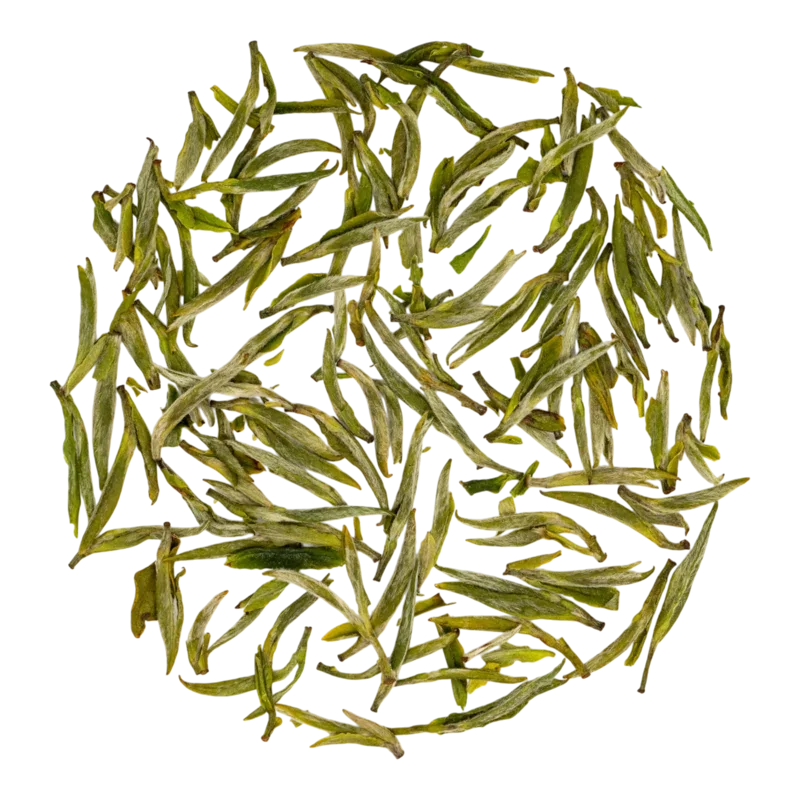
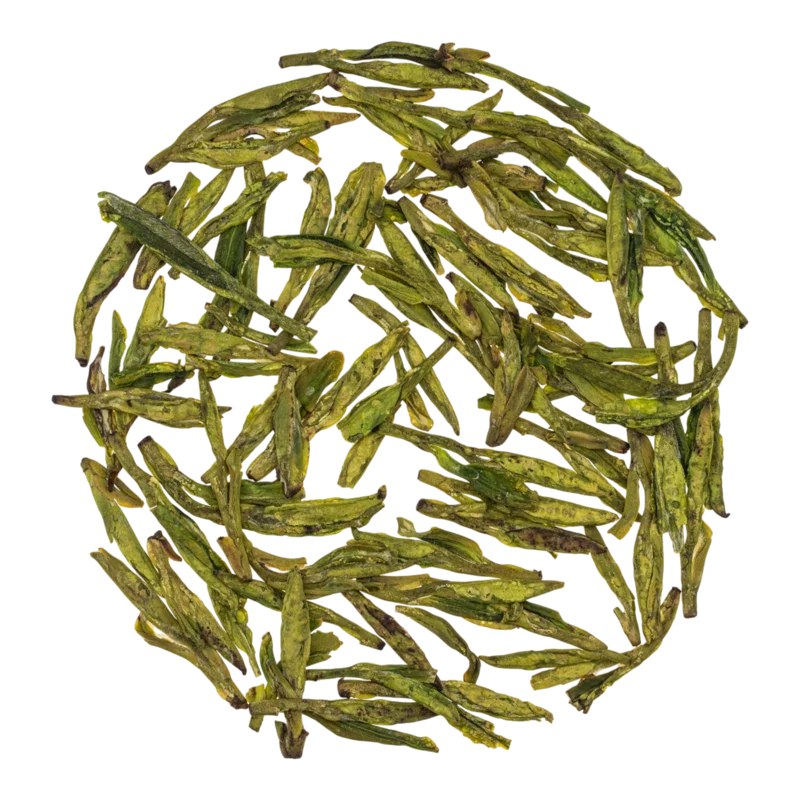
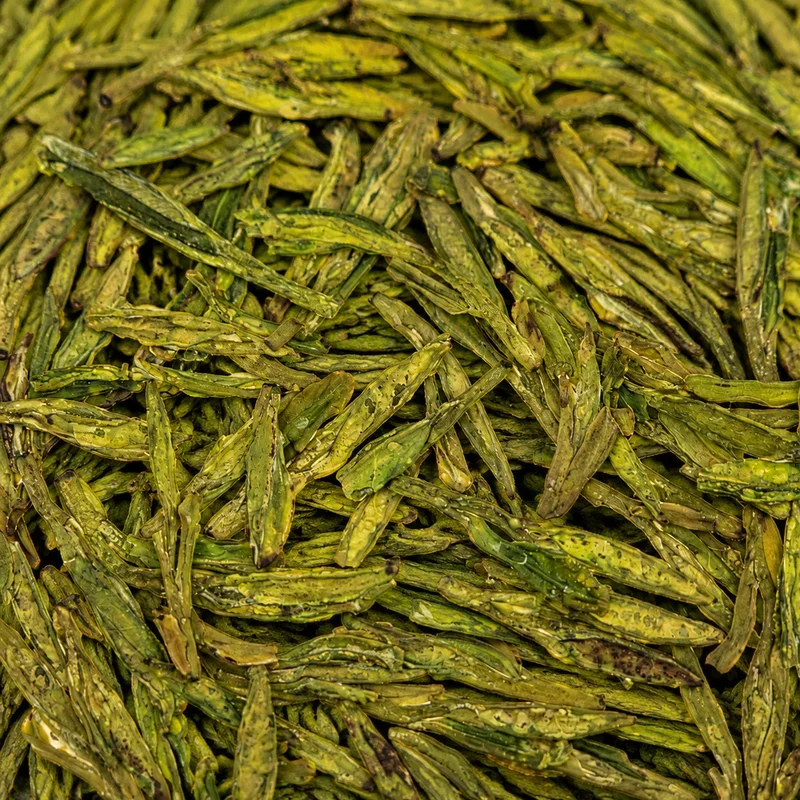
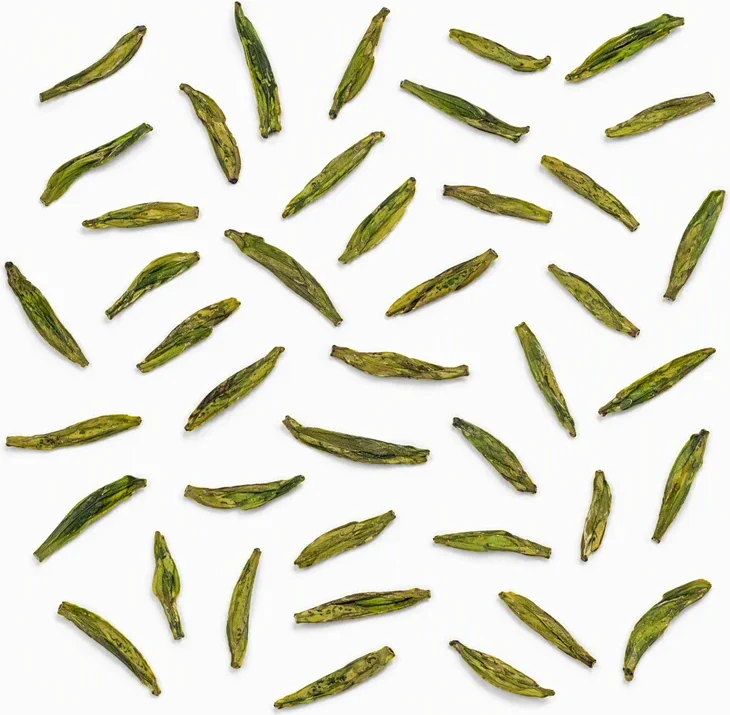
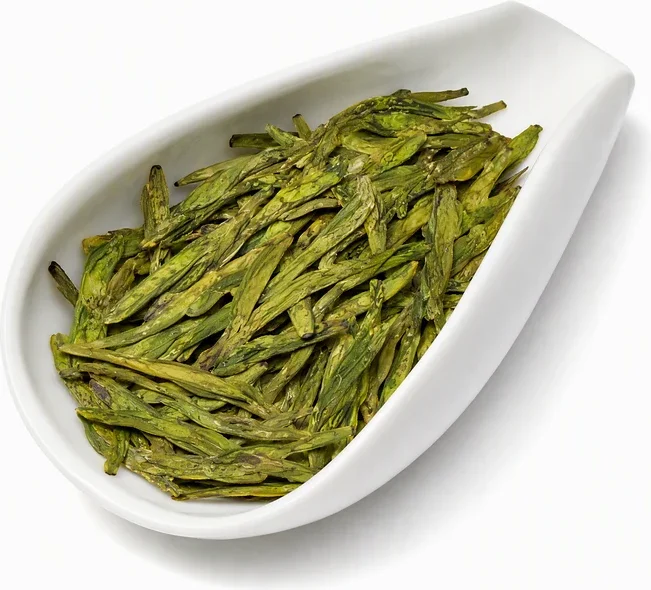
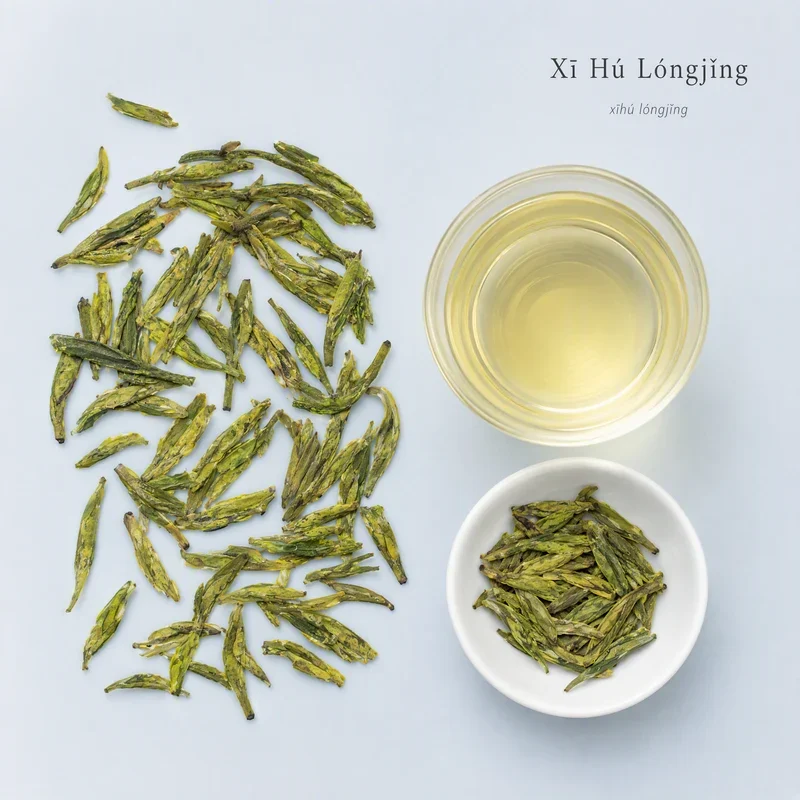
Dry Leaf Appearance: Flat, smooth, even, pointed leaves resembling "sparrow tongues" (雀舌, quèshé) or "sword blade." Size uniform, leaf straight and sharp (挺直尖削). Color — from tender green with luster (嫩绿光润) to characteristic yellow-green shade of "unpolished rice" (糙米色, cāomǐ sè) — the latter especially typical for tea from Shifeng Mountain. Leaf surface smooth, may have light oily luster.
Dry Leaf Aroma: Fresh, clean, with characteristic note of green bean flowers (豆花香, dòuhuā xiāng) — reminiscent of fresh pea pods or green beans. In highest grades of spring tea — tender chestnut note (嫩栗香, nèn lì xiāng). Light floral nuance may be present, reminiscent of orchid (for tea from Shifeng Mountain). Traditional technology does not permit pronounced "fire" aroma.
Liquor Aroma: Clean, persistent, fresh. The same notes dominate — bean floral aroma, tender green sweetness, light chestnut roast. In tea from Shifeng zone — noticeable orchid nuance. Aroma unfolds gradually with each infusion.
Liquor Color: Light green, clean and transparent, with tender yellowish-green shade (嫩绿明亮). In highest grade teas — crystal clear, "alive."
Spent Leaves: Even, whole, elastic leaves and buds of light green color, preserving the form "one bud — one leaf." Leaf tender, uniform, without damage.
Taste: Rich but delicate. Freshness is perceptible (鲜爽, xiānshuǎng) — characteristic "umami" note due to high amino acid content. Sweet aftertaste with soft, enveloping sweetness (甘醇, gānchún — "sweet mellowness"). Medium body, balanced (醇厚, chúnhòu — "dense mellowness"), without pronounced astringency. Long, refreshing aftertaste with returning sweetness (回甘, huígān). The bouquet contains distinguishable notes of roasted chestnuts, fresh greens, orchid.
Alkaloids: Caffeine content — approximately 4.0–4.8% of dry mass (according to scientific publications — up to 4.81%, one of the highest indicators among Chinese green teas). Theobromine and theophylline are also present in smaller quantities.
Amino Acids: High content — up to 4.46% (according to research of 20 famous Chinese green teas — highest indicator among studied samples). L-theanine (茶氨酸, chá'ānjīsuān) predominates, comprising over 50% of amino acid profile. L-theanine is responsible for the sensation of freshness, "umami" and mild relaxing effect.
Volatile aromatic compounds include linalool, geraniol and other terpenoids forming the characteristic floral-bean bouquet. Water-soluble sugars and pectins are also contained, giving the liquor soft "body."
indicators substantially depend on cultivar, picking season, plantation altitude and processing technology. Spring tea from Quntizhong, as a rule, has the highest level of amino acids and most balanced profile.
Minerals: Fluorine (promotes dental enamel protection), potassium, magnesium, zinc, iron, manganese, selenium.
Polyphenols: Tea polyphenol content comprises approximately 13–20% of dry mass. Dominant component — epigallocatechin gallate (EGCG), providing powerful antioxidant properties. Catechin content in Quntizhong variety — about 12.1%. Thanks to early spring picking and gentle technology, the ratio of polyphenols to amino acids (酚氨比, fēn'ān bǐ) remains moderately low, which provides characteristic soft sweetness without pronounced bitterness.
Vitamins: Vitamin C — 100–300 mg per 100 g dry tea (in fresh leaf of "one bud — one leaf" standard — over 1%). B vitamins: B₁ (thiamine) — ≈0.5 mg/100 g, B₂ (riboflavin) — ≈1.5 mg/100 g, B₃ (pantothenic acid) — ≈1.8 mg/100 g, PP (nicotinic acid) — ≈6.5 mg/100 g. Also contains vitamin A, vitamin E, folic acid.
Catechins, especially EGCG, effectively neutralize free radicals, slowing oxidative stress and cellular aging processes.
Caffeine stimulates the central nervous system, increasing concentration, performance and reaction speed. L-theanine softens caffeine's action, providing gentle, even energy lift without sharp peak and crash.
Polyphenols and vitamin C help reduce "bad" cholesterol (LDL) levels, strengthen vessel walls and normalize blood pressure.
Stimulates secretion of digestive enzymes, promotes breakdown of proteins and fats, helps with feeling of heaviness after meals.
Tea polyphenols and tannins suppress growth of pathogenic bacteria, freshen breath (eliminate bad breath).
Caffeine and catechins accelerate metabolism and promote fat breakdown.
Theobromine and theophylline provide mild diuretic effect, promoting elimination of excess fluid.
Contained fluorine strengthens dental enamel and increases resistance to caries.
listed properties are based on publicly available data about green tea composition and are not medical recommendations.
new tea (fresh harvest) is recommended to age 1–2 weeks before consumption so "fire taste" (火气) from pan-firing dissipates — this reduces stomach burden. Strong Longjing is not recommended on empty stomach. Light cloudiness of cooled liquor (茶乳凝, chá rǔ níng — "tea milk precipitation") is normal physical phenomenon not affecting quality.
Tea Amount: 3 g per 150 ml water.
Teaware: Glass tumbler (玻璃杯, bōli bēi) — best option for observing "dance" of leaves in water. White porcelain gàiwǎn (白瓷盖碗, bái cí gàiwǎn) of 150 ml volume also suitable — allows more precise control of steeping time and better evaluation of aroma.
Water Temperature: 80–90°C (recommendation for highest grades — 85°C; use water cooled after boiling for ~2 minutes). Water should not be rolling boil — overheating destroys delicate aroma and increases bitterness.
From Jiangsu Province. Unlike flat Longjing, twisted into tight spirals with abundant down. Aroma more floral-fruity, taste — sweetish and soft, with pronounced fruity notes. Longjing — more "structured," with chestnut roast.
From Anhui Province. Leaf twisted in form of "bird tongues" with abundant white down. Aroma softer and more floral, taste — tender and delicate, less saturated than Longjing. Longjing distinguished by more pronounced "umami" note and chestnut aftertaste.
From Anhui Province. Unique in being made only from leaves, without buds and stems. Shape — flat "melon seeds." Aroma dense, grassy; taste rich and full, with notes of roasted seeds. Longjing — more refined and fresh.
From Anhui Province. Distinguished by large flat leaves (largest among famous green teas). Taste — pronounced orchid aroma and deep, somewhat grassy taste. Longjing — more compact and "beany" in aroma.
From Zhejiang Province. Despite the word "white" in the name, belongs to green teas. Made from albino shoots with exceptionally high amino acid content (6–7%). Taste — bright-sweet, with pronounced "umami." Longjing possesses more complex chestnut-bean profile, while Anji Bai Cha — emphasized "sweet freshness."
authentic high-quality Longjing has even flat shape, whole leaf, without abundance of dust. Bright green color without yellow shades may indicate tea not from Xihu zone or machine production.
real Longjing smells of fresh greens and beans, without sharp foreign notes and "chemical" smell.
clean, transparent, light green. Cloudy or dull liquor — reason for doubt.
suspiciously low price — sure sign of counterfeit. If "Xi Hu Longjing" is offered at ordinary tea price — this is most likely tea from outer production zones or from another region entirely.
real Xi Hu Longjing from core zone appears no earlier than late March. "First picking" in early March with "Xihu" marking — almost certainly tea from Qiantang or Yuezhou zones.
No reviews yet. Tell us what you think of this tea.
Rate this tea and share your impressions. We review each submission before publishing it.
The name originates from an ancient well in Longjing Village at the foot of Shifeng Mountain, where legend says a rain-summoning dragon lived. There is also a version that the water in the well created a twisting pattern reminiscent of dragon movements.
Genuine tea has a flat, even shape in the color of unpolished rice or a tender green sheen, a characteristic aroma of green beans and orchids, and a long sweet aftertaste. The best tea comes from micro-areas around West Lake (Shifeng, Longjing, Meijiawu, etc.).
Mingqian Cha is tea picked before the Qingming Festival (early April) from the most tender buds. It has a subtle, refined aroma and belongs to the highest category. Yuqian Cha is picked before Guyu (late April), its taste is richer and denser, and the price is more affordable.