Brewing
Gongfu brewing
- Water temperature
- 75 °C
- Tea amount
- 5 g
- Water volume
- 100 ml
- First steep
- 10 s
- Time added per infusion
- 5 s
- Infusions
- 3

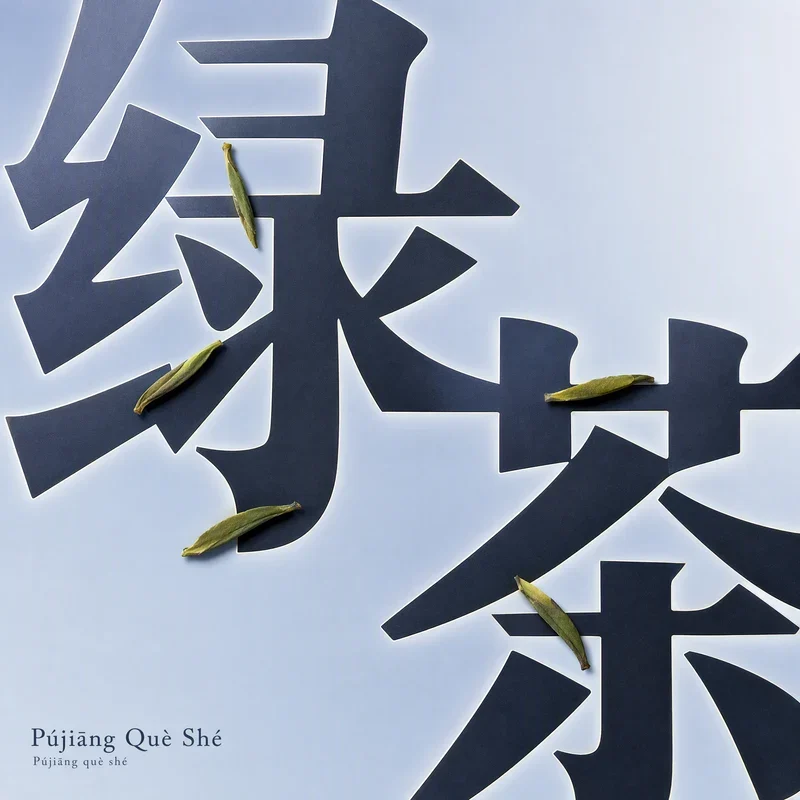
Pújiāng què shé
Choose a brewing method. Start with the recommended quantities and time, then adjust to taste.
Brewing
Brewing
Taste
Tea encyclopedia
Category: Regional famous tea of Sichuan; national geographical indication product (国家地理标志产品, guójiā dìlǐ biāozhì chǎnpǐn, since 2008); included in the list of geographical indications mutually protected by the China-EU Agreement on geographical indication protection. Three-time first prize winner of the "Zhong Cha Bei" (中茶杯) competition.
Category: Regional famous tea of Sichuan; national geographical indication product (国家地理标志产品, guójiā dìlǐ biāozhì chǎnpǐn, since 2008); included in the list of geographical indications mutually protected by the China-EU Agreement on geographical indication protection. Three-time first prize winner of the "Zhong Cha Bei" (中茶杯) competition.
Coordinates: ~30°12′ N, 103°30′ E (center of Pujiang County).
Origin: China; Sìchuān Province (四川, Sìchuān); Pújiāng County (蒲江县, Pújiāng Xiàn) within Chéngdū Municipality (成都, Chéngdū). Protection zone — entire territory of the county. Production core — Chengjia Township (成佳镇, Chéngjiā Zhèn, birthplace of the "tea garden management" model), Datang Township (大塘镇, Dàtáng Zhèn, ancient tribute tea zone) and Xīlái Township (西来镇, Xīlái Zhèn); these account for approximately 80% of premium grade tea.
Type: Green tea (绿茶) (non-oxidized, 绿茶, lǜchá). Kill-green fixation — drum pan-firing.
Established Pujiang brand specializing in premium Que She. Known for strict quality control and traditional processing methods.
Focus on organic certification and sustainable farming practices. Premium grades from Chengjia Township core zone.
Named after Wei Liaoweng, emphasizes historical heritage. Produces limited edition tribute-style teas.
Modern brand combining traditional craftsmanship with contemporary packaging and marketing.
Chengjia Township tea cooperatives offer farm-direct purchasing during spring season (March-April).
Always verify geographical indication certification and organic certificates when purchasing premium grades.
Cultural Significance: Pujiang Que She is the flagship tea brand of Chengdu and symbol of western Sichuan's tea industry. The region actively develops tea tourism: the annual China Tea Picking Festival (中国采茶节, Zhōngguó Cǎichá Jié) in Chengjia attracts up to 10,000 visitors daily. The tea is associated with the image of "early spring" — thanks to Pujiang's mild microclimate, harvesting begins in February, several weeks earlier than famous tea zones in Zhejiang and Jiangsu, earning it the poetic nickname "First Tea of Early Spring" (早春第一茶).
Name Breakdown: 蒲江 (Pújiāng) — county name; 雀 (què) — "sparrow"; 舌 (shé) — "tongue." Full meaning: "sparrow's tongue from Pujiang" — after the shape of early spring buds resembling tiny bird tongues. This imagery recurs in many famous tea names (Ba Shan Que She, Ningqiang Que She, Jintan Que She), but Pujiang secured the "surname" — "que she with Pujiang registration."
Cultivar: Main cultivated varieties — clonal medium- and small-leaf cultivars Camellia sinensis var. sinensis: Fuxuan 9 (福选9号, Fúxuǎn 9 Hào) and Mingshan Bai Hao 131 (名山白毫131, Míngshān Bái Háo 131). Both distinguished by early bud break, high frost resistance, full, fleshy buds with pronounced down. Biochemical profile: polyphenols ≥25%, amino acids ≥3.5%, making them ideally suited for producing green tea with high aroma and good steeping endurance.
Picking: Spring harvest from February to April. Thanks to high effective temperature sums in early spring, Pujiang leads tea zones in Zhejiang and Jiangsu by 10–35 days.
Pluck Standard: For premium grade (特级, tèjí) — exclusively single buds (单芽, dān yá) ≤2.5 cm long; for first grade — bud with one half-opened leaf (一芽一叶初展, yī yá yī yè chū zhǎn); for second grade — bud with two leaves. 500g of finished premium tea requires 50,000 to 80,000 buds.
Raw Material: Strict "Nine Prohibitions" principle (九不采, jiǔ bù cǎi): do not pick in rain, do not take thin buds, solitary ones (without adjacent leaves), wind-damaged, insect-affected, opened, hollow, diseased, too long or too short. Harvested material is delivered to the factory the same day; during transport, ventilation is ensured and heating excluded.
Altitude: 550–630 m above sea level (geographical indication protection zone).
Climate: Average annual temperature 16.4°C; frost-free period 302 days; abundant precipitation — 1,280 mm annually. Spring effective temperature sums higher than tea zones in Zhejiang and Jiangsu, ensuring earlier vegetation. Cloudy-foggy diffused radiation comprises >70% of light flux — optimal conditions for amino acid and aromatic compound accumulation.
Soil: Predominantly yellow-purple loams (黄紫壤, huáng zǐ rǎng) with pH 4.5–6.5, organic matter ≥15 g/kg in topsoil and humus layer depth up to 15 cm. Soils enriched with zinc and magnesium, positively affecting leaf tenderness and aromatic precursor accumulation.
County forest coverage — 49.16%. Tea gardens interspersed with Masson pine (马尾松, mǎwěi sōng) stands, forming natural "ecological barriers" (生态阻隔) against pest spread. Air quality meets national Class II standard, surface waters — Class III. Plantations distant from urban development, excluding industrial pollution.
Seedlings — vegetatively propagated (cuttings). Double-row planting, ≤7,000 bushes per mu (667 m²). Fertilization predominantly organic: base fertilizer ≥300 kg/mu/year, supplemental feeding at least 3 times yearly (≥100 kg/mu). Young plantations undergo three stages of formative pruning, mature ones — annual light or deep pruning for crown renewal.
Freshly picked buds are spread in thin layers in ventilated rooms for 4–8 hours. During this time, moisture is partially lost (15–20%), enzymes activate, aromatic precursor formation begins.
Drum pan-firing (滚筒杀青, gǔntǒng shāqīng) at 100–120°C. High temperature inactivates oxidases and fixes the green color of leaves. Mechanization of this stage ensures uniform heating.
Pan-fired buds are quickly spread for cooling, preventing excessive heating and yellowing.
At 90–110°C, tea buds are passed through a shaping machine, giving them the flat, straight "sparrow's tongue" form. This stage is also partially mechanized.
At 80–90°C, the master manually processes tea in a flat wok (辉锅, huī guō), achieving perfect surface smoothness, characteristic luster and final shape. This stage is the most important element of manual craftsmanship, preserved as intangible heritage.
At 100–110°C, the master briefly heats the tea, intensifying and fixing high aroma notes. This operation determines the "long cold cup fragrance retention" (冷杯留香) characteristic of Pujiang Que She.
Removal of non-standard fractions, size and shape standardization.
Hermetic packaging using aluminum foil and metal cans for oxidation protection.
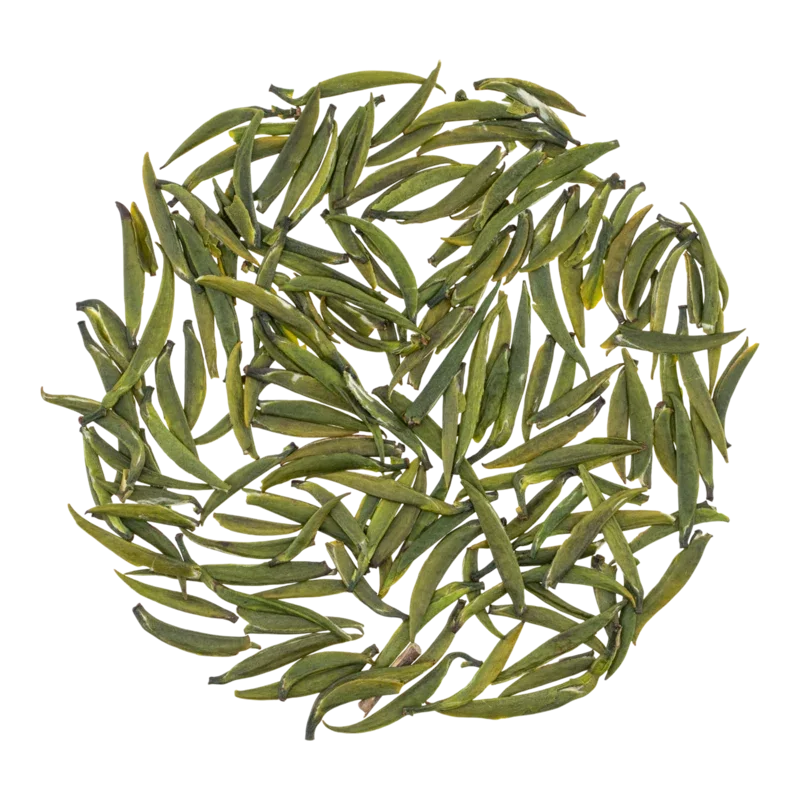
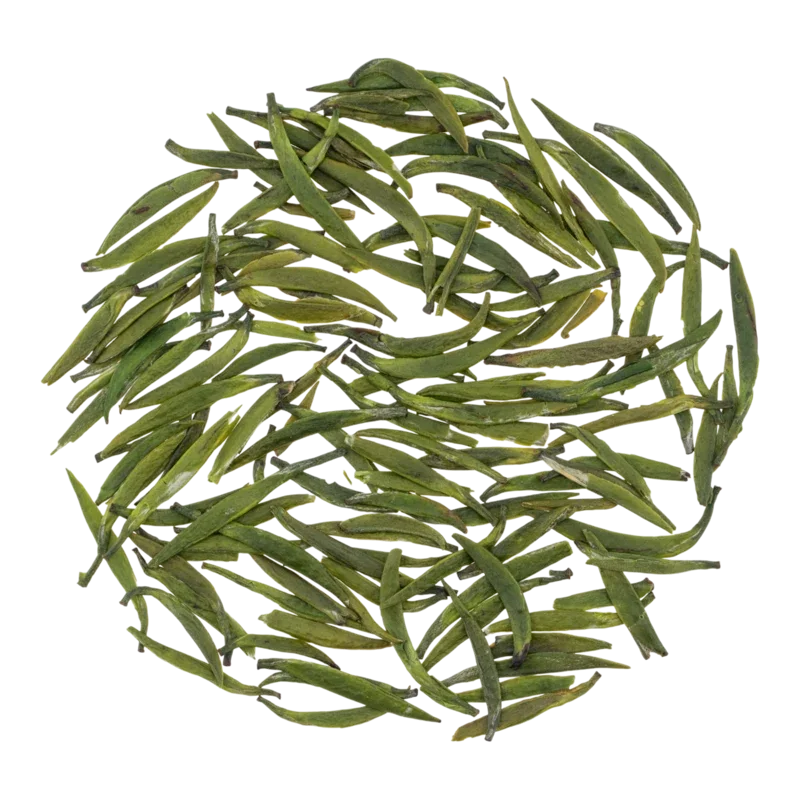
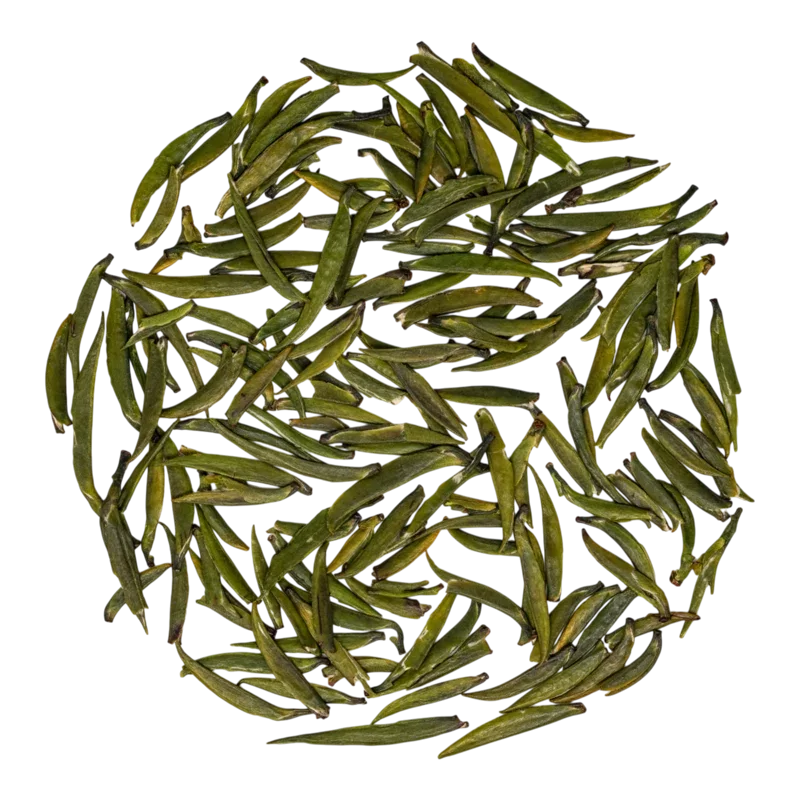
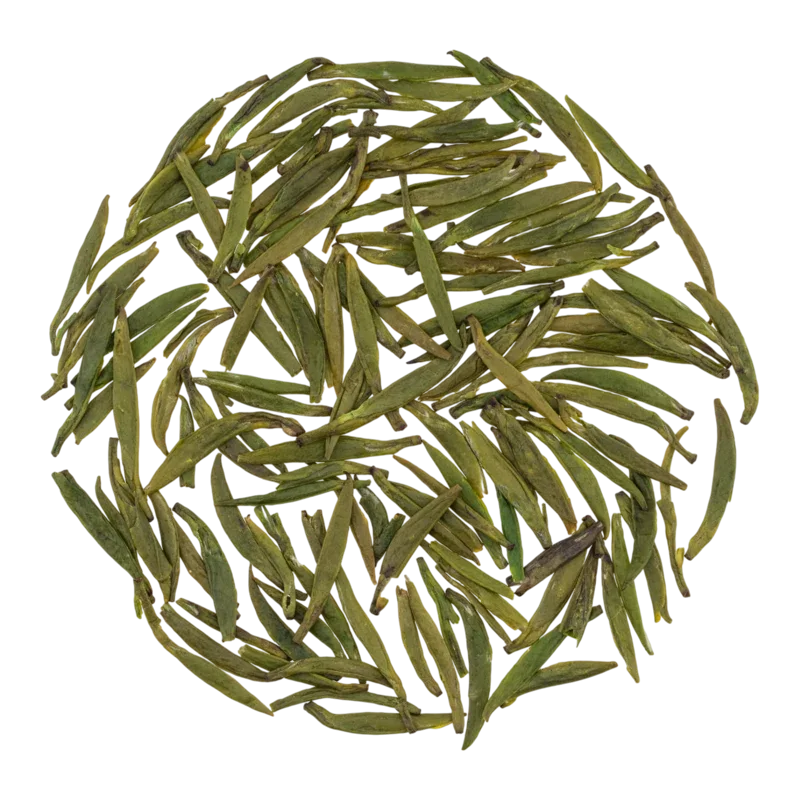
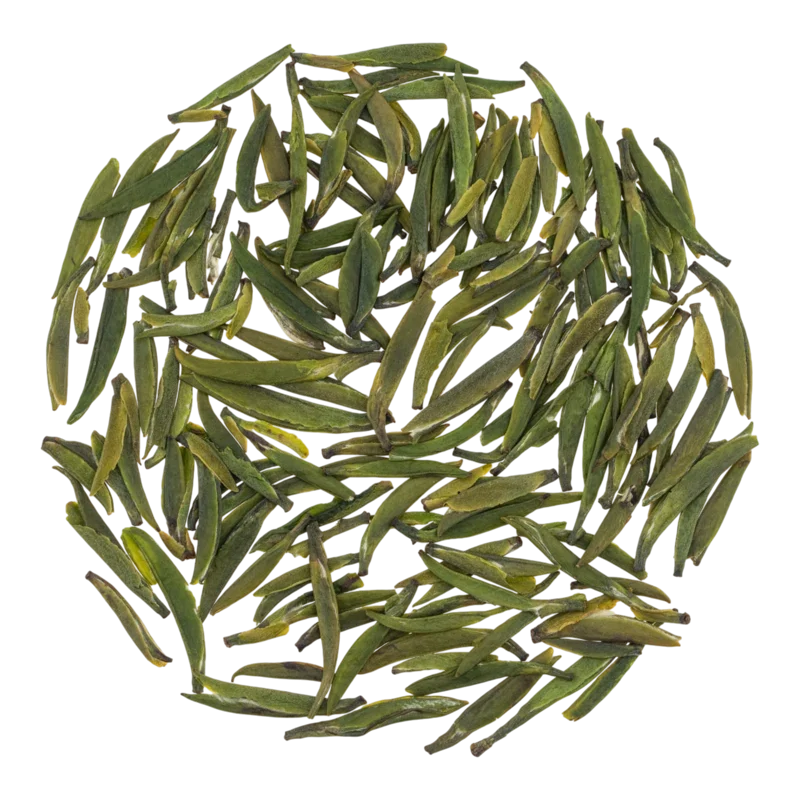
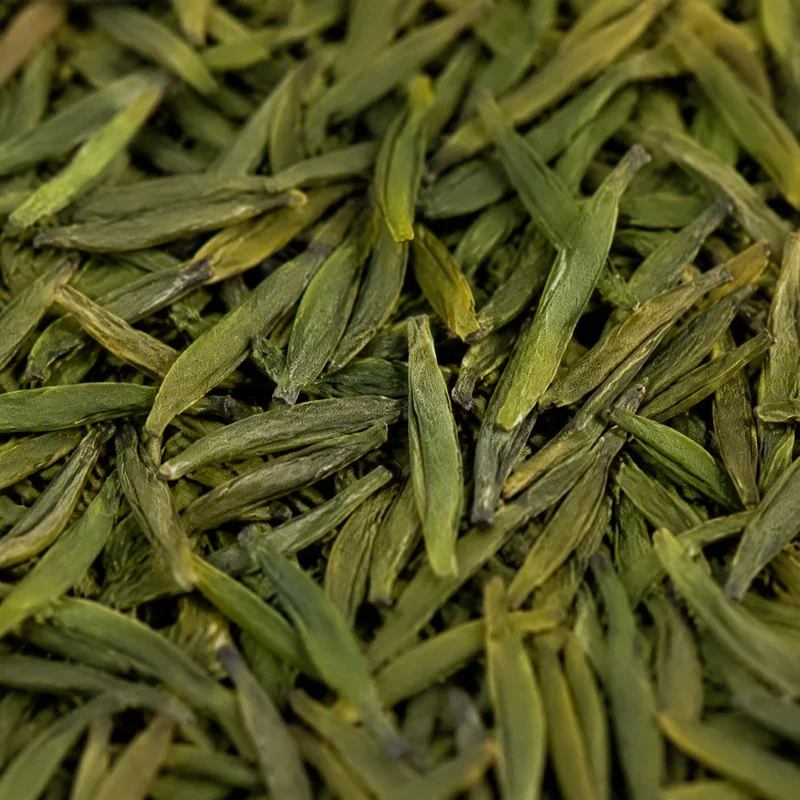
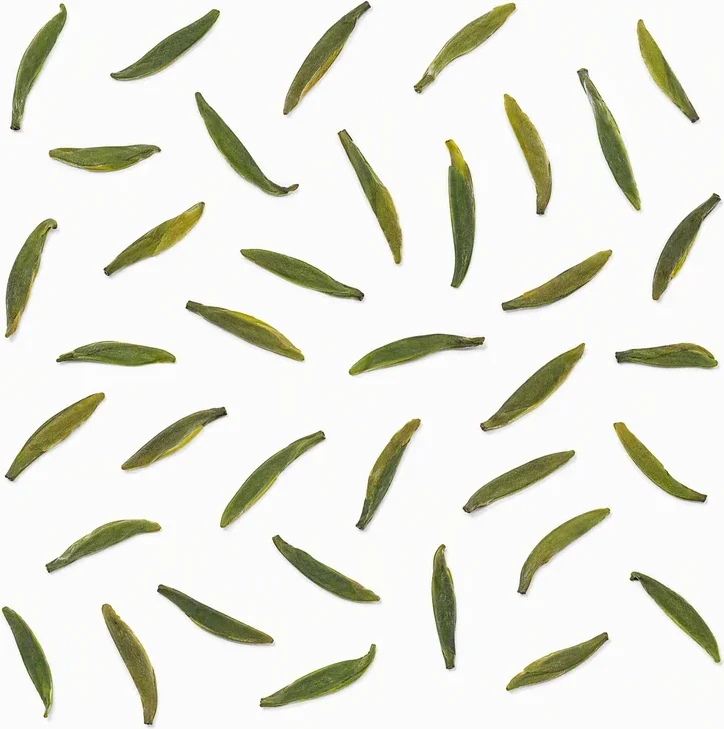
Dry Leaf Appearance: Flat, straight, uniform buds of characteristic "tongue" shape (扁平挺直, biǎnpíng tǐngzhí). Color — rich emerald green with oily luster and noticeable silvery down (翠绿光润显毫). Premium grade buds are miniature, resembling "lotus heart" shape (莲心, liánxīn).
Dry Leaf Aroma: Clean, fresh green aroma (清香, qīng xiāng) as base. Premium grade supplemented with delicate "youthful aroma" (嫩香, nèn xiāng); spring batches — chestnut notes (栗香, lì xiāng). Aroma persistent, long-lasting in cooled cup.
Liquor Aroma: High and lasting (馥郁高长, fùyù gāo cháng). Fresh green note dominates with delicate floral-chestnut background. As liquor cools, aroma doesn't weaken but acquires creamy undertones.
Liquor Color: Yellow-green, clear and bright (黄绿明亮, huánglǜ míngliàng). High transparency.
Spent Leaves: Tender green, even and uniform (嫩绿匀整). Bud tips retain liveliness, opening as "buds" (芽尖鲜活成朵).
Taste: Fresh and brisk (鲜爽, xiān shuǎng) thanks to high amino acid content. Body — full and round (醇厚, chún hòu) due to moderate polyphenol levels. Pronounced sweet aftertaste (回甘, huí gān), minimal astringency. Balance of amino acids and polyphenols creates harmonious, "velvety" flavor profile.
Alkaloids: Caffeine content elevated compared to summer-autumn harvests, providing pronounced tonic effect. Theobromine and theophylline also present.
Amino Acids: ≥3.5%, substantially higher than average for green teas (usually 2–3%). L-theanine — main component responsible for characteristic taste freshness, relaxed concentration effect and sweet aftertaste.
≥43.3% (for premium grade) — indicator of high liquor saturation and taste "density."
Essential Oils: Complex of volatile compounds forming "clean aroma" (清香) and "chestnut notes" (栗香), fixed by manual aroma enhancement stage (提香).
Minerals: Zinc and magnesium — natural markers of Pujiang soils; potassium, manganese, fluorine.
Polyphenols: ≥25%. Among catechins, EGCG and EGC predominate — powerful antioxidants. Relatively high level for early green tea, due to abundant cloudy illumination and moderate altitude.
Vitamins: Vitamin C — content 10% higher than average for green teas, due to early harvest and minimal heat treatment. B-group vitamins (B₁, B₂, B₆), vitamin E, vitamin K also present.
Polyphenols (≥25%) effectively neutralize free radicals, slowing cellular aging processes.
Elevated caffeine content combined with L-theanine provides gentle, sustained alertness without sharp peaks and crashes — "calm concentration" effect.
Catechins help reduce LDL cholesterol levels and improve vascular elasticity.
Polyphenols and caffeine stimulate lipid metabolism, potentially supporting weight control.
Vitamin C and zinc from Pujiang soils support body's protective functions.
Antioxidant complex (EGCG, vitamin E) protects skin cells from photodamage.
L-theanine stimulates alpha-wave brain activity, promoting improved attention and memory.
Listed properties are based on general green tea data and are not medical recommendations. Not recommended on empty stomach (tannins may irritate gastric mucosa); optimal — one hour after meals. When taking iron supplements, maintain interval of at least 2 hours.
First infusion contains abundant tea down (茶毫, chá háo) — this is not a defect but sign of high grade; recommended to drink without discarding.
Tea Amount: 3g per 150ml (1:50 ratio).
Teaware: Glass tumbler (玻璃杯, bōli bēi) — for observing "bud dance" during opening; white porcelain gaiwan (白瓷盖碗, báicí gàiwǎn) — for aroma concentration.
Water Temperature: 80°C for standard tea; 75°C for premium grade (特级). Practical tip: bring water to boil and let cool ~90 seconds.
Container: Double sealing — inner aluminum foil bag + outer metal can (铝箔袋+铁罐双重密封). Exclude air and moisture access.
Light: Store in darkness; sunlight and fluorescent light accelerate chlorophyll oxidation and destroy aroma.
Shelf Life: 12 months under proper conditions. Recommended to consume as quickly as possible for full aroma.
Isolate from strong-smelling products; tea actively absorbs foreign aromas.
Temperature: 0–5°C (refrigerator) — mandatory condition for preserving early green tea freshness.
Zhejiang / Jiangsu. Also flat and straight, but produced from the Longjing 43 (龙井43) cultivar. Distinguished by a more pronounced chestnut aroma and slightly greater astringency. GI status since 2013 — 5 years later than Pujiang. Cooler climate, later harvest.
Bazhong (巴中), northern Sichuan. Famous for high selenium content. Taste somewhat more "dense" and sharp. More mountainous terroir (800–1200 m) imparts a mineral note absent in lowland Pujiang.
Guizhou. Often called "Guizhou que she," though officially belongs to the "cui ya" (翠芽, "jade bud") category. More delicate and "floral" profile, less pronounced chestnut character. Tea gardens located at greater altitude (900–1400 m).
Shaanxi. Produced in the Qínlǐng Mountains (秦岭) — one of China's northernmost tea zones. Taste more "bready," with pronounced sweetness; form less strict than Pujiang's.
Exclusively single buds. Length ≤2.5 cm. "Lotus heart" shape (莲心). Chestnut aroma, high sweetness, water extractives ≥43.3%.
Bud with one half-opened leaf (一芽一叶初展). "Flag with spear" shape (旗枪, qí qiāng) — leaf as flag, bud as spear point. Fresh and clean taste, infusion slightly more concentrated.
Bud with two leaves (一芽二叶). Classic "sparrow tongue" form — two leaves embracing the bud. Suitable for daily drinking, more democratic in price.
No reviews yet. Tell us what you think of this tea.
Rate this tea and share your impressions. We review each submission before publishing it.