Brewing
Gongfu brewing
- Water temperature
- 75 °C
- Tea amount
- 5 g
- Water volume
- 100 ml
- First steep
- 10 s
- Time added per infusion
- 5 s
- Infusions
- 3

Pǔjiāng chūn háo
Choose a brewing method. Start with the recommended quantities and time, then adjust to taste.
Brewing
Brewing
Taste
Tea encyclopedia
Category: Famous Tea of China (中国名茶, 1989); regional named tea of Zhejiang. Production technique recognized as intangible cultural heritage at municipal level (Jinhua City, 金华市, 2009). Multiple gold medal winner at provincial and international tea competitions.
Category: Famous Tea of China (中国名茶, 1989); regional named tea of Zhejiang. Production technique recognized as intangible cultural heritage at municipal level (Jinhua City, 金华市, 2009). Multiple gold medal winner at provincial and international tea competitions.
Coordinates: 119°33′–120°14′ E, 29°21′–29°41′ N (Pujiang County territory).
Origin: China; Zhèjiāng Province (浙江, Zhèjiāng); Pǔjiāng County (浦江县, Pǔjiāng Xiàn), part of Jīnhuá City prefecture (金华市, Jīnhuá Shì). The county is located in central Zhejiang. Production zone covers the entire county territory. Quality core area includes Hángpíng Town (杭坪镇, Hángpíng Zhèn), Yúzhái Township (虞宅乡, Yúzhái Xiāng), and Huāqiáo Township (花桥乡, Huāqiáo Xiāng) in the Longmenshan Mountains (龙门山脉, Lóngmén Shānmài). Birthplace of the tea is the Cháping tea plantation in Wūjiāng Village (乌浆村茶坪, Wūjiāng Cūn Cháping).
Type: Green tea (non-oxidized, 绿茶, lǜchá). Kill-green fixation by hand pan-firing (锅炒杀青). Final drying by charcoal roasting (烘焙, hōngbèi).
Pujiang County tea cooperatives and certified organic farms in Hangping Town, Yuzhai Township, and Huaqiao Township.
"Xianhuashan" (仙华山牌) brand products from Jinhua Zhenxiang Tea Industry Co., Ltd.
Stores specializing in Zhejiang green teas with proper cold storage facilities.
Tmall and JD.com official stores of certified Pujiang producers.
Hangzhou Tea Market, Shanghai Tea City—sections specializing in Zhejiang famous teas.
Cultural Significance: Pujiang Chun Hao is the county's flagship tea brand, produced primarily under the "Xianhuashan" brand (仙华山牌, "Immortal Flower Mountain")—named after the sacred Mount Xiānhuā (仙华山), Pujiang's calling card. The tea is inseparably linked with the mountain landscape of Longmenshan: tea gardens intermingle with peony fields and mountain streams, forming a unique aesthetic of "tea and landscape fusion" (茶景相融). The county is located in a scenic zone of Dānxiá (丹霞, Dānxiá) landforms—red sandstone cliffs, making local tea plantations among the most photogenic in Zhejiang.
Name Breakdown: 浦江 (Pǔjiāng)—county name (not to be confused with Sichuan's 蒲江 Pújiāng); 春 (chūn)—"spring," indicating spring harvest; 毫 (háo)—"down," "fuzz"—reference to the abundant white down on buds. Full meaning: "Spring down from Pujiang."
The foundation consists of two types of tea bushes. First—local population (seed-propagated) small-leaf variety "caicha" (群体种菜茶, qúntǐ zhǒng càichá, Camellia sinensis var. sinensis), transmitting genetic diversity and depth of flavor. Second—clonal variety "Yinshuang Cha" (银霜茶, Yínshuāng Chá, "silvery-frosted tea")—a named cultivar used in creating Chun Hao in 1981, distinguished by abundant white down and high amino acid content. New plantations introduce clonal saplings of vegetative propagation (cutting).
Picking: Spring—from March to early April. The main mass of high-quality tea falls in the spring season (about 43% of total volume, but 71% of value).
Pluck Standard: For premium grade—single buds (单芽); for first grade—bud with one half-opened leaflet (一芽一叶初展); for second grade—bud with two leaflets (一芽二叶).
Raw Material: Young shoots without mechanical damage, without traces of insects and diseases. Raw material must be processed on the day of harvest.
Altitude: 300–800 m above sea level. About 70% of tea plantations in the core zone are located above 500 m.
Climate: Average annual temperature 15–18°C; precipitation >1,600 mm/year; foggy days >180 per year; daily temperature difference >10°C. Abundant cloud cover provides a high proportion of diffused light, stimulating accumulation of L-theanine and other amino acids. The Longmenshan Mountains block cold northern flows, creating a mild microclimate.
Soil: Red soils and yellow soils predominate (红壤、黄壤, hóng rǎng, huáng rǎng), pH 4.5–6.5. Organic matter content is high. Distinctive feature—enrichment in zinc (76.2 mg/kg) and selenium (0.82 mg/kg), which is a natural geochemical marker of Pujiang's Danxia landscapes.
Forest coverage of the county territory is 81%—one of the highest among tea regions in Zhejiang. Tea gardens often neighbor peony fields and mountain streams, forming an ecosystem of "tea and landscape fusion." Irrigation is provided by the Húyuán River (壶源江, Húyuán Jiāng).
New plantations are established with clonal saplings. Formative pruning follows "Three cuts—one shape" (三剪一定型, sān jiǎn yī dìngxíng): young bushes are formed over 3 years, mature ones alternate light and deep pruning. Use of chemical fertilizers and pesticides is prohibited by the 1997 standard—production follows principles of harmless/organic farming.
Freshly picked shoots are spread in a thin layer on bamboo trays in a ventilated room for 6–8 hours. During this time up to 20% moisture is lost, aromatic precursors are activated, leaves become pliable for further processing.
Hand pan-firing in a heated wok (锅炒, guō chǎo) at 100–120°C using the "tossing" method (抛杀, pāo shā) for 3–5 minutes. The master continuously tosses the raw material, ensuring even contact with the hot wok wall and rapid enzyme inactivation while preserving green color.
At reduced temperature (60–80°C) the master combines rolling (揉捻, róuniǎn, 4–8 minutes) with rhythmic tossing and shaking (抛抖结合). This is a proprietary technique defining Chun Hao's characteristic form: thin, tightly twisted threads with abundant down. Rolling breaks cell walls, releasing juices, while shaking separates stuck buds and evens out the shape.
Two-stage: primary heating "mao huo" (毛火, máo huǒ, "rough fire") at 100°C for rapid removal of main moisture, then final heating "zu huo" (足火, zú huǒ, "full fire") at 60°C over charcoal until moisture content ≤7%. The charcoal "zu huo" specifically forms the characteristic chestnut-floral aroma profile.
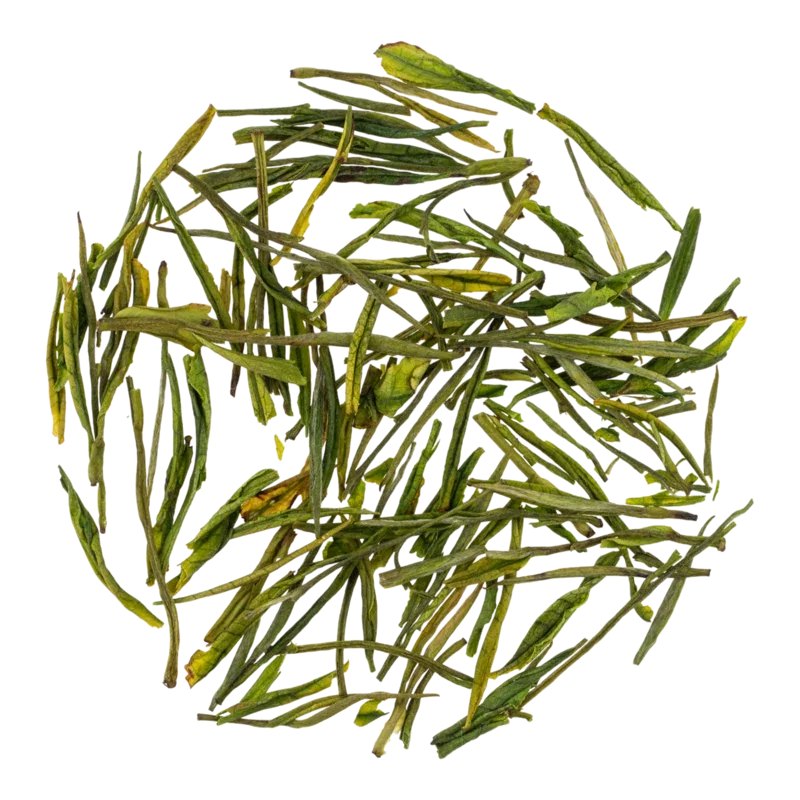
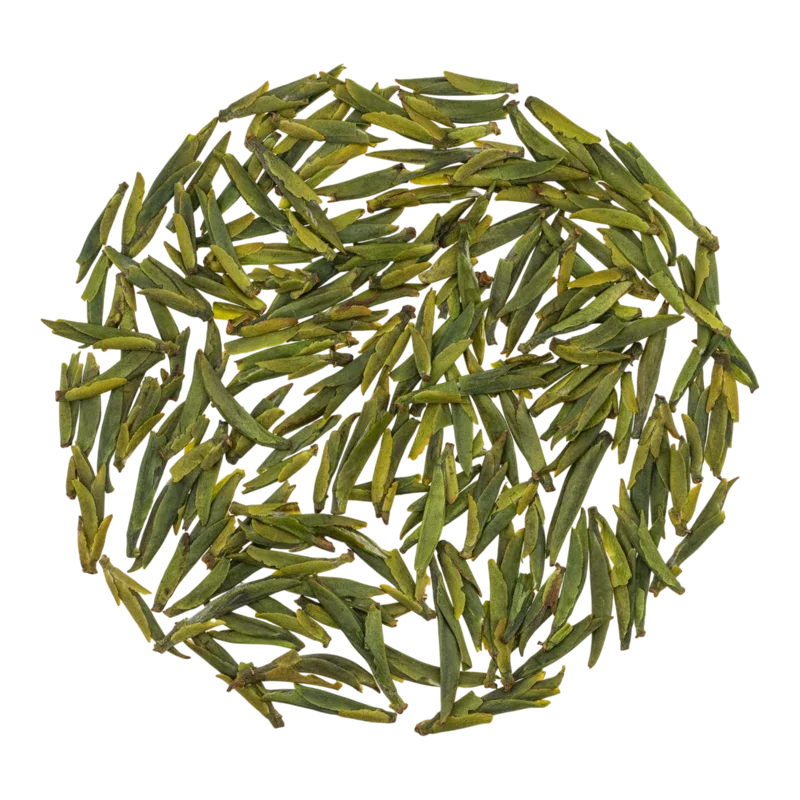
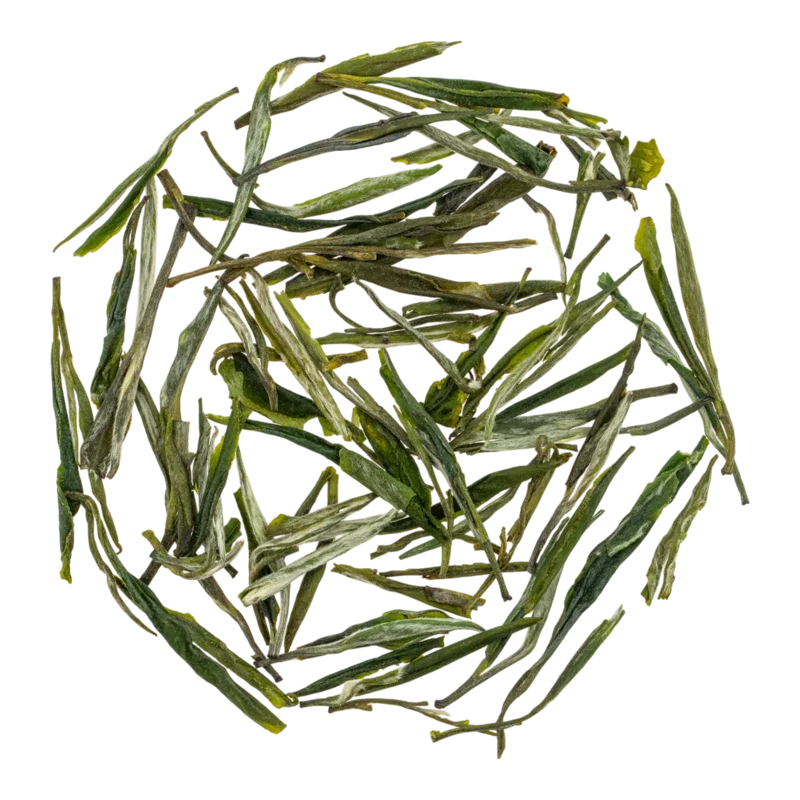
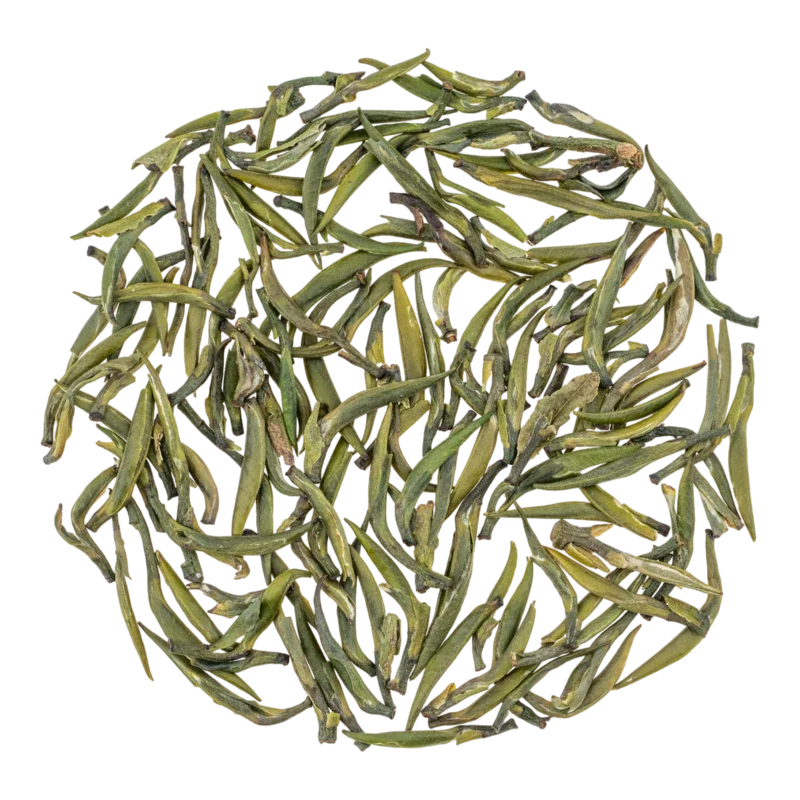
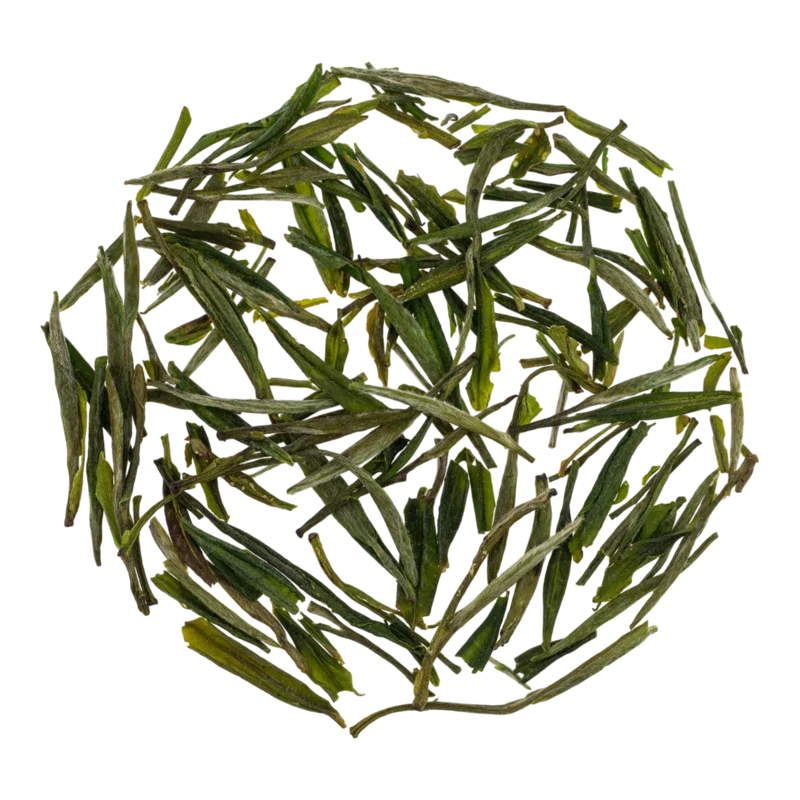
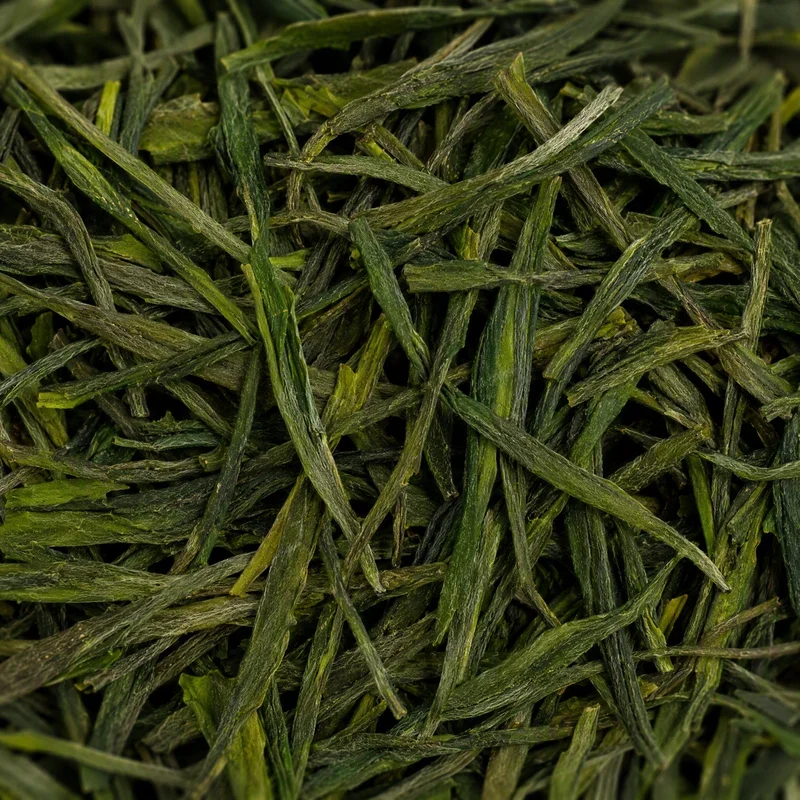
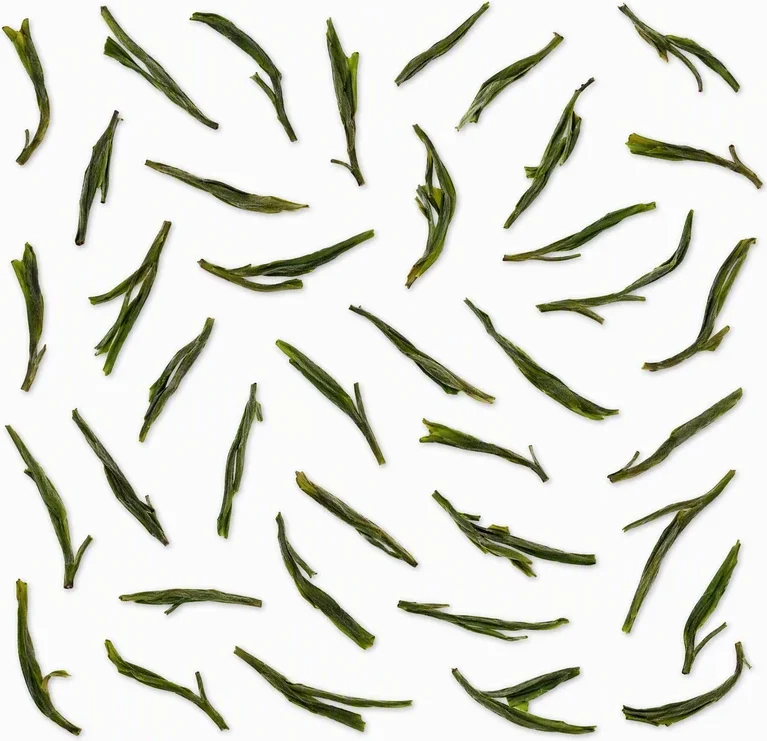
Dry Leaf Appearance: Premium grade—thin "needles" (针芽状, zhēn yá zhuàng); first grade—"eyebrows" (眉形, méi xíng). Common features: tightly twisted, thin, covered with dense white down (白毫密布), color—bright emerald green (翠绿). Down is so abundant it gave the tea its name.
Dry Leaf Aroma: Clean green freshness (清香, qīng xiāng) as base, enriched with delicate chestnut tones (嫩栗香, nèn lì xiāng) and delicate orchid notes (兰花香, lánhuā xiāng)—the latter characteristic of high-altitude lots.
Liquor Aroma: High and lasting. Orchid note intensifies as it cools, chestnut dominates in hot liquor. Aroma is "clean and elevated" (清高, qīng gāo).
Liquor Color: Emerald green, clear and bright (碧绿清澈透亮, bìlǜ qīngchè tòuliàng).
Spent Leaves: Tender green, even and uniform (嫩绿匀整), buds and leaflets gather into "flowers" (芽叶成朵). Unique feature: when brewed in a glass, buds first separate into two tiers and stand vertically, then gradually settle to the bottom while maintaining vertical position—a spectacle Chinese tea experts compare to "dancing."
Taste: Fresh (鲜爽, xiān shuǎng) with pronounced amino acid "liveliness" (鲜味, xiān wèi). Sweet and clean (甘醇, gān chún) with long returning sweetness (回甘, huí gān). Body—harmonious, medium density (醇和, chún hé), without excessive astringency or wateriness. High amino acid content (≥4.2% for first grade) creates a sensation of velvety softness.
Alkaloids: Caffeine combined with L-theanine provides gentle, prolonged alertness. According to sources, the tonic effect is ~20% higher than standard green teas.
Amino Acids: ≥4.2% (first grade)—significantly higher than average for green teas (2–3%). L-theanine is the dominant component, responsible for characteristic freshness and "velvety" taste, as well as synergistic tonic effect with caffeine.
≥45% (premium grade)—indicator of high liquor saturation.
Present in amounts sufficient for noticeable influence on lipid metabolism; participate in forming taste "fullness."
Minerals: Zinc—76.2 mg/kg (soil marker), selenium—0.82 mg/kg (selenium-containing tea). Also potassium, manganese, magnesium.
Polyphenols: ≥28% (premium grade). Catechins—predominantly EGCG and ECG—provide antioxidant activity and moderate astringency. The indicator is somewhat higher than many flatland Zhejiang teas, thanks to high-altitude origin and intense diffused lighting.
Vitamins: Vitamin C (preserved thanks to gentle charcoal drying), B vitamins (B₁, B₂), vitamin E.
Synergy of caffeine and L-theanine provides "calm concentration"—increased attention without anxiety. Research shows tea from high-altitude zones with high amino acid content enhances this effect.
Catechins (≥28%) effectively neutralize free radicals, protecting cells from oxidative stress.
Tea polysaccharides promote regulation of fat synthesis enzyme activity, which may aid weight control.
Natural selenium (0.82 mg/kg)—important microelement for thyroid and immune system.
Catechins and vitamin C support vascular elasticity and promote blood pressure regulation.
EGCG + vitamin E complex protects against ultraviolet damage.
L-theanine stimulates alpha-wave brain activity, improving memory and learning ability.
Listed properties are based on general green tea data and are not medical recommendations. Not recommended on empty stomach; optimal—30 minutes after meals. Fresh tea should preferably be aged 3 days in a dark place to "shed fire energy" (褪火气, tuì huǒqì). When taking medications—interval of at least 2 hours.
When brewing in a glass tumbler, the first minutes provide special aesthetic pleasure—buds form two tiers and stand vertically, then gradually descend while maintaining upright posture. Don't rush to drink—enjoy the spectacle.
Tea Amount: 3 g per 150 ml (1:50 ratio).
Teaware: Glass tumbler (玻璃杯)—ideal choice for observing "two-tier standing" of buds; white porcelain gaiwan (白瓷盖碗)—for concentrating orchid aroma.
Water Temperature: 80–85°C for standard tea; 75°C for premium grade (单芽). Do not use boiling water—temperature above 85°C destroys L-theanine and increases bitterness.
Container: Airtight packaging with minimal air space. Aluminum foil + tight jar.
Light: Store in darkness; ultraviolet and fluorescent lighting accelerate chlorophyll oxidation.
Isolate from products with strong aromas—tea actively absorbs foreign odors.
Fresh tea is recommended to be aged 3 days in a dark place at room temperature before first brewing—to "shed fire energy" (褪火气) remaining from charcoal drying. After this—move to refrigerator.
Temperature: 0–5°C (refrigerator)—mandatory condition for spring green tea.
Neighboring Pan'an County, same Jinhua Prefecture. Also a high-altitude tea (600–900 m), but with more pronounced "cloudy" aromatics and large-leaf structure. Chun Hao is more delicate, "needle-like," with emphasis on down.
Wuyi County, Jinhua Prefecture. Shape — thin "pine needles" resembling spring rain. Orchid aroma is more pronounced; taste is lighter and more "airy." Chun Hao is denser and more concentrated thanks to high water-extractable content (≥45%).
Jiangshan, Xianxialing Mountains. Shape — opened "peony petals." Visually completely different tea, but similar in principle of "spectacular brewing." Chun Hao is more compact, with "vertical" aesthetics, while Lü Mu Dan is "horizontal," opening with petals.
Kaihua County, source of Qiantang River. Certified GI, more famous brand. Shape is straight, "dragon peak." Taste is more "green" and "chlorophyll-like," with less sweetness. Chun Hao is softer, with more pronounced chestnut-orchid aromatics.
No reviews yet. Tell us what you think of this tea.
Rate this tea and share your impressions. We review each submission before publishing it.