Brewing
Gongfu brewing
- Water temperature
- 93 °C
- Tea amount
- 5 g
- Water volume
- 100 ml
- First steep
- 10 s
- Time added per infusion
- 5 s
- Infusions
- 4

Míngjiān mì xiāng hóngchá
Choose a brewing method. Start with the recommended quantities and time, then adjust to taste.
Brewing
Brewing
Taste
Tea encyclopedia
Category: Taiwanese regional red tea (black tea) with honey aroma. Belongs to the group of Taiwanese "Mì Xiāng" teas (蜜香茶, Mì Xiāng Chá), but has clear territorial identity — Mingjian Township.
Category: Taiwanese regional red tea (black tea) with honey aroma. Belongs to the group of Taiwanese "Mì Xiāng" teas (蜜香茶, Mì Xiāng Chá), but has clear territorial identity — Mingjian Township.
Coordinates: Approximately 23°50′ N, 120°40′ E.
Origin: Táiwān (台灣, Táiwān), Nántóu County (南投縣, Nántóu Xiàn), Míngjiān Township (名間鄉, Míngjiān Xiāng). Mingjian is the largest township by tea cultivation area in Nantou County, located in central Taiwan, at the foot of the mountain range between the Zhuóshuǐ River (濁水溪, Zhuóshuǐ Xī) and the Bāguà Hills (八卦山, Bāguà Shān). This is a traditional center of Taiwanese tea cultivation, historically specializing in oolongs, but in recent decades actively developing production of red "honey" teas.
Type: Red tea (black tea) (紅茶, hóngchá) — fully oxidized (oxidation degree ~90–95%). According to European classification — black tea. Distinctive feature — honey aroma (蜜香, mì xiāng), formed as a result of green leafhopper (Jacobiasca formosana) impact on tea leaves before harvest.
The township is one of the largest tea-producing territories of Nantou County — a region that itself is considered the "tea heart" of Taiwan. Here high-mountain oolong gardens neighbor lowland plantations producing honey teas — a rare combination of terroir diversity in compact territory.
Mingjian honey tea producers don't simply "avoid poisoning" leafhoppers — they purposefully form tea garden ecosystem, planting companion plants that attract leafhopper predators (spiders, dragonflies) to maintain insect population at optimal level — sufficient for honey aroma but not destructive to bushes.
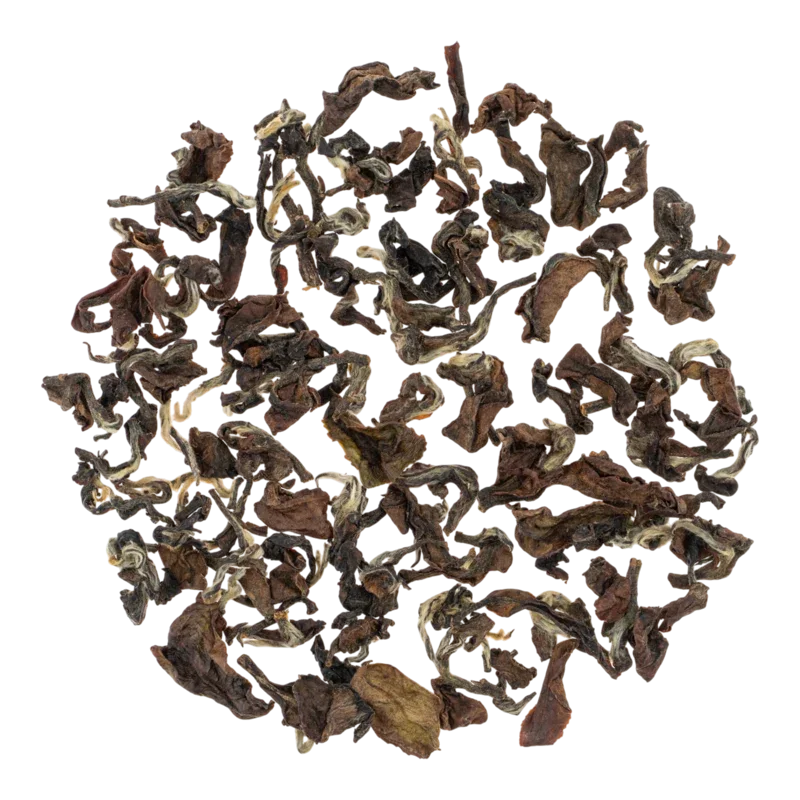
Some Mingjian producers roll honey red tea (black tea) into semi-spherical form — method characteristic of Taiwanese oolongs but rare for red tea (black tea). This gives Mingjiān Mì Xiāng Hóng Chá recognizable appearance and affects brewing dynamics: the ball unfolds slowly, releasing aroma and taste gradually.
Mingjiān Mì Xiāng Hóng Chá and famous oolong Dōngfāng Měirén (東方美人, Dōngfāng Měirén) owe their honey aroma to the same leafhopper, but differ in oxidation degree: Dōngfāng Měirén — heavy oolong (60–80%), while Mingjiān Mì Xiāng — fully oxidized red tea (black tea).
Mingjiān Mì Xiāng Hóng Chá — rare case where ecological purity is not marketing choice but production necessity. Any pesticide use will destroy leafhopper population and deprive tea of its main virtue.
Cultural Significance: Mingjiān Mì Xiāng Hóng Chá is a bright example of Taiwan's regional tea identity. Mingjian Township actively promotes this tea as its calling card, conducting tastings, participating in competitions and developing tea tourism. The tea demonstrates that even at relatively low elevations (by Taiwanese standards), one can create a product of outstanding quality if masterfully using terroir and ecological features. For consumers, it is attractive for combining bright taste qualities with guaranteed ecological purity — two characteristics increasingly valued in the modern world.
History: Tea cultivation in Mingjian Township has deep roots: the region has long been known as one of the main producers of Sì Jì Chūn (四季春, Sì Jì Chūn — "Four Seasons Spring"), Jīn Xuān (金萱, Jīn Xuān) and other Taiwanese oolongs. The reorientation of some farms to honey red tea production occurred at the turn of the 20th–21st centuries and was driven by several factors: falling prices for mass-market oolongs due to competition from Vietnamese and Chinese imports; growing consumer interest in red teas in the domestic Taiwanese market; success of honey oolongs and red teas from neighboring regions; and — most importantly — expansion of ecological farming, where pesticide rejection naturally created conditions for leafhopper appearance. Mingjian tea growers quickly realized that the "side effect" of organic approach — leaf damage by leafhoppers — was not a problem but a valuable resource. Thus was born Mingjiān Mì Xiāng Hóng Chá — a tea that became a symbol of innovative thinking by Taiwanese farmers and their ability to turn limitations into advantages.
Cultivar: Mingjian farmers use several Taiwanese cultivars:
Picking: Year-round, however summer harvest (June–August) is considered most valuable, when green leafhopper (Jacobiasca formosana) activity is maximum. Autumn harvest (September–October) also gives good results — leafhoppers remain active until significant cooling. Spring harvest — with less pronounced honey character, but with brighter floral notes.
Pluck Standard: Bud with two to three upper leaves (一心二葉至一心三葉). More democratic standard compared to "Jīn Yá" version (where emphasis is on buds), making this tea somewhat more accessible in price.
Raw Material: Mandatory leaf damage by green leafhopper (小綠葉蟬, xiǎo lǜ yè chán; Jacobiasca formosana). Impact mechanism: the 2.4–2.7 mm long leafhopper pierces the young leaf epidermis with its proboscis and sucks cell sap. In response, the leaf triggers defense reactions: polyphenol oxidase activity sharply increases in damaged areas, intensive synthesis of monoterpene alcohols (linalool, geraniol, nerol) and their oxides begins, as well as 2,6-dimethyl-3,7-octadien-2,6-diol — the key compound forming honey aroma. The more intensive the «著涎» (zhuó xián — degree of leafhopper damage), the more pronounced the honey character of the finished tea becomes.
Altitude: 200–500 m above sea level — significantly lower than classic high-mountain Taiwanese tea territories (Alishan, Lishan). However, precisely these low, warm foothills create optimal habitat for the green leafhopper: sufficient humidity, moderate shade from surrounding vegetation and absence of severe cold.
Climate: Subtropical monsoon. Average annual temperature 22–24°C, precipitation — 1500–2000 mm per year. Humid hot summer with abundant rains creates ideal conditions for leafhopper reproduction — precisely why summer harvest produces the most "honey" tea.
Soil: Fertile alluvial and red-brown lateritic soils with high organic matter content and good drainage. Proximity to the Zhuoshui river system provides stable water supply.
Rejection of pesticides and herbicides — absolute requirement. Use of chemical plant protection agents destroys leafhopper population and makes honey tea production impossible. Most Mingjian honey tea producers practice comprehensive ecological approach: biological pest control, maintaining biodiversity in tea gardens (including planting companion trees and creating "living hedges"), composting. Many farms are certified under organic farming standards or the Taiwanese Council of Agriculture's "Traceable Agricultural Products" (TAP) program.
Occurs directly on the bush during vegetation period. Green leafhoppers colonize young shoots and systematically pierce tissues, sucking cell sap. The tea bush responds by intensifying synthesis of protective terpenoids. The degree of «著涎» depends on leafhopper population size, weather conditions (optimal — warm, humid periods) and season timing. The tea grower controls the process, determining the moment of optimal balance between damage and shoot viability.
Manual. Shoots with pronounced traces of leafhopper impact are collected — yellowed and dried edges of young leaves. Standard: bud with two to three leaves.
Solar (日光萎凋, rìguāng wěidiāo) or indoor (室內萎凋, shìnèi wěidiāo). Duration — from several hours to a day. Most important stage for honey aroma development: during withering, terpenoid compounds accumulated in the leaf in response to leafhopper impact begin to actively release and transform, forming the characteristic bouquet. Leaf loses 35–45% moisture, becomes soft and elastic.
Manual or machine. For Mingjiān Mì Xiāng Hóng Chá, rolling can be either longitudinal (creating elongated tea particle shape) or ball-shaped (spherical rolling, characteristic of Taiwanese oolongs) — depending on specific producer preferences. Ball-shaped rolling produces denser tea particles that unfold longer during brewing, gradually releasing aroma and taste.
Full oxidation at temperature 25–30°C and high humidity. Duration — 3–5 hours. At this stage, final red-brown leaf color forms, taste enriches with theaflavins and thearubigins, and honey aroma becomes fixed and deepened.
Oxidation fixation with hot air in drying chambers. Residual moisture — 4–6%. Drying regime is selected to avoid "burning" delicate honey notes.
Separation by fractions — whole leaf, broken leaf, tea dust. For premium Mingjiān Mì Xiāng Hóng Chá, whole leaf fraction with maximum tip content is selected.
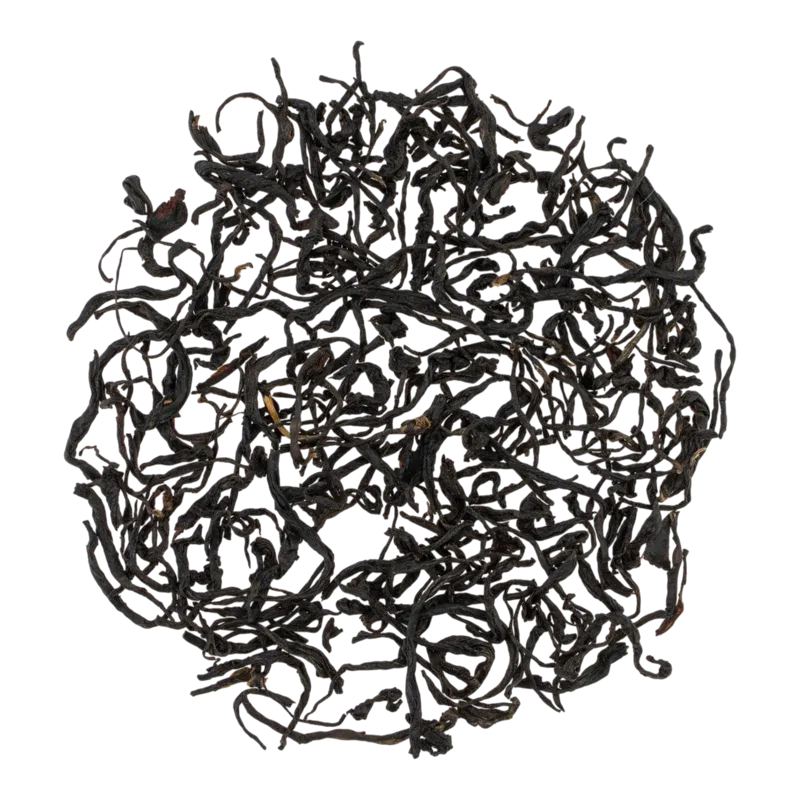
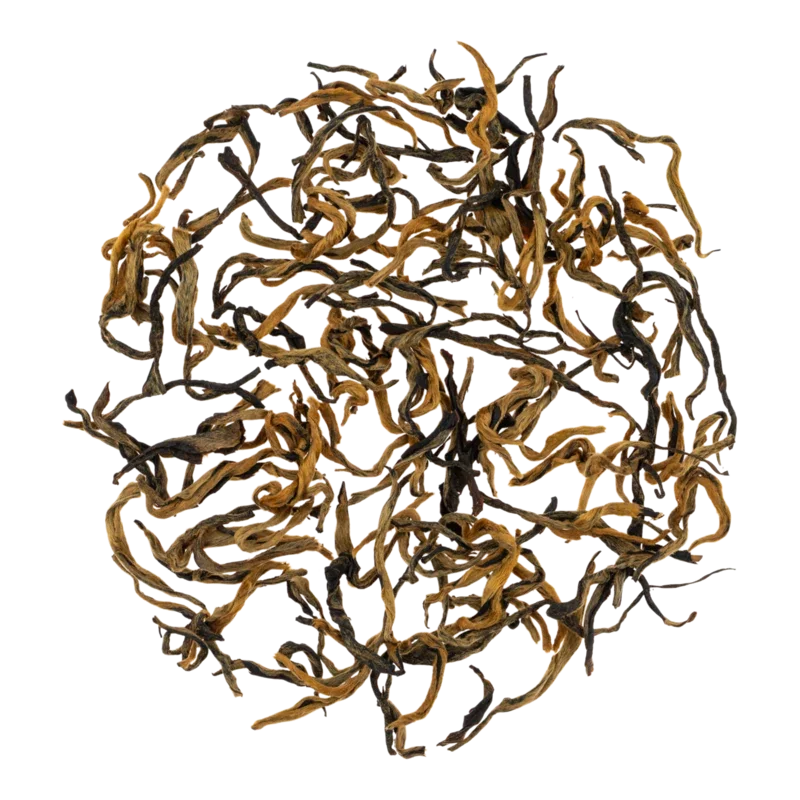
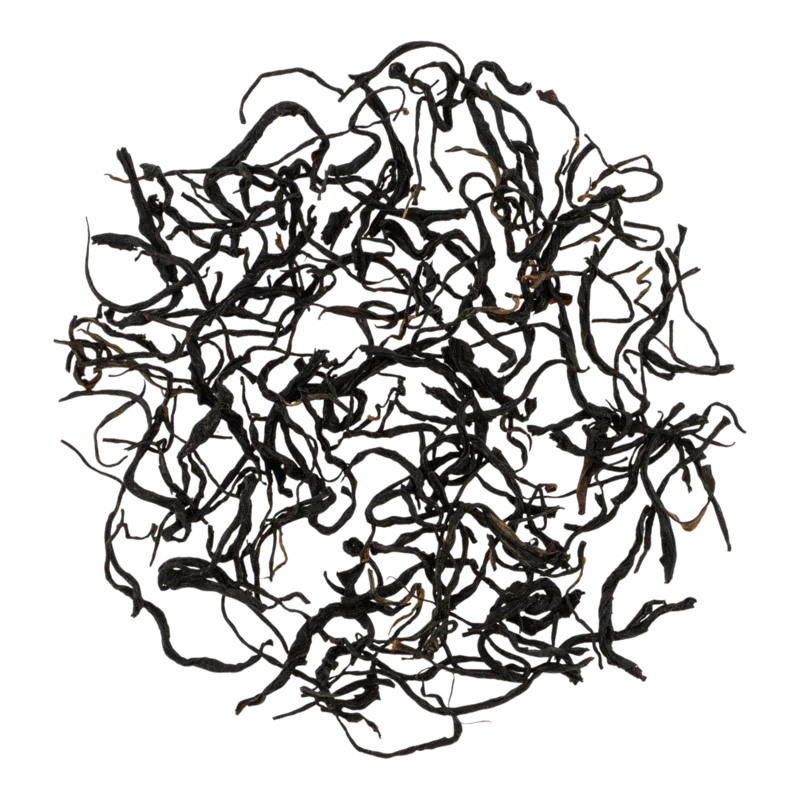
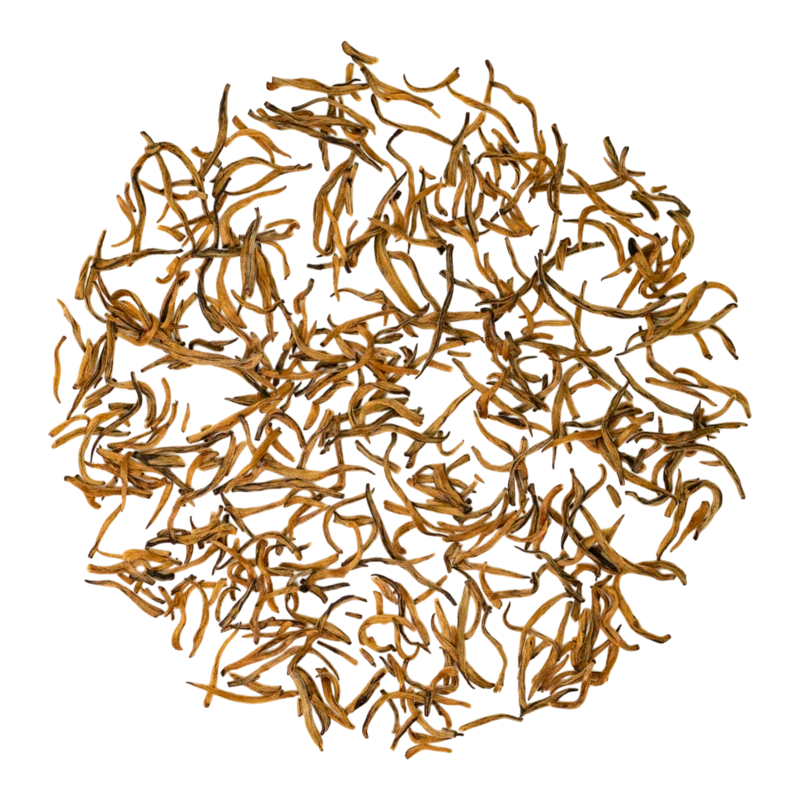
Dry Leaf Appearance: Tea particle shape varies depending on producer — from elongated, slightly twisted leaves to dense, semi-spherical balls. Color — from dark brown to black with golden and reddish inclusions (tips). Characteristic uneven spots are visible on leaf surfaces — traces of leafhopper damage.
Dry Leaf Aroma: Bright, intense, immediately recognizable honey character — signature feature of all "Mì Xiāng" teas. Base — warm, enveloping honey, complemented by notes of ripe fruits (peach, lychee, grape, mango), flowers, light caramel and warm spices. Aroma is dense, "voluminous," without harshness.
Liquor Aroma: Rich and persistent, with predominance of honey-fruit complex. As it cools, additional facets unfold — floral, spicy, sometimes with subtle fruit acidity. Aroma holds well in empty cup.
Liquor Color: From amber-red to red-brown — rich, clear, with pronounced shine and color depth.
Spent Leaves: Whole, resilient leaves, opened after brewing. Color — uneven, from greenish-brown to reddish-brown. Reddish-brown traces of leafhopper damage are clearly visible on leaves. Spent leaf aroma — persistent, sweet, honey.
Taste: Full, velvety, with pronounced natural sweetness and minimal astringency. Body — medium, with smooth, enveloping texture. Honey tones dominate with fruit accompaniment (peach, lychee, grape), nuances of flowers, caramel and light spices. Aftertaste — long, soft, with persistent honey sweetness. Bitterness is absent.
Alkaloids: Caffeine (2.5–3.5%), theobromine, theophylline.
Amino Acids: L-theanine — leading amino acid, determining sweetness and "volume" of taste. Total amino acid content — 2–3% of dry matter.
Key group forming honey aroma. Jacobiasca formosana impact stimulates synthesis of monoterpene alcohols (linalool, geraniol, nerol, trans-nerolidol) and their oxides, as well as 2,6-dimethyl-3,7-octadien-2,6-diol — marker compound of "honey" teas. Content of these substances significantly (5–10 times) exceeds indicators of tea from undamaged raw material.
Minerals: Potassium, magnesium, manganese, fluorine, iron, zinc.
Polyphenols: Fresh leaf catechins transform during full oxidation into theaflavins (responsible for brightness and "liveliness" of liquor) and thearubigins (providing color depth and body). Feature of leafhopper-damaged raw material — increased polyphenol oxidase activity in bite zones, promoting more uniform and deep oxidation.
Vitamins: C (partially preserved), E, K, B group (B₁, B₂, B₃).
Combination of caffeine with L-theanine provides alertness without anxiety, with smooth onset and prolonged action.
In terms of traditional Chinese medicine, red tea (black tea) belongs to "warm" beverages (温性, wēn xìng), promoting improvement of qi and blood circulation, making it especially suitable for cold season.
Theaflavins and thearubigins — powerful antioxidants, neutralizing free radicals and reducing risk of cellular damage.
Red tea (black tea) polyphenols stimulate peristalsis and secretion of digestive enzymes, promote fatty food absorption.
Regular red tea (black tea) consumption is associated with lowering LDL cholesterol levels, improving vascular elasticity and normalizing blood pressure.
Polyphenols promote activation of liver enzymes involved in metabolism and elimination of toxic substances.
L-theanine stimulates dopamine and serotonin synthesis, promoting feelings of calm and pleasure.
Absence of pesticide residues in tea produced by ecological technology is an additional health advantage for consumers.
Tea Amount: 5–7 g per 150 ml water (gongfu method); 3–4 g per 200–250 ml (European method).
Teaware: Porcelain gàiwǎn (蓋碗, gàiwǎn) — universal and optimal choice. Taiwanese porcelain teapot or Yíxīng clay teapot (紫砂壺, zǐshā hú) also work well. For tea particles rolled into balls, container with wide bottom is preferable, allowing leaf to fully unfold.
Water Temperature: 90–95°C. Mingjiān Mì Xiāng Hóng Chá typically contains more leaf (not just buds), allowing use of slightly higher temperature for full taste development.
Premium bud version of Taiwanese honey red tea (black tea). Differs from Mingjian variant by higher tip content (golden buds), somewhat more delicate and refined taste, and higher price. Mingjiān Mì Xiāng — more "democratic" variant with slightly more pronounced astringency and more accessible price positioning.
Heavy oolong (60–80% oxidation), not red tea (black tea). Distinguished by variegated (five-color) leaf coloration, more "perfumed" and light character, and higher white hair content. Mingjiān Mì Xiāng — denser, richer, with "warm" character of fully oxidized red tea (black tea).
Taiwanese red tea (black tea) from Sun Moon Lake region (also in Nantou County), often from cultivar Tái Chá №18 (Hóng Yù). Characteristic cinnamon and mint notes, absence of honey profile. More powerful and "straightforward" compared to multi-layered "honey character" of Mingjiān Mì Xiāng.
Yunnan red tea (black tea) — more astringent and powerful, with malty-chocolate character. Mingjiān Mì Xiāng — softer, sweeter, with completely different (fruit-honey) style. Difference caused by both terroir and unique leafhopper factor.
Anhui red tea (black tea) with characteristic "qí mén xiāng" — combination of floral, fruit and smoky notes. More restrained, "intellectual" style compared to open, sensual honey character of Mingjian.
Fujian premium red tea (black tea) from single buds — more subtle, elegant, with honey-floral aroma. Jīn Jùn Méi honey character — result of varietal and terroir features, not leafhopper impact, determining completely different aroma character.
Authentic honey aroma — natural, deep, multi-layered. Artificial honey or essence flavoring produces flat, one-dimensional, "chemical" smell.
Uneven coloration, characteristic yellowish-brown spots on leaf edges — signs of authentic Jacobiasca formosana impact.
Color — clean, bright, from amber-red to red-brown. Cloudiness, dullness, flat taste — signals of low quality.
Abnormally low cost practically guarantees absence of authentic leafhopper impact or substitution of origin region.
No reviews yet. Tell us what you think of this tea.
Rate this tea and share your impressions. We review each submission before publishing it.