Brewing
Gongfu brewing
- Water temperature
- 93 °C
- Tea amount
- 5 g
- Water volume
- 100 ml
- First steep
- 10 s
- Time added per infusion
- 5 s
- Infusions
- 4


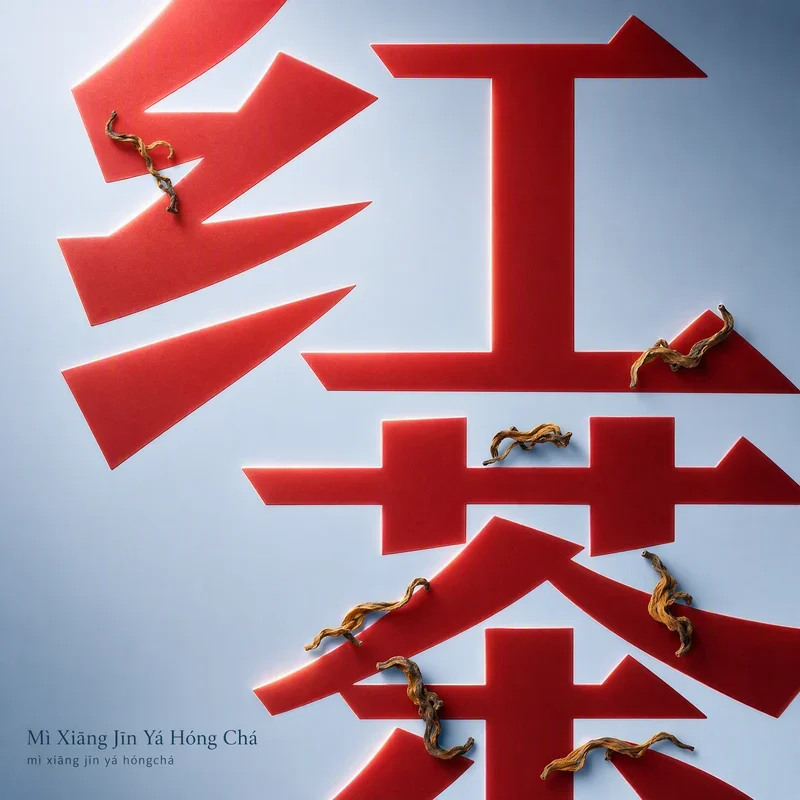
mì xiāng jīn yá hóngchá
Choose a brewing method. Start with the recommended quantities and time, then adjust to taste.
Brewing
Brewing
Taste
Tea encyclopedia
Category: Taiwanese red teas with honey aroma (台灣蜜香紅茶, Táiwān Mì Xiāng Hóngchá). Premium bud version — "Golden Buds" (金芽, Jīn Yá).
Category: Taiwanese red teas with honey aroma (台灣蜜香紅茶, Táiwān Mì Xiāng Hóngchá). Premium bud version — "Golden Buds" (金芽, Jīn Yá).
Coordinates: Depend on specific producer. For Nantou County — approximately 23°50′ N, 120°40′ E; for Hualien — approximately 23°30′ N, 121°25′ E.
Origin: Táiwān (台灣, Táiwān). Exact production location varies, however main regions include: Nántóu County (南投縣, Nántóu Xiàn) — especially Míngjiān Township (名間鄉, Míngjiān Xiāng) and Yúchí District (魚池鄉, Yúchí Xiāng); Hualien County (花蓮縣, Huālián Xiàn) — Ruìsuì (瑞穗鄉, Ruìsuì Xiāng), known for red tea production; as well as individual farms in Nántóu and Chiayi Counties (嘉義縣, Jiāyì Xiàn). Production is tied to territories where green leafhoppers actively inhabit — predominantly mid-altitude areas up to 800 m elevation.
Type: Red tea (black tea) (紅茶, hóngchá) — fully oxidized (oxidation degree ~90–95%). According to European classification — black tea. Distinctive feature — presence of honey aroma (蜜香, mì xiāng), caused by the impact of leafhoppers on tea leaves before harvest.
Cultural Significance: Mi Xiang Jin Ya Hong Cha is one of the most expressive examples of Taiwan's innovative approach to tea cultivation, where masters not only adapt traditional technologies but create fundamentally new flavor categories. This tea embodies the philosophy of cooperation with nature: what seemed like pest damage (leafhopper damage to leaves) is transformed into the main virtue. Production of such tea is impossible without ecologically clean farming, which gives it additional value in the eyes of modern consumers.
History: Red tea production in Taiwan has over a century of history, dating back to the Japanese colonial period (1895–1945). The Japanese administration actively developed the island's tea industry, including red tea production for export. However, after World War II, priorities shifted toward oolongs, and red tea in Taiwan found itself on the periphery. Revival of interest in Taiwanese red teas occurred in the late 20th — early 21st century, when local tea growers began experimenting with applying to red tea the technology of using leaves damaged by leafhoppers — a method long mastered in the production of Dōngfāng Měirén oolong (東方美人, Dōngfāng Měirén). The idea proved successful: the honey aroma brought by leafhoppers magnificently revealed itself in the context of fully oxidized tea, creating a completely new flavor profile. The "Jin Ya" version — with increased bud content — appeared as a natural continuation of the trend toward premiumization of Taiwanese red teas.
Leaves must be damaged by green leafhoppers (小綠葉蟬, xiǎo lǜ yè chán; Latin name — Jacobiasca formosana). This tiny insect (body length 2.4–2.7 mm) from the leafhopper family (Cicadellidae) pierces young shoot tissues with its proboscis and sucks sap. In response to damage, the tea bush activates defense mechanisms: oxidation intensifies at bite sites, synthesis of terpenoid compounds increases (primarily 2,6-dimethyl-3,7-octadiene-2,6-diol and linalool oxides), forming the unique honey-fruity aroma — so-called "chanyan" (蟬涎, chán xián — literally "leafhopper saliva"). The degree of leaf damage by leafhoppers is the main factor determining the intensity of honey aroma in the finished tea.
Cultivar: Several Taiwanese cultivars are used for Mi Xiang Jin Ya Hong Cha, each contributing its own nuances:
Picking: Summer harvest (June–August) is considered most valuable, when leafhopper population reaches peak activity. Also produced from spring and autumn material, but honey aroma is less pronounced in these cases.
Pluck Standard: Bud with one to two upper leaves (一心一葉至一心二葉). For the "Jin Ya" version, emphasis is on maximum content of buds (tips) in the total volume of raw material.
Altitude: 200–800 m above sea level — lower than classic high-mountain oolongs (Gaoshan Cha), but sufficient for forming a microclimate with abundant mists and moderate temperatures. It is precisely in this altitude range that leafhoppers feel most comfortable.
Climate: Warm and humid subtropical, with average annual temperature 20–25°C, abundant precipitation (1500–2500 mm per year) and prolonged growing season.
Soil: Well-drained, slightly acidic alluvial and lateritic soils with high organic matter content.
Critically important feature — pesticides and herbicides are not used for Mi Xiang tea production. Any chemical treatment would destroy or repel leafhoppers, depriving the tea of its main value. Essentially, honey tea production is impossible without organic or ecologically sustainable farming approaches. Many farms specializing in honey teas have organic or ecological production certification.
Occurs on the bush before harvest. Green leafhoppers pierce young shoot tissues, sucking sap and injecting saliva enzymes. The tea leaf triggers defense reactions: increased synthesis of polyphenol oxidase, accumulation of terpenoid compounds, partial oxidation at damage sites. Leaves subjected to impact acquire characteristic yellowish-brown edge coloration.
Manual, careful. Shoots with obvious signs of leafhopper damage are collected. For "Jin Ya," priority is buds and first leaf.
Solar or indoor. Duration — from several hours to a day. Goal — reducing moisture to 60–65%, increasing elasticity and further development of oxidative processes already begun by leafhoppers on the bush. For Taiwanese honey teas, withering plays a special role: it is at this stage that terpenoid "honey" compounds begin to actively release.
Manual or mechanical. Destroys cell walls, releasing sap and enzymes, which accelerates oxidation. Rolling degree — from moderate to intensive, depending on desired shape. For "Jin Ya," rolling is delicate to preserve bud integrity.
Full oxidation under controlled temperature (25–30°C) and humidity (≥90%) conditions. Duration — 3–6 hours. At this stage, the honey aroma laid by leafhoppers and developed during withering is finally formed and fixed. Catechins transform into theaflavins and thearubigins, leaves acquire reddish-brown color.
High-temperature fixation to stop oxidation and bring moisture to 4–6%. Conducted in drying chambers, sometimes in two stages.
For "Jin Ya" — selection of fraction with maximum content of golden buds (tips).
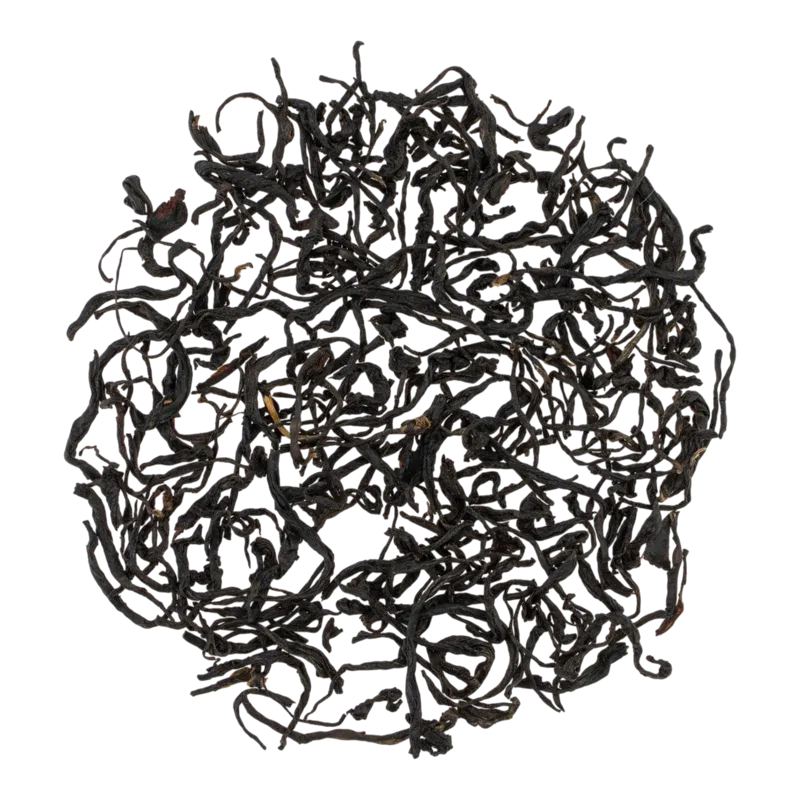
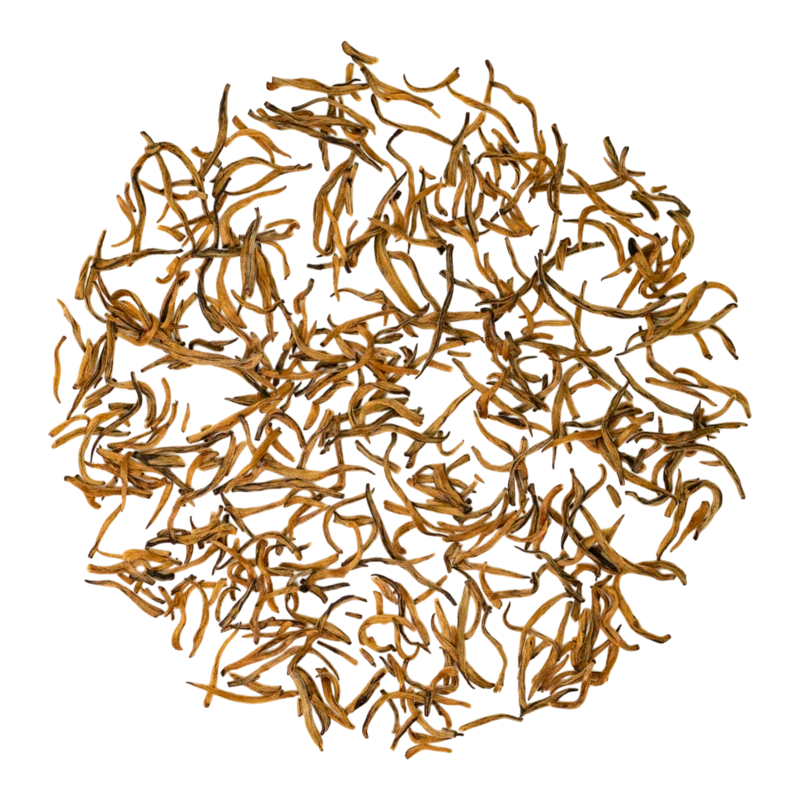
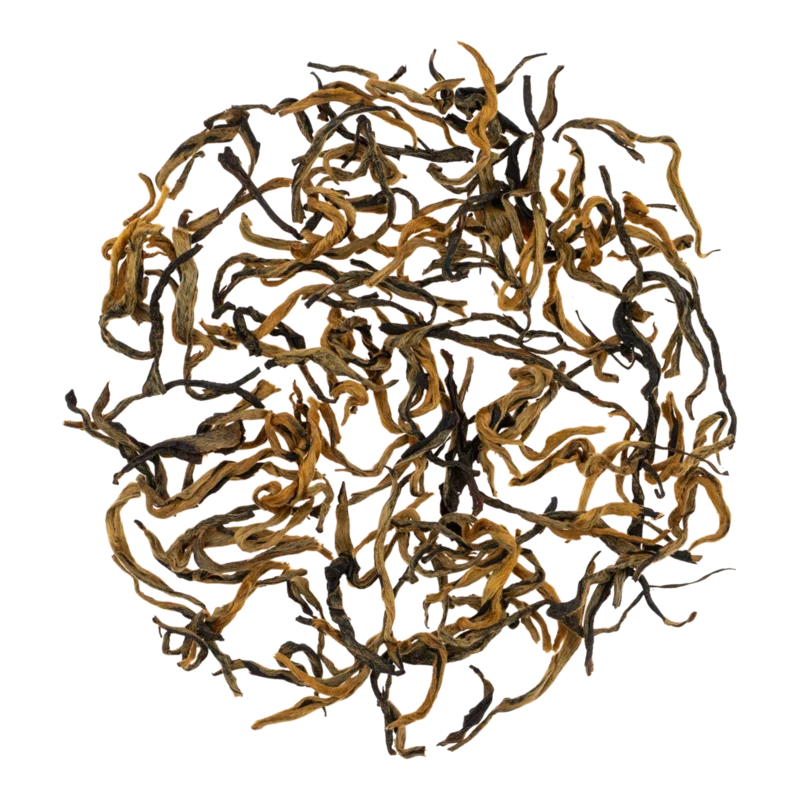
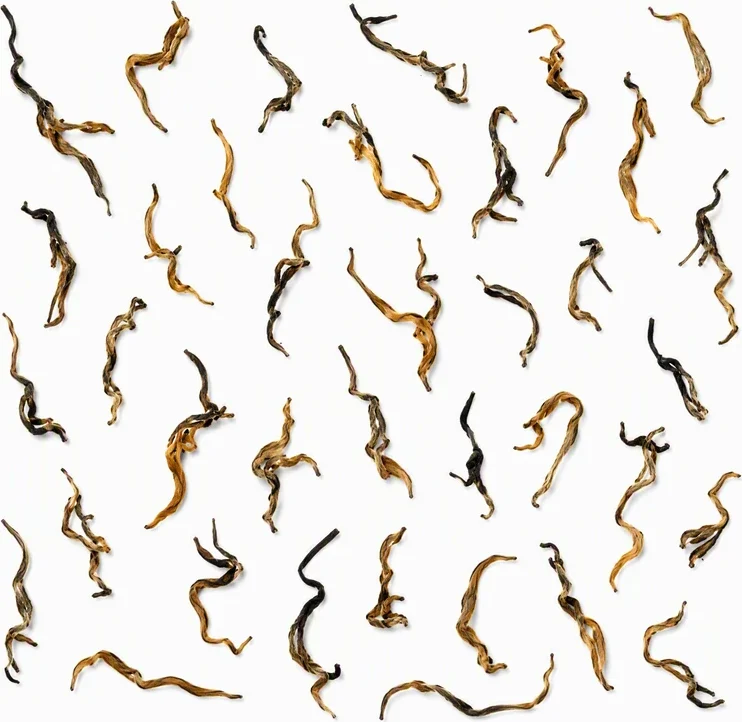
Dry Leaf Appearance: Tea leaves slightly twisted, elongated, medium density. Color — from dark brown to black, with abundant golden and reddish inclusions of tips covered with fine down. On individual leaves, characteristic yellowish-brown traces of leafhopper damage are noticeable — a peculiar "quality mark" for the initiated.
Dry Leaf Aroma: Intense, sweet, with immediately recognizable honey character — the calling card of all "Mi Xiang" teas. Additional notes: ripe fruits (peach, lychee, mango, grape), flowers, hints of caramel and warm spices. The aroma is enveloping, deep, without the slightest harshness.
Liquor Aroma: Rich and persistent, with predominance of honey-fruity complex. As the cup cools, additional layers unfold — floral, spicy, sometimes with subtle acidity of ripe fruits. The aroma is distinguished by rare "length" — persists in the empty cup (杯底香, bēi dǐ xiāng) for an extended time.
Liquor Color: Bright amber-red or orange-red, clear, transparent, with pronounced brilliance. More saturated than most Taiwanese oolongs, but somewhat lighter than classic Yunnan Dian Hongs.
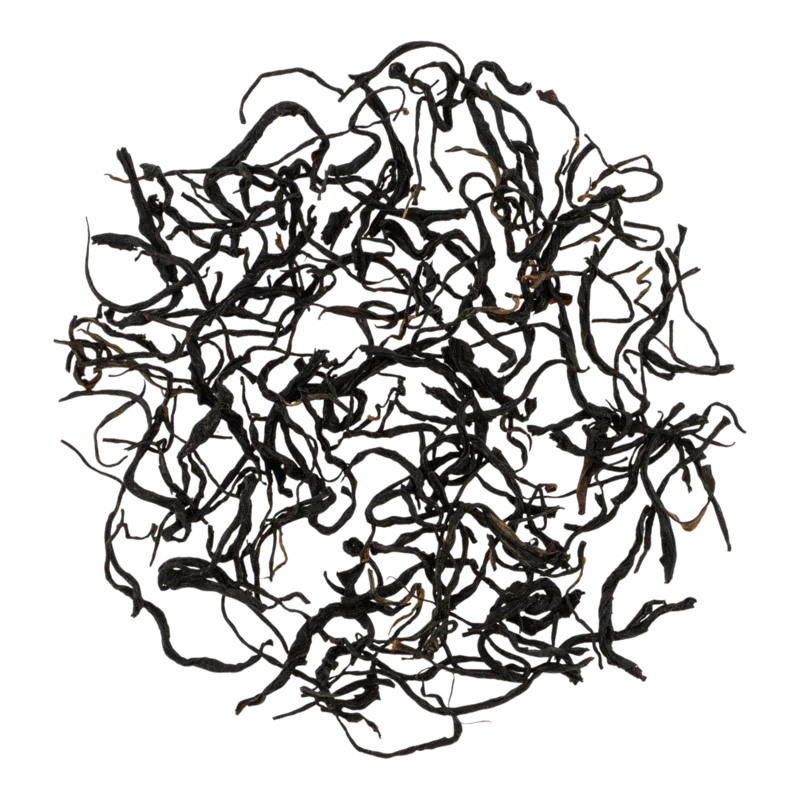
Spent Leaves: Mixture of opened buds and leaves of non-uniform color — from golden-yellow (buds) to reddish-brown (leaves). Reddish traces of leafhopper damage are clearly visible on leaves. Leaves are soft, elastic, with pronounced sweet aroma.
Taste: Full, velvety, rounded, with pronounced natural sweetness. Liquor body — medium to full, with silky texture. Honey and fruity tones dominate the taste (peach, lychee, ripe grape, mango), supported by nuances of flowers and caramel. Astringency is minimal, bitterness is absent. Aftertaste — long, warm, with growing sweetness and sensation of "honey enveloping film" on the tongue.
Alkaloids: Caffeine (2.5–3.5% of dry matter), theobromine — in smaller quantities.
Amino Acids: L-theanine — leading amino acid, contributing to sweetness and "umami" character of taste. Total amino acid content in Taiwanese red teas usually comprises 2–3% of dry matter.
Key distinguishing group for honey teas. Leafhopper impact stimulates significant increase in synthesis of monoterpene alcohols and their oxides: 2,6-dimethyl-3,7-octadiene-2,6-diol, linalool and its oxides, geraniol, nerol, trans-nerolidol. These compounds are responsible for the characteristic honey-fruity aroma. Studies have shown that tea from leafhopper-damaged leaves can contain 5–10 times more 2,6-dimethyloctadienediol than tea from undamaged material.
Minerals: Potassium, magnesium, manganese, fluorine, iron, zinc.
Polyphenols: During full oxidation, main catechins transform into theaflavins and thearubigins, determining color, taste and antioxidant properties. Peculiarity of honey teas — increased polyphenol oxidase activity in leafhopper damage zones, leading to more uniform and deep oxidation.
Vitamins: C (partially preserved), E, K, B group.
Theaflavins and thearubigins possess pronounced antioxidant activity, neutralizing free radicals and reducing risk of cellular damage.
Caffeine in synergy with L-theanine provides alertness without nervousness and "caffeine anxiety," with smooth onset and prolonged action.
L-theanine promotes increased production of alpha brain waves, providing a state of calm concentration.
Red tea polyphenols stimulate peristalsis, promote normalization of intestinal microflora and facilitate digestion of fatty foods.
Regular red tea consumption is associated with reduced "bad" cholesterol levels and blood pressure normalization.
Polyphenolic compounds exhibit anti-inflammatory activity.
Complex of polyphenols and amino acids has immunomodulating effects.
Tea Amount: 5–6 g per 150 ml water (gongfu method); 3–4 g per 200 ml (European method).
Teaware: Porcelain gàiwǎn (蓋碗, gàiwǎn) — optimal choice, allowing full appreciation of aroma and control of steeping time. Yíxīng clay teapot (紫砂壺, zǐshā hú) or thin-walled porcelain teapot are also acceptable. Glass teaware allows observation of beautiful liquor color.
Water Temperature: 85–95°C. For more delicate honey aroma development — closer to lower range; for fuller body — toward upper range.
A heavy oolong (60–80% oxidation), not a black tea. Produced from leaves damaged by the same leafhopper. Differs from Mi Xiang Hong Cha with a brighter, "perfumed" honey-fruit aroma, variegated (five colors) leaf coloration, and higher content of white tips. The taste of Dongfang Meiren is typically lighter and less "warm" than fully fermented Mi Xiang Hong Cha.
Premium black tea from Wuyishan (Fujian), also made from single buds. Distinguished by a more refined, elegant honey-floral aroma without pronounced fruity tones. The taste is more delicate and "cool." The honey character of Mi Xiang Hong Cha is of a different nature: it is caused by leafhoppers, while the sweetness of Jin Jun Mei results from high amino acid content in high-altitude bud material.
Taiwanese black tea from the Sun Moon Lake region (Nantou), most often from cultivar Tai Cha No. 18 (Hong Yu). Characteristic notes of cinnamon, mint, and eucalyptus with no honey profile. More intense and "straightforward" compared to the multi-layered complexity of Mi Xiang Jin Ya.
Yunnan black tea — more astringent, powerful, with dominant malty-chocolate notes. Mi Xiang Jin Ya is softer, sweeter, with a fruity-honey character of completely different style.
Famous Anhui black tea with "qi men xiang" (祁门香) — characteristic aroma combining floral, fruity, and light smoky notes. More restrained, intellectual style compared to the bright and sensual "honey character" of Mi Xiang Hong Cha.
Authentic Mi Xiang Jin Ya should have natural, deep, "living" honey-fruity aroma. Artificial flavoring produces flat, monotone, "perfumery" smell without depth.
On authentic tea, characteristic yellowish-brown spots and uneven leaf coloration are noticeable — visual confirmation of Jacobiasca formosana impact.
Clear, transparent, bright amber-red. Cloudiness and dullness are signs of low quality.
Excessively low cost almost certainly indicates absence of authentic leafhopper impact or origin substitution.
No reviews yet. Tell us what you think of this tea.
Rate this tea and share your impressions. We review each submission before publishing it.