Brewing
Gongfu brewing
- Water temperature
- 93 °C
- Tea amount
- 5 g
- Water volume
- 100 ml
- First steep
- 10 s
- Time added per infusion
- 5 s
- Infusions
- 4

Bānlán Hóngchá
Choose a brewing method. Start with the recommended quantities and time, then adjust to taste.
Brewing
Brewing
Taste
Tea encyclopedia
Category: Hǎinán flavoured teas (海南添香茶). Belongs to the same line as the famous Hainan "Xianglan Cha" (香兰茶, Xiānglán Chá) — tea with vanilla (Vanilla planifolia), created in 1993, but uses pandan rather than vanilla as the flavouring agent.
Category: Hǎinán flavoured teas (海南添香茶). Belongs to the same line as the famous Hainan "Xianglan Cha" (香兰茶, Xiānglán Chá) — tea with vanilla (Vanilla planifolia), created in 1993, but uses pandan rather than vanilla as the flavouring agent.
Coordinates: ≈ 19.2° N, 109.7° E (central part of Hainan Island; specific production location varies).
Origin: China, Hǎinán Province (海南, Hǎinán). Production is widespread in several districts of the island: cities and counties of Wànníng (万宁, Wànníng), Ding'an (定安, Dìng'ān), Qiónghǎi (琼海, Qiónghǎi), Wénchāng (文昌, Wénchāng), Chéngmài (澄迈, Chéngmài) and others. Pandan is cultivated on an area of approximately 30,000 mu (~2,000 hectares) throughout the island.
Type: Flavoured red tea (black tea) (添香红茶, tiānxiāng hóngchá) — fully oxidized tea base enriched with natural plant flavouring (pandan leaves). By degree of processing, the tea base is fully oxidized red tea (black tea); by flavouring method — addition of natural plant component.
Cultural Significance: Banlan Hong Cha occupies a special place in Hainan's "lao ba cha" (老爸茶, lǎo bà chá) culture — unhurried tea drinking in family teahouses, which is a social ritual of the island. Pandan red tea (black tea) is served both cold (with ice) and hot, often accompanied by characteristic Hainan snacks: banlan jianmianbing (斑兰煎面饼, pandan fried pancakes), banlan gao (斑兰糕, pandan cakes), qingbuliang (清补凉, sweet dessert soup). In a broader context, pandan symbolizes the "South Sea" (南洋, nányáng) cultural identity of Hainan — the connection with the Malay-Singaporean diaspora and the aesthetics of a tropical island.
History: The presence of pandan on Hainan dates back to the 1920s, when huaqiao (华侨, huáqiáo — ethnic Chinese living in Southeast Asia) began bringing saplings of this plant from Malaysia, Singapore and Thailand, which had become an integral part of "nanyang" cuisine. Pandan seeds and cuttings easily took root in the tropical climate of the island, and for almost a century Hainan people have used pandan leaves in cooking — for flavouring rice, preparing nine-layer glutinous rice flour pudding (九层糯, jiǔ céng nuò) and other traditional dishes.
Name Breakdown: 斑兰 (Bānlán) — Chinese colloquial name for pandan, borrowed from Malay "pandan". 红茶 (Hóngchá) — red tea (black tea), indicating the tea base. The full name translates as "red tea with pandan."
Red tea (black tea) from Hainan large-leaf varieties of Camellia sinensis var. assamica — primarily Hǎinán large leaf (海南大叶种) and/or Yúnnán large leaf (云南大叶种), as well as varieties introduced from Fujian (Fuding Da Bai, Fuyun-6, etc.). Large-leaf varieties are distinguished by high content of tea polyphenols and caffeine, making them an ideal base for red tea (black tea) with rich, full-bodied flavour.
Pandanus amaryllifolius Roxb. (family Pandanaceae). Chinese names: xiangludou (香露兜, xiāng lùdōu), banlanye (斑兰叶, bānlán yè), xianglanye (香兰叶, xiānglán yè), xianglingtou (香林投, xiāng líntóu). Perennial herbaceous plant with long (40–80 cm), narrow, lanceolate leaves of rich green colour. The characteristic aroma is due to the presence of 2-acetyl-1-pyrroline (2-AP) — the same compound that gives fragrance to jasmine "basmati" rice. Besides aromatic properties, pandan leaves contain chlorophyll (natural green pigment), vitamins A and C, as well as a number of bioactive compounds.
Year-round (Hainan is the only region in the PRC where tea can be harvested in four seasons; growing season — up to 10 months). Tea base harvesting standard: bud and one-two leaves (一芽一叶, 一芽二叶).
Leaves are cut throughout the year, preferably young ones with maximum concentration of essential oils.
Climate: Tropical monsoon. Average annual temperature — 22–26 °C. Precipitation — 1,700–2,400 mm. Relative humidity — >80%. Conditions are close to the climate of Sri Lanka and Malaysia, which explains both successful tea cultivation and excellent acclimatization of pandan.
Soil: Lateritic and red tropical soils with good drainage and high content of iron and organic matter. In some areas — volcanic soils with increased selenium content.
From coastal plains (~50 m) to mountain plantations of central Hainan (up to 600–800 m). Tea gardens are located in Ding'an County (southern foothills), Wanning (eastern coast), Qiongzhong, Wuzhishan and Baisha.
Predominantly lowland and foothill areas (up to 200–300 m); pandan grows well under the canopy of palm and betel groves (林下种植, línxià zhòngzhí — understory cultivation).
Pandan is cultivated as ān understory crop under betel palms (槟榔, bīnglang) or coconut palms, which allows rational use of inter-row space. Does not require chemical fertilizers; reproduces well vegetatively.
12–18 hours; reduction of leaf moisture by 25–30%.
Formation of conditionally strip-like or conditionally spiral leaf structure.
Controlled oxidation at T 24–28 °C and humidity >90% for 3–5 hours.
With hot air at T 100–120 °C to residual moisture ≤6%.
Separation of fractions.
Cut pandan leaves are mixed with finished red tea (black tea) and re-dried slightly at moderate temperature (60–80 °C), allowing volatile aromatic compounds of pandan to be absorbed into the tea leaf. The process is similar to traditional Chinese "xunzhi" (窨制, xūn zhì) technology — jasmine tea scenting.
Dried fragments or pandan powder are mixed with finished red tea (black tea) in a certain proportion.
Tea leaf is impregnated with fresh pandan juice, then dried.
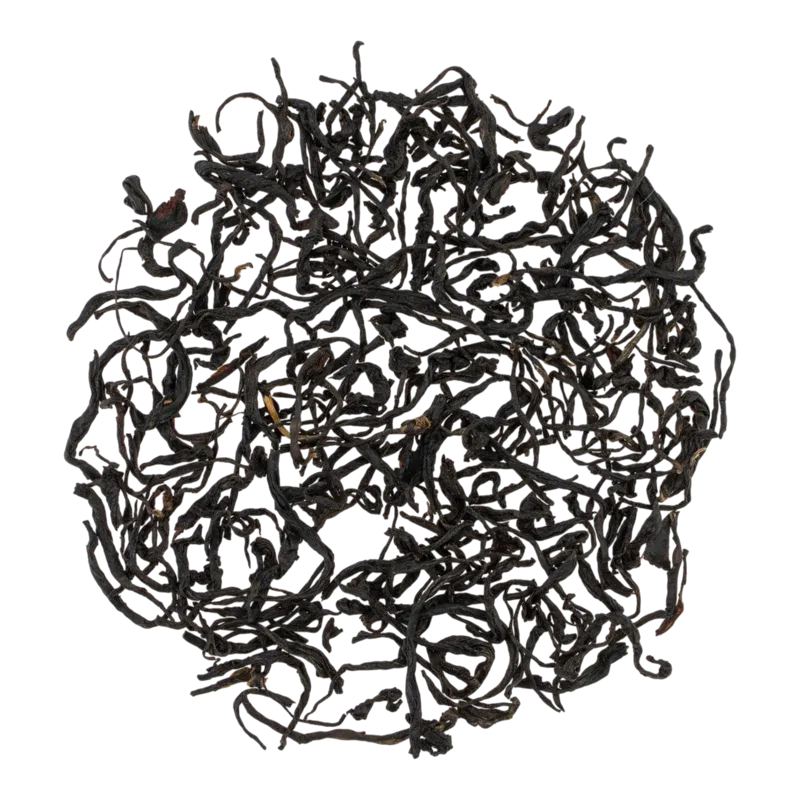
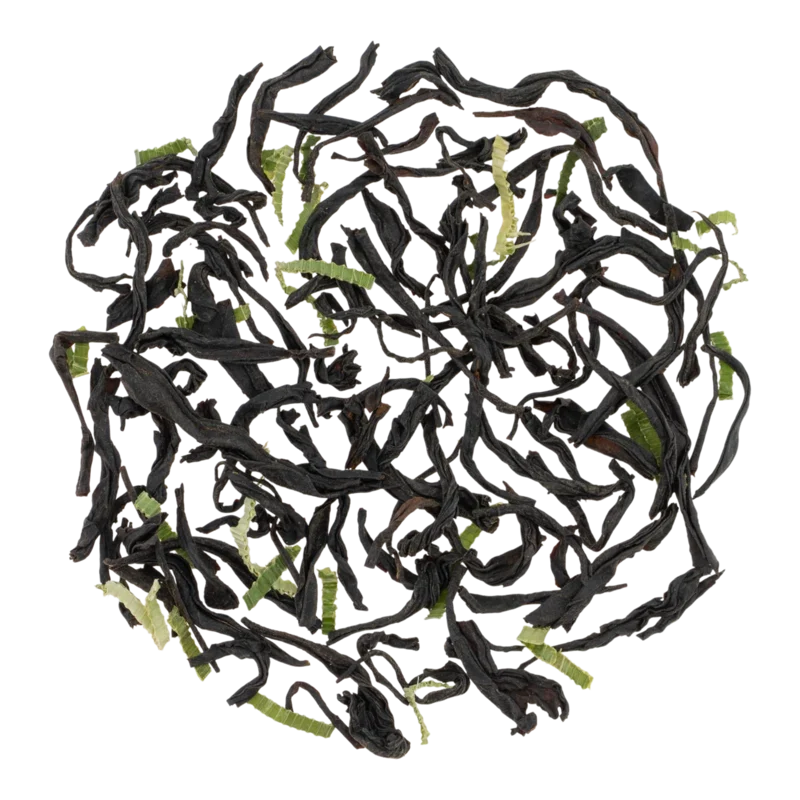
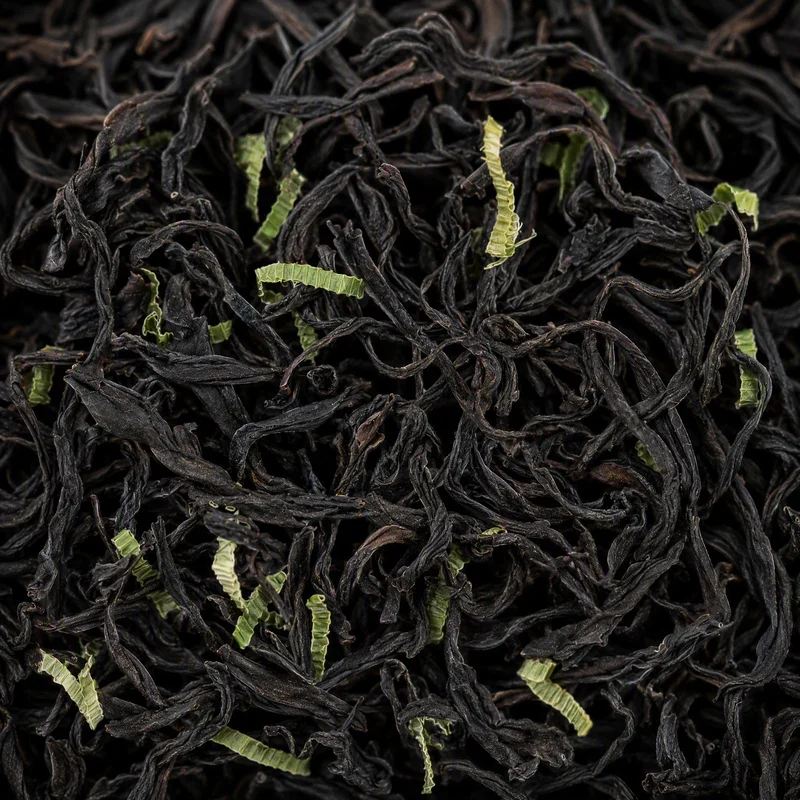
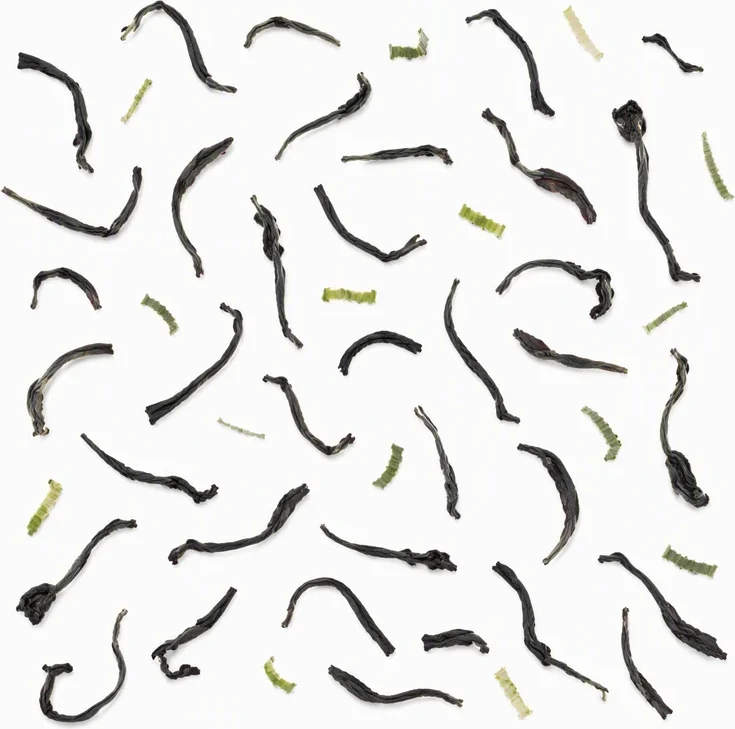
Dry Leaf Appearance: Dark brown or black twisted tea leaves of red tea (black tea), interspersed with fragments of dried pandan leaves — from pale green to golden-yellow, depending on the drying method. In some versions, golden tips (显毫, xiǎn háo) of the tea base are visible.
Dry Leaf Aroma: Pandan notes dominate: sweet-herbaceous, with hints of vanilla, fresh-cut grass and a light "rice" note. Underneath — warm, honey background of red tea (black tea).
Liquor Aroma: Bright and unusual: first wave — characteristic "green" sweet-creamy pandan aroma, which in Southeast Asia is associated with home baking; second — honey-fruity tones of red tea (black tea); on the finish — soft herbaceous and nutty nuances.
From amber to red-chestnut, clear. With a significant proportion of pandan, the liquor may acquire a light greenish tint.
Spent Leaves: Tea leaves open elastically, copper-brown; pandan fragments — soft, pale green or olive.
Taste: Soft, rounded, with sweet "creaminess" of pandan, which organically combines with the density and moderate astringency of Hainan red tea (black tea). Aftertaste — prolonged, with herbaceous coolness and residual honey sweetness. The tea is well perceived both hot and cold — chilled banlan hongcha with ice is especially refreshing in tropical heat.
Amino Acids: Including L-theanine; content somewhat lower than in small-leaf varieties.
3.5–4.5% — high level, characteristic of var. assamica.
Key aromatic compound determining the characteristic sweet-vanilla fragrance. This same substance causes the aroma of jasmine rice.
Natural green pigment; maximally preserved with freeze-drying.
Possess mild antioxidant action.
Minerals: Potassium, magnesium, manganese, zinc; on selenium-containing soils — increased selenium content.
Polyphenols: 18–25% (above average for red teas/black teas thanks to large-leaf raw material). Oxidation products dominate: theaflavins, thearubigins.
Vitamins: A (beta-carotene), C (ascorbic acid).
Caffeine and L-theanine of the tea base provide gentle, prolonged vigour.
Polyphenols of red tea (black tea) combined with bioactive compounds of pandan complement each other, forming comprehensive antioxidant protection.
Fermented polyphenols of red tea (black tea) act gently on gastric mucosa. In traditional Southeast Asian medicine, pandan is considered a remedy that promotes digestion and relieves bloating.
Volatile components of pandan (2-AP and terpene compounds) have a mild relaxing effect, making banlan hongcha a good choice for evening tea drinking.
Cold with ice, the tea excellently quenches thirst and reduces subjective sensation of heat.
Potassium and polyphenols of red tea (black tea) with regular moderate consumption support vascular elasticity.
Vitamin C from pandan leaves (with gentle processing) and trace elements of the tea base contribute to overall immune balance.
Tea Amount: 4–5 g per 120–150 ml (gongfu method); 3–4 g per 250–300 ml (European method or mug brewing for daily tea drinking).
Teaware: Porcelain teapot or gàiwǎn (盖碗) — for hot brewing; glass teapot — for visual enjoyment of the colour contrast of tea and pandan; for cold tea — glass pitcher with ice.
Water Temperature: 90–95 °C.
Container: Airtight, opaque — tin can or foil package. Pandan components are sensitive to light and moisture.
Shelf Life: 6–12 months. Pandan aroma weakens over time faster than the taste of the tea base, so banlan hongcha is better consumed relatively fresh.
Dry, dark, cool place, 15–25 °C. Do not store near strongly aromatic products.
Closest "relative" — tea flavoured with vanilla pods (Vanilla planifolia). Has deeper, "confectionery" vanilla aroma, while banlan hongcha is distinguished by fresher, "green" and herbaceous character.
Classic Chinese flavoured tea (usually on green base). The method of jasmine tea scenting (窨制, xūn zhì) — repeated exposure of tea with jasmine buds — has been perfected over centuries and differs from the simpler blending of banlan hongcha. Jasmine profile is floral and more "airy"; pandan is "creamy" and "vanilla-like."
Flavoured red tea (black tea) with osmanthus flowers. Osmanthus gives fruity-honey aroma with apricot notes, while pandan gives more exotic, "tropical" nuance.
Thai tea drinks with pandan are common in Bangkok and Chiang Mai street food. The difference of Hainan banlan hongcha is the use of quality gongfu-grade tea base instead of mass-market tea and more careful flavouring technology.
Price Category: Medium segment of Hainan specific teas. Price varies from 100–300 yuan/250 g depending on tea base quality, pandan processing method and brand. Products with freeze-dried pandan are more expensive than those with ordinary drying.
No reviews yet. Tell us what you think of this tea.
Rate this tea and share your impressions. We review each submission before publishing it.