Brewing
Gongfu brewing
- Water temperature
- 75 °C
- Tea amount
- 5 g
- Water volume
- 100 ml
- First steep
- 10 s
- Time added per infusion
- 5 s
- Infusions
- 3

Yǒngxī huǒ qīng
Choose a brewing method. Start with the recommended quantities and time, then adjust to taste.
Brewing
Brewing
Taste
Tea encyclopedia
Category: National Agricultural Product Geographical Indication of the Ministry of Agriculture of the PRC (全国农产品地理标志, quánguó nóngchǎnpǐn dìlǐ biāozhì). Historic famous tea of Anhui Province. Received geographical indication protection in 2011.
Category: National Agricultural Product Geographical Indication of the Ministry of Agriculture of the PRC (全国农产品地理标志, quánguó nóngchǎnpǐn dìlǐ biāozhì). Historic famous tea of Anhui Province. Received geographical indication protection in 2011.
Coordinates: 118°15′18″—118°38′18″ East longitude, 30°25′07″—30°37′52″ North latitude.
Origin: China, Ānhuī Province (安徽, Ānhuī), Jìng County (泾县, Jīngxiàn), Lángqiáo Township (榔桥镇, Lángqiáo Zhèn). The geographical indication zone encompasses 12 administrative villages: Huangtian (黄田), Yǒngxī (涌溪), Zhexi (浙溪) and others.
Type: Green tea (non-oxidized). Belongs to the category of "zhucha" (珠茶, zhūchá) — pearl green teas rolled into dense round pellets. By final drying method — chaoqing (炒青, chǎoqīng), pan-firing drying in a wok.
Cultural Significance: Yǒngxī Huǒ Qīng is one of the symbols of tea culture in southern Ānhuī (皖南, Wǎnnán), a region that has given the world an entire constellation of famous teas. The tea is inseparably linked with the tradition of Huizhou craftsmanship and the philosophy of "slow fire" — patient, multi-hour work in which mastery is manifested not in speed, but in endurance.
History: Yongxi Huo Qing traces its history to the Ming era (1368–1644). The first documentary evidence is the "Records of Jing County" (泾县志, Jīngxiàn Zhì) from 1645 (second year of Shunzhi reign, 顺治二年, Qing dynasty), which noted that in the area of Yongxi stream "excellent tea is produced in abundance" (涌溪一带"多产美茶"). The production peak came during the Xiánfēng period (咸丰, 1851–1861), when annual output reached over one hundred dan (approximately 5 tons), with 20% being highest grades.
Cultivar: The main cultivar is Yǒngxī Liǔyè Zhǒng (涌溪柳叶种, Yǒngxī Liǔyè Zhǒng) — "Willow Leaf from Yongxi," a local indigenous variety of Camellia sinensis var. sinensis. Belongs to the medium-leaf bush type. Leaves are elliptical, fleshy, with a characteristic bend of the main vein and sparse serrations along the edge. Distinguished by high resistance to adverse conditions, good yield, and suitability for forming dense pellets.
Picking: Spring picking — standard "one bud with two leaves in initial opening stage" (一芽二叶初展, yī yá èr yè chū zhǎn). For highest grades, raw material is hand-picked in dry weather, without purple shoots, damaged or coarse leaves.
Raw Material: Fresh, tender, uniform shoots without defects, foreign matter, or signs of wilting. Processing begins on the day of picking.
Altitude: 400–900 meters above sea level. The best plantations are in the terroir core: Fengkeng (枫坑), Pankeng (盘坑) and Shijingkeng (石井坑) gorges, at elevations of 600–900 m.
Climate: Subtropical monsoon climate. Average annual temperature — 15.6°C, annual precipitation — 1519–1800 mm, relative humidity — 90%. Spring cloudiness is exceptionally high — the proportion of sunny days in spring is only 26%. This ensures the predominance of diffused light and minimizes photosynthetic conversion of amino acids to catechins, preserving mildness and sweetness of taste. Daily temperature fluctuations are significant, which promotes accumulation of aromatic substances.
Soil: Mountain "dark sandy" soils (乌沙土, wūshā tǔ) with deep profile, pH around 5.5, rich in organic matter and macroelements (nitrogen, phosphorus, potassium). The soil type provides good aeration and water permeability.
Mountain gorges with numerous streams and waterfalls, constant cloudiness. Proximity to water creates a microclimate of increased humidity, ideal for forming thick, juicy shoots.
Three gorges — Fengkeng Tuanjieyan (枫坑团结岩), Pankeng Jizhaoou (盘坑鸡爪坞) and Shijingkeng Yingwoyan (石井坑鹰窝岩) — produce tea of the highest quality.
Leaves are pan-fired in a heated wok, stopping enzyme oxidation and fixing fresh aromatics.
Gentle rolling to form initial structure and partial release of cellular juice.
Pan-firing in a wok for preliminary drying and initial pellet formation.
Additional rolling to compact the tea leaf structure.
Continuation of shaping: tea leaves gradually compact, taking on a round form.
Intermediate cooling for moisture redistribution.
The key and most characteristic stage. Tea is placed in a wok with charcoal heating and slowly dried at low temperature for approximately 20 hours. The master continuously stirs and shapes the tea leaves, bringing them to perfect round form and deep, multi-layered aroma. It is this "slow fire" that gave the tea its name — "Huo Qing" (火青, "fire green").
Finished tea is sifted, separated by size and debris is removed.
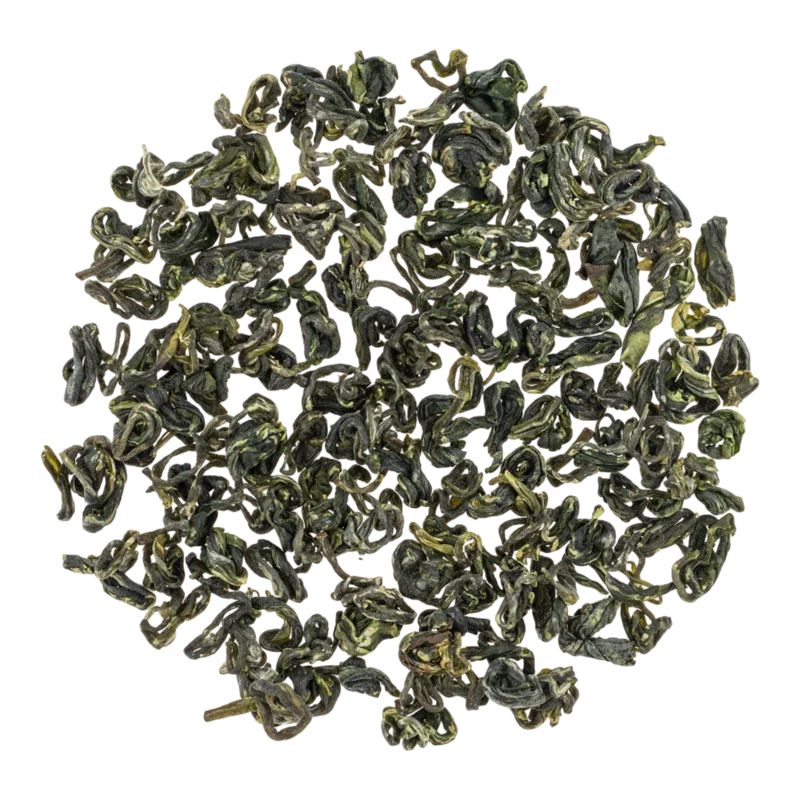
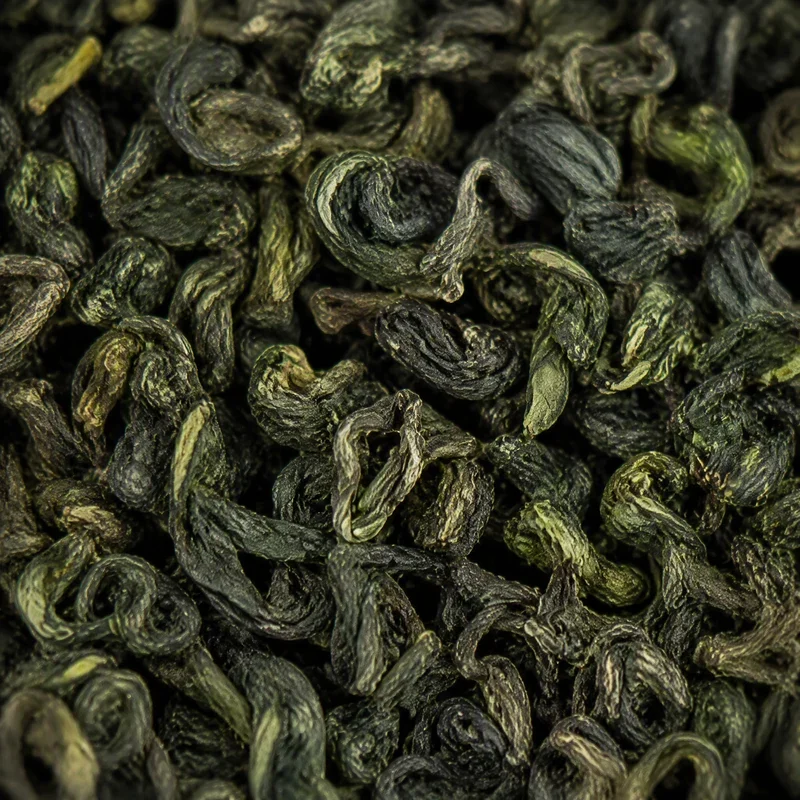
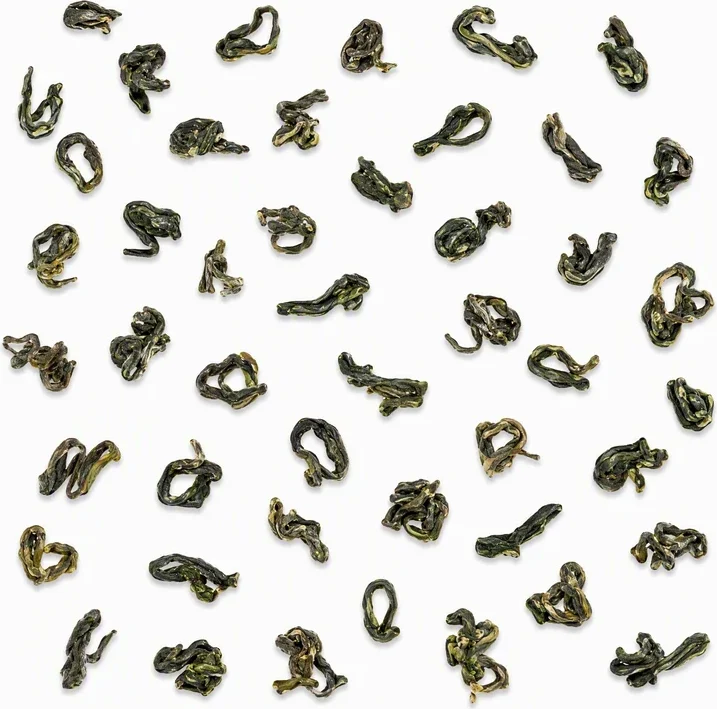
Dry Leaf Appearance: Dense, heavy pellets of round form (腰圆形, yāoyuán xíng — "waist-round bead shape"), resembling small pearls. Color — deep dark green with oily luster (墨绿莹润, mòlǜ yíngrùn). Surface densely covered with silvery down (银毫密披). Pellets are uniform, dense, noticeably heavy in hand — a sign of proper formation.
Dry Leaf Aroma: Pure floral aroma (清花香, qīng huāxiāng) with chestnut and orchid notes. Expressed "Buddha's hand citron rhyme" (佛手韵, fóshǒu yùn) — a delicate citrus-floral nuance characteristic of tea with prolonged charcoal drying. In highest grades — persistent, deep, multi-layered.
Liquor Aroma: Rich, fragrant (清香馥郁, qīngxiāng fùyù). Orchid note unfolds in first steeps, chestnut — in second and third. Aroma is persistent, lasting through 4–5 brewings.
Liquor Color: Unusual for green tea — apricot-yellow, bright and clear (杏黄明亮, xìnghuáng míngliàng). This warm golden tone — the result of prolonged charcoal drying — distinguishes Yongxi Huo Qing among most green teas, which produce greenish liquor.
Spent Leaves: Tender, elastic shoots, unfolded from pellets like flowers (嫩匀成朵). Color — tender green with slight yellowness. Leaves are whole, without damage.
Taste: Dense and full-bodied (醇厚, chúnhòu), fresh and brisk (鲜爽, xiānshuǎng), with pronounced returning sweetness (甘爽回甘). The taste of 2nd and 3rd steeps is considered optimal — here the balance of aroma, body and sweetness reaches its peak. Astringency is minimal, bitterness is absent. Aftertaste — long, warm, sweetish.
Alkaloids: Caffeine — moderate content. Also present are theobromine and theophylline, providing mild tonic and diuretic effects.
Amino Acids: Elevated content — result of high-mountain origin and abundant diffused light (spring cloudiness 74%). Provides freshness, sweetness and mildness of taste.
According to research, flavonoid content is significant. Flavonoids complement the antioxidant action of catechins.
Prolonged charcoal drying forms a unique aromatic complex with notes of Buddha's hand citron, chestnut and orchid — "warmer" and deeper than standard green teas.
Minerals: Elevated zinc content (锌, xīn) is noted, which is related to the mineral composition of mountain soils.
Polyphenols: Content — moderate for green tea. Catechins provide antioxidant potential and light structural depth of taste. Prolonged drying partially transforms catechins, which softens astringency.
Vitamins: Vitamin C, B vitamins, carotenoids.
Traditionally believed that regular consumption of green tea supports eye health — carotenoids and vitamin C contribute to protection from oxidative stress.
Caffeine combined with L-theanine provides gentle alertness and concentration.
Catechins and flavonoids neutralize free radicals.
Polyphenols stimulate secretion of digestive enzymes, help break down fatty foods (消食去腻).
Traditionally recommended in hot weather (止渴生津, 清热消暑).
Flavonoids and polyphenols promote vascular elasticity.
the listed properties are based on publicly available data and are not medical recommendations.
optimal taste — on 2nd and 3rd steeps: by this time pellets fully open, releasing maximum aroma and sweetness. Apricot-golden liquor color is normal for this tea, not a sign of aging.
Tea Amount: 5 g per 250 ml water (1:50 ratio). Dense pellets are heavier than loose tea, so visually the portion appears small.
Teaware: Glass tumbler — for observing pellet opening, which unfolds in water like orchid flowers (如兰花舒展). White porcelain gaiwan — for precise aroma control.
Water Temperature: 85°C (boiling water, cooled for ~2 minutes).
Baked (烘青) green tea with "sparrow tongue" shape. Mao Feng is lighter and more floral, with predominant orchid notes. Yongxi Huo Qing is denser, rounder and "warmer," with pronounced chestnut depth and unique apricot liquor.
Large flat leaf with orchid aroma. Hou Kui is "monumental" and deep; Yongxi Huo Qing is compact, concentrated and enduring.
Flat "melon seeds" from pure leaves. Gua Pian is more intense and grassy; Yongxi Huo Qing is rounder and sweeter, with unique pearl form.
Fellow from the same county. Te Jian is more classical in form (twisted leaf), Yongxi Huo Qing radically differs with pellet form and prolonged drying method.
genuine pellets are dense, heavy, round, with oily luster. Loose, light "balls" are signs of counterfeiting or low quality.
characteristic apricot-yellow color, pure and clear. Greenish liquor without golden tones may indicate a different type of tea.
authentic Yongxi Huo Qing withstands 4–5 full brewings. Counterfeits "exhaust" after 1–2 steeps.
suspiciously low price is a sure sign of counterfeiting.
No reviews yet. Tell us what you think of this tea.
Rate this tea and share your impressions. We review each submission before publishing it.