Brewing
Gongfu brewing
- Water temperature
- 93 °C
- Tea amount
- 5 g
- Water volume
- 100 ml
- First steep
- 10 s
- Time added per infusion
- 5 s
- Infusions
- 4


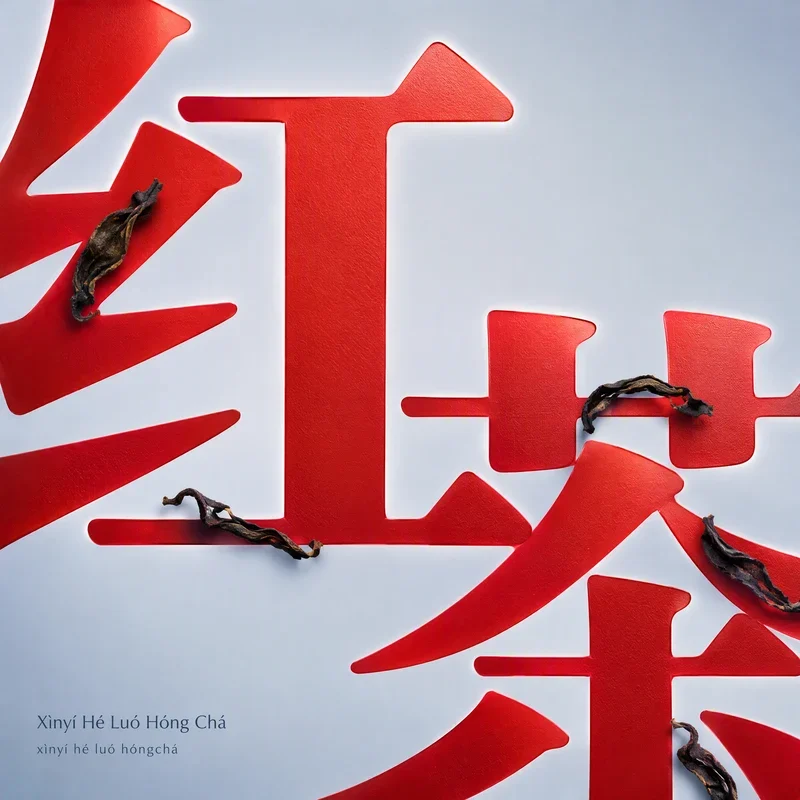
Xìnyí hé luó hóngchá
Choose a brewing method. Start with the recommended quantities and time, then adjust to taste.
Brewing
Brewing
Taste
Tea encyclopedia
Category: Regional Chinese red teas (black teas). Belongs to gōngfu hóngchá (工夫红茶, gōngfu hóngchá) — red teas (black teas) of fine hand processing.
Category: Regional Chinese red teas (black teas). Belongs to gōngfu hóngchá (工夫红茶, gōngfu hóngchá) — red teas (black teas) of fine hand processing.
Coordinates: ≈ 22.35° North latitude, 110.95° East longitude.
Origin: China, Guǎngdōng Province (广东省, Guǎngdōng Shěng), Maoming Prefecture-level City (茂名市, Màomíng Shì), Xinyi County-level City (信宜市, Xìnyí Shì), Jīndòng Town (金垌镇, Jīndòng Zhèn), Sānmài Dǐng Tea Garden (三唛顶茶园, Sānmài Dǐng cháyuán).
Type: Red tea (black tea) (红茶, hóngchá) — fully fermented (oxidized).
Cultural Significance: He Luo Cha is listed in the "Registry of Famous Teas of China, Guangdong Volume" (《中国名茶志·广东卷》, "Zhōngguó míngchá zhì · Guǎngdōng juàn") as one of the fifteen famous teas of the province and is considered a historical famous tea (历史名茶). For Xinyi city, this tea plays the role of a "calling card" of local terroir and agricultural heritage. A legend exists: in the Qianlong era, a white-bearded "immortal" (仙人, xiānrén), attracted by the aroma, descended to the tea garden, was treated by an old tea grower, was delighted with the beverage and left an inscription: "Pure aroma brings guests from beyond the clouds, wonderful taste lures immortals from mountain caves" (清香招来云外客,美味引出洞中仙). Emperor Qianlong himself, having tasted the tribute, allegedly proclaimed: "He Luo Cha — beautiful in form, sweet and noble in taste, truly a treasure of the Middle Kingdom."
History: The tea tradition of Xinyi spans more than three hundred years. According to the "Xinyi County Gazetteer" (信宜县志, "Xinyi xiànzhì"), as early as the Ming period, before the middle of the dynasty's reign, the Qimeishi (奇美石) area was a major tea zone with tens of thousands of mu of plantations and a special trading street "Hengjie" (横街), where tea leaves were bought and sold. Hé Luó Chá (合箩茶) itself traces its history to the Qiánlóng period of the Qīng dynasty (清乾隆年间, ≈ 1736–1795), giving it more than a two-hundred-year lineage. In the imperial era, the tea was included in the lists of palace tributes (贡品, gòngpǐn). After the establishment of the PRC, the area of tea gardens was restored: in 1953 it comprised about 50 mu, and from 1965 accelerated growth began. In 1992 and 1996, He Luo Cha twice won the highest scores at the Guangdong provincial tea quality competition in the "special high-quality teas" category and entered the registry of "Chinese Famous Teas" (中国名茶). The red tea (black tea) version — He Luo Hong Cha — represents a modern expansion of the assortment, emerging in the 2010–2020s on the wave of nationwide interest in regional red teas (black teas).
Name Breakdown: Component breakdown: 信宜 (Xìnyí) — name of the county-level city, indicating geographic origin; 合箩 (Hé Luó) — literally "joined baskets": on the summit of Sanmai Ding mountain there is a rock formation more than three meters in diameter, shaped like two bamboo baskets (箩, luó) joined together. In the crevice of this rock once grew a wild tea tree that became the progenitor of the entire plantation; 红茶 (Hóngchá) — red tea (black tea), indication of the processing method.
Cultivar: Uses the Xinyi small-leaf variety (信宜小叶种, Xìnyí xiǎoyè zhǒng) — a local population of Camellia sinensis var. sinensis. Bushes are low (1–3 m), belonging to the small-leaf type. The palisade tissue of the leaf is well-developed, with elevated content of carotenoids and xanthophylls, which contributes to the formation of terpenoid derivatives — β-ionone (β-紫罗酮) and tea spiroenone (茶螺烯酮), responsible for the high aromatic potential of the raw material.
Picking: Spring — early summer (March–May); in high-mountain zones the season may shift to April–June. For the red tea (black tea) version, spring raw material with the highest amino acid content is preferable.
Pluck Standard: Bud and one-two leaves (一芽一叶 — 一芽二叶, yī yá yī yè — yī yá èr yè). For premium batches — predominance of single buds (单芽, dān yá) and "bud + one leaf" harvest with a high proportion of golden tips.
Raw Material: Whole, undamaged leaf without mechanical injuries; clean, fresh raw material; minimal hardness of the central vein.
Altitude: Main zone — slopes of Sānmài Dǐng mountain (三唛顶), 605 m above sea level. Adjacent tea lands are located at altitudes of 400–650 m.
Climate: Subtropical monsoon, with abundant precipitation and high average annual temperature (above 22 °C). Mountain areas are characterized by notable differences between day and night temperatures, frequent fogs and cloudiness, which slows growth and increases the concentration of flavor-aromatic substances in the leaf.
Soil: Red-yellow lateritic soils (红壤 / 红黄壤, hóng rǎng / hóng huáng rǎng), weakly acidic (pH 4.5–5.5), with high organic content and good drainage. The mineral composition of soils forms the characteristic "density" and depth of flavor of the finished tea.
Emphasis on ecological practices. He Luo Cha possesses natural resistance to pests, which reduces the need for pesticides. Harvest is predominantly manual. He Luo Cha production is certified as "pollution-free food" (广东省无公害食品).
Manual selection of tender raw material in morning hours, after dew has lifted.
Leaf is spread in a thin layer for moisture evaporation (30–40% loss). Natural withering on bamboo trays or combined (sun + indoor) is possible. At this stage, "tuning" of the aromatic palette begins: floral and fruity notes emerge.
Formation of tight stringy twist of the leaf and destruction of cell walls to release juice, which subsequently oxidizes on the leaf surface. For small-leaf raw material, rolling is conducted carefully to avoid excessive astringency.
Rolled leaf is laid in a humid room at 25–30 °C temperature, 90–95% relative humidity. Duration 3–5 hours, until the leaf acquires a reddish-copper shade and pronounced honey-fruity aroma appears. Controlled oxidation ensures formation of theaflavins and thearubigins.
Hot air at 100–120 °C stops oxidation and fixes the aromatic and flavor profile. Some producers apply two-stage drying: first at high temperature, then — gentle "maturing" heating at 60–80 °C to enhance honey and caramel notes.
Division by fractions: whole leaf with tips, standard leaf, small fraction. Each grade has its own aromatic accent.
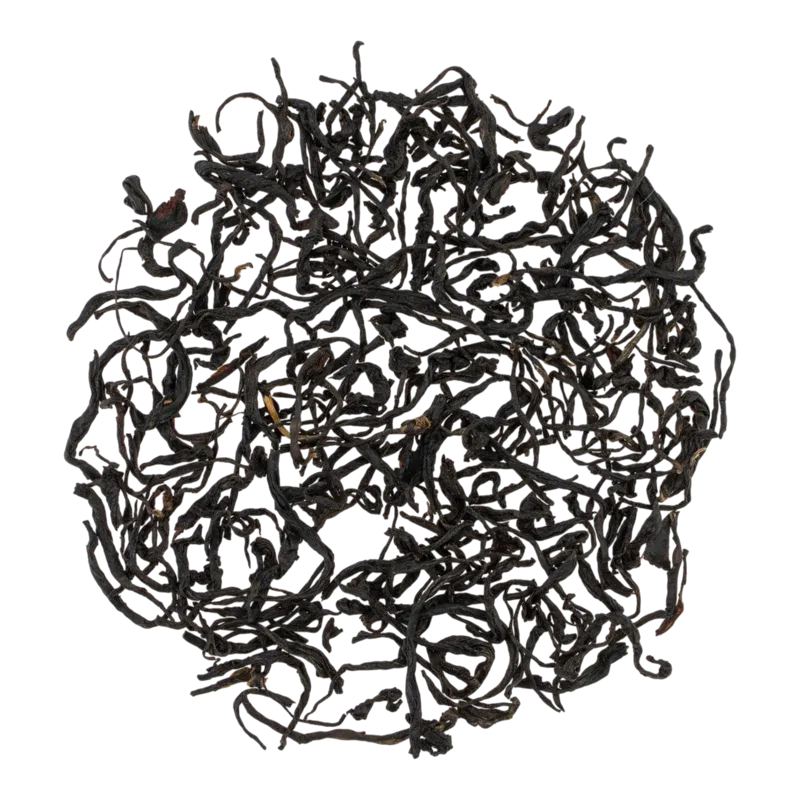
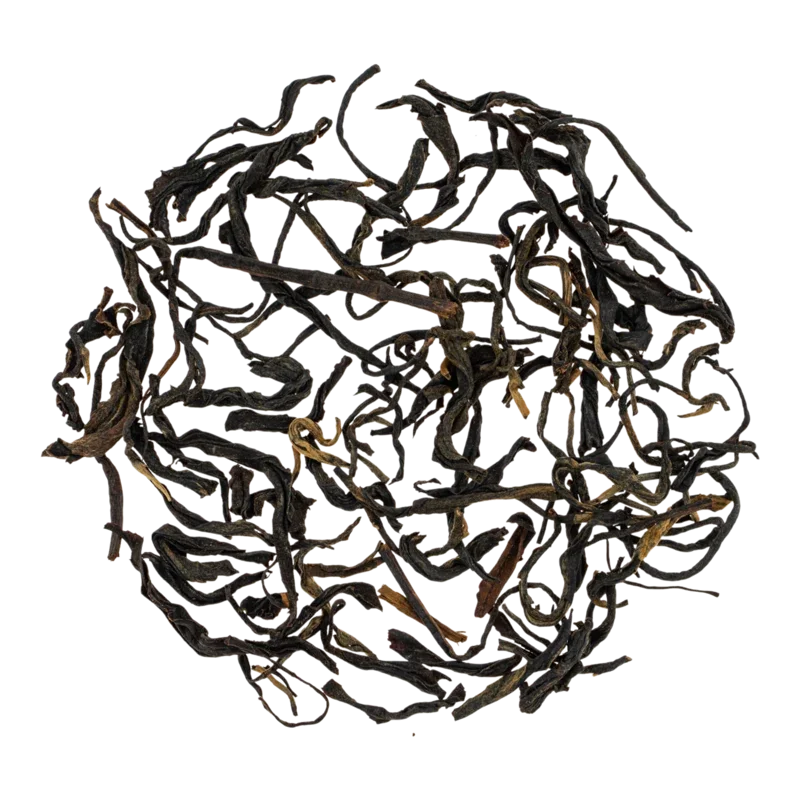
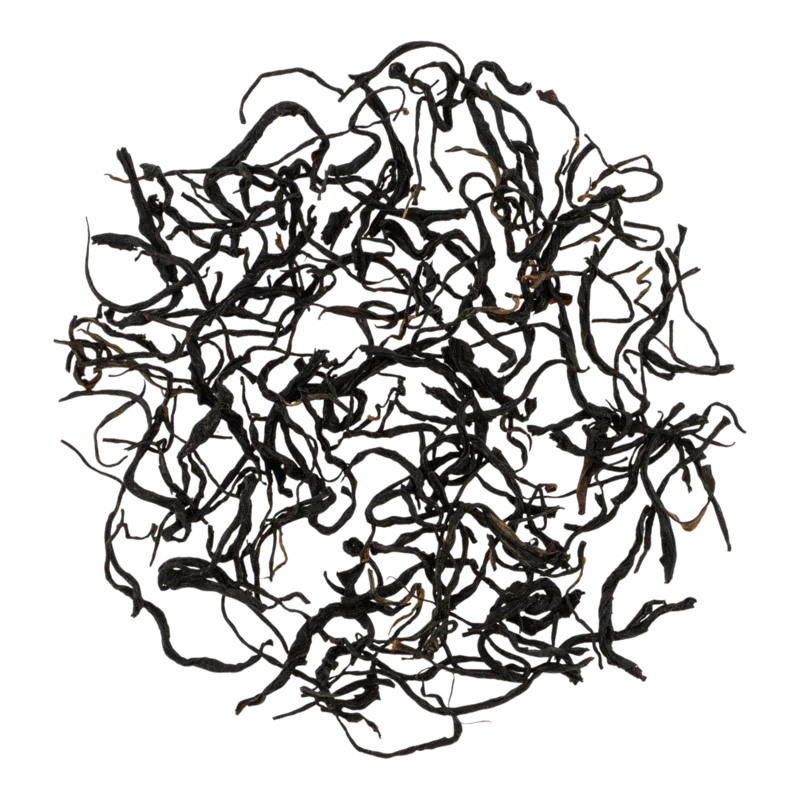
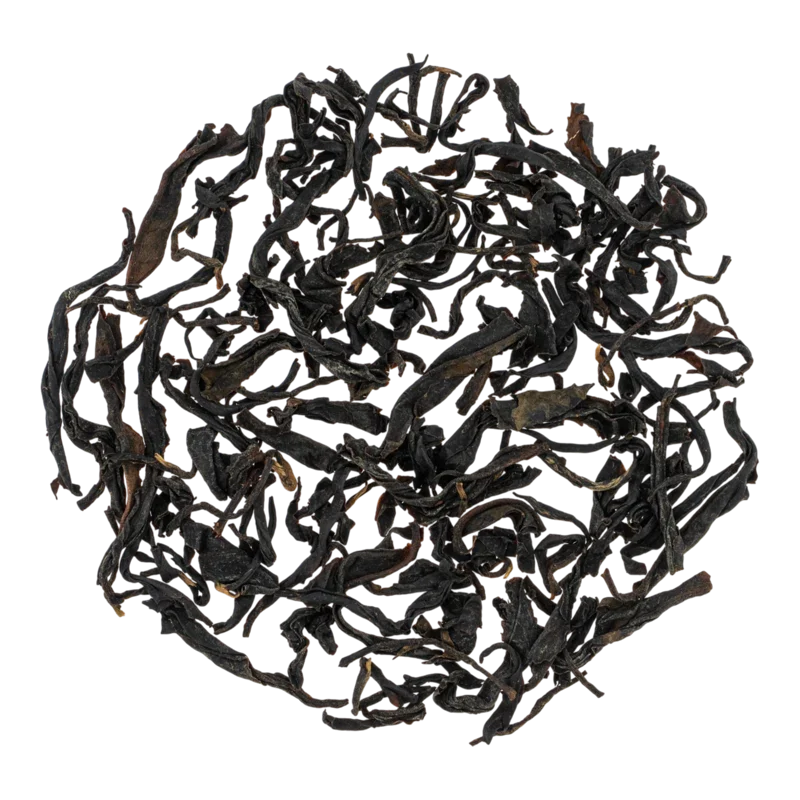
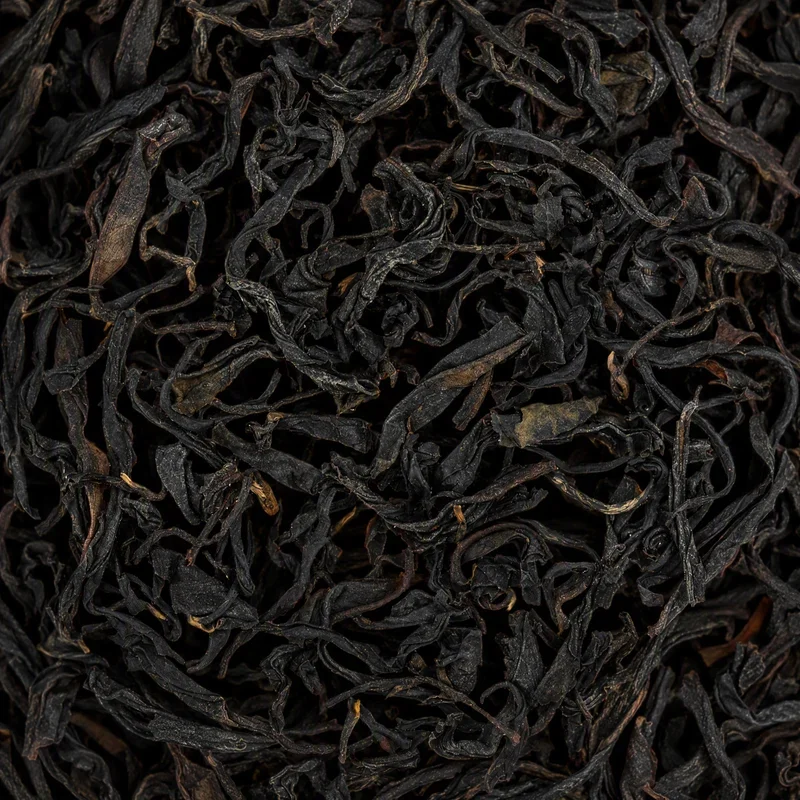
Dry Leaf Appearance: Thin, tightly twisted stringy tea particles (条索紧细, tiáosuǒ jǐn xì), dark brown or black-chestnut color with abundant golden tips (金毫, jīn háo). Leaf is even, well-sorted, without foreign inclusions.
Dry Leaf Aroma: Sweet, warm, with pronounced notes of dried fruits (apricot, raisins), honey and light floral undertone, characteristic of small-leaf high-aromatic cultivars.
Liquor Aroma: Multi-layered: in top notes — honey and ripe southern fruits (lychee, longan); in middle notes — bread-caramel shades; in base — light woody warmth. Aroma is persistent, unfolds with each subsequent infusion.
Liquor Color: Red-amber, bright and clear (红琥珀色, hóng hǔpò sè), with pronounced golden "ring" around the edge of the cup.
Spent Leaves: Leaf unfolds evenly and elastically; color — from copper-brown to reddish-chestnut. Veins are flexible, leaf is whole, without tears.
Taste: Dense, rounded, with pronounced natural sweetness (回甘, huígān). Astringency is moderate and soft, quickly transitioning to long warming aftertaste. In the best batches, "silkiness" of texture (柔滑, róu huá) and clean, transparent flavor profile without roughness is felt.
Alkaloids: Caffeine (咖啡碱, kāfēi jiǎn) — 4.1% in dry raw material, corresponding to medium and slightly elevated level for red teas (black teas). Theobromine and theophylline are also present in trace amounts.
Amino Acids: Free amino acid content in raw material — 3.3%, including L-theanine (L-茶氨酸, L-chá ānjīsuān), which provides gentle sweetness and relaxing effect without sedation.
Total catechin content in fresh leaf — 132.2 mg/g; after full oxidation, a significant portion transforms into oxidized derivatives.
38.99% — an indicator testifying to high flavor saturation and good "brewability."
Complex of terpenes (linalool, geraniol, β-ionone) and Maillard reaction products, forming the honey-fruity-caramel aromatic profile. Small-leaf cultivar with elevated carotenoid content gives a particularly rich palette of terpenoid aromas.
B-group vitamins, ascorbic acid (partially preserved), potassium, magnesium, manganese, zinc.
Polyphenols: The original He Luo Cha raw material is distinguished by high polyphenol content — 38.3% (according to laboratory measurements of unfermented leaf). In the red tea (black tea) version, a significant portion of catechins is transformed into theaflavins (TF) and thearubigins (TR), forming the bright liquor color and "body" of taste. Approximate total polyphenol content in finished red tea (black tea) — 15–22%.
The combination of caffeine and L-theanine provides gentle, sustained alertness without sharp peaks and drops characteristic of coffee. Concentration improves while maintaining calmness.
Theaflavins and thearubigins possess pronounced antioxidant activity, helping neutralize free radicals and reducing oxidative stress.
Warm red teas (black teas) are traditionally recommended after meals for comfortable digestion. Tannins stimulate gastric juice secretion to a moderate degree.
Regular moderate consumption of red tea (black tea) may contribute to maintaining vascular elasticity and normalizing blood pressure.
Fully oxidized tea possesses a "warm" nature according to traditional Chinese dietology and is well-suited for cold seasons.
Fluoride compounds and polyphenols help suppress growth of cariogenic bacteria and maintain oral health.
Polyphenolic compounds exhibit moderate antimicrobial activity.
Tea Amount: 4–6 g per 100–120 ml of water.
Teaware: Gàiwǎn (盖碗, gàiwǎn) made of porcelain — optimal choice for revealing aromatic potential. Porcelain teapot or Yíxīng teapot (宜兴紫砂壶, Yíxīng zǐshā hú) is acceptable for a more rounded, enveloping profile.
Water Temperature: 90–95 °C (not boiling water, to avoid "burning" the delicate small-leaf tea and extracting excessive astringency).
Container: Airtight opaque packaging — metal tin with tight lid, vacuum foil bag or ceramic container with fitted stopper.
Dry (humidity below 60%), dark place, away from sources of strong odors and direct sunlight. Optimal temperature 15–25 °C.
Red teas (black teas) are best consumed within the first 6–18 months, while aroma brightness is preserved. Quality, well-dried batches may gently "round out" over 2–3 years with proper storage, acquiring a deeper, aged profile.
Moisture, light, foreign odors, temperature fluctuations — the main enemies of red tea (black tea).
Another famous red tea (black tea) of Guangdong, produced predominantly from large-leaf Yunnan cultivars. Yingde Hong Cha is distinguished by more powerful, full-bodied taste with pronounced chocolate-malty palette and less pronounced floral aromaticity. Xinyi He Luo Hong Cha, conversely, is built on the delicacy of small-leaf raw material: it is lighter, more aromatic, with higher fruity-floral note.
Flavored red tea (black tea) of Guangdong with lychee aroma. Xinyi He Luo Hong Cha is not flavored: fruity notes (including lychee and longan shades) are formed naturally due to cultivar and terroir characteristics.
One of the world standards of red tea (black tea), produced from medium-leaf Zhūyè cultivar (槠叶种) in Anhui. Possesses the famous "Qimen aroma" (祁门香) — complex floral-honey range with rose notes. Xinyi He Luo Hong Cha is closer to tropical palette (lychee, longan, honey of southern honey plants) and somewhat "warmer" in overall impression.
Rare red tea (black tea) from Zhejiang, made from "Longjing" raw material. Distinguished by fine, almost silky texture and gentle acidity. Xinyi He Luo Hong Cha is denser and more "oily" in taste, with longer warming aftertaste.
Price Category: He Luo Hong Cha is a niche regional product with limited production volume. Price depends on harvest standard (tippy batches are more expensive), season (spring more expensive than summer), reputation of specific farm. On the domestic Guangdong market, cost varies from medium to high for regional hongcha.
No reviews yet. Tell us what you think of this tea.
Rate this tea and share your impressions. We review each submission before publishing it.