Brewing
Gongfu brewing
- Water temperature
- 93 °C
- Tea amount
- 5 g
- Water volume
- 100 ml
- First steep
- 10 s
- Time added per infusion
- 5 s
- Infusions
- 4

Yīngdé hóngchá
Choose a brewing method. Start with the recommended quantities and time, then adjust to taste.
Brewing
Brewing
Taste
Tea encyclopedia
Category: Famous red teas of China (中国名茶, Zhōngguó míngchá). National geographical indication product (国家地理标志产品, guójiā dìlǐ biāozhì chǎnpǐn). Since 2019 — "World High-Aroma Red Tea" (世界高香红茶, Shìjiè Gāoxiāng Hóngchá) by decision of the International Tea Committee.
Category: Famous red teas of China (中国名茶, Zhōngguó míngchá). National geographical indication product (国家地理标志产品, guójiā dìlǐ biāozhì chǎnpǐn). Since 2019 — "World High-Aroma Red Tea" (世界高香红茶, Shìjiè Gāoxiāng Hóngchá) by decision of the International Tea Committee.
Coordinates: Yingde — approximately 24°10′ N, 113°24′ E. The region is located in the northern part of Guangdong Province, in the middle reaches of the Běijiāng River (北江, Běijiāng).
Origin: China, Guǎngdōng Province (广东省, Guǎngdōng Shěng), Qīngyuǎn Prefecture (清远市, Qīngyuǎn Shì), Yingde County-level City (英德市, Yīngdé Shì). Yingde is the primary and benchmark production area. Tea gardens are also located in adjacent areas of northern Guangdong.
Type: Red tea (black tea) (红茶, hóngchá), fully oxidized (oxidation degree ~85–95%). According to European classification — black tea.
Yingde Hongcha is one of the "youngest" great red teas of China. From creation (1959) to international recognition took only 4–5 years — unprecedented speed for tea industry.
Yinghong No. 9 is a rare case when a single tea cultivar became the driver of an entire regional economic rise. Today, Yinghong No. 9 accounts for more than 90% of all tea plantings in Yingde.
Formula "浓强鲜爽" (nóng qiáng xiān shuǎng — "concentrated, powerful, fresh, clean") became official descriptor of Yinghong No. 9 and is used in marketing and tasting protocols.
Journey of Yinghong No. 9 from single plant selection in 1961 to mass distribution in 2010s — almost 50 years. This reminds how long and laborious the process of creating new tea cultivar is.
Thanks to high strength, intense color and taste stability, Yingde Hongcha is traditionally considered one of the best Chinese red teas for brewing with milk — in this it's closer to Ceylon and Assam teas than to most Chinese reds.
In 2016, 50 g of Yinghong No. 9 cultivar seeds went to orbit with space station "Tiangong-2" (天宫二号) and returned to Earth after 33 days aboard "Shenzhou-11" — longest space experiment with tea seeds in history.
In April 2023, Yingde Hongcha was served at "tea meeting" (茶叙, cháxù) of PRC Chairman Xī Jinping and French President Macron in Sunyuan Garden (松园) in Guangzhou, becoming part of diplomatic tea ceremony protocol.
Cultural Significance: Yingde Hongcha is a source of regional pride and one of Guangdong's key brands. According to popular legend, this tea was among the favorites of the British royal family and was served at receptions alongside Qimen Hongcha. Today, Yingde Hongcha is a key instrument for developing the rural economy of northern Guangdong, around which an entire industry of tea tourism, scientific research, and branding has been built. Yingde County-level City bears the honorary title "Hometown of China's Red Tea" (中国红茶之乡, Zhōngguó hóngchá zhī xiāng).
History: The tea history of Yingde reaches back to ancient times. Already in the "Classic of Tea" (《茶经》, Chájīng) by Lù Yǔ (陆羽, Lù Yǔ), written in 764 CE, Sháozhōu (韶州, Sháozhōu) — the historical region to which Yingde belonged — is mentioned as one of the tea districts of "Lingnan" (岭南, Lǐngnán, "south of the mountain ranges"). During the Ming and Qing dynasties, local tea was presented to the court as tribute tea (贡茶, gòngchá). However, until the mid-20th century, Yingde primarily produced green tea from local small-leaf varieties.
Yinghong No. 1 (英红1号), Yinghong No. 3 (英红3号), Yinghong No. 5 (英红5号), local Shuǐ Xiàn (水仙, Shuǐ Xiān, with characteristic floral aroma), as well as introduced Yúnnán Dǎ Yè Zhǒng and Fènghuáng Shuǐxiān (凤凰水仙, Fènghuáng Shuǐ Xiān). However, Yinghong No. 9 accounts for more than 90% of plantings.
Cultivar: Several cultivars are used for producing Yingde Hongcha, but the absolute dominant is:
Picking: From March to November (long vegetation period — advantage of subtropical Guangdong). Spring harvest (March–April) — most valuable. Summer and autumn — less expensive, but constitute the main volume.
Pluck Standard: For highest grades — one bud and one-two young leaves (一芽一叶 / 一芽二叶). For standard grades — up to one bud and three-four leaves.
Raw Material: Shoots must be elastic, fresh, with abundant down on buds. Yinghong No. 9 is distinguished by large, thick buds with characteristic golden down.
Altitude: 50–500 m above sea level, individual high-mountain gardens — up to 800 m. Significantly lower than Yunnan Dianhongs, which is compensated by favorable subtropical climate.
Climate: Subtropical monsoon, transitional between southern and central subtypes. Average annual temperature 20–22°C. Annual precipitation 1800–2200 mm — one of the highest among major tea regions of China. Frost-free period — more than 300 days. High humidity (78–82%), abundant diffused light, sufficient sunshine hours (1600–1800 h/year). Mild winters and long vegetation period allow harvesting raw material from March to November, ensuring high plantation productivity.
Soil: Red soils (红壤) and lateritic yellow soils (黄壤) with deep fertile layer, acidic reaction (pH 4.5–5.5), rich in organic matter, potassium and phosphorus. Karst soils are additionally enriched with minerals.
Hand or mechanized harvesting of young shoots.
Freshly picked raw material is spread on trays in ventilated rooms or processed in special trough installations (槽萎凋, cáo wěidiāo) with forced warm air supply. Duration — 10–16 hours. Target moisture — 60–65%. Yinghong No. 9 with its thick, fleshy shoots requires careful control of withering uniformity.
Conducted on rollers in several cycles with increasing pressure. Goal — destroy cell walls, ensure juice release to leaf surface and initiate intensive oxidation. For Yingde Hongcha, rolling is repeated 2–3 times with intermediate cooling pauses, forming tight, firm twist.
Rolled raw material is spread in a room with controlled temperature (25–30°C) and high humidity (over 90%). Oxidation lasts 3–5 hours. Thanks to high polyphenol content in Yinghong No. 9 (up to 34%), oxidation proceeds actively, forming rich liquor color and bright aroma. Key oxidation products — theaflavins and thearubigins.
Two-stage: primary at 110–120°C for immediate oxidation stoppage; final at 85–95°C to residual moisture of 5–6%.
Finished tea undergoes stages of sifting (筛分, shāifēn), selection (精选, jīngxuǎn), grading (分级, fēnjí) and batch blending (拼合, pīnhé) before packaging.
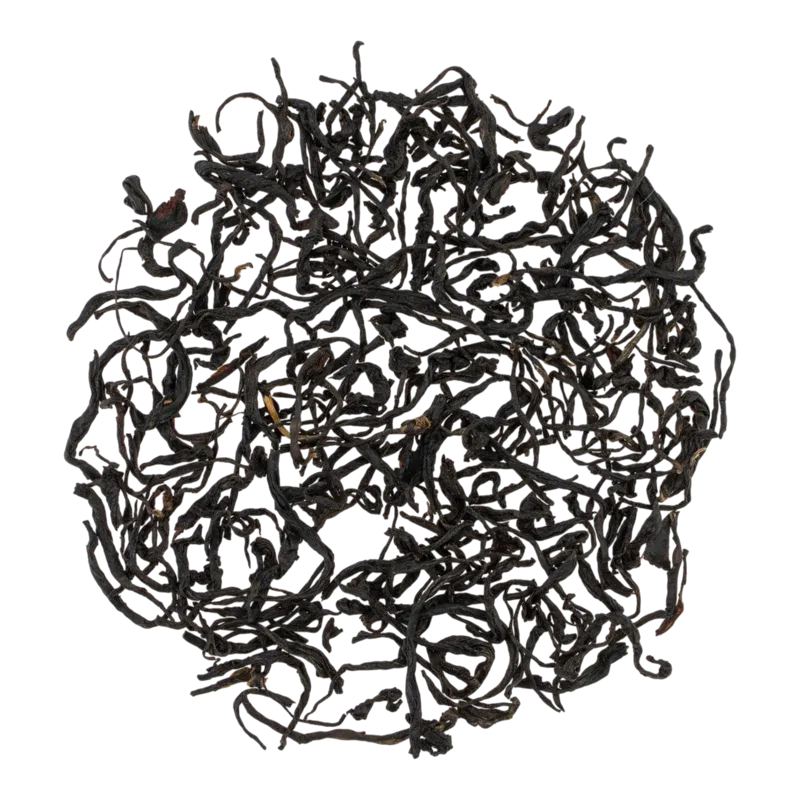
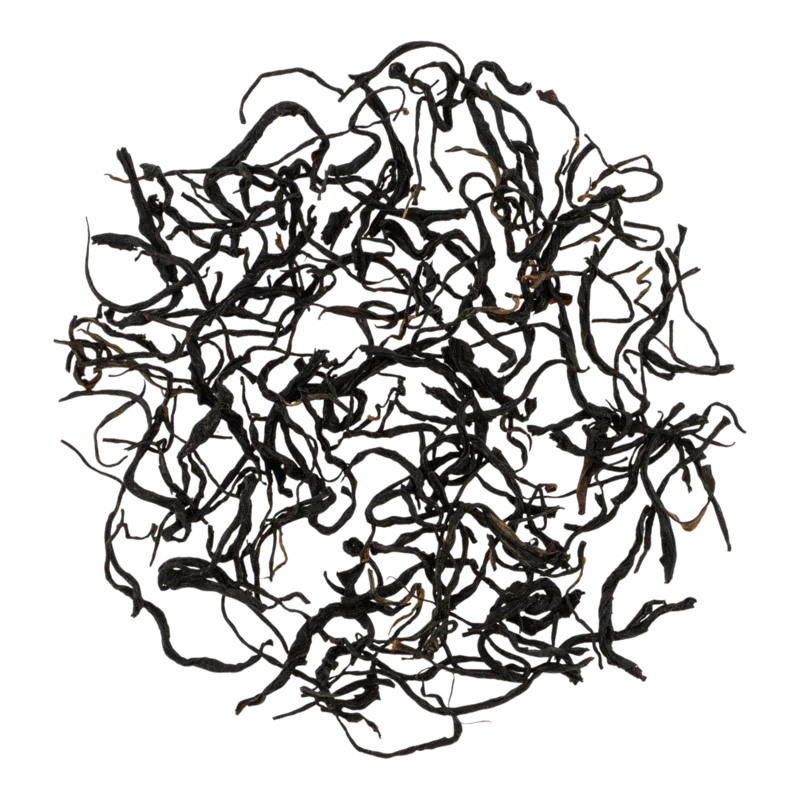
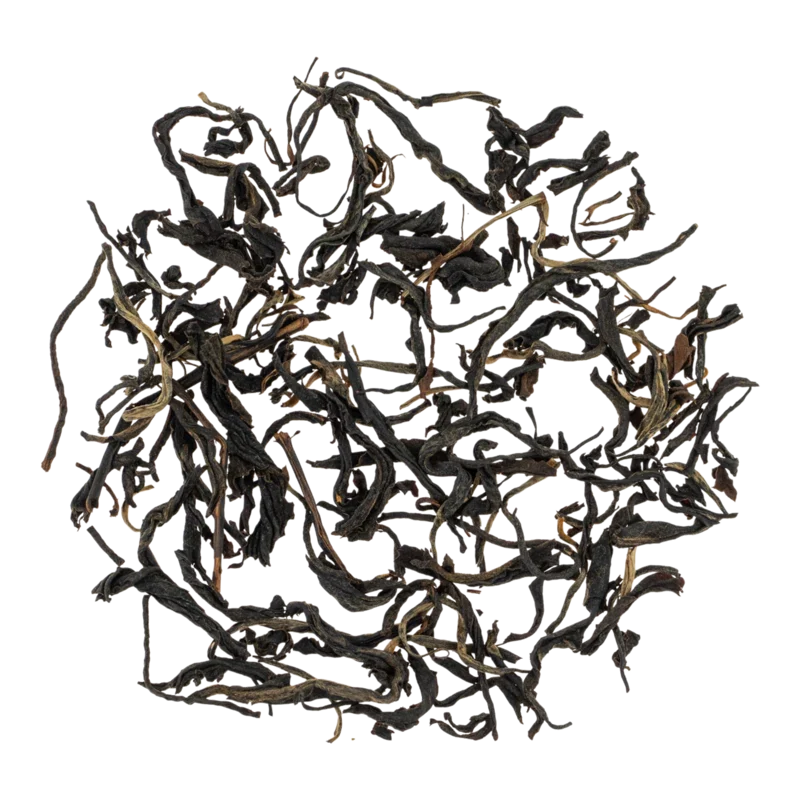
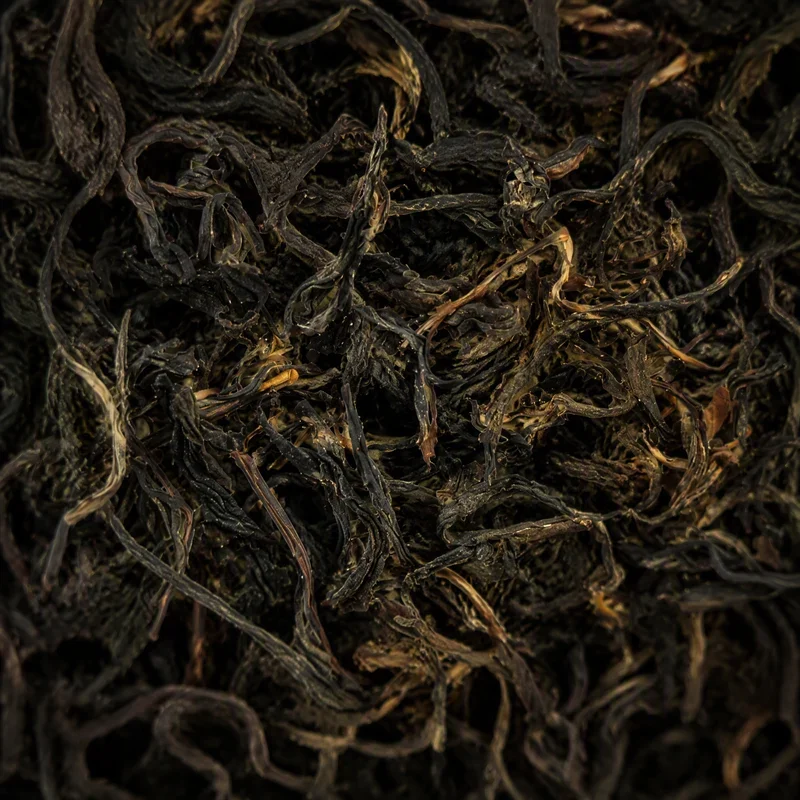
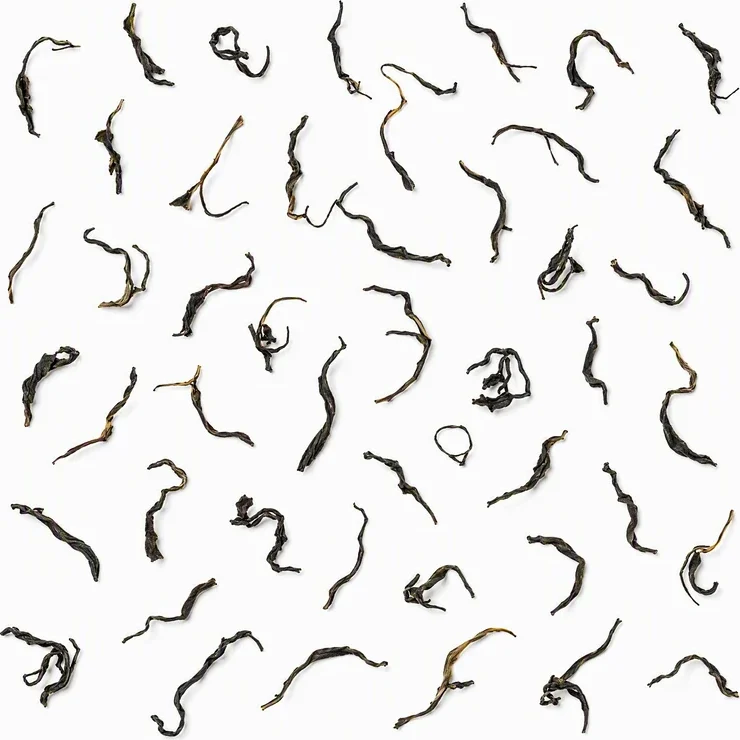
Dry Leaf Appearance: Tightly twisted tea particles in "eyebrow" shape (眉形, méi xíng) or slightly curved strips, uniform in size. Color — black with oily luster (乌润, wū rùn), with abundant golden tips. Buds large, noticeable, covered with dense golden down — characteristic feature of Yinghong No. 9.
Dry Leaf Aroma: High, bright, sweet. Floral-honey range dominates with distinct notes of sweet potato (番薯香, fānshǔ xiāng — "sweet potato aroma"), rose, lychee, caramel. Sweet potato aroma is considered the signature marker of Yinghong No. 9 and distinguishes it from most other Chinese red teas.
Liquor Aroma: Intense, high, persistent. Sweet floral-fruity dominance: honey, rose, lychee, sweet potato. As the liquor cools, notes of baked bread, nutmeg and light spice unfold.
Liquor Color: Red, bright, rich (红浓明亮, hóng nóng míng liàng) — from ruby to deep red-amber. Clear, with pronounced luster and golden ring (金圈, jīnquān). When cooling, high-quality batches may show "cold haze" (冷后浑, lěng hòu hún) — sign of high theaflavin content.
Spent Leaves: Buds and young leaves, even, elastic, red-copper color with good brightness (红亮, hóng liàng). Buds clearly distinguishable, large.
Taste: Concentrated, strong, fresh and sweet (浓强鲜爽, nóng qiáng xiān shuǎng — four-character formula established for Yinghong No. 9). Body full, dense, with "tea energy" (茶气, cháqì). Sweetness natural, deep, honey-fruity. Astringency present but harmoniously balanced with sweetness. Aftertaste (回甘, huígān) prolonged, clean, with sweet "potato" trail. Tea exceptionally resistant to brewing.
Alkaloids: Caffeine — 4.35% of fresh leaf dry mass (above average for red teas), determining pronounced tonic effect and strength. Theobromine and theophylline present in smaller quantities.
Amino Acids: 0.782–2.06% (varies between fresh leaf and finished tea). L-theanine — main component, responsible for sweetness and relaxing effect.
41.25% — indicator determining "richness" and liquor persistence.
152.13 mg/g in fresh leaf.
Among volatile components, linalool and its oxides dominate; terpene index (萜烯指数) reaches 0.938 — exceptionally high indicator, indicating genetic predisposition of the variety to form intense floral aroma.
Minerals: Potassium, magnesium, manganese, fluorine, zinc, iron, selenium. Karst soils of Yingde enrich tea with calcium and strontium.
Polyphenols: Content in fresh leaf — up to 34.17% (for comparison: Qimen — about 20–25%). This ensures intense color and strength of liquor. In finished tea, polyphenols are transformed into theaflavins — 1.514% (high indicator, determining brightness and "golden ring") and thearubigins — 11.159% (providing depth and fullness). Total tea polyphenol content in finished tea — about 11%.
Vitamins: C (partially), B₁, B₂, PP, E, K.
High caffeine content (higher than many red teas) combined with L-theanine provides powerful but "clean" alertness without tremor and rapid heartbeat.
Red tea of "warm" nature warms the body, stimulates circulation and is especially beneficial on cool days.
Studies showed that Yinghong No. 9 has significantly higher antioxidant activity compared to several other red teas, explained by high theaflavin and thearubigin content.
Theaflavins — "soft gold of tea" (茶中软黄金, chá zhōng ruǎn huángjīn) — suppress cholesterol synthesis and reduce LDL levels. Research results published in international medical journal JAMA.
Stimulates digestive enzyme secretion, improves peristalsis, helps digest heavy food.
Polyphenols suppress growth of pathogenic bacteria in oral cavity and gastrointestinal tract.
Studies showed that regular consumption of red tea with high polyphenol content may contribute to weight reduction and lipid profile improvement.
L-theanine promotes serotonin and dopamine production, improving mood and cognitive functions.
Highest grade, exclusively from buds. Abundant golden down. Most delicate and aromatic, with maximum floral sweetness.
Predominantly from buds with minimum young leaf. Balance of delicacy and strength.
Standard grade, bud and one-two leaves. Main commercial product. Bright aroma, full strength.
CTC granules for export. Historically constituted main production volume in 1960s–1980s. Very strong, ideal for milk tea.
From raw material of old plantations from 1950s–1960s. Deeper, "mature" profile.
Tea Amount: 5 g per 150 ml (gongfu method); 3 g per 200 ml (European teapot or cup).
Teaware: Porcelain gàiwǎn (盖碗, gàiwǎn) — recommended option, allowing control of extraction time and evaluation of aroma from lid. Also suitable: porcelain teapot, glass teapot for visual enjoyment. To soften powerful taste, Yíxīng purple clay teapot (紫砂壶, zǐshā hú) can be used.
Water Temperature: 90–95°C. Yinghong No. 9 with its powerful structure tolerates hot water well.
Container: Airtight opaque container: tin, ceramic, porcelain jar with tight lid. When purchased in factory vacuum packaging — store unopened.
Enemies: Moisture (especially relevant for humid climate of Southern China), direct light, strong odors, high temperature.
Shelf Life: 24–36 months under proper conditions. Some connoisseurs note that well-stored Yingde Hongcha after 1–2 years acquires additional roundness and softness, though special aging for red tea is not practiced.
Dry, cool (15–25°C), dark place, away from foreign odors. Humidity not exceeding 60%.
Famous red tea from Anhui Province. Made from small-leaf variety (褚叶种, zhǔyèzhǒng). Aroma — "rose-honey," with characteristic "Qimen note" (祁门香, Qímén xiāng). Taste more delicate, "silky," with floral-fruity accents. Less strong than Yingde Hongcha. Historical fame significantly older.
Yunnan red teas, also from large-leaf raw material. Close to Yingde Hongcha in strength and density, but differ in aromatic profile: malty, chocolate, spicy notes predominate (unlike floral-sweet potato in Yinghong No. 9). Dianhong liquor generally more amber, less ruby.
Lapsang Souchong from Fujian — small-leaf, with unique smoky aroma (in traditional version) or pronounced floral-fruity range (in modern "unsmoked" versions). Taste lighter and "drier" than Yingde. Completely different stylistic profile.
Zhejiang red tea with subtle, delicate, floral character. Much lighter and more delicate than Yingde Hongcha. Different taste scale — chamber vs. orchestral.
Look for producers with confirmed geographical indication "Yingde Hongcha."
Authentic Yinghong No. 9 has characteristic baked sweet potato aroma — this feature is difficult to imitate. Absence of this note with claimed Yinghong No. 9 variety — reason for doubt.
Real Yinghong No. 9 withstands 8–10 infusions. Tea "giving up" by 3rd–4th infusion likely made from lower quality raw material.
Ruby-red, bright, clear, with golden ring. Dull, cloudy liquor — sign of technology or storage violations.
Market encounters substitution of Yinghong No. 9 with Yunnan Dianhong (both from large-leaf raw material and externally similar). Can be distinguished by aroma: Dianhong — malty-honey; Yinghong No. 9 — floral-sweet potato.
No reviews yet. Tell us what you think of this tea.
Rate this tea and share your impressions. We review each submission before publishing it.