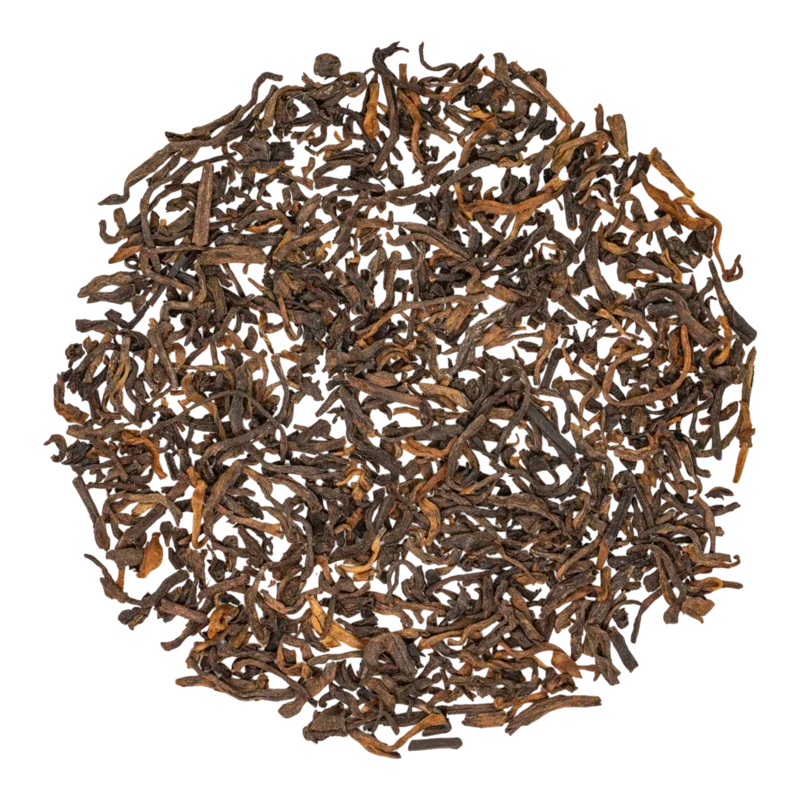
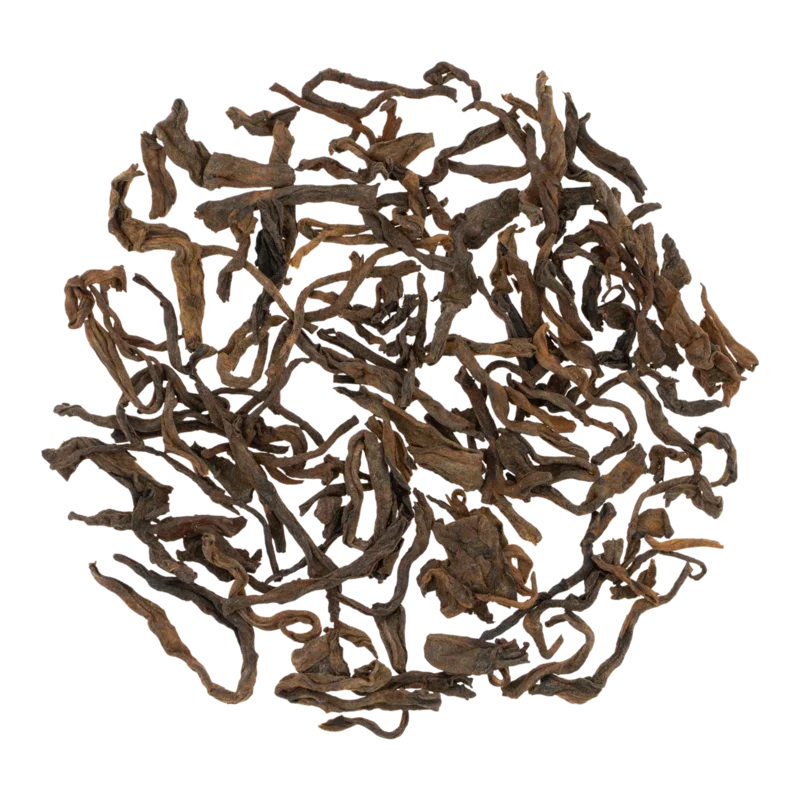
Brewing
Gongfu brewing
- Water temperature
- 98 °C
- Tea amount
- 7 g
- Water volume
- 100 ml
- First steep
- 10 s
- Time added per infusion
- 5 s
- Infusions
- 12

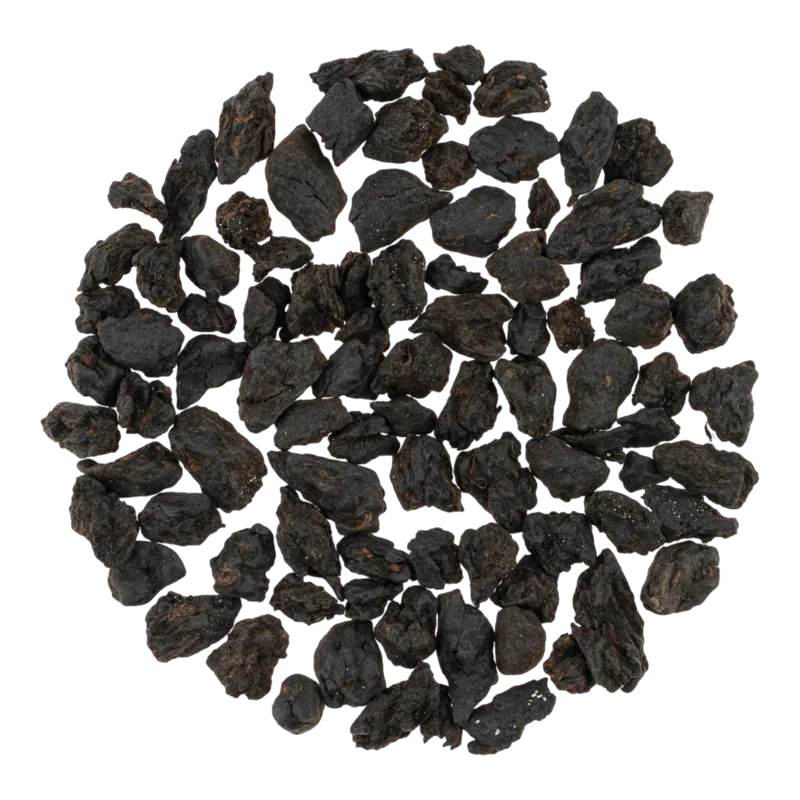
suì yín zi
Choose a brewing method. Start with the recommended quantities and time, then adjust to taste.
Brewing
Brewing
Taste
Tea encyclopedia
Category: Modern artisanal product based on shu pu-erh. It is a highly processed variety of Lao Cha Tou — a byproduct of fermentation, refined to the state of a commercially attractive independent tea. Also known under the names Chá Huā Shì (茶化石, Chá Huàshí) — "tea stone" or "tea fossil," as well as Jīn Bù Huàn (金不换, Jīn Bù Huàn) — "not to be exchanged even for gold."
Category: Modern artisanal product based on shu pu-erh. It is a highly processed variety of Lao Cha Tou — a byproduct of fermentation, refined to the state of a commercially attractive independent tea. Also known under the names Chá Huā Shì (茶化石, Chá Huàshí) — "tea stone" or "tea fossil," as well as Jīn Bù Huàn (金不换, Jīn Bù Huàn) — "not to be exchanged even for gold."
Coordinates: Approximately 21°–22° North latitude, 100°–101° East longitude (Menghai area).
Origin: China, Yúnnán Province (云南, Yúnnán). Main production centers are concentrated in Xīshuāngbǎnnà Dǎi Autonomous Prefecture (西双版纳, Xīshuāngbǎnnà), primarily in Měnghǎi County (勐海, Měnghǎi), as well as in Pu'er City (普洱, Pǔ'ěr).
Type: Post-fermented tea (dark tea, 黑茶). Belongs to the category of shu pu-erh (熟普洱, Shú Pǔ'ěr) — "ripe," "mature" pu-erh that has undergone accelerated fermentation through wet piling (渥堆, wò duī). Degree of fermentation — complete (post-fermentation).
According to producer data, from 10 tons of fermenting shu pu-erh, only 100–200 kg of tea mass can be considered Lao Cha Tou of sufficient quality, and from them only a small part is selected for Sui Yin Zi production. Thus, with honest production, the yield of final product amounts to about 1–2% of the source raw material volume. However, critics point out that modern industrial scales of Sui Yin Zi production can hardly be ensured exclusively by natural Lao Cha Tou.
One of the unique features of Sui Yin Zi — its granules practically do not break down during brewing and even during prolonged boiling. This property gave rise to the second name — "tea stone" (茶化石). This is uncharacteristic for classic Lao Cha Tou — that gradually opens during brewing.
Semnostachya menglaensis — endemic of Xishuangbanna tropical forests, growing in understory. Plant height 30–100 cm, with small leaves that acquire characteristic glutinous rice aroma when dried. In the tradition of Dǎi (傣族, Dǎizú) and Hāní (哈尼族, Hānízú) peoples from Yunnan, this plant has long been used as a beverage flavoring and has phytotherapeutic application (清热解毒, qīngrè jiědú — "cooling heat and removing toxins").
Sui Yin Zi is one of the brightest examples in Chinese tea history, when marketing renaming (from unremarkable "tea stone" to romantic "scattered silver") radically changed the market fate of a product, transforming it from a niche curiosity into a mass bestseller.
The discussion around Sui Yin Zi reflects a broader problem of the modern tea market — conflict between artisanal tradition, assuming transparency and traceability, and industrial approach oriented toward standardization, scaling and marketing.
Cultural Significance: Sui Yin Zi became one of the most commercially successful tea products of the 2010–2020s in China, significantly expanding the audience of shu pu-erh consumers. Thanks to its simplicity of brewing, attractive appearance and unusual nuoxiang (糯香), it lowered the entry barrier for newcomers to the world of pu-erh. At the same time, Sui Yin Zi became a symbol of discussion about the boundary between innovation and marketing manipulation in the tea industry. In the professional tea community, attitudes toward it are ambiguous: connoisseurs of classic pu-erh often view it as a deeply processed product that has lost connection with terroir and the mastery of tea craftsmanship.
History: Sui Yin Zi is a product of the 21st century, inextricably linked to the history of Lao Cha Tou and the wet piling technology of shu pu-erh. The wò duī (渥堆) technology was developed and implemented in 1973–1975 at the Kūnmíng Tea Factory (昆明茶厂, Kūnmíng Cháchǎng). During the piling process, part of the tea leaves stick together into dense clumps under the influence of released pectin, forming Lǎo Chá Tóu (老茶头) — "old tea heads." For a long time, these clumps were considered production defects and waste — they were discarded or sold at throwaway prices. However, over time, tea makers and enthusiasts appreciated the rich taste and sweetness of these "tea heads."
Cultivar: Main raw material — leaves of the large-leaf Yunnan variety Yúnnán Dǎ Yè Zhǒng (云南大叶种, Yúnnán Dàyèzhǒng), including its local varieties: Měngkù Dà Yè Zhǒng (勐库大叶种) and Měnghǎi Dà Yè Zhǒng (勐海大叶种). This is typical Camellia sinensis var. assamica — a large-leaf form of tea tree with high content of polyphenols and pectic substances. Premium segment producers claim to use raw material from trees over 100 years old (古树, gǔ shù), however independent verification of tree age for the final product is difficult.
Picking: Spring, summer, autumn. For production of highest quality Sui Yin Zi, spring raw material (春茶, chūnchá) with higher content of amino acids and pectin is preferable.
Pluck Standard: Usually one bud with two to four leaves (一芽二叶至一芽四叶). For premium lines, a standard of "one bud — one leaf" (一芽一叶初展, yī yá yī yè chū zhǎn) is claimed, however after going through the full cycle of fermentation, cutting and polishing, determining the original picking standard from the finished product is practically impossible.
Raw Material: Key requirement — high content of pectic substances in leaves, ensuring natural sticking during fermentation. Leaves from young, juicy shoots of large-leaf trees contain more sugars and pectin, which determines the quality of final Lao Cha Tou and, accordingly, Sui Yin Zi.
Altitude: 1000–1800 m above sea level for main tea regions of Menghai. The most valuable raw material comes from high-altitude areas: Bùlǎng Mountain (布朗山, Bùlǎng Shān, up to 1800 m), Lǎo Bān Zhāng area (老班章, Lǎo Bān Zhāng), Nánnuò area (南糯, Nán Nuò).
Climate: Xishuangbanna has a tropical monsoon climate: average annual temperature 14–21°C, annual precipitation over 1500 mm, relative humidity 80–88%, cloudiness and fog throughout a significant part of the year. Winters are mild, without frost, allowing tea trees to grow year-round.
Soil: Red-yellow lateritic soils (红黄壤, hónghuáng rǎng), acidic (pH 4.5–6.5), well-drained, rich in organic matter and minerals — iron, aluminum, magnesium. High mineral content in soil forms the characteristic mineral profile of Yunnan teas.
Yunnan Province is located in southwestern China, at the junction of Indochina and the Tibetan Plateau. This is the recognized cradle of the tea tree Camellia sinensis, where the world's most ancient tea trees grow.
Ancient tea gardens of Bulang Mountain and surroundings are located in conditions of rich tropical and subtropical forest with forest coverage up to 93%. Tea trees grow in symbiosis with other species — camphor trees, ficus, epiphytes, forming a complex microecosystem that influences the chemical composition of the leaf.
Manual or mechanized harvesting of tea leaf.
Collected raw material is spread in a thin layer under a canopy for partial moisture removal. Time — from several hours to a day.
Key stage for pu-erh raw material — drying under direct sunlight. The resulting product is called Shài Qīng Máo Chá (晒青毛茶, shài qīng máo chá) — "sun-dried rough tea."
Mechanical or manual rolling to break cell membranes and release juice, which activates future enzymatic processes.
Central stage of shu pu-erh production. Maocha is laid in large piles (from 1 to 10 and more tons), moistened with water and covered with cloth. Controlled microbial fermentation starts in the piles at high temperature (50–65°C) and humidity. The process lasts from 45 to 60 days, sometimes longer. The tea master regularly turns the piles (翻堆, fān duī) to control temperature, humidity and uniformity of fermentation. During piling, tea leaves actively release pectin — a viscous, sticky substance that glues individual leaves into dense clumps. It is from these clumps, which cannot be separated without damaging the leaf, that Lǎo Chá Tóu (老茶头) — "old tea heads" are formed. According to producer statistics, from 10 tons of fermenting shu pu-erh, only 100–200 kg of material suitable for further processing into Sui Yin Zi is obtained.
Tightly stuck clumps are extracted from the mass of fermented tea. The densest, most compact specimens with high pectin content are selected.
Selected tea heads are cut with special equipment into granules of approximately equal size (usually 0.5–1.5 cm). This gives the product its characteristic appearance of uniform "pieces of silver."
Cut granules undergo mechanical polishing, which gives them a smooth, shiny surface, enhances visual similarity to metallic nuggets and increases density.
A significant part of commercial Sui Yin Zi undergoes aromatization with leaves of the plant 糯米香 (Nuo Mi Xiang) — Semnostachya menglaensis H. P. Tsui (syn. Strobilanthes tonkinensis), an endemic herbaceous plant of the Acanthaceae family, growing in tropical forests of Xishuangbanna. Dried leaves of this plant when crushed release a characteristic aroma of glutinous (糯) rice, due to 2-propanoyl-3,4,5,6-tetrahydropyridine and 2-propanoyl-1,4,5,6-tetrahydropyridine. The aromatization method is analogous to the technique of aromatizing jasmine teas (窨制, xūn zhì): tea granules are mixed with crushed herb or subjected to contact aromatization. There is also a version without aromatization — "原味" (yuán wèi, "original taste").
Final drying to bring moisture to a safe storage level (usually ≤12%).
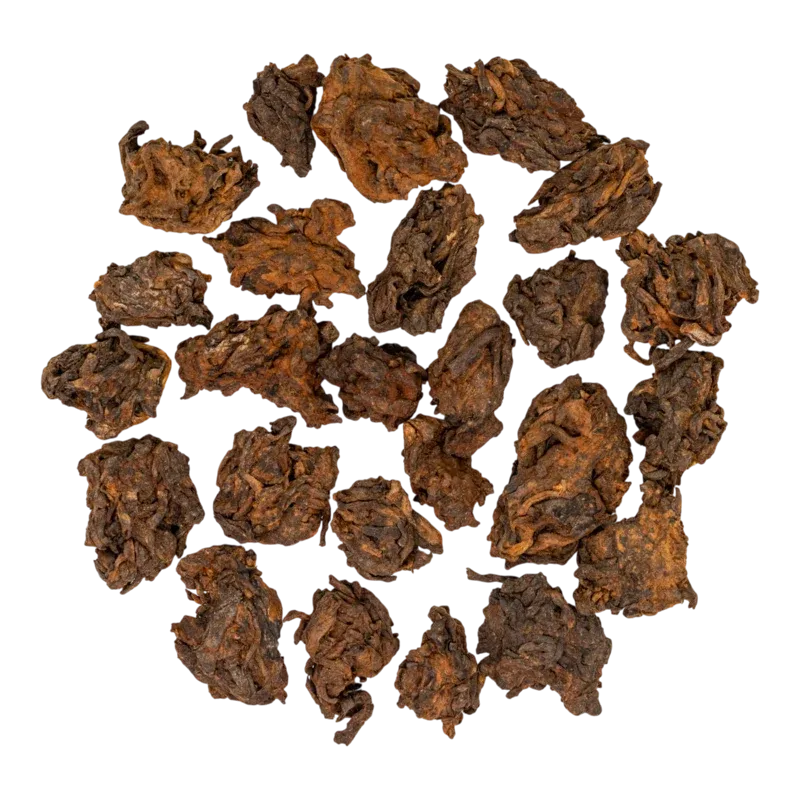
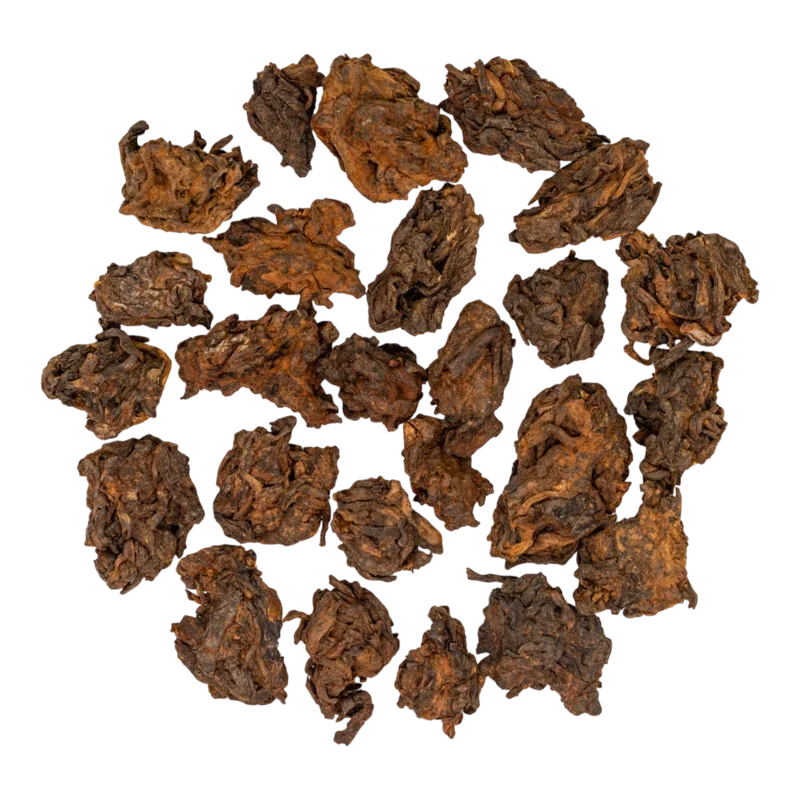
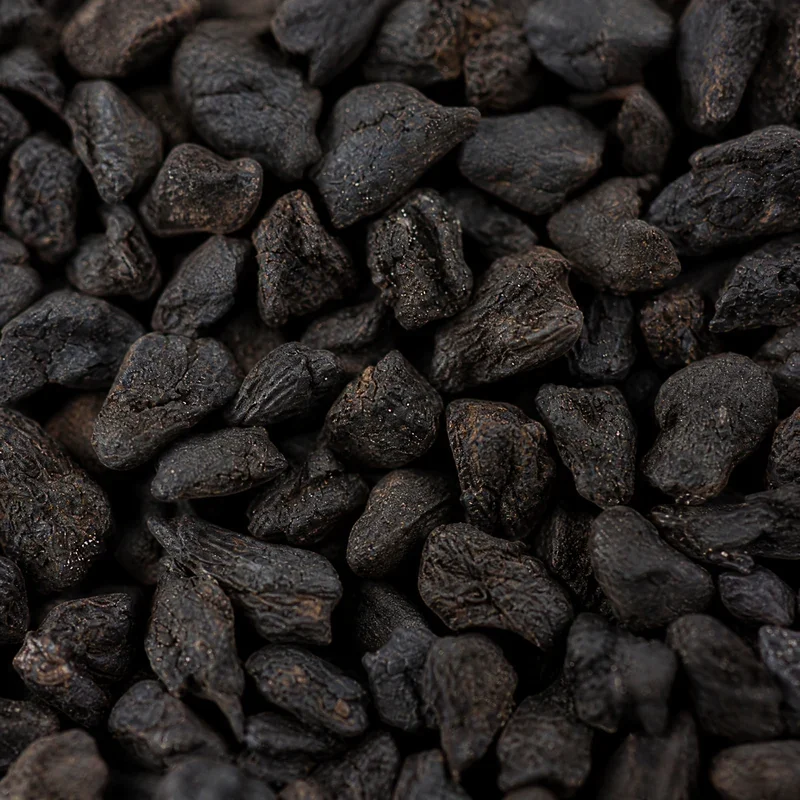
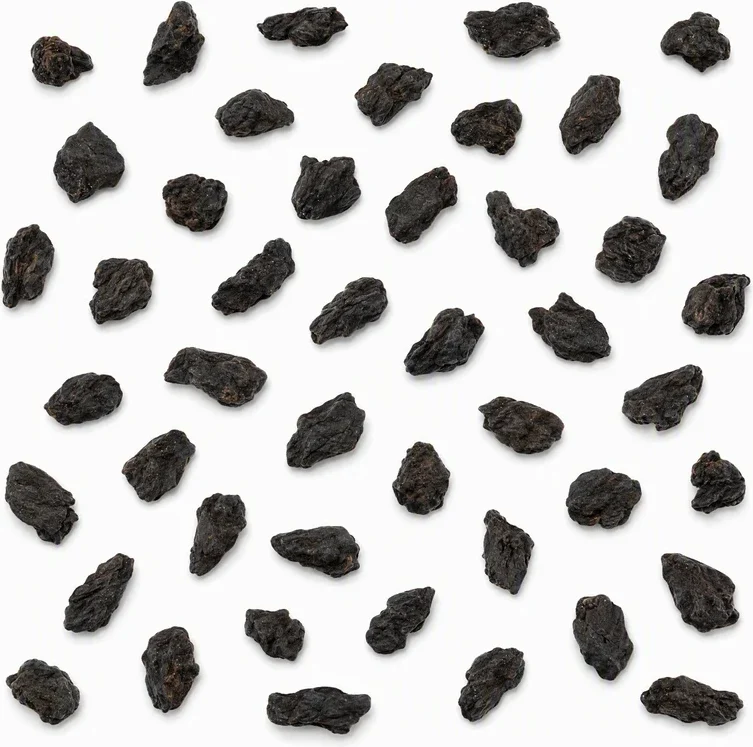
Dry Leaf Appearance: Granules of irregular or slightly rounded shape 0.5–1.5 cm in size, rarely larger. Color — dark brown to black, with oily shine on the surface due to polishing. Texture — very dense, hard, "stone-like." Granules are heavy to the touch, significantly denser than ordinary pressed pu-erh. Characteristic feature — uniformity of shape and size within one batch.
Dry Leaf Aroma: In aromatized versions — pronounced, enveloping aroma of glutinous rice (糯香), soft and sweetish. Underneath — warm notes of mature shu pu-erh: wood, prunes, dried fruits. In non-aromatized versions — clean aroma of mature fermentation: earth, warm wood, nuts, without nuoxiang (糯香).
Liquor Aroma: Dense, enveloping. In aromatized versions — sweet nuoxiang (糯香, glutinous rice aroma) in the foreground, gradually transitioning to deep notes of mature shu pu-erh: nutty, woody, occasionally chocolate and date (枣香, zǎo xiāng). In "original" versions — classic profile of mature shu pu-erh with notes of prunes, tree bark, nuts.
Liquor Color: Red-brown (红浓, hóng nóng), deep, clear, with warm amber-ruby tint. Resembles the color of dark amber or aged cognac. The liquor is transparent and clean even with multiple brewings.
Spent Leaves: Characteristic feature of Sui Yin Zi — granules maintain their shape even after 15–20 and more steeps. They do not break down into individual leaves, but only slightly soften and increase in volume. This sharply distinguishes Sui Yin Zi from ordinary Lao Cha Tou, which gradually opens up. Color of soaked granules — dark brown, brownish-red.
Taste: Dense, thick, oily (厚滑, hòu huá). Sweet (甜润, tián rùn), with pronounced stickiness and enveloping texture, due to high content of pectin and soluble sugars. Bitterness and astringency are practically absent (with quality raw material and correct fermentation). Aftertaste (回甘, huígān) — long, soft, sweetish, with residual notes of nuts and dried fruits. Taste profile is relatively simple and linear compared to classic aged pu-erh.
Alkaloids: Caffeine (content in shu pu-erh usually amounts to 20–30 mg per 150 ml cup — lower than in green tea or coffee), theobromine, theophylline.
Amino Acids: Contains L-theanine and other free amino acids, however in smaller quantities than in green or white teas, due to deep fermentation.
Pectin content in Sui Yin Zi is substantially higher than in ordinary loose shu pu-erh — it is pectin that ensures the formation of dense clumps during piling and the "oily" texture of the liquor. Pectin is a soluble dietary fiber that positively affects gastrointestinal function.
Shu pu-erhs contain mycobiotic metabolites, including lovastatin — a natural statin synthesized by fungi Aspergillus and Monascus participating in the wo dui process.
Mold fungi (Aspergillus niger, Aspergillus luchuensis, Rhizopus, Penicillium), yeasts (Saccharomyces, Candida) and bacteria actively participate in the piling process, whose metabolites form the specific taste-aromatic profile of mature shu pu-erh.
When using aromatization with Semnostachya menglaensis leaves, characteristic tetrahydropyridine alkaloids are introduced into the composition — 2-propanoyl-3,4,5,6-tetrahydropyridine and 2-propanoyl-1,4,5,6-tetrahydropyridine (up to 41% and 37% of the volatile fraction of leaf extract respectively), causing the glutinous rice aroma.
Minerals: Potassium, magnesium, manganese, iron, fluorine, zinc, selenium — typical mineral profile of Yunnan large-leaf teas growing on lateritic soils.
Polyphenols: Catechin content is significantly reduced as a result of deep fermentation, however the content of their oxidation products — theaflavins and thearubigins is increased, giving the liquor its characteristic red-brown color and soft, bitterness-free taste.
Vitamins: In small quantities — B vitamins, vitamin C (significantly destroyed during fermentation), vitamin E, vitamin K.
High pectin content forms a soft enveloping film on the gastric mucosa, promoting comfortable digestion. Shu pu-erh is traditionally drunk after abundant, fatty food.
Thearubigins and lovastatin contained in shu pu-erh contribute to normalization of cholesterol and triglyceride levels in blood. Numerous Chinese and international studies confirm the hypolipidemic action of shu pu-erh.
Despite reduced catechin content during fermentation, their oxidation products — theaflavins and thearubigins — retain pronounced antioxidant activity, neutralizing free radicals.
Caffeine content in shu pu-erh is moderate, so the tonic effect is milder than green tea or coffee, and combines with the relaxing action of L-theanine.
Shu pu-erh belongs to "warm" teas in traditional Chinese medicine terminology (中医, zhōngyī). Sui Yin Zi warms well in cold weather, improves peripheral circulation.
Metabolites of microorganisms that participated in fermentation have probiotic action, supporting healthy intestinal microflora.
A number of studies indicate the ability of polysaccharides and polyphenols of shu pu-erh to reduce postprandial glycemia.
Tea Amount: 5–7 g per 150–200 ml water (ratio approximately 1:30).
Teaware: Optimal — clay teapot from Yíxīng clay (紫砂壶, zǐshā hú), especially from porous Duǎn Ní (段泥) or Zǐ Ní (紫泥) clay, which retains heat well. Also suitable are gàiwǎn (盖碗, gàiwǎn) from porcelain or clay, as well as heat-resistant glass teapot for visual observation of the liquor. For boiling — cast iron or glass teapot.
Water Temperature: 95–100°C (Sui Yin Zi is a dense, deeply fermented tea requiring boiling water for full flavor and aroma development).
Container: Ceramic or clay containers with loose lid (for tea "breathing"), paper bags, bamboo containers. Food-grade tin cans are acceptable. Completely airtight packaging (plastic, vacuum) is categorically not recommended — tea needs minimal air exchange for continuation of microbiotic processes.
Enemies: Direct sunlight, moisture, foreign odors (spices, coffee, household chemicals).
Humidity: 50–70%. Too high humidity (>75%) may provoke unwanted mold; too low (<40%) — will slow natural aging.
Dry, dark, well-ventilated room without foreign odors. Avoid direct sunlight, sharp temperature changes.
With proper storage, Sui Yin Zi can be stored for years. Over time, nuoxiang (糯香) gradually weakens, giving way to deeper chenxiang (陈香, chén xiāng) — "aging aroma," woody and nutty. Taste becomes softer and sweeter.
Temperature: Optimally 20–30°C. Fluctuations of more than 10°C during the day are undesirable.
Classic loose shu from mature leaf — coarser, often more astringent, with pronounced "earthy" and woody notes. Costs significantly less. Sui Yin Zi differs from it fundamentally in different texture, higher sweetness and nuoxiang (糯香), but yields in depth and variability of taste profile.
"Palace pu-erh" is produced from small-leaf, bud raw material of highest grade and distinguished by delicate, refined taste with nutty, chocolate and creamy notes. Gong Ting is tea where quality is determined by raw material and fermentation mastery, while Sui Yin Zi is a product of additional mechanical and aromatic processing, in which the source raw material is largely "hidden."
Elite shu pu-erh from large golden buds. Has velvety, soft, chocolate-fruity taste, beautiful appearance. Common with Sui Yin Zi — positioning in premium segment, but Da Jin Ya is a straightforward production product (fermentation → sorting), without cutting and polishing stages.
Price Category: Natural nuoxiang (糯香) — soft, delicate, pleasant. Sharp, intrusive, "chemical" sweet smell that remains unchanged from first to last brewing — sign of synthetic flavoring. Natural nuomixiangye (糯米香叶) aroma gradually weakens by the 3rd–5th steep, giving way to tea base.
Give preference to specialized tea shops with stable reputation, capable of providing information about producer, year of release and raw material origin.
Quality Sui Yin Zi — uniform dark brown or black color with oily shine, without visible foreign inclusions, dust and mold. Granules are dense, heavy. Counterfeits often look dull, loose or, conversely, suspiciously "glossy."
Liquor of quality Sui Yin Zi — clear, red-brown, without cloudiness. Cloudy, dull liquor with foreign tastes (mustiness, sourness, "fishy" smell) indicates low quality or production violations.
Real Sui Yin Zi brews 15–20 and more times, maintaining taste and sweetness. Counterfeits "give up" after 8–10 steeps, noticeably losing richness.
If the price of Sui Yin Zi is comparable to the price of cheapest loose shu pu-erh — this is almost certainly a fake, produced from low-grade raw material with binding additives.
No reviews yet. Tell us what you think of this tea.
Rate this tea and share your impressions. We review each submission before publishing it.