Brewing
Gongfu brewing
- Water temperature
- 100 °C
- Tea amount
- 7 g
- Water volume
- 100 ml
- First steep
- 10 s
- Time added per infusion
- 5 s
- Infusions
- 12

gōngtíng pǔ'ěr
Choose a brewing method. Start with the recommended quantities and time, then adjust to taste.
Brewing
Brewing
Taste
Tea encyclopedia
Category: Highest grade (花色档次) of loose Shu Pu-erh according to standard T/MHC 003-2020. Standard GB/T 22111-2008 "Geographical Indication — Pu-erh Tea" defines general requirements for pu-erh; Menghai standard T/MHC 003-2020 details grading. Water extractives for shu pu-erh according to Menghai standard — ≥30% (higher than GB/T 22111).
Category: Highest grade (花色档次) of loose Shu Pu-erh according to standard T/MHC 003-2020. Standard GB/T 22111-2008 "Geographical Indication — Pu-erh Tea" defines general requirements for pu-erh; Menghai standard T/MHC 003-2020 details grading. Water extractives for shu pu-erh according to Menghai standard — ≥30% (higher than GB/T 22111).
Origin: China, Yúnnán Province (云南省). Main production centers: Měnghǎi (勐海), Líncāng (临沧), Pu-erh (普洱). Gong Ting Pu-erh is not a territorial designation, but a sorting grade: it can be produced at any Yunnan factory from any Yunnan raw material.
Type: Post-fermented tea (dark tea, 黑茶). Shu Pu-erh (熟普洱, Shú Pǔ'ěr) — "ripe", "mature" pu-erh that has undergone accelerated microbial fermentation through wet piling (渥堆, wò duī).
Cultural Significance: Gong Ting Pu-erh is a paradox: tea with an "imperial" name, born in the era of Mao Zedong, at the intersection of Guangdong technologies and Yunnan raw materials. Its value lies not in imaginary "palace status", but in being the quintessence of shu pu-erh mastery: the most tender raw material, the most careful fermentation, the most thorough sorting.
Name Breakdown: 宫廷 (Gōngtíng) — "palace", "imperial court". Has no historical basis: shu pu-erh appeared in 1973, 61 years after the fall of the last dynasty. Marketing term.
Gong Ting is a sorting grade. Fermentation in piles is conducted from maocha of mixed grades; after completion, the finest fraction is separated as "宫廷". Yield — 5–10% of the batch.
Cultivar: Yúnnán Dàyè Zhǒng (云南大叶种) — Camellia sinensis var. assamica. Large, fleshy buds with high polyphenol content (28–38% in fresh leaf). Cultivars: Měngkù Dayejia (勐库大叶种), Fèngqìng Dayejia (凤庆大叶种), Měnghǎi Dayejia (勐海大叶种).
Picking: Spring and autumn — preferred. Standard: one bud or one bud + one unopened leaf.
Altitude: 800–2000 m. High-altitude gardens (1400+ m) provide raw material with higher amino acid and aromatic compound content. In Gong Ting grade this manifests as increased sweetness and aroma complexity.
Climate: Subtropical monsoon. Average annual temperature 15–22°C. Precipitation 1200–1800 mm/year. High humidity and abundant fog — more than 180 days per year. Significant diurnal temperature variation (>10°C at altitudes 1400+ m) — stimulates aromatic compound accumulation.
Soil: Red-yellow lateritic (红壤, 黄壤), acidic (pH 4.5–5.5), deep (>1 m), rich in organic matter, iron and aluminum. Parent rocks — granites, sandstones, limestones. Acidic soil reaction — key factor for polyphenol accumulation in leaves.
Ménghǎi (勐海, Xishuangbanna), Líncāng (临沧), Pu-erh (普洱) — three main districts. Menghai is considered the "capital" of shu pu-erh: the unique microbiome of factory floors, formed over decades of continuous fermentation, creates the inimitable "勐海味" ("Menghai taste") — more "earthy", "mushroomy", with characteristic "陈香" (chén xiāng, "aged aroma"). Kunming Factory, located at 1900 m, fermented at lower temperature and longer (up to 180 days in winter), creating a different profile — "昆明味" ("Kunming taste"), more "clean" and "mineral".
Yunnan — birthplace of the tea tree (Camellia sinensis). Ancient tea forests (古茶林) of Jingmai Mountain — UNESCO World Heritage site (2023). Forest cover of tea regions — 60–80%. Xishuangbanna region — one of 25 global biodiversity "hotspots".
Fixation → rolling → sun-drying.
Maocha in piles 0.7–1 m high, moistening (潮水, cháo shuǐ) — 30–40% of mass. Temperature inside pile rises to 50–65°C due to exothermic activity of microorganisms. Main fermentation agents: Aspergillus niger (黑曲霉) — produces polyphenol oxidase, cellulase, glucoamylase, is the "architect" of color and texture; Rhizopus (根霉) — produces pectinase, creates "smoothness" (顺滑) and "sweetness"; Aspergillus oryzae (米曲霉) — improves aroma. Also participating are yeasts (酵母), bacilli (芽孢杆菌) and actinomycetes (放线菌). Duration — 45–60 days by Wu Qiying's classical technology; modern "slow" methods (低温慢发酵) — up to 90–120 days with reduced temperature and less water volume, which reduces "堆味" (pile odor) and increases taste "purity". Master regularly turns piles (翻堆, fān duī — usually 3–5 times per cycle), controlling temperature (not above 65°C — otherwise "burns") and humidity. During fermentation, polyphenols decrease by ~60%, transforming into theabrownins (茶褐素, Theabrownins — dominant pigment class), thearubigins (茶红素) and gallic acid (没食子酸). Simultaneously, microorganisms synthesize lovastatin — natural statin — and break down cellulose into soluble sugars and pectins.
To moisture ≤13%.
Decisive stage. Sieving through screens + manual selection. Finest fraction (buds + golden tips) → "宫廷". Yield — 5–10%.
Mini-tuocha, tablets, small cakes. Delicate — to avoid crushing buds.
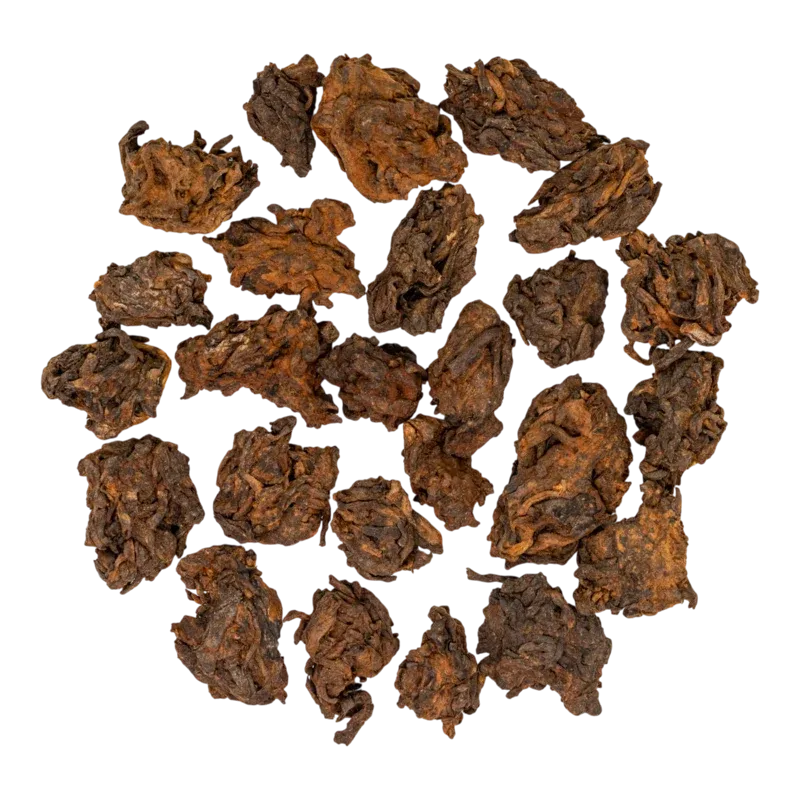
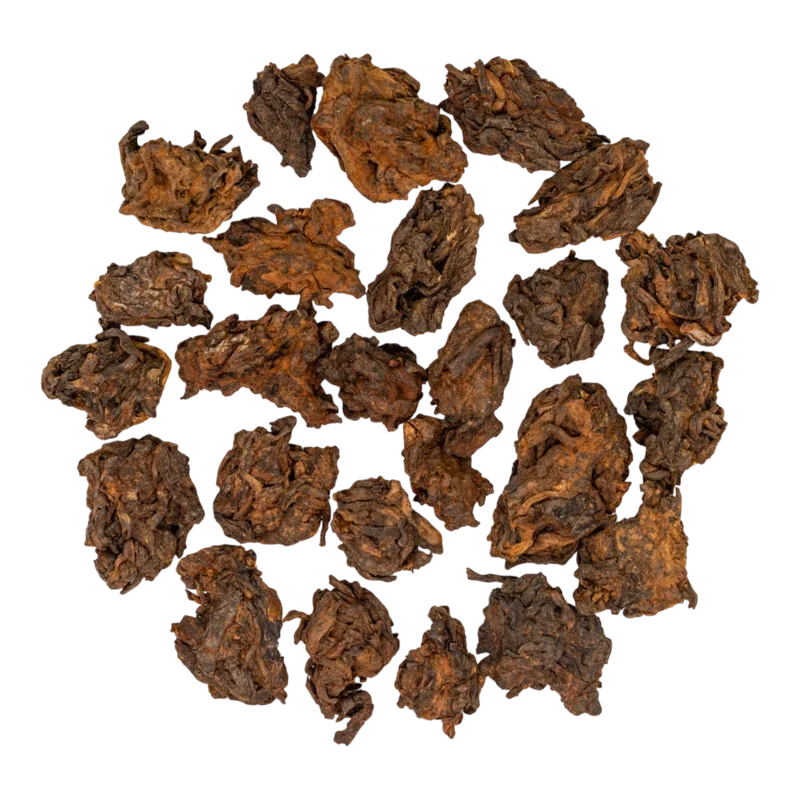
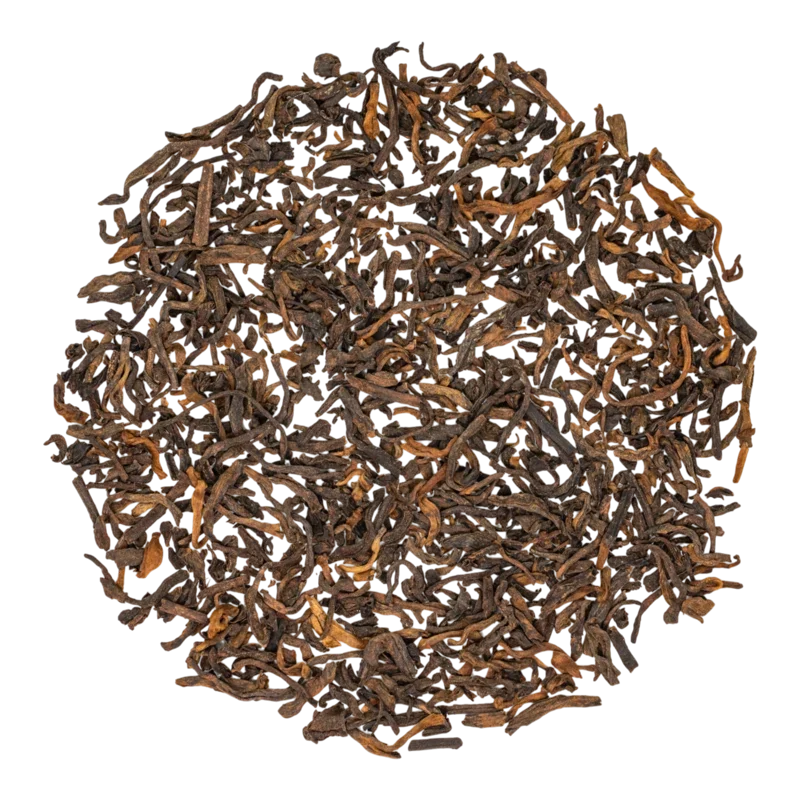
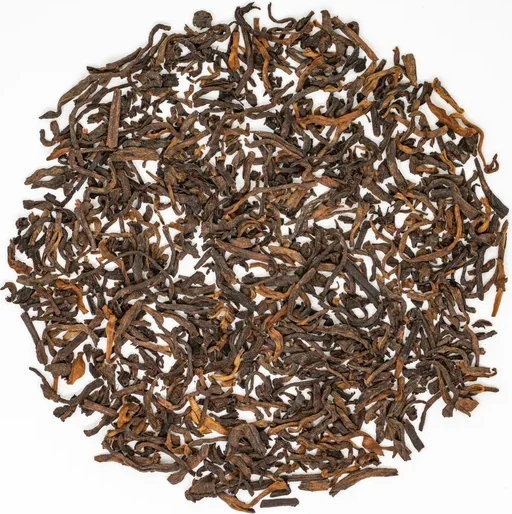
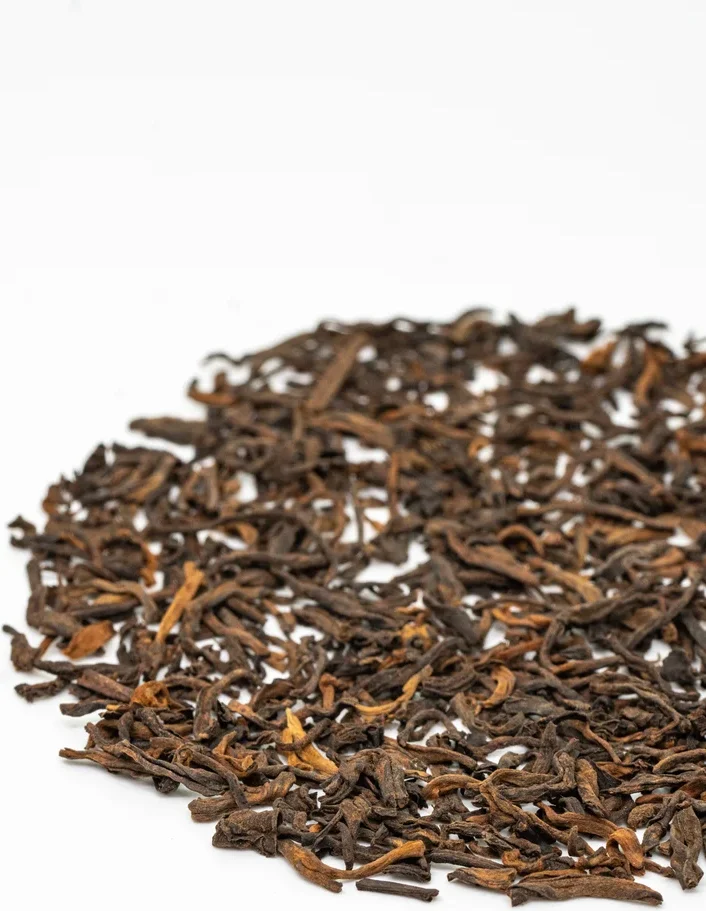
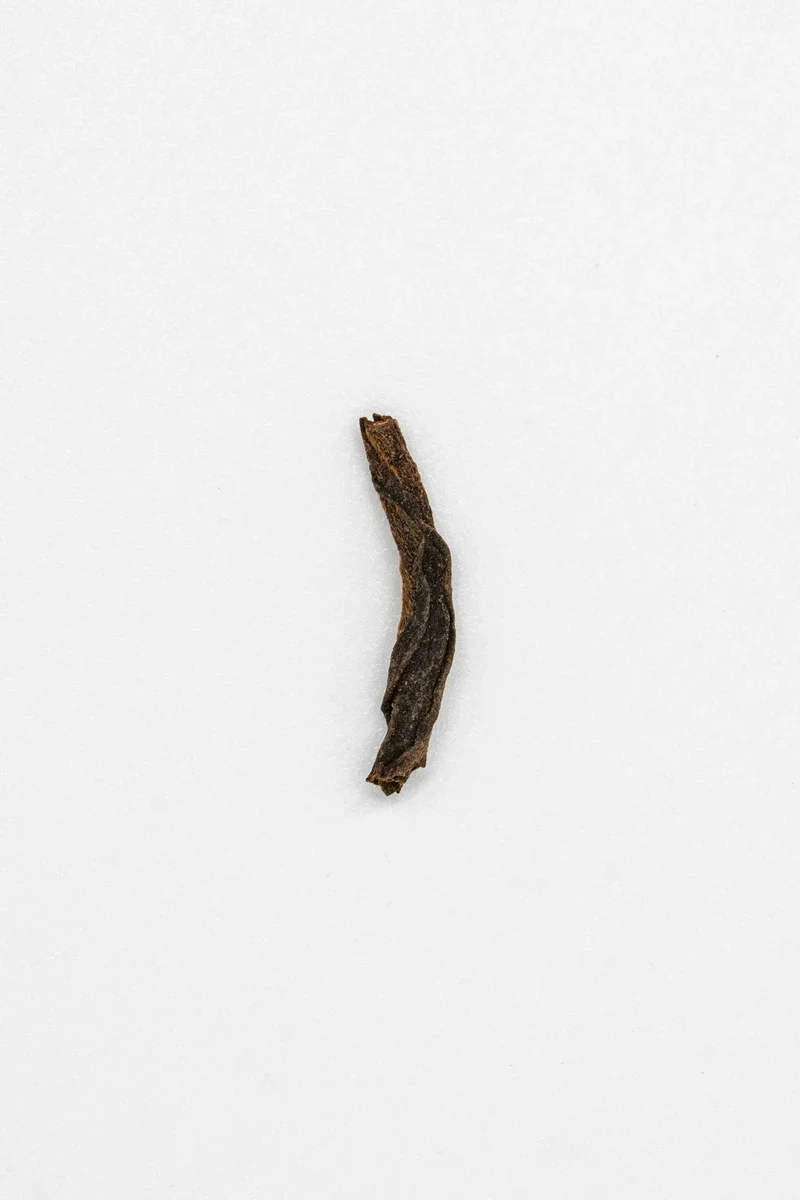
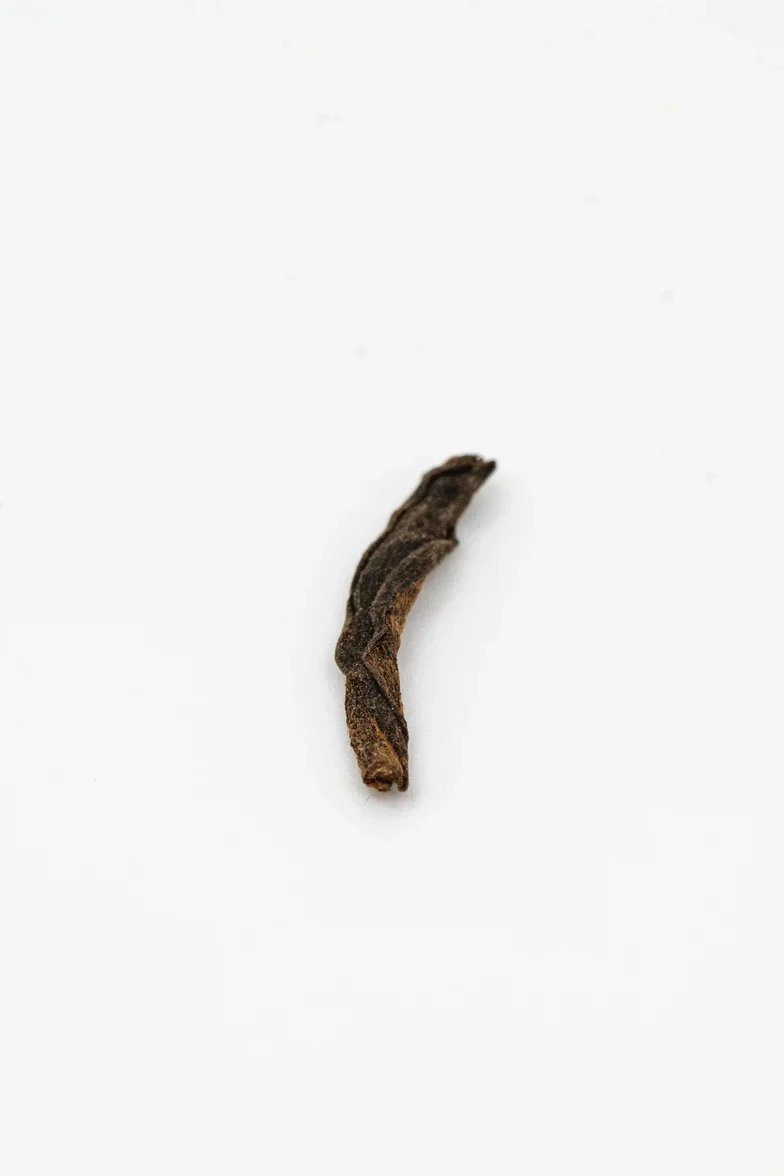
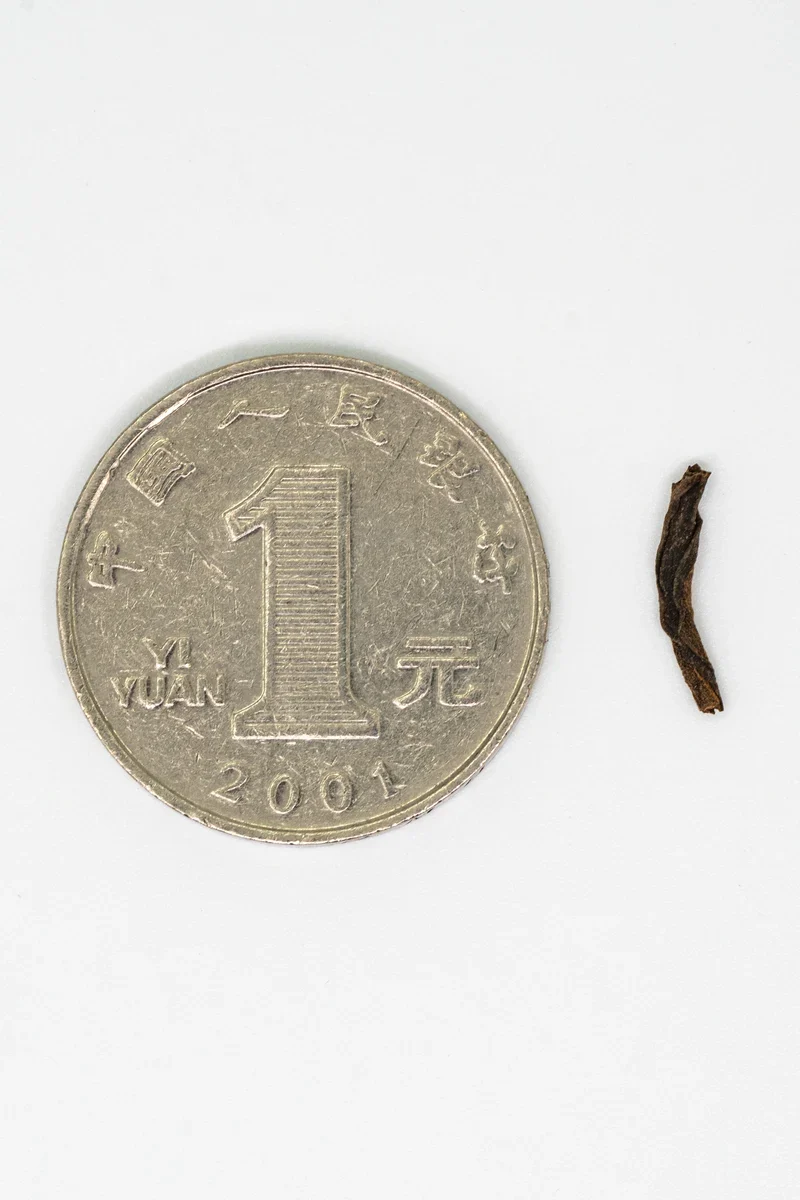
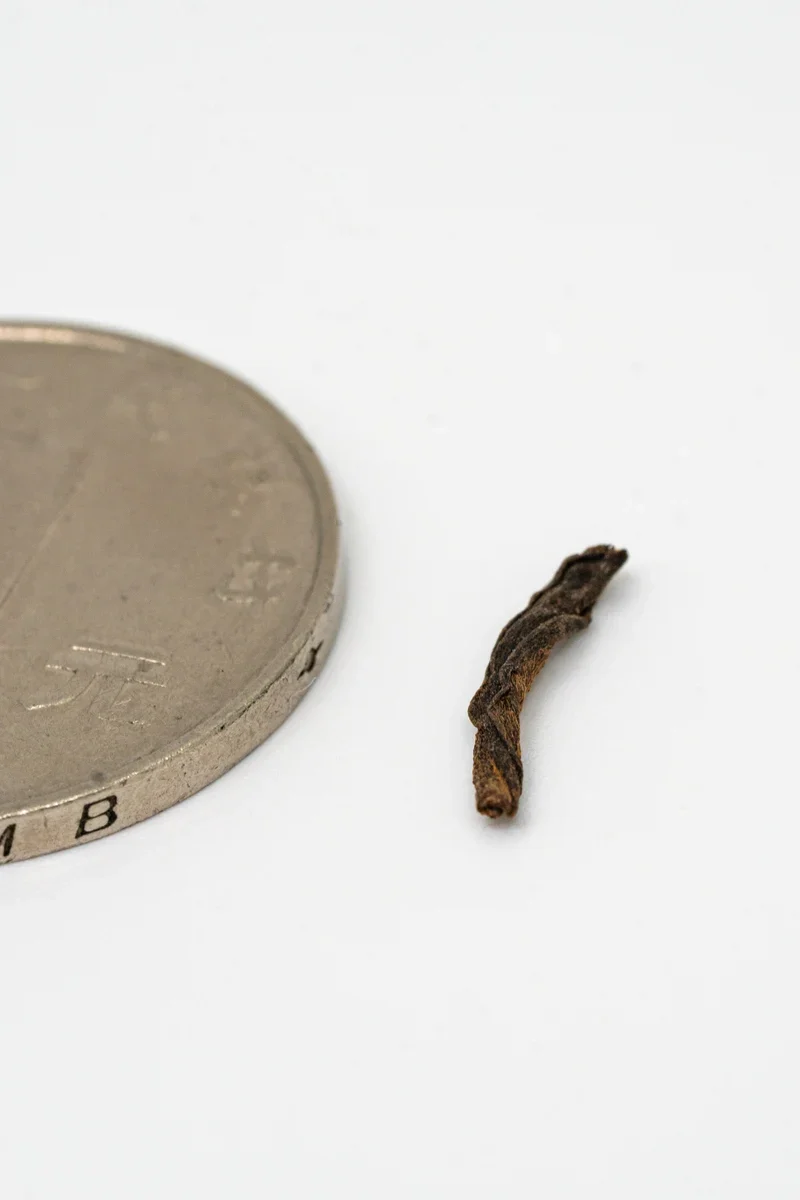
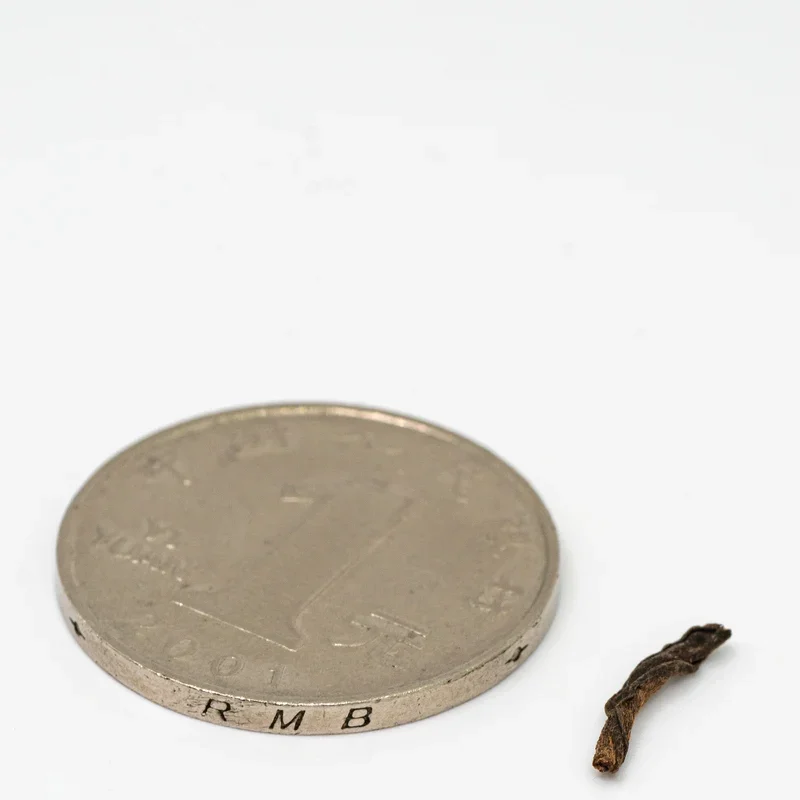
Dry Leaf Appearance: Small, dense buds and shoots, dark chestnut to black, with abundant golden tips (金毫). Size uniformity — key marker.
Liquor Color: Dark amber to cognac. Clear, with ruby reflection.
"Clean aged" (陈香) — without "堆味". Woody-nutty tones, dried fruits, chocolate, caramel. Best samples — floral and creamy overtones.
Spent Leaves: Small uniform buds, dark chestnut, soft, elastic.
Taste: Soft, "velvety" (醇滑). Pronounced sweetness (甘甜). No bitterness or astringency. Medium body, "silky". Aftertaste — long, nutty.
Amino Acids: ~1.5% (consumed by microorganisms as nitrogen source).
8–14% — dominant pigment. Determines color, texture and "mature" taste.
Significantly elevated. Powerful antioxidant.
~3.5–3.8% — slightly higher than in sheng, as it's released from complexes with catechins.
Unique component — synthesized by Aspergillus during fermentation. Natural HMG-CoA reductase inhibitor.
Elevated — "smoothness" and "sweetness" of liquor.
≥30% per T/MHC 003-2020.
Polyphenols: ~10–15% (in maocha — 28–38%). Conversion ~60–70%. Residual catechins minimal.
Theabrownins + statins (lovastatin) — dual mechanism for LDL cholesterol reduction. Shu pu-erh — the only tea with natural statins. Theabrownins, according to research, contribute to blood viscosity reduction and lipid profile normalization.
In TCM, shu pu-erh is "warm" (温性, wēn xìng), unlike "cold" sheng. Recommended for people with "cold" constitution and in cool weather.
Microbial enzymes (pectinase, cellulase, lipase) present in liquor aid in breaking down fats and heavy food. Traditionally shu pu-erh is drunk after abundant, fatty meals — especially in Guangdong and Hong Kong, where it accompanies dim sum.
Gallic acid (significantly elevated after fermentation) + residual polyphenols + theabrownins — triple antioxidant complex.
Caffeine (~3.7%) in form bound with theabrownins and pectins — smooth, prolonged stimulation without sharp "caffeine hit". Shu pu-erh is milder than sheng and most green teas.
Theabrownins and polysaccharides of shu pu-erh, according to preclinical studies, contribute to blood glucose level normalization.
This is a food product, not medicine. Not recommended on empty stomach (caffeine + acidity may irritate mucosa). Daily dose — 5–8 g.
95–100°C (boiling water). Unlike green teas, shu pu-erh requires maximum temperature to unfold heavy theabrownin complexes and dissolve pectins.
5–7 g per 100–150 ml (gongfu); 3–4 g per 200 ml (casual brewing).
Due to fine raw material, Gong Ting brews significantly faster than other shu pu-erhs. Over-steeping by 10 seconds can give excessive density and "soapy" taste. Precision — key to revealing this grade's delicacy.
Gong Ting can be boiled after 4–5 steeps — when extraction weakens. Boiling reveals "deep" sweetness and "brothy" texture difficult to achieve with steeping.
Teaware: Yíxīng teapot from zǐshā clay (宜兴紫砂壶) — ideal: porous structure "remembers" shu pu-erh and over time enriches the liquor. Recommended to dedicate separate teapot only for shu pu-erh. Gàiwǎn (盖碗) — for tasting, allows more precise extraction control. Glass — not recommended (doesn't hold temperature; shu pu-erh cools — loses texture).
Container: Ceramics, cardboard (original packaging), clay vessels. NOT airtight — shu pu-erh "breathes", and moderate air exchange is necessary for continuing microbial transformation.
Humidity: 40–70%. Too dry — tea "dies"; too humid — mold.
Light: Avoid direct sun — UV destroys pigments.
Complete isolation — shu pu-erh easily absorbs foreign odors (spices, coffee, household chemicals).
Practically unlimited. Gong Ting can be drunk young (1–2 years — after "堆味" dissipation), mature (3–7 years — optimal balance), or old (10+ years — maximum "smoothness"). Unlike sheng, there's no dramatic transformation with aging, but taste becomes more "rounded" and "transparent".
Temperature: Room temperature (15–30°C). Without sharp fluctuations.
Next after Gong Ting. Slightly coarser, denser taste, more "body". Gong Ting — more delicate, "cleaner", less resistant to steeps.
Standard raw material. Coarser, "earthy" profile, 8–12 steeps. Lower price.
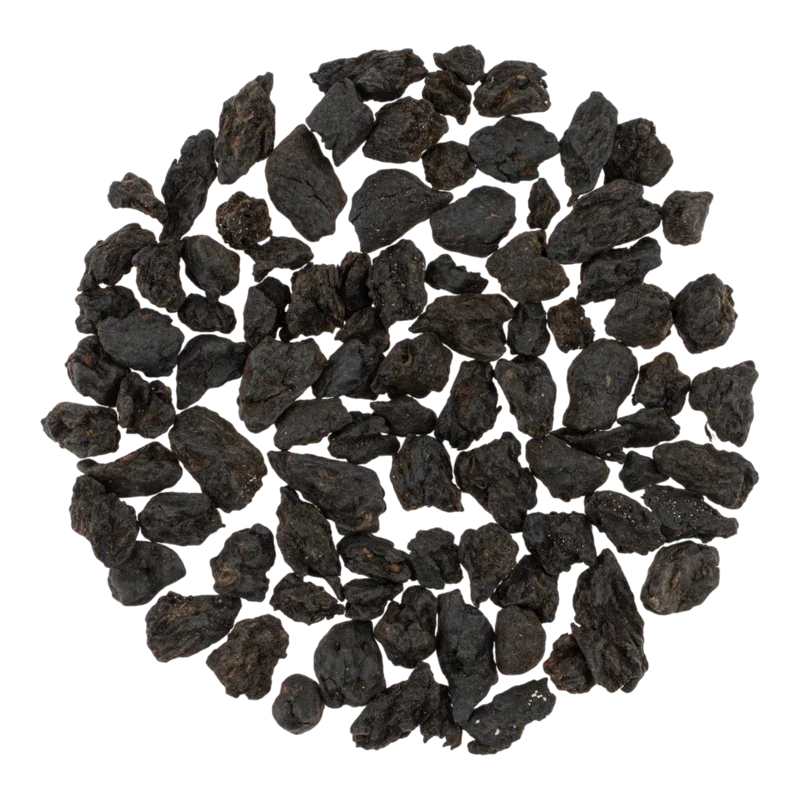
Lumps, pectin-bound. Dense, "brothy" taste. Heavy texture. Gong Ting — light, "silky".
Also bud-based, but emphasizing large golden buds. More "chocolatey" and "fruity". Visually more impressive.
Polished granules from Lao Cha Tou. Completely different category.
No reviews yet. Tell us what you think of this tea.
Rate this tea and share your impressions. We review each submission before publishing it.