Brewing
Gongfu brewing
- Water temperature
- 100 °C
- Tea amount
- 7 g
- Water volume
- 100 ml
- First steep
- 10 s
- Time added per infusion
- 5 s
- Infusions
- 12



dà jīn yá shú pǔ'ěr
Choose a brewing method. Start with the recommended quantities and time, then adjust to taste.
Brewing
Brewing
Taste
Tea encyclopedia
Category: Commercial bud grade of shu pu-erh. Not formalized as a separate level in T/MHC 003-2020 (unlike "宫廷" and "特级"), but widely used by producers and sellers to designate batches with a predominance of large golden buds. In terms of raw material tenderness — between "宫廷" (finest) and "特级/一级" (larger leaf).
Category: Commercial bud grade of shu pu-erh. Not formalized as a separate level in T/MHC 003-2020 (unlike "宫廷" and "特级"), but widely used by producers and sellers to designate batches with a predominance of large golden buds. In terms of raw material tenderness — between "宫廷" (finest) and "特级/一级" (larger leaf).
Origin: China, Yúnnán Province (云南省). Main regions: Měnghǎi (勐海), Líncāng (临沧), Pu-erh (普洱), Jinghong (景洪). Raw material with large fuzzy buds — often from Líncāng and Fèngqìng (凤庆) regions, where the Fengqing Large-leaf cultivar (凤庆大叶种) produces particularly fleshy, downy shoots.
Type: Post-fermented tea (dark tea, 黑茶). Shu pu-erh (熟普洱, Shú Pǔ'ěr) — "ripe", having undergone accelerated microbial fermentation (渥堆, wò duī).
Cultural Significance: Da Jin Ya is a "showcase" shu pu-erh: its impressive appearance makes it a popular choice for gifts and tea presentations. Unlike Gong Ting, whose value lies in "invisible" delicacy, Da Jin Ya's value lies in "visible" beauty: large golden buds are impossible to miss.
Name Breakdown: 大 (Dà) — "large, big"; 金 (Jīn) — "gold, golden"; 芽 (Yá) — "bud, shoot". Emphasis on size (大 — "large", unlike the small ones of Gong Ting) and color (金 — "golden" — dense reddish-golden down on buds, preserved after fermentation).
Like Gong Ting, Da Jin Ya is a sorting grade: selected from the general mass of finished shu pu-erh after fermentation. But the selection criterion is different: not smallness, but size + fuzziness. Yield is also limited: no more than 10–15% of the batch (large, whole, fuzzy buds are not the majority of the pile).
Cultivar: Yunnan Large-leaf (云南大叶种) — Camellia sinensis var. assamica. For Da Jin Ya, cultivars with particularly large, fleshy buds and abundant golden down are preferred: Fengqing Large-leaf (凤庆大叶种) — leader in "fuzziness" and bud size; Mengku Large-leaf (勐库大叶种); Menghai Large-leaf (勐海大叶种). Fengqing Large-leaf buds are among the largest among Yunnan cultivars, with golden-reddish down that persists even after 45–60 days of fermentation.
Picking: Spring — most valued: buds are maximally fleshy and fuzzy. Standard — one bud or one bud + one-two unopened leaves (一芽一二叶初展). Key difference from Gong Ting: for Da Jin Ya, the largest shoots are selected, while for Gong Ting — the smallest.
Altitude: 1000–2000 m. Fengqing — predominantly 1500–1800 m, which provides increased amino acids and aromatics.
Climate: Subtropical monsoon. Fengqing: average annual temperature ~16.5°C, precipitation ~1400 mm, humidity >75%. Lincang: ~17°C, ~1200 mm. Both regions — with abundant fogs and significant daily temperature fluctuations.
Soil: Red-yellow lateritic (pH 4.5–5.5). Fengqing soils — on granite foundation, with high mineral content (iron, zinc, manganese), which is reflected in the "minerality" of taste.
Líncāng (临沧) and Fèngqìng (凤庆) — preferred sources of raw material for Da Jin Ya thanks to the Fengqing Large-leaf cultivar with its large, fuzzy buds. Fengqing is one of the oldest tea-growing counties in Yunnan: here grows "Jinxiu Tea Ancestor" (锦绣茶祖母, Jǐnxiù Chá Zǔmǔ, "Great-grandmother of tea [from] Jinxiu") — the world's oldest cultivated tea tree (age estimated at ~3200 years). Fengqing became the birthplace of "Dianhong" (滇红, Yunnan red tea): in 1938, Fēng Shàoqiú (冯绍裘) created the first Yunnan red tea here from local large-leaf varieties. The "golden tips" of Fengqing are the calling card of both dianhong and Da Jin Ya. Menghai — for fermentation (factories with "living floors"). Often practiced scheme: raw material from Lincang/Fengqing → fermentation in Menghai — combining the best raw material with the best microbiome.
Fengqing — birthplace of "Dianhong" (滇红) variety, one of the oldest tea regions in the province. Lincang — region with the highest concentration of ancient tea trees (古茶树) in Yunnan.
Fixation → rolling → sun-drying. For Da Jin Ya — from spring raw material with large buds.
45–60 days (classic) or 90–120 days (slow fermentation). Microbiological agents are the same: Aspergillus niger, Rhizopus, A. oryzae, yeasts, bacilli. For batches with predominantly bud material, piles are usually smaller (less than 1 ton), and turning is more frequent to avoid "overheating" delicate buds.
To moisture ≤13%.
Key stage. From the general mass, large, whole, fuzzy buds with 0–2 leaves are selected. Criterion — not smallness (as with Gong Ting), but size, wholeness, and abundance of golden down. Hand selection is mandatory.
Most often Dà Jīn Yá is sold loose (散茶) — so buyers can see the "golden buds". Sometimes — mini-tuocha or small cakes.
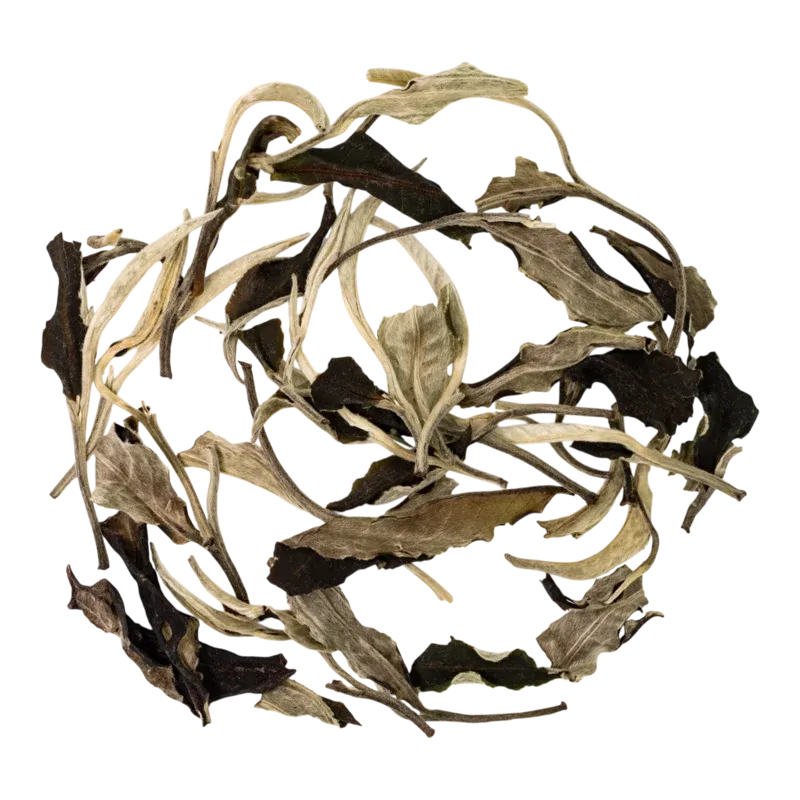
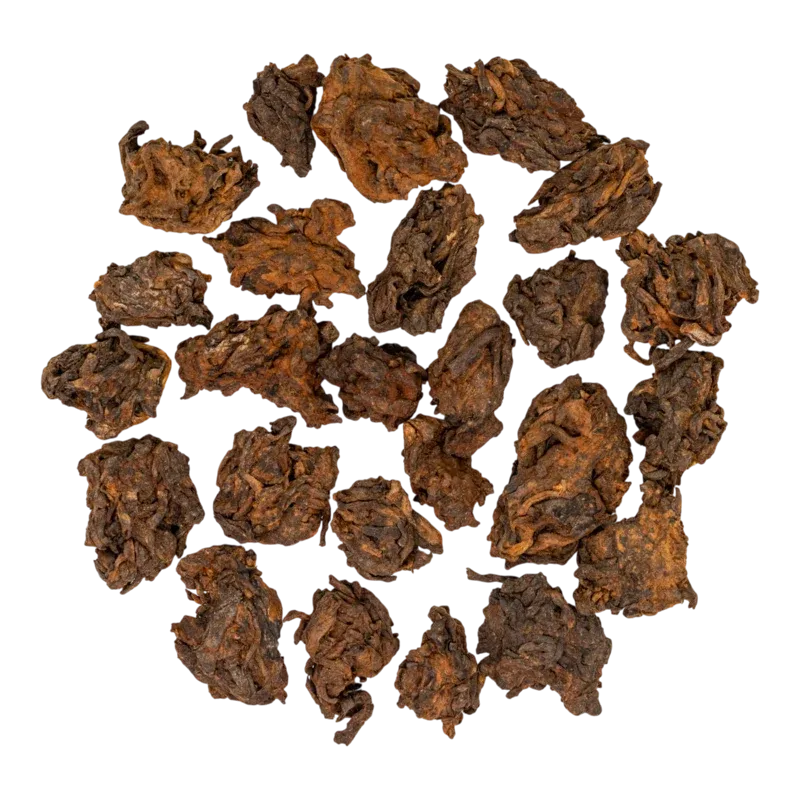
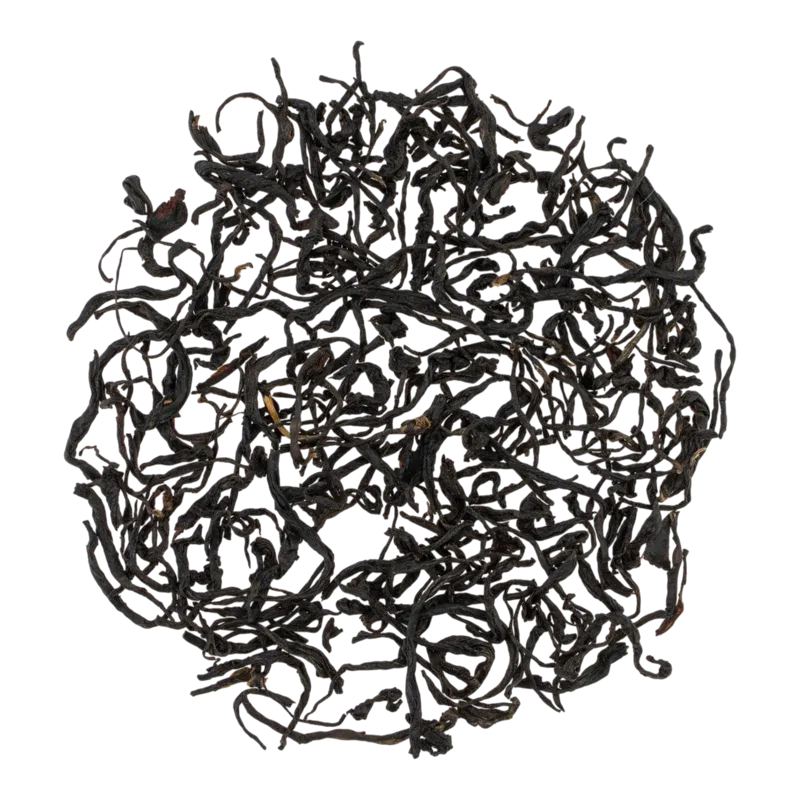
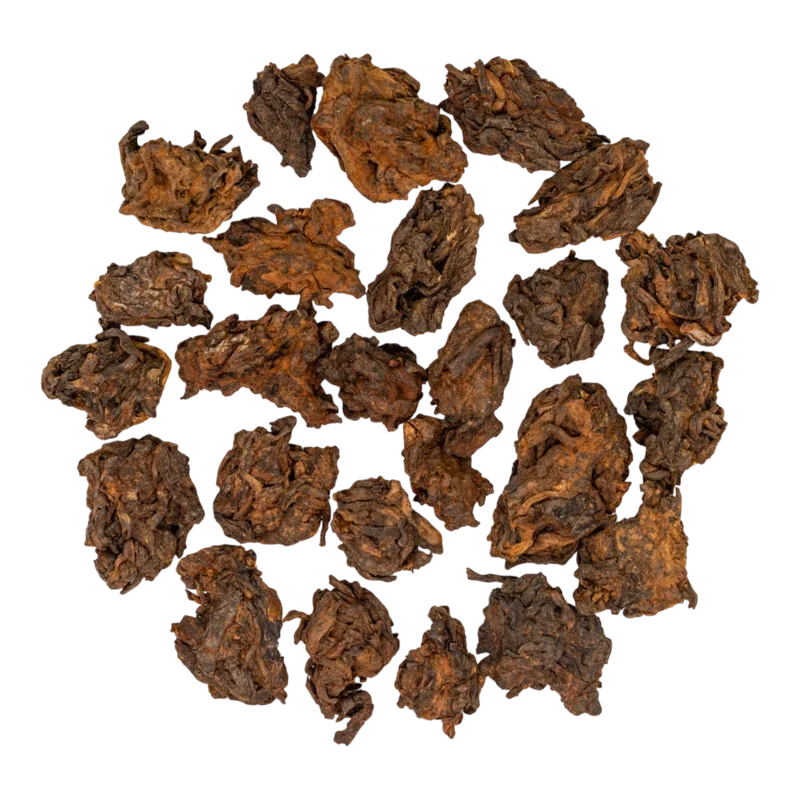
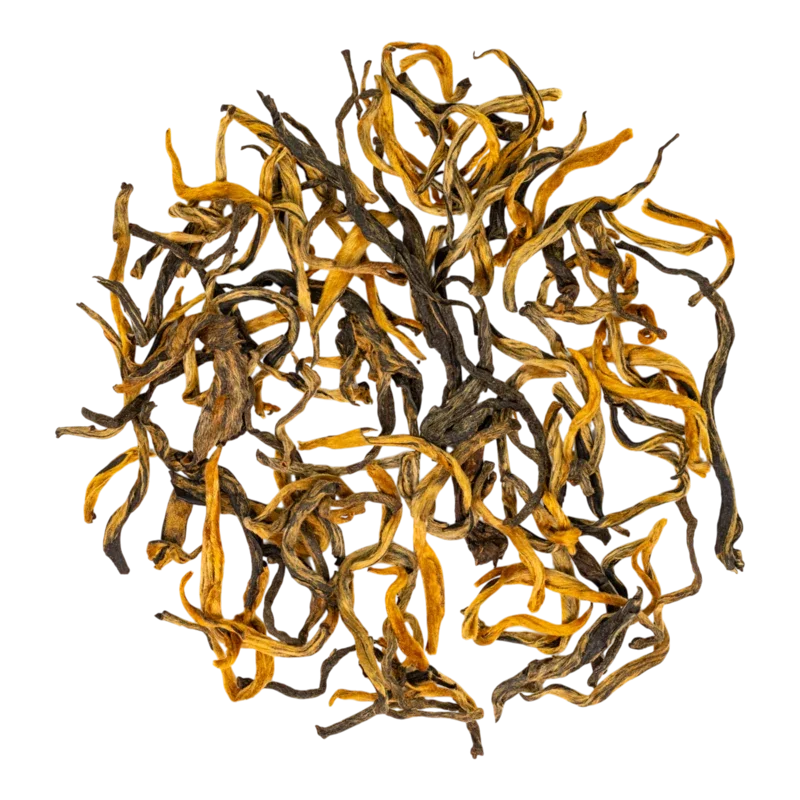
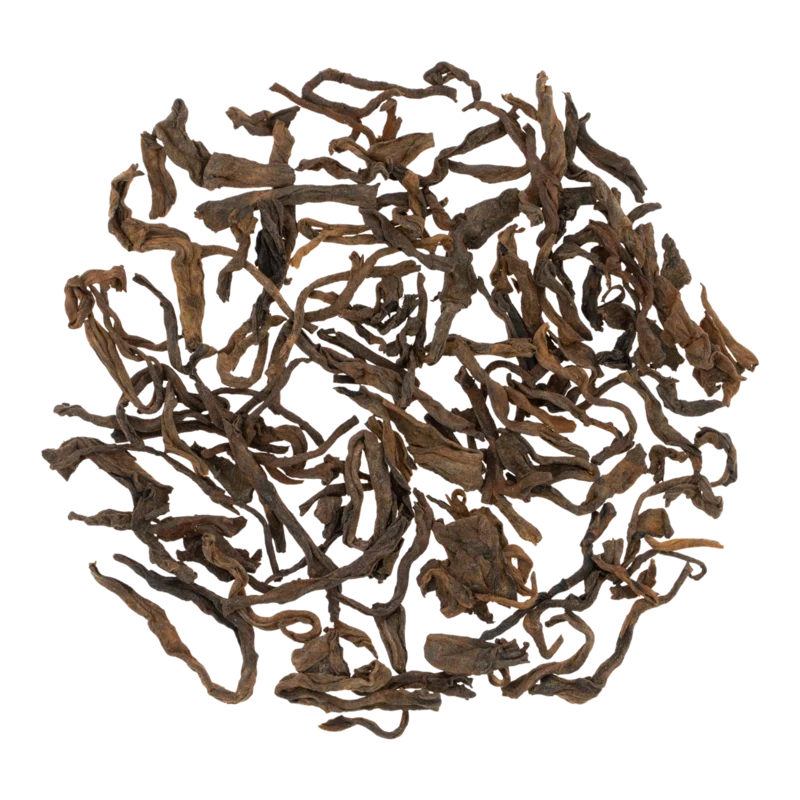
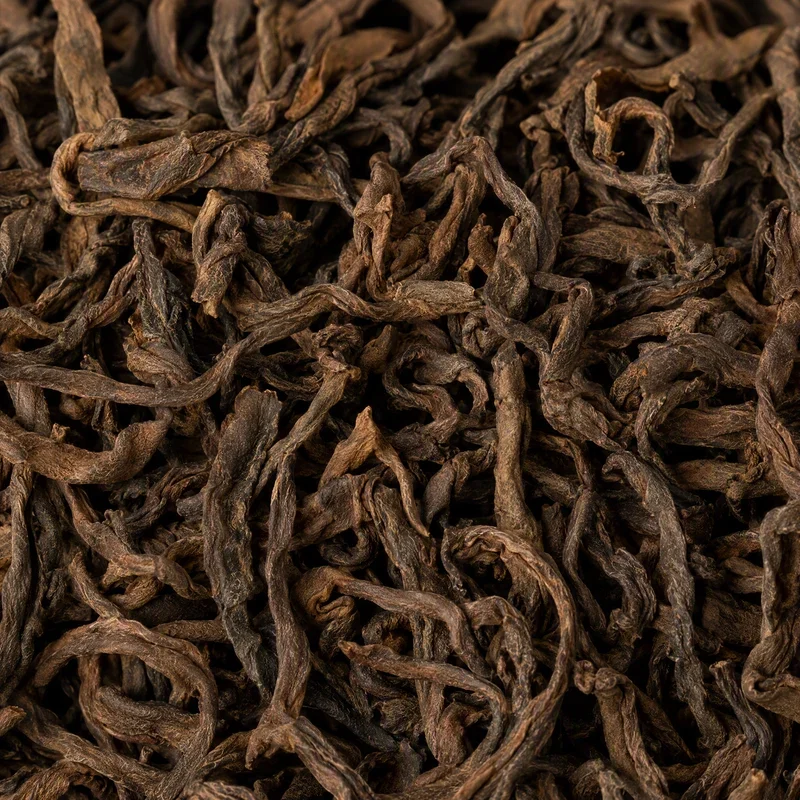
Dry Leaf Appearance: Large, fleshy buds densely covered with bright golden or reddish down. Color — from golden-chestnut to dark brown with golden "frost". Visually — the most impressive of all shu pu-erh grades: a scatter of large "golden buds" makes a strong impression.
Liquor Color: Dark amber to ruby. Clear, with characteristic oily sheen (油润). Slightly "warmer" in tone than Gong Ting — due to the larger volume of down, which "gilds" the infusion.
More "sweet" and "fruity" than Gong Ting. Main notes: chocolate (dark chocolate, cocoa powder), dried fruits (date, prune, apricot), honey, caramel. Less "earthy" and "woody" — large buds with high amino acid content during fermentation form more volatile compounds of the "sweet" register (furfural, maltol — products of Maillard reaction). In the best samples — light "creaminess" (from lactones) and "vanilla notes". When the infusion cools — "honey-nutty" trail.
Spent Leaves: Large, whole, fleshy buds of golden-chestnut color. Soft, elastic. Golden down is clearly visible.
Taste: Soft, sweet, "velvety". Denser body than Gong Ting — large buds provide more extractive substances. "Chocolate" base with fruity overtones. Pronounced "returning sweetness (huí gān)" (回甘). Minimal astringency. Aftertaste — long, chocolate-nutty, with "honey" finish.
Amino Acids: ~1.5–2% — slightly higher than small grades, as large spring buds contain more L-theanine.
8–12% — main pigment. Slightly lower than Gong Ting (8–14%), as large buds ferment slightly less "deeply".
Elevated (fermentation product).
~3.5–3.8%.
Present — synthesized by microorganisms during fermentation.
Elevated. Large buds with 1–2 leaves contain more cellulose — more substrate for microbial hydrolysis into sugars and pectins. Hence — denser body of infusion.
≥30% according to T/MHC 003-2020.
Polyphenols: ~12–18% — slightly higher than Gong Ting (~10–15%) — large buds contain more polyphenols.
Theabrownins + statins (lovastatin) — dual mechanism for reducing LDL cholesterol. Shu pu-erh is the only tea with natural statins.
"Warm" (温性) in TCM. Recommended for people with "cold" constitution, in cool weather, after exposure to cold.
Microbial enzymes (pectinase, cellulase, lipase) promote breakdown of fats and proteins. Traditionally — after fatty, heavy meals. Especially popular in Guangdong and Hong Kong as "after-dinner" tea.
Gallic acid (elevated after fermentation) + residual polyphenols + theabrownins — triple antioxidant complex. Da Jin Ya, with slightly higher polyphenols (~12–18% vs ~10–15% in Gong Ting), may have somewhat more pronounced antioxidant potential.
Caffeine (~3.7%) in bound form with pectins and theabrownins — smooth stimulation without "caffeine crash".
Not medicine. Not on empty stomach (may irritate mucosa). 5–8 g/day.
95–100°C (boiling water).
5–7 g per 100–150 ml (gongfu); 3–4 g per 200 ml (everyday).
Unlike Gong Ting, Da Jin Ya is more "tolerant" of over-steeping: large buds release extractive substances more slowly, and even with a 20-second steep it doesn't become "overwhelming". But for maximum "chocolatiness" — short steeps are better. After 5–6 steeps, one can switch to boiling (煮茶): large buds excellently "hold" boiling, revealing deep caramel sweetness.
Da Jin Ya is one of the few shu pu-erhs that can be recommended as a "dessert" tea: the chocolate-fruity profile pairs well with dark chocolate, nuts, dried fruits, and soft cheeses. Traditionally — after a heavy lunch.
Teaware: Yixing teapot — ideal. Gaiwan — for tasting. For Da Jin Ya, glass teapot is also good — it allows admiring large golden buds "dancing" in water.
Container: Ceramic, cardboard, clay. Not airtight — shu pu-erh "breathes". Da Jin Ya is often stored in transparent glass jars for beauty — this is acceptable short-term (1–2 months), but for long-term storage — opaque containers are better.
Humidity: 40–70%. Too dry — tea "dries out", loses "body"; too humid — mold.
Light: Avoid direct sunlight. UV destroys pigments and down.
Shelf Life: Unlimited. Young (1–2 years — after "pile flavor" dissipates), mature (3–7 years — optimal balance of "chocolatiness" and "smoothness"), aged (10+ years — maximum "velvetiness").
Complete isolation — large fuzzy buds especially well absorb odors.
Temperature: Room temperature (15–30°C). Without sharp fluctuations.
Finest buds. More "clean", "delicate", "silky" taste. Less "body". 5–8 steeps. Da Jin Ya — larger, more "chocolate", denser, 7–10 steeps.
Buds + small leaves. Less fuzzy than Da Jin Ya. More "standard" profile. Da Jin Ya — visually more impressive, with more "fruity" character.
Completely different product — pectin clumps. Densest, "brothy" taste. Da Jin Ya — "velvety", "chocolate", without "brothiness".
Polished granules with "rice" aroma. Different category. Da Jin Ya — natural whole buds without additional processing.
Red tea from the same "golden buds" of Fengqing. Fully fermented (vs post-fermented in Da Jin Ya). Dianhong — "honey", "malty"; Da Jin Ya — "chocolate", "earthy".
Some producers add red tea (dianhong) to shu pu-erh for visual "goldness". Sign — uncharacteristic brightness of down + "honey" aroma atypical for shu.
No reviews yet. Tell us what you think of this tea.
Rate this tea and share your impressions. We review each submission before publishing it.