Brewing
Gongfu brewing
- Water temperature
- 75 °C
- Tea amount
- 5 g
- Water volume
- 100 ml
- First steep
- 10 s
- Time added per infusion
- 5 s
- Infusions
- 3

Sānjiāng lǜchá
Choose a brewing method. Start with the recommended quantities and time, then adjust to taste.
Brewing
Brewing
Taste
Tea encyclopedia
Category: National Geographical Indication Product (国家地理标志产品, since 2012); included in the first batch of Guangxi GI Protection Program (2024). The largest tea brand in Guangxi Zhuang Autonomous Region.
Category: National Geographical Indication Product (国家地理标志产品, since 2012); included in the first batch of Guangxi GI Protection Program (2024). The largest tea brand in Guangxi Zhuang Autonomous Region.
Coordinates: ~25°30′–26°00′ N, 108°30′–109°30′ E.
Origin: China; Guǎngxī Zhuāng Autonomous Region (广西壮族自治区, Guǎngxī); Sānjiāng Dōng Autonomous County (三江侗族自治县, Sānjiāng Dòngzú Zìzhìxiàn), part of Liuzhou Prefecture-level City (柳州市, Liǔzhōu Shì). The county is located at the junction of Hunan, Guizhou, and Guǎngxī provinces (湘黔桂三省交界). Protection zone — the entire county territory (162 administrative villages). Quality core — Xianrenshan Mountain (仙人山, Xiānrén Shān, "Mountain of Immortals") in Bùyāng Village (布央村, Bùyāng Cūn), Bājiāng Township (八江镇, Bājiāng Zhèn), as well as high-altitude gardens in Tongdao (同道) and Dudong (独峒) townships.
Type: Green tea (绿茶) (non-oxidized, 绿茶, lǜchá). Kill-green fixation — high-temperature pan-firing (220–260 °C).
Thanks to ultra-early cultivar Fuyun 6 and mild subtropical climate, Sanjiang begins harvest in late January — 20+ days earlier than other tea regions of the country. This is an official nickname, established by Guangxi government.
Stone stele from 1881 in Tongle Township — one of few Qing dynasty documents fixing criminal responsibility for tea leaf theft. Fine of "huahong erqian" (花红二千) was a substantial sum at that time.
In Sanjiang, tea is consumed not only in classical brewing, but also as thick oily "yucha" (油茶): tea leaves are roasted with rice, peanuts, and ginger in a cast iron pot with oil, then boiling water is added and strained. Yucha is the basis of Dong breakfast and mandatory element of hospitality.
Sanjiang tea industry — largest in Guangxi, encompassing one-third of county population. Tea became the main instrument of poverty alleviation (脱贫攻坚) in the region — average income of Buyang residents grew from 8,153 yuan (2012) to 20,000+ yuan (2021).
Buyang's Xianrenshan (4A zone since 2018) offers overnight stays in "starry wooden houses" (星空木屋) among tea plantations at 800 m altitude — one of the most photogenic tea places in Southern China.
Sanjiang is a record holder for number of registered tea trademarks among Chinese counties. With population of about 400,000 people, 436 tea brands and 490 processing enterprises operate here — tea industry literally permeates every aspect of life.
The Dòng people are one of few ethnic groups in the world preserving the tradition of polyphonic choral singing without conductor (侗族大歌, Dòngzú Dàgē, included in UNESCO list). At Buyang tea festivals, tea picking is accompanied by polyphonic songs — a unique experience combining sound and taste landscape.
Cultural Significance: Sanjiang Lü Chá is ān inseparable part of the culture of the Dōng people (侗族, Dòngzú), one of the most distinctive ethnic groups in Southern China. Tea enters daily diet through the tradition of "yucha" (油茶, yóuchá) — an oily tea beverage prepared by roasting tea leaves with rice, peanuts, and ginger in a cast iron pot. Yucha is served in every Dong home and is a mandatory element of the "Hundred Families Feast" (百家宴, bǎijiā yàn) — a collective meal where each family brings their own dish. The tea gardens of Buyang have become a tourist phenomenon: in 2018, Xianrenshan received national 4A tourist zone status; visitors can participate in tea picking and processing, stay overnight in starry wooden houses (星空木屋) among tea plantations, and watch sunsets from tea terraces to the sounds of Dōng polyphonic songs (侗族大歌, Dòngzú Dàgē), included in UNESCO's intangible heritage list.
Name Breakdown: 三江 (Sānjiāng) — "Three Rivers" — after the three main waterways of the county. The Dong name for the locality reflects the triple confluence of water flows; 绿茶 (Lǜchá) — "green tea." Full meaning: "Green Tea of Three Rivers."
Cultivar: Primary — Fuyun 6 (福云六号, Fúyún Liù Hào), an early-ripening clonal variety of Camellia sinensis var. sinensis, ensuring ultra-early spring harvest. Supplemented by local population (seed-propagated) varieties, contributing genetic diversity. Characteristics: tender, soft buds; weight of 100 shoots ~45 g; polyphenols 25.95%, amino acids 2.28% (baseline level; in high-altitude gardens — up to 5%).
Picking: Ultra-early spring — from late January to early February, 20+ days earlier than other tea zones in China. Main period — February–April.
Pluck Standard: Premium grade — single buds or bud with one half-opened leaf (一芽一叶初展), abundant down. First grade — single buds + one leaf (90%). Second grade — bud with two leaves.
Raw Material: Tender shoots without damage. Planting — by cuttings; organic fertilizer 15–30 t/ha; chemical pesticides prohibited.
Altitude: 300–1,100 m; core zone (Buyang, Bajiang) — 600–1,000 m. Up to 70% of the county's tea gardens are located in the high-altitude zone.
Climate: Subtropical, southern Nanling type. Average annual temperature 18.3°C; precipitation 1,557 mm/year; frost-free period 320 days; daily temperature difference >15°C. Cloudy-foggy diffused radiation comprises ~70% of light flow, stimulating amino acid synthesis 30% more efficiently than in lowland zones.
Soil: Yellow-red loams (黄红壤, huáng hóng rǎng), pH 4.5–6.0, organic matter ≥1%. Good drainage ensured by mountainous terrain.
Forest coverage — 78% — one of the highest among tea counties in China. Disease and pest frequency 60% lower than in lowlands — consequence of altitudinal isolation and biodiversity. Tea gardens are surrounded by natural forests with no industrial facilities within dozens of kilometers. Buyang Village is a model of "tea-landscape integration": terraced tea plantations interspersed with red four-season maples, bamboo groves, and Dong wooden structures — wind and rain bridges, drum towers (鼓楼, gǔlóu), and stilt houses. This ecosystem is not only aesthetic but functional: forest massifs serve as windbreaks and moisture reservoirs for tea gardens.
At 20–25°C for 4–6 hours. Gentle moisture evaporation and beginning of aromatic precursor formation.
High-temperature pan-firing at 220–260°C for ~5 minutes. Precise temperature control allows preservation of up to 90% of chlorophyll, ensuring bright emerald color of the finished product.
Light, with destruction of 50–60% of cell walls. For elite batches — exclusively manual; mechanical rolling prohibited to preserve integrity of buds and leaves.
Depending on target product: rolling into spirals (for biluochun), flattening (for longjing), rolling into thin threads (for maojian). Method — manual "twisting and tightening" (搓条紧结, cuō tiáo jǐn jié).
To final moisture content ≤6.5%.
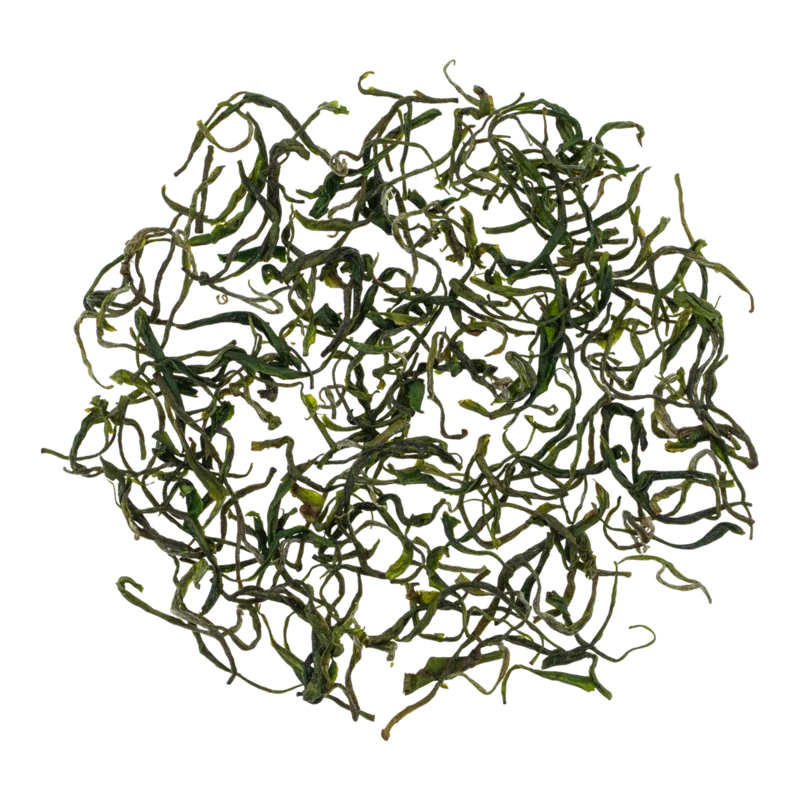
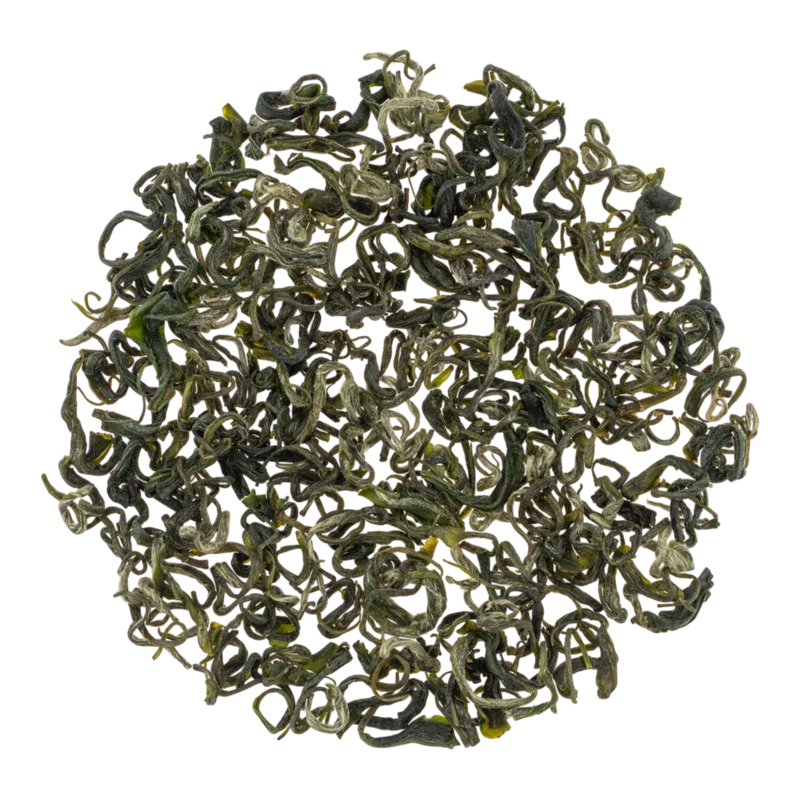
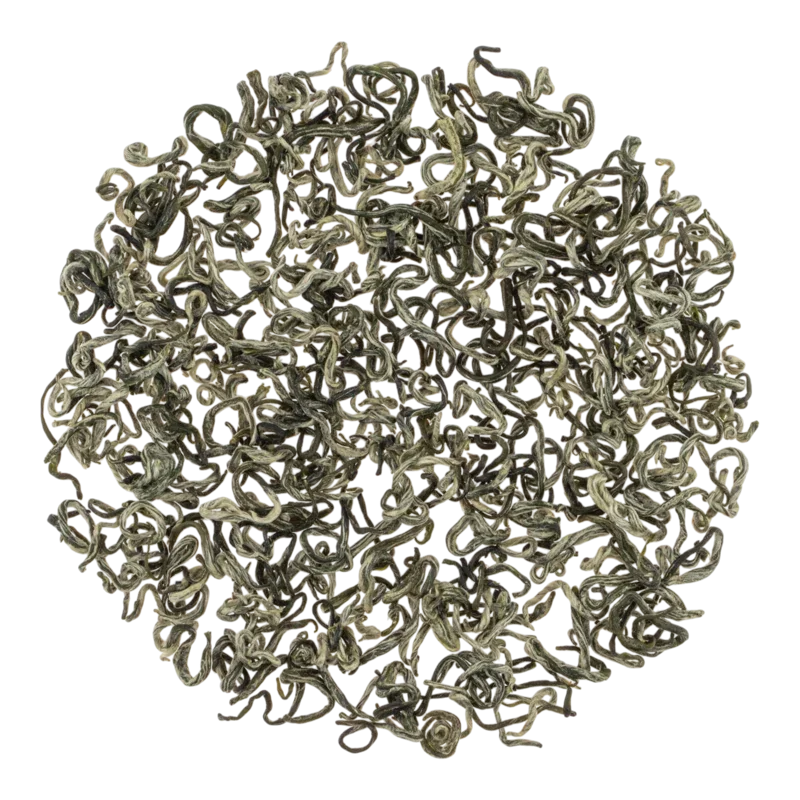
Dry Leaf Appearance: Depends on form. Biluochun — tightly twisted spirals, silvery-green, with "subdued" down (翠绿隐毫, cuìlǜ yǐn háo). Longjing — flat "blades." Maojian — thin, straight, with abundant white down. Common feature: thick, "fleshy," heavy strips (条索厚重, tiáosuǒ hòuzhòng) — result of high-altitude raw material.
Dry Leaf Aroma: Chestnut (栗香, lì xiāng) — dominant note, high and sharp (高锐, gāo ruì). Delicate orchid undertone (兰花香, lánhuā xiāng) on the "tail." With aging — light honey notes.
Liquor Aroma: Chestnut-orchid, stable and long-lasting. With cooling acquires sweet "floral" background.
Liquor Color: Yellow-green, clear and bright (黄绿明亮).
Spent Leaves: Tender, even, lively (嫩匀鲜活); buds and leaves stand vertically (芽叶竖立) — sign of high-quality raw material.
Taste: Fresh and brisk (鲜爽, xiān shuǎng) — pronounced amino acid "liveliness." Sweet and clean (甘醇, gān chún), with long returning sweetness (回甘持久). Brewing resistance — 5–7 infusions, significantly higher than average for green tea.
Alkaloids: Caffeine in standard range for green tea; theobromine, theophylline.
Amino Acids: Up to 5% in elite high-altitude batches — 20% higher than average for green teas. L-theanine dominates, ensuring taste freshness and "gentle alertness."
High indicator, determining richness and brewing resistance of liquor.
Minerals: Potassium, manganese, zinc, fluorine — determined by yellow-red loams of mountainous terrain.
Polyphenols: ~28% — higher than Xi Hu Longjing (~25%). High EGCG content ensures powerful antioxidant activity.
Vitamins: Vitamin C, B-group vitamins, vitamin E.
Polyphenols (~28%) and amino acids (up to 5%) provide comprehensive protection against oxidative stress.
Synergy of caffeine and L-theanine — gentle concentration enhancement without anxiety.
High catechin content stimulates fat metabolism.
Polyphenols support vascular elasticity and promote cholesterol regulation.
Vitamin C and mineral complex support protective functions.
L-theanine stimulates alpha-wave brain activity.
Fluorine and catechins inhibit cariogenic bacteria activity.
Listed properties are based on general green tea data and are not medical recommendations. Not recommended on empty stomach; optimal — one hour after meals. With medication — interval of at least 1 hour. Daily norm — no more than 500 ml.
Sanjiang Lü Cha has exceptional brewing resistance — this is one of the green teas with the highest number of full infusions (up to 7).
Tea Amount: 3 g per 150 ml (1:50 ratio).
Teaware: Glass cup (玻璃杯) — for observing leaf opening; white porcelain gaiwan (白瓷盖碗) — for aroma concentration.
Water Temperature: 80–90°C for standard tea; 80°C for premium grade. Mountain spring water (山泉水) is ideal.
Container: Airtight vacuum or foil packaging.
Light: Store in complete darkness.
Shelf Life: Up to 12 months under proper conditions. Recommended to consume as quickly as possible for full chestnut aroma — after six months notes begin to soften.
Isolate from products with strong aromas.
Temperature: 0–5°C (refrigerator) — mandatory for spring green tea.
Guangxi, Lingyun County. Also high-altitude (800–1,500 m), but from Língyún Bái Háo cultivar (凌云白毫). More delicate, "floral" profile, less chestnut. Sanjiang — denser and "more powerful" in body; wins in harvest earliness.
Guangxi, Guilin. Mid-altitude, with increased selenium content. Form — thin "needles." Sanjiang — more diverse in forms (longjing, biluochun, maojian) and with more pronounced chestnut character.
Guizhou, Duyun. One of "Ten Famous Teas of China." Form — dense, hook-shaped "needles" with abundant down. Taste — more "chlorophyll" and "green," with less chestnut character. Sanjiang — with warmer, "nutty" profile and significantly greater resistance (5–7 vs 3–4 infusions).
Zhejiang. Standard of flat green tea. Polyphenol content ~25% vs 28% in Sanjiang; aroma — chestnut-nutty, but more "dry." Sanjiang longjing — softer and sweeter thanks to subtropical microclimate; brewing resistance (5–7 infusions) notably higher than classic Longjing (3–4). Sanjiang's price advantage makes it an attractive alternative for daily drinking.
No reviews yet. Tell us what you think of this tea.
Rate this tea and share your impressions. We review each submission before publishing it.