Brewing
Gongfu brewing
- Water temperature
- 75 °C
- Tea amount
- 5 g
- Water volume
- 100 ml
- First steep
- 10 s
- Time added per infusion
- 5 s
- Infusions
- 3

Língyún lǜchá
Choose a brewing method. Start with the recommended quantities and time, then adjust to taste.
Brewing
Brewing
Taste
Tea encyclopedia
Category: National Geographical Indication Product of the PRC (国家地理标志产品, 2005; trademark — 2016). Cultivar Huacha No. 26 — one of the first 21 national tea cultivars (1965). National first-class tea cultivar (国家级茶树良种, 1984). Second medal at the Panama International Food Exhibition (巴拿马国际食品博览会二等奖, 1915). Multiple international competition winner: gold in red and yellow tea categories, silver — green tea (II and III International Famous Tea Competitions). Lingyun — one of the first 20 national...
Category: National Geographical Indication Product of the PRC (国家地理标志产品, 2005; trademark — 2016). Cultivar Huacha No. 26 — one of the first 21 national tea cultivars (1965). National first-class tea cultivar (国家级茶树良种, 1984). Second medal at the Panama International Food Exhibition (巴拿马国际食品博览会二等奖, 1915). Multiple international competition winner: gold in red and yellow tea categories, silver — green tea (II and III International Famous Tea Competitions). Lingyun — one of the first 20 national demonstration counties for safe tea production (全国无公害茶叶生产示范基地县, 2001).
Coordinates: Approximately 24°06′–24°36′ N, 106°23′–106°55′ E.
Origin: China, Guangxi Zhuang Autonomous Region (广西壮族自治区, Guǎngxī Zhuàngzú Zìzhìqū), Baise City (百色市, Bǎisè Shì), Lingyun County (凌云县) and Leye County (乐业县, Lèyè Xiàn). Production core — Cenwanglaoshan (岑王老山, Cénwáng Lǎoshān) and Qinglongshan (青龙山, Qīnglóng Shān) mountain ranges, 800–1,500 m.
Type: Green tea (绿茶, lǜchá), unfermented. Produced in several forms: Baimao Wang (白毫王, Báiháo Wáng, "King of White Down") — straight "needles" (针形, zhēnxíng); Lingluochun (凌螺春, Língluóchūn) — spiral twist (螺形); Baimao Yinzhen (白毫银针, Báiháo Yínzhēn) — single bud. Technology — pan-firing with proprietary method of "slow triple pan-firing at low temperature" (低温慢炒三青, dīwēn mànchǎo sān qīng) and final heating for "aroma enhancement" (复香, fùxiāng).
One bud + one leaf, down ≥90%, chestnut aroma with "board" notes (板栗香). For Baimao Wang form — straight "needles".
One bud + two leaves, tight twist.
Mature leaf, mass market line.
Cultivar: Lingyun Baimao Zhong (凌云白毫种, Língyún Báiháo Zhǒng), also known as Huacha No. 26 (华茶26号) — Camellia sinensis var. sinensis (according to alternative classification — var. pubilimba, to be clarified). Semi-arbor (小乔木, xiǎo qiáomù) type. Large-leaf (大叶类, dàyè lèi), medium-maturing (中生种, zhōngshēng zhǒng). Propagation — by seeds (有性繁殖系, yǒuxìng fánzhí xì). Botanical characteristics:
Climate: Subtropical monsoon (亚热带季风气候). Average annual temperature — 19–23°C. Annual precipitation — 1,700–1,800 mm. Cloudy and foggy days — over 100 per year. Daily temperature variation significant, especially in the 1,000–1,500 m zone. Air humidity — ≥90% in the cloud belt.
Soil: Developed on volcanic rocks (火山岩风化土, huǒshān yán fēnghuà tǔ) of Cenwanglaoshan and Qinglongshan ranges. Acidic (pH 4.5–5.5). Organic content — 3.0–4.5‰. Rich in mineral elements. Good drainage due to rocky base.
Forest coverage — 76.7% — one of the highest among tea counties in Guangxi. Water resources — mountain streams, 1st class purity. Production core — Yuhong Township (玉洪乡, Yùhóng Xiāng) and Jiayou Town (加尤镇, Jiāyóu Zhèn). Biodiversity — high: karst forests support rich fauna and flora, natural enemies of tea pests sufficient to minimize chemical protection.
Relatively long (摊放时间较长) — more prolonged than for most green teas. Allows large, fleshy buds to evenly lose moisture and form aromatic precursors.
Temperature — 180–200°C. Fixation degree — intentionally deeper (杀青程度偏重): this destroys residual enzyme activity in large-leaf material with high polyphenol content (35.6%), preventing browning. Immediately after fixation — fan cooling (扇风散热, shàn fēng sàn rè) to prevent "yellowing" (防闷黄, fáng mèn huáng) — a crucial technique preventing spontaneous transition to yellow tea category.
Initial shape formation — for Baimao Wang — straight "needles", for Lingluochun — spiral twist.
Key stage. Low temperature, slow process, triple cycle: pan-firing → cooling → re-pan-firing → cooling → final pan-firing. "Small fire, long time, multiple slow tosses" (小火长时间多次慢抛). Goal — maximum preservation of white down (白毫) and formation of deep chestnut aroma (板栗香) without scorching. This method distinguishes Lingyun Green Tea from other large-leaf green teas.
Gentle heating to "lift" aroma and bring moisture to ≤6%.
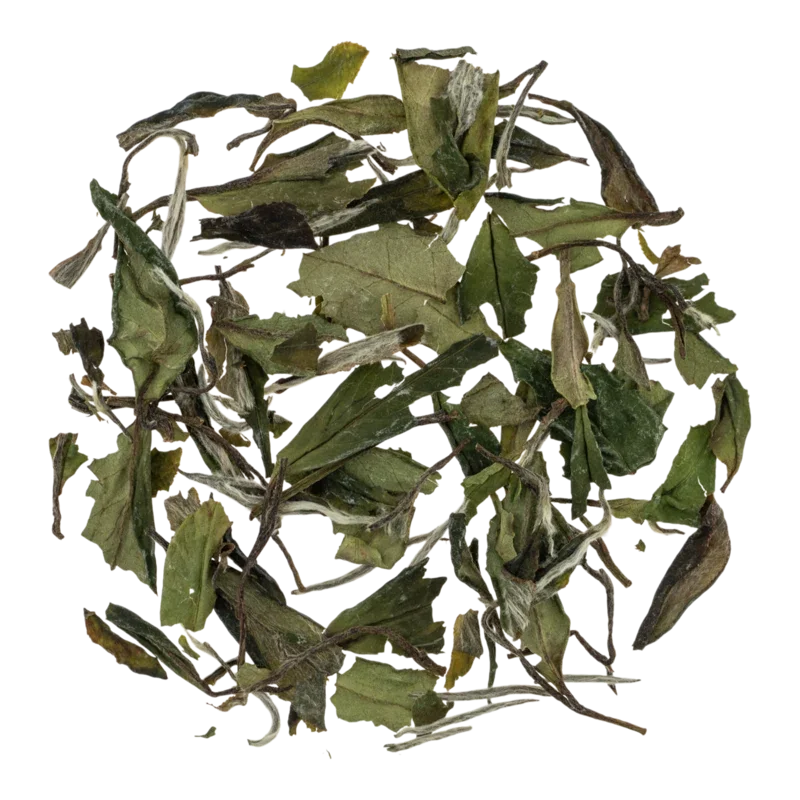
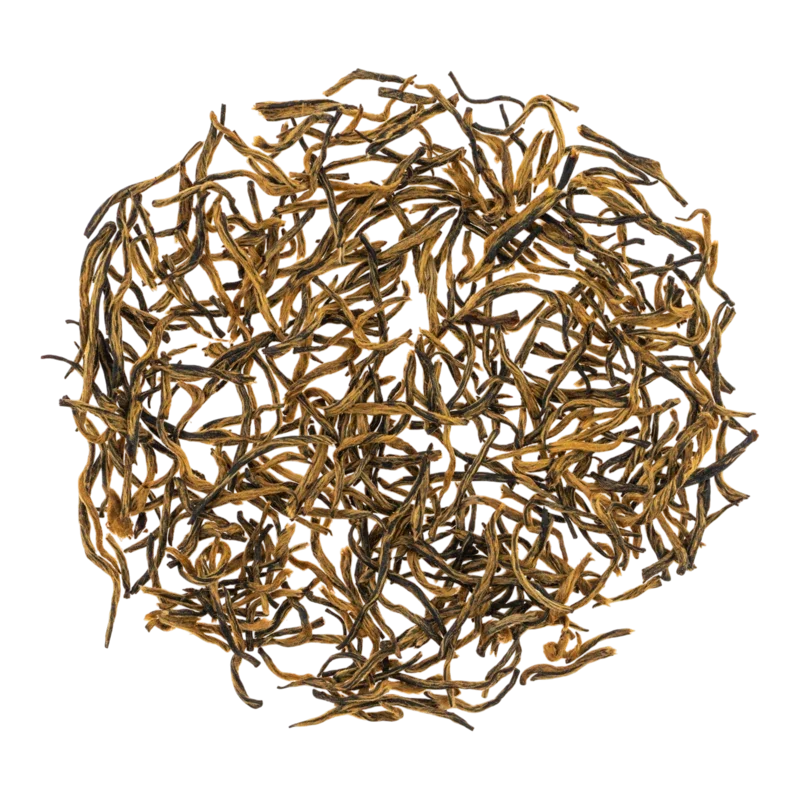
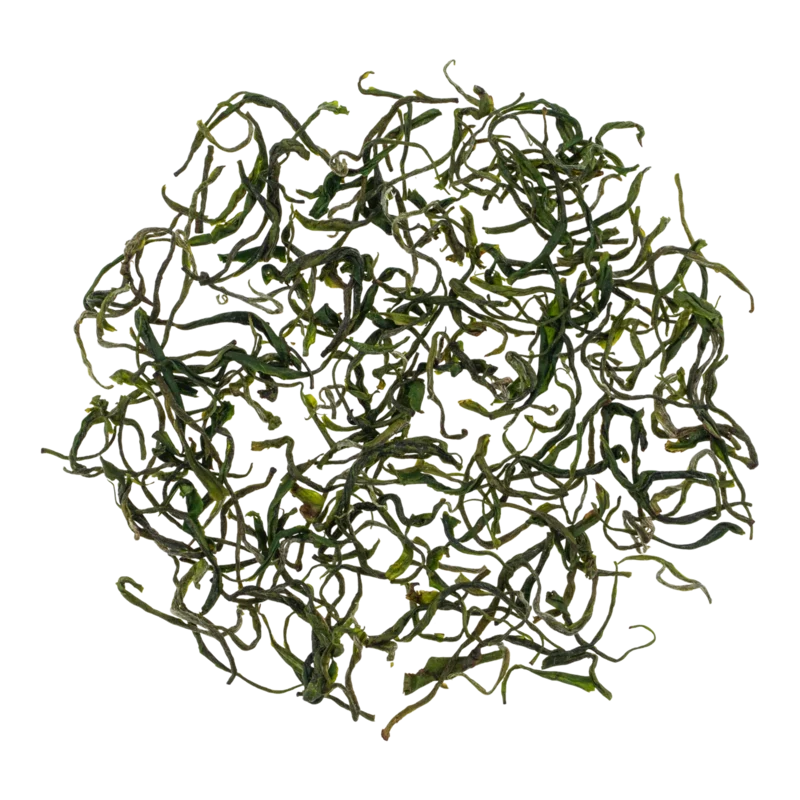
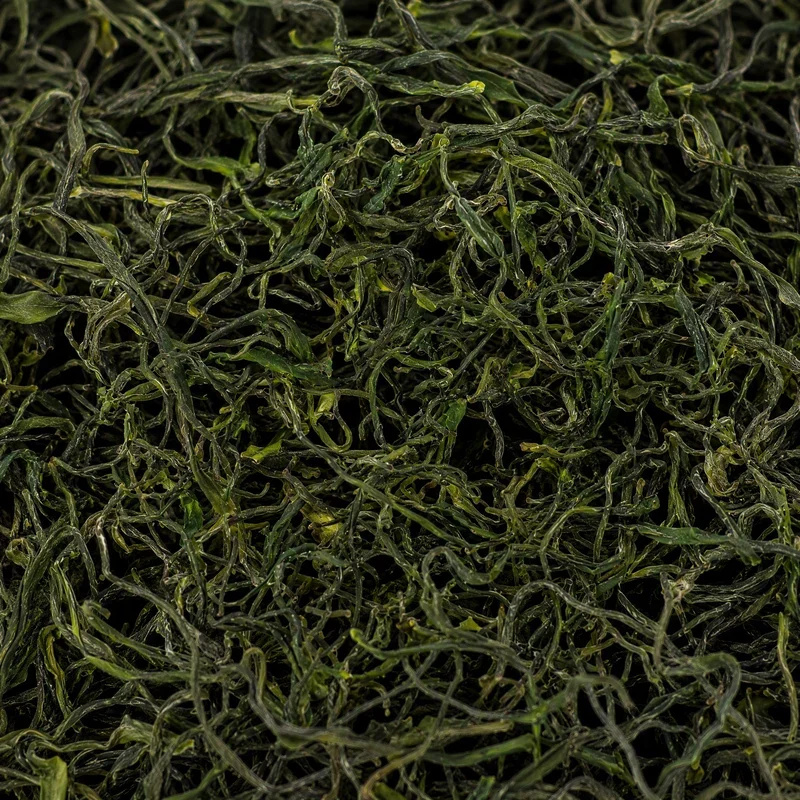
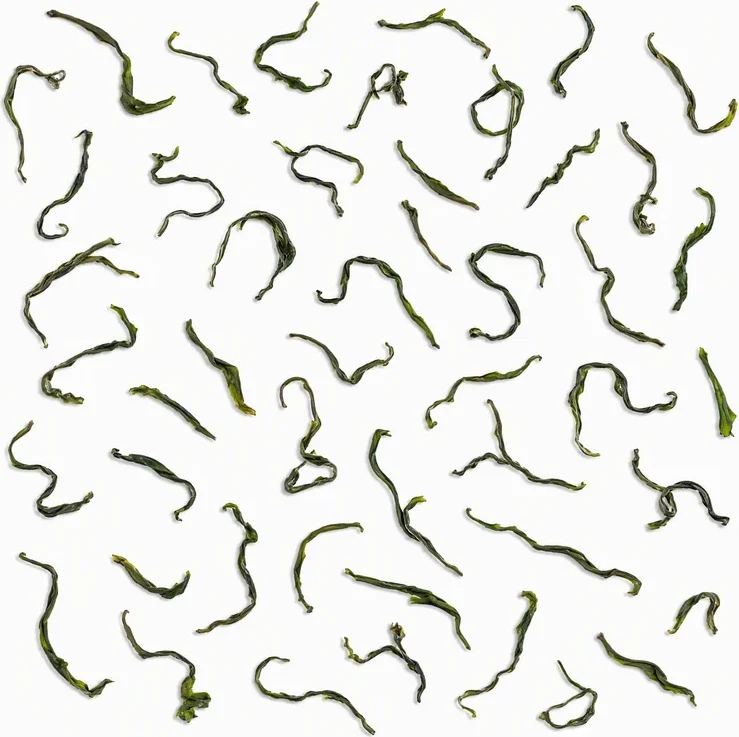
Dry Leaf Appearance: Depends on form. Baimao Wang — straight "needles" with abundant white down, resembling silver rods (形似银针, xíng sì yínzhēn). Lingluochun — tight spirals. Color — green with abundant white down (条索紧结、白毫显露, tiáosuǒ jǐnjié, báiháo xiǎnlù). Five famous characteristics: "色翠、毫多、香高、味浓、耐泡" — "emerald color, abundant down, high aroma, rich taste, durability".
Dry Leaf Aroma: Chestnut (板栗香, bǎnlì xiāng) — primary and most characteristic. Pure (清香, qīngxiāng). "Downy" (毫香, háoxiāng) — subtle "corn-like" note characteristic of abundantly downy teas.
Liquor Color: Tender green, clear and transparent (嫩绿清澈, nèn lǜ qīngchè). On second-third infusion — with light yellow tint.
Chestnut — deep, warm, persistent. "Downy" — sweetish note appearing upon cooling. Aroma persists in the cup for a long time, and spent leaves retain aroma even after several days — a rare characteristic.
Olive-green, tender, lustrous (青橄榄色、匀嫩亮润, qīng gǎnlǎn sè, yún nèn liàng rùn). Leaves — large, whole, with visible down. When brewed in a glass cup — leaves descend "standing", like spring shoots — a spectacular effect.
Taste: Fresh (鲜爽, xiānshuǎng). Rich and mellow (浓醇, nóngchún) — full-bodied infusion with pronounced structure, atypical for green teas and due to high polyphenol content (35.6%). Returning sweetness (回甘) — stable, long-lasting. Durability — 4–5 full infusions without losing character, also atypical and explained by large-leaf raw material.
Amino Acids: 3.36% — moderate indicator, characteristic of large-leaf varieties of southern origin. Polyphenol to amino acid ratio (酚氨比) — high (about 10.6:1), determining a "rich, structured" taste profile with noticeable astringency and long aftertaste.
182.92 mg/g — exceptional antioxidant potential. Main fractions — EGCG (epigallocatechin gallate), EGC, ECG, EC. For comparison: typical medium-leaf green tea contains 80–120 mg/g catechins.
4.91% — elevated, providing pronounced tonic effect.
Potassium, magnesium, manganese, zinc, iron, fluorine. Volcanic substrate provides expanded mineral profile.
The combination of large-leaf nature, 35.6% polyphenols and 182.92 mg/g catechins with 3.36% amino acids creates a profile atypical for green tea and approaching "pu'er-like" — with emphasis on body, structure and durability rather than lightness and "freshness".
Polyphenols: 35.6% — one of the highest indicators among Chinese green teas, comparable to Yunnan large-leaf teas (Dianlü, Pu'er Sheng). High content is due to large-leaf variety, subtropical climate with intense insolation, and volcanic soils stimulating phenolic compound synthesis.
Vitamins: Vitamin C — preserved thanks to "slow triple pan-firing" at low temperature. B-group vitamins (B₁, B₂, B₃). Vitamin E.
Tea Amount: 3 g per 150 ml (1:50 ratio).
Teaware: Glass cup (for observing the "dance" of downy needles). Gaiwan. Porcelain teapot.
Water Temperature: 80–85°C. Large-leaf material with high polyphenol content requires moderate temperature to avoid excessive bitterness.
Price Category: Superior grade (Baimao Wang, one bud + one leaf) — from 500–1,500 yuan/500 g depending on producer and year. Lingluochun — 200–600 yuan/500 g. Mass market — from 100 yuan/500 g.
No reviews yet. Tell us what you think of this tea.
Rate this tea and share your impressions. We review each submission before publishing it.