Brewing
Gongfu brewing
- Water temperature
- 75 °C
- Tea amount
- 5 g
- Water volume
- 100 ml
- First steep
- 10 s
- Time added per infusion
- 5 s
- Infusions
- 3

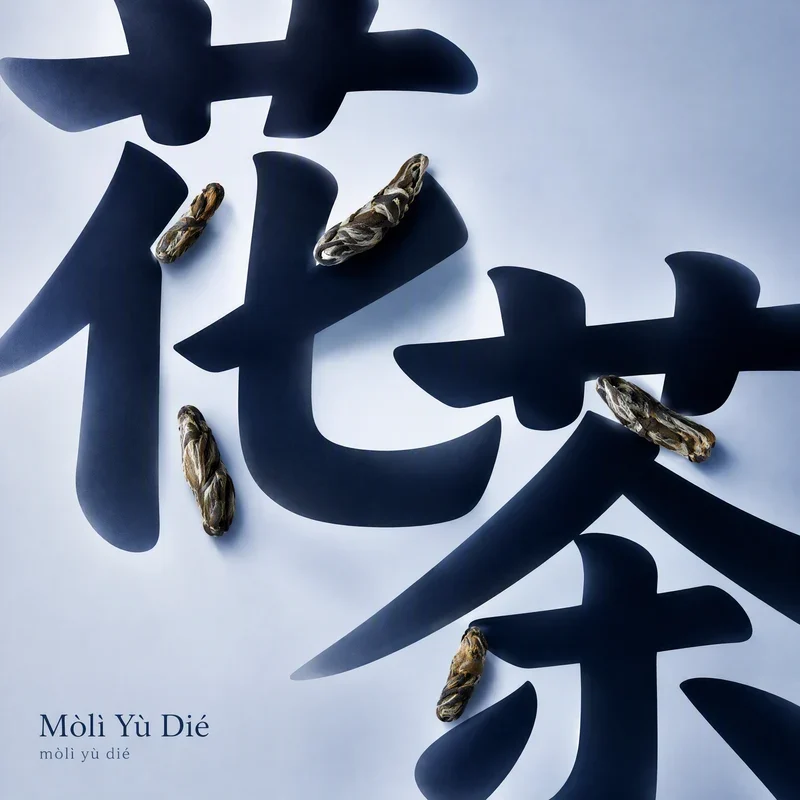
mòlì yù dié
Choose a brewing method. Start with the recommended quantities and time, then adjust to taste.
Brewing
Brewing
Taste
Tea encyclopedia
Category: Artistic jasmine tea (工艺花茶, gōngyì huāchá). Belongs to the group of hand-crafted shaped (bound) teas. Is a unique product of the Fuzhou school of jasmine tea production.
Category: Artistic jasmine tea (工艺花茶, gōngyì huāchá). Belongs to the group of hand-crafted shaped (bound) teas. Is a unique product of the Fuzhou school of jasmine tea production.
Coordinates: Fuzhou — approximately 26°04′ N, 119°18′ E.
Origin: China, Fújiàn Province (福建省, Fújiàn shěng), Fúzhōu city (福州, Fúzhōu) — the historic center of jasmine tea production, recognized as the birthplace of this technology. The Fǔzhōu scenting technology (窨制, yìnzhì) was included in the fourth registry of national intangible cultural heritage of the PRC in 2014, and in 2022 entered the UNESCO List of Intangible Cultural Heritage as part of the project "Traditional Chinese tea processing techniques and associated social practices." Production is also possible in Guǎngxī Province (广西, Guǎngxī) — the largest jasmine growing region, Yúnnán Province (云南, Yúnnán) and Sìchuān Province (四川, Sìchuān).
Type: Scented tea (花茶, huāchá) — green tea (non-oxidized), scented with jasmine. Belongs to the category of floral teas (再加工茶, zàijiāgōng chá — "reprocessed tea"), representing a special class in Chinese tea classification.
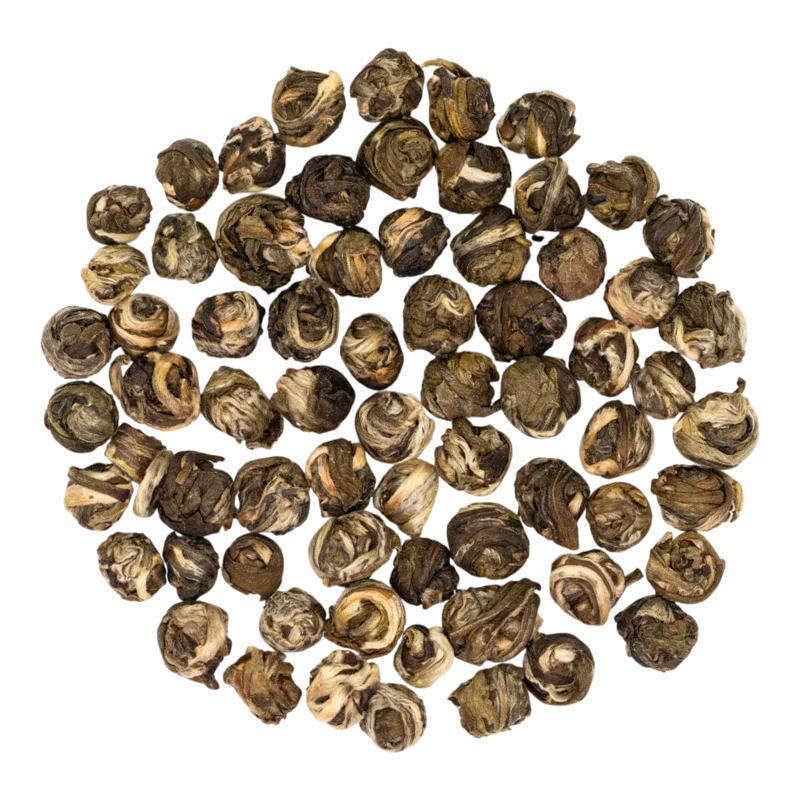
Leaves rolled into tight balls. Unlike the flat "butterfly" Yu Die, Long Zhu is more compact, unfolds longer and produces denser, more concentrated liquor. Both teas are high-quality shaped jasmine teas, but the visual effect during brewing is fundamentally different.
Base — white buds (silver needles, 白毫银针, Báiháo Yínzhēn). Taste is more subtle, delicate and sweet, with less density than Yu Die. Jasmine aroma is gentler and more transparent. Belongs to premium price segment.
General name for all jasmine teas. Standard Moli Hua Cha — loose tea without shaped forming, often machine-produced with 3–4 scenting cycles. Yu Die surpasses it in raw material quality, number of scenting cycles and, of course, aesthetic impression.
Another hand-crafted shaped jasmine tea where leaves are formed into an elongated oval resembling the eye of the mythical phoenix bird. Taste-aroma profile is close to Yu Die, main difference is in form and symbolism: butterfly (Yu Die) embodies lightness and rebirth, phoenix eye (Feng Yan) — revival and prosperity.
Cultural Significance: The butterfly in Chinese culture is a symbol of joy, lightness and rebirth. The image of a butterfly fluttering among flowers is closely connected with Daoist aesthetics and the famous parable of Zhuāngzǐ (庄子, Zhuāngzǐ) about the butterfly dream. Moli Yu Die is valued not only as a beverage but also as an object of contemplation: the process of the "butterfly" unfolding in hot water carries meditative, aesthetic pleasure. This tea is one of the most popular gift varieties of jasmine tea, symbolizing beauty and refinement.
History: The art of scenting tea with jasmine originated in China during the Sōng dynasty (宋朝, Sòng cháo, 960–1279), when methods of combining tea with flower aromas were first described. The flourishing of the technology occurred during the Míng (明朝, Míng cháo, 1368–1644) and Qīng (清朝, Qīng cháo, 1644–1912) dynasties. As Zhú Quán (朱权) wrote in "Tea Records" (《茶谱》, Chápǔ): "among flowers for combining with tea, the best are meihua, guihua and jasmine." During the Qing era, Empress Dowager Cíxǐ (慈禧太后, Cíxǐ Tàihòu) particularly valued jasmine and made it her personal flower at court, after which Fǔzhōu jasmine tea received the status of tribute tea (贡茶, gòngchá), and Fuzhou became the largest center for jasmine tea production and trade.
For producing Moli Yu Die, high-quality green tea is used, typically of the hongqing type (烘青, hōngqīng — "dried with hot air"), produced in spring in Fujian Province. Precisely the hongqing base best absorbs and retains jasmine aroma due to the porous structure of the leaf. Tea bush variety — predominantly Camellia sinensis var. sinensis, local Fujian small-leaf populations.
Fresh, just-opened jasmine flowers of the species Jasminum sambac (L.) Ait. (sambac jasmine, 茉莉花, mòlihuā), also known as "Arabian jasmine," are used. This particular species possesses the most intense, sweet, pure aroma among all commercially used jasmine species. More than 110 aromatic compounds have been identified in J. sambac flowers, with key ones being linalool (芳樟醇, fāngzhāngchún), benzyl alcohol (苯甲醇, běnjiǎchún), methyl benzoate (苯甲酸甲酯, běnjiǎsuān jiǎzhǐ) and indole (吲哚, yǐnduǒ).
Early spring (March–April). Tender buds with one or two top leaves are picked (一芽一叶或一芽二叶, yī yá yī yè or yī yá èr yè). The raw material must be whole, fresh, without mechanical damage.
Flowers are collected during summer months (June–September), predominantly after 2:00 PM, when buds reach maximum maturity and readiness to open. Fuzhou masters observe the principle of "three prohibitions" (三不采, sān bù cǎi): do not collect in the morning, do not collect in cloudy weather, do not collect for three days after rain.
Raw Material: Exceptionally high. Only undamaged, aromatic jasmine buds and select tea buds with downy fuzz (白毫, báiháo) are selected.
Subtropical monsoon climate with mild winter and hot humid summer. Average annual temperature +19…+21°C, precipitation 1200–1600 mm per year. Tea plantations are located predominantly at 200–800 m above sea level in mountainous areas of northern and western Fujian, where acidic red-yellow soils (红壤, hóng rǎng) with high organic matter content are favorable for forming the mild, sweetish taste of green tea.
Jasmine growing zones are located along the Mǐn River (闽江, Mǐnjiāng) and Wūlóng River (乌龙江, Wūlóngjiāng), on alluvial sandy soils (冲积土, chōngjī tǔ) with deep fertile layer. Warm days and relatively cool nights promote accumulation of aromatic substances in flowers, giving Fuzhou jasmine its characteristic "icy sweetness" (冰糖甜, bīngtáng tián). The "Fuzhou Jasmine and Tea Culture" system was included in the FAO list of Globally Important Agricultural Heritage Systems (GIAHS) in 2014.
Lowland plains, 5–50 m above sea level.
At the final stage, masters hand-form butterfly figures from the scented tea leaves. Several leaves and buds are carefully folded and secured with thread or interweaving, creating the characteristic silhouette with "wings." This is a meticulous, labor-intensive operation requiring years of experience and jeweler's precision.
Finished "butterflies" are sorted by size, symmetry of form and aroma quality.
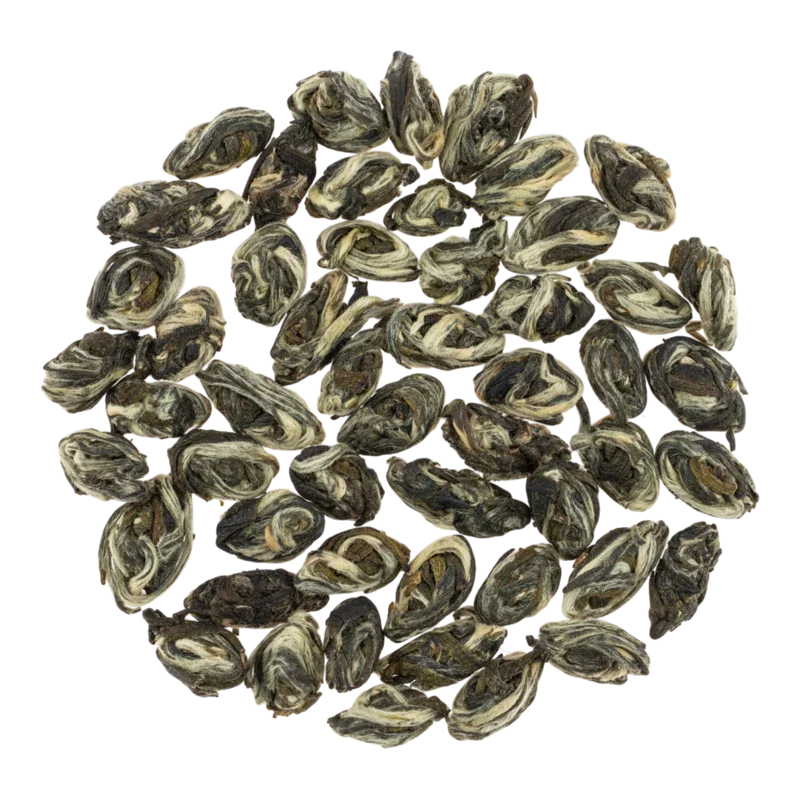
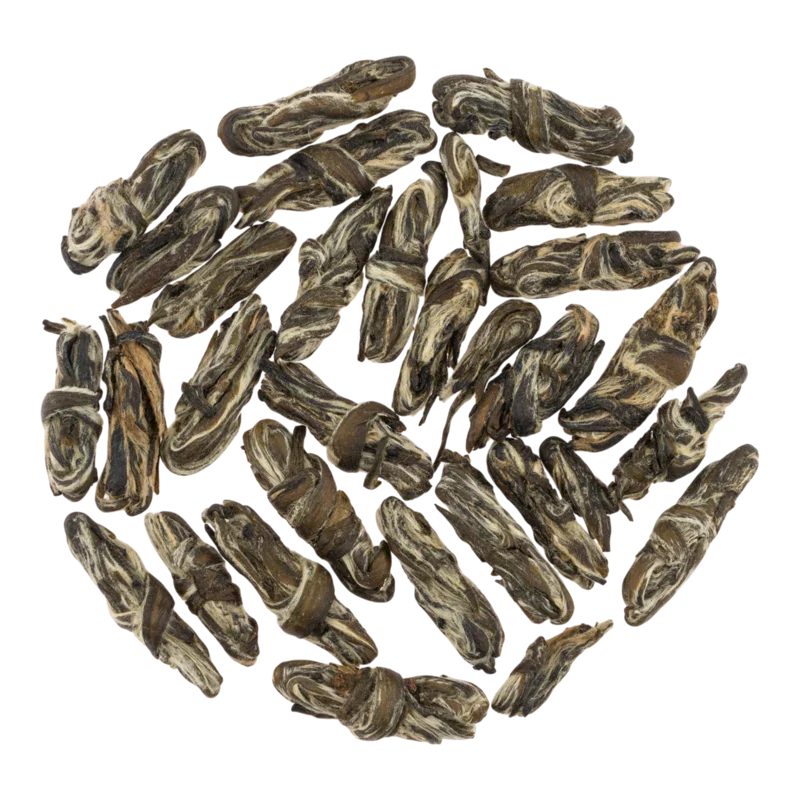
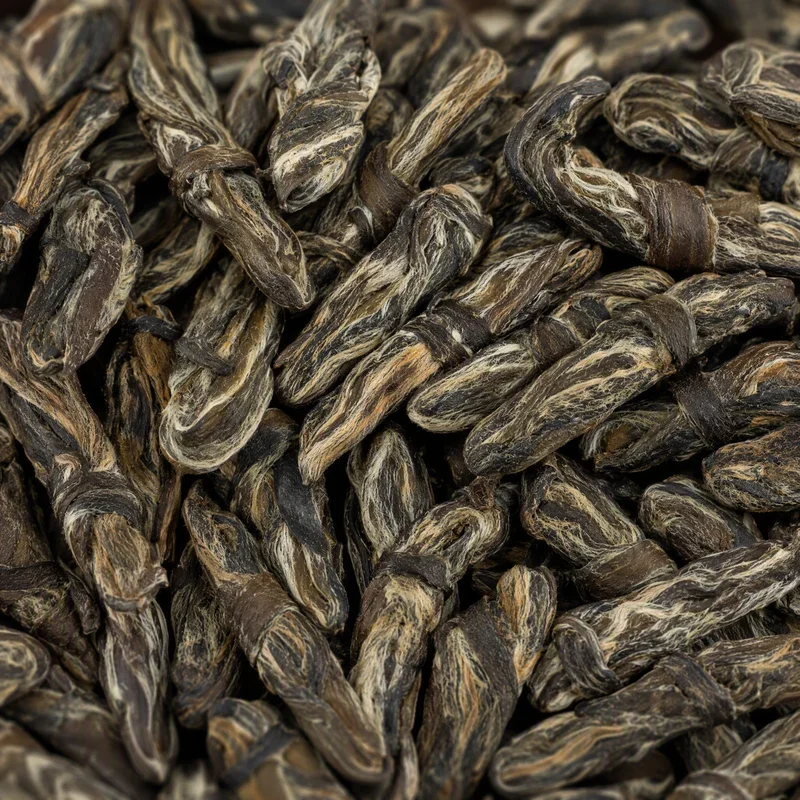
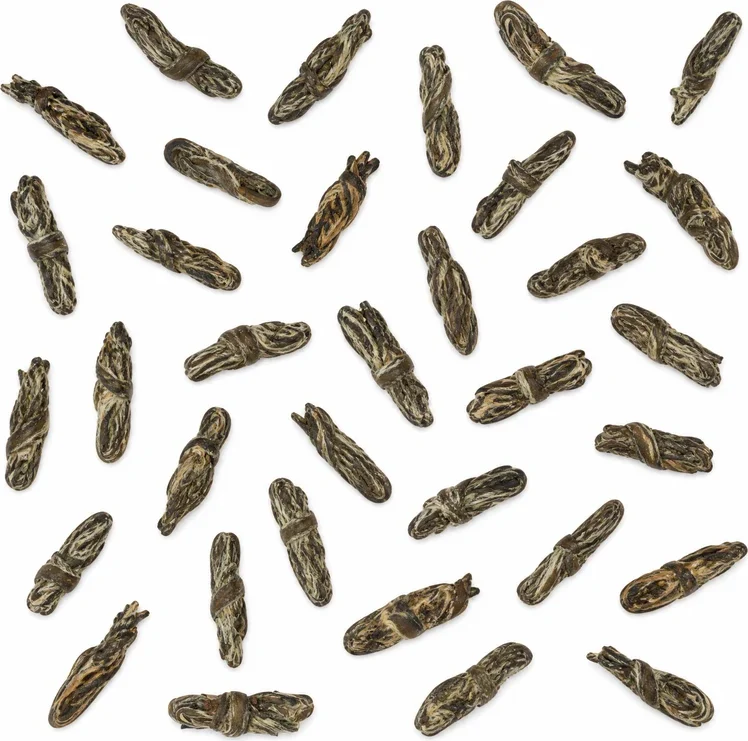
Dry Leaf Appearance: Neat butterfly-shaped figures with symmetrically spread "wings." Size varies from 3 to 5 cm. Color — from silvery-green to olive-green, often with visible white down (白毫, báiháo) on buds. Individual dried jasmine petals may be present among the leaves.
Dry Leaf Aroma: Bright, rich jasmine aroma with notes of fresh greenery and light honey sweetness. The scent should be clean, natural, without signs of artificial fragrances or mustiness.
Liquor Aroma: Enveloping, deep jasmine aroma with tones of creamy sweetness and barely perceptible floral freshness characteristic of high-quality linalool. As it cools, subtle green-grassy undertones from the tea base emerge.
Liquor Color: Light yellow with golden tint, transparent, clean, with bright luster. With repeated infusions the shade becomes lighter, pale straw-colored.
Spent Leaves: Opened buds and leaves of tender green color, soft, elastic. The "butterfly" often retains its shape even after several brewings, which testifies to manufacturing mastery. Leaves demonstrate high raw material quality — whole, without damage.
Taste: Soft, tender, refreshing, with pronounced natural sweetness. The taste harmoniously interweaves tones of green tea and jasmine. Astringency is minimal or absent, no bitterness. Aftertaste is long, clean, floral-honey, with light coolness (回甘, huígān).
Alkaloids: Caffeine — 2–3% of dry mass (approximately 20–35 mg per 150 ml cup). Theobromine and theophylline in trace amounts.
Amino Acids: L-theanine (L-茶氨酸, L-cháānjīsuān) — 1–2% of dry mass, providing sweetish taste and calming effect combined with mild stimulation.
Form the basis of the aromatic profile. Key components: linalool (铃兰型香气 — lily-of-the-valley tone), benzyl acetate (蜂蜜般甜味 — honey sweetness), methyl benzoate (floral-fruity tone), indole (in small concentrations enhances perception of floral aroma), methyl anthranilate (orange blossom tone), α-farnesene. The total number of identified volatile compounds in jasmine tea exceeds 145.
Preserved thanks to kill-green fixation at the shaqing stage, gives the liquor a greenish tint.
Minerals: Potassium, magnesium, fluorine, manganese, zinc.
Polyphenols: Total polyphenol content in the green tea base comprises 15–25% of dry mass. Key catechin — epigallocatechin-3-gallate (EGCG), possessing pronounced antioxidant activity.
Vitamins: Ascorbic acid (vitamin C), B-group vitamins (B₁, B₂), vitamin P (rutin).
Green tea catechins, especially EGCG, neutralize free radicals and reduce oxidative stress, slowing cellular aging processes.
The combination of caffeine and L-theanine provides smooth, prolonged alertness without sharp peaks and drops, improves concentration and cognitive functions.
Jasmine aromatic components — linalool and benzyl acetate — have a mild sedative effect on the nervous system, reduce anxiety levels and promote emotional relaxation.
Polyphenols and catechins stimulate secretion of digestive enzymes, promote normalization of metabolism.
Regular green tea consumption is associated with lowering "bad" cholesterol (LDL) levels and normalizing blood pressure.
Thanks to the complex of vitamins C and B-group, as well as catechins with antibacterial properties.
Jasmine essential oils possess antiseptic properties that suppress growth of certain pathogenic microorganisms.
Excellently quenches thirst, especially in cold brewing (冷泡茶, lěng pào chá) during summer.
Tea Amount: 1 "butterfly" (approximately 5–7 g) per 150–200 ml water. When brewing in a glass teapot, 2–3 "butterflies" can be used for 300–500 ml volume.
Teaware: Glass teapot or glass bowl (玻璃壶, bōli hú) — ideal choice, allowing observation of the "butterfly" unfolding. White porcelain gàiwǎn (盖碗, gàiwǎn) and porcelain teapot are also suitable. Clay teaware (Yixing teapots) is not recommended since porous clay absorbs jasmine aroma.
Water Temperature: 75–85°C. Too hot water "burns" delicate leaves, causing bitterness and destroying subtle aromatic components.
Container: Airtight opaque container — porcelain, tin can or vacuum foil bag. Glass container is acceptable provided storage in darkness.
Enemies: Moisture, light, foreign odors, high temperature. Multiple opening of packaging should be avoided.
Shelf Life: Under proper conditions — 12–18 months. Over time jasmine aroma gradually weakens, so consumption within a year of purchase is recommended.
Temperature: Optimal storage in refrigerator at 0–5°C in a separate airtight compartment, isolated from products with strong odors.
Leaves are rolled into tight balls. Unlike the flat "butterfly" of Yu De, Long Zhu is more compact, takes longer to unfurl, and produces a denser, more concentrated infusion. Both teas are high-quality shaped jasmine teas, but the visual effect during brewing is fundamentally different.
Based on white buds (silver needles, 白毫银针, Báiháo Yínzhēn). The taste is more delicate, refined and sweet, with less density than Yu De. The jasmine aroma is gentler and more transparent. Belongs to the premium price segment.
General name for all jasmine teas. Standard Moli Hua Cha is loose tea without shaped forming, often machine-produced with 3–4 scenting cycles. Yu De surpasses it in raw material quality, number of scenting cycles and, naturally, in aesthetic impression.
Another handcrafted shaped jasmine tea where leaves are formed into an elongated oval resembling the eye of the mythical phoenix bird. The flavor-aromatic profile is close to Yu De, the main difference lies in shape and symbolism: the butterfly (Yu De) embodies lightness and transformation, while the phoenix eye (Feng Yan) represents rebirth and prosperity.
Price Category: Suspiciously low cost for tea of this class is a sure sign of fake or use of synthetic fragrances instead of natural jasmine.
"Butterflies" should be neatly formed, approximately the same size, without broken leaves, dust and foreign inclusions. Careless form is a sign of low-quality product or fake.
Natural jasmine aroma — soft, deep, multi-layered. Sharp, "perfumery," cloying smell indicates use of artificial fragrances. In quality tea, jasmine aroma harmoniously interweaves with green tea note rather than overpowering it.
Soft, sweetish, without bitterness. Bitter or "empty" taste indicates poor raw material or insufficient scenting.
Transparent, clean, light golden. Cloudy or dark liquor is a warning sign.
No reviews yet. Tell us what you think of this tea.
Rate this tea and share your impressions. We review each submission before publishing it.