Brewing
Gongfu brewing
- Water temperature
- 75 °C
- Tea amount
- 5 g
- Water volume
- 100 ml
- First steep
- 10 s
- Time added per infusion
- 5 s
- Infusions
- 3




mòlì lóngzhū
Choose a brewing method. Start with the recommended quantities and time, then adjust to taste.
Brewing
Brewing
Taste
Tea encyclopedia
Alt Names: Fújiàn Zhū (福建珠, Fújiàn Zhū), Mòlì Bái Lóngzhū (茉莉白龙珠, Mòlì Bái Lóngzhū — "White Dragon Pearl", variant made from white buds), Mòlì Xiuqiu (茉莉绣球, Mòlì Xiùqiú — "Embroidered Jasmine Ball"), Jasmine Dragon Pearls (English).
Alt Names: Fújiàn Zhū (福建珠, Fújiàn Zhū), Mòlì Bái Lóngzhū (茉莉白龙珠, Mòlì Bái Lóngzhū — "White Dragon Pearl", variant made from white buds), Mòlì Xiuqiu (茉莉绣球, Mòlì Xiùqiú — "Embroidered Jasmine Ball"), Jasmine Dragon Pearls (English).
Category: High-quality scented teas of China. Mòlì Long Zhú stands alongside such iconic jasmine teas as Mòlì Yín Zhèn (茉莉银针), Mòlì Dà Bái Háo (茉莉大白毫) and Mòlì Shòu Zhú (茉莉寿珠).
Coordinates: Approximately 26°05′ N, 119°18′ E (for Fuzhou).
Origin: China, Fújiàn Province (福建, Fújiàn), Fúzhōu city (福州, Fúzhōu) — the historical birthplace of jasmine teas and the recognized center of the yinzhi industry in China. Specific production areas: Jin'an (晋安区, Jìn'ān qū), Cāngshān (仓山区, Cāngshān qū), Mǎwěi (马尾区, Mǎwěi qū), Mǐnhóu County (闽侯县, Mǐnhóu xiàn), Chánglè (长乐, Chánglè), Yǒngtài County (永泰县, Yǒngtài xiàn), Mǐnqīng County (闽清县, Mǐnqīng xiàn). Mòli Lǒng Zhú is also produced in Guǎngxī Zhuāng Autonomous Region (广西, Guǎngxī) — the largest jasmine-growing region in China — as well as in Sìchuān (四川, Sìchuān) and Yúnnán (云南, Yúnnán) provinces, where large-leaf Yunnan cultivars (Camellia sinensis var. assamica) are used, producing a more full-bodied liquor.
Type: Scented tea (再加工茶, zài jiāgōng chá; 花茶, huāchá). Base — green tea (non-oxidized), hongqing (烘青, hōngqīng). Scenting method — multiple yinzhi (窨制, yìnzhì) with fresh jasmine flowers. Belongs to the subcategory of special jasmine teas (特种茉莉花茶, tèzhǒng mòlì huāchá).
Cultural Significance: Jasmine tea is an integral part of daily life for Fuzhou residents and a symbol of the city. Jasmine has been Fuzhou's municipal flower since 1985. In Fuzhou tradition, the word "moli" (茉莉, jasmine) sounds similar to "莫离" (mò lí — "don't part"), making jasmine teas a symbol of loyalty and longing for home. Writer Bīng Xīn (冰心, Bīng Xīn), a native of Fuzhou, wrote: "In the homes and shops [of Fujian emigrants], over Fujian food and jasmine tea, I feel that for a Fujianese, the whole world is home." In old Fuzhou, there was a romantic custom: on the night of Qìxī (七夕, Qīxī — Chinese "Valentine's Day"), girls on boats decorated with jasmine would scatter flowers on the river, praying for happy love. Jasmine tea is traditionally drunk after meals to improve digestion and served to guests as a sign of hospitality. At the end of the Qing reign and the beginning of the Republican era, jasmine tea became part of Beijing's cultural code thanks to the oldest tea brands — Zhāng Yī Yuán (张一元) and Wǔ Yǔ Tái (吴裕泰), which use Fujian raw materials and traditional technologies. Fuzhou jasmine tea is the only jasmine tea included in the "Registry of Famous Chinese Teas" (《中国名茶志》) as a historical famous tea (历史名茶) in the flower tea category.
History: The tradition of scenting tea with jasmine in Fujian is one of the oldest in the world, with a history of more than 800 years. Jasmine (Jasminum sambac) arrived in China from South Asia via the Maritime Silk Road during the Western Hàn era (西汉, Xī Hàn, 206 BCE — 9 CE) and firmly took root in Fuzhou, where a characteristic landscape formed: "tea trees on hills, jasmine along rivers" (山丘栽茶树,沿河种茉莉). The origins of scenting tea with flowers can be traced to the Northern Sōng era (北宋, Běi Sòng, 960–1127), when Fuzhou became the "jasmine capital" and began producing the first jasmine teas. Southern Sōng poet Shì Yuè (施岳) in the ci "Bu Yue — Moli" (《步月·茉莉》) described the early jasmine scenting technique: «焙旋熏» (roasting while immediately scenting). In 1240, Zhào Xīhú (赵希鹄) in the treatise "Tiaoxie leibian" (《调燮类编》) detailed the methodology for making jasmine tea. By the Míng era (明朝, Míng cháo, 1368–1644), the yinzhi technology had formed into a stable system: Xú Bó (徐勃) in "Mingtan" (《茗谭》) wrote: «闽人多以茉莉之属,浸水瀹茶» — "Fujian people commonly steep tea with jasmine and similar flowers." In the Qīng era (清朝, Qīng cháo), under Emperor Xiánfēng (咸丰, 1850–1861), Fújiàn jasmine tea received the status of tribute tea (贡茶, gòng chá) and entered mass commercial production. Empress Dowager Cíxǐ (慈禧, Cíxǐ) particularly revered jasmine teas and presented them as gifts to foreign diplomats; under her reign, jasmine was once considered the "national flower." From 1856–1886, Fuzhou became one of Ch
Name Breakdown: Each character carries semantic meaning:
For the highest quality Moli Long Zhu, hongqing lücha (烘青绿茶, hōngqīng lǜchá) is used — green tea dried by hot air heating. This method preserves the natural taste of tea without introducing extraneous tones characteristic of pan-firing (炒青, chǎoqīng), and provides optimal leaf porosity for absorbing jasmine aroma. Traditional Fujian cultivars: Fúdǐng Dà Bái Chá (福鼎大白茶, Fúdǐng Dà Bái Chá), Fúdǐng Dà Háo Chá (福鼎大毫茶, Fúdǐng Dà Háo Chá) — large-bud varieties of Camellia sinensis var. sinensis with abundant white down, providing excellent absorption of aromatic compounds — as well as Róngchūn Zǎo (榕春早, Róngchūn Zǎo) and local Gǔshān cacha (鼓山菜茶, Gǔshān càichá). Yunnan versions are based on large-leaf Camellia sinensis var. assamica, which produces a more full-bodied liquor with pronounced honey sweetness.
Fresh flowers of jasmine sambac (Jasminum sambac (L.) Ait.) — a perennial evergreen shrub of the olive family (Oleaceae). For scenting, both double (双瓣, shuāngbàn) and single (单瓣, dānbàn) flowers are used, which alternate during multiple scenting. The highest quality flowers are those collected during the period of "three hot seasons" (三伏, sān fú) — at the height of summer (July–August), when jasmine exhibits maximum fragrance.
Spring (March–April), period of early spring shoots (明前, míngqián or 雨前, yǔqián). After harvest, the leaf undergoes a full cycle of green tea production and is rolled into pearls before the jasmine season begins.
Summer (June–September). Buds are collected in the second half of the day (after 2:00 PM), when they are maximally filled but not yet fully opened — on the verge of full opening, possessing the greatest reserve of aromatic oils and "tuxiang energy" (吐香, tǔ xiāng — "fragrance emission"). Opening and maximum aroma release occur in the evening and night, which determines the night work schedule of scenting masters.
Pluck Standard: One bud and one-two upper leaves (一芽一叶 or 一芽二叶). For premium batches — single buds (单芽, dān yá).
Raw Material: Exceptionally high. Tea buds — whole, uniform, without mechanical damage. Jasmine buds — snow-white, firm, without signs of wilting or damage.
Located in southeastern China in the lower reaches of the Mǐn River (闽江, Mǐn Jiāng). Subtropical marine monsoon climate: mild winter, hot humid summer, abundant precipitation (1100–1700 mm per year), average annual temperature 19–20°C, frost-free period ~326 days. Jasmine plantations are concentrated on alluvial plains along the banks of the Mǐn River and Wūlóng River (乌龙江, Wūlóng Jiāng) — fertile alluvial soils (冲积平原砂壤土), slightly acidic or neutral, loose, well-drained, rich in organic matter. The key factor is the sharp difference between day and night temperatures in summer: hot days intensify the synthesis of aromatic compounds in buds, cool sea breezes at night slow their dissipation, "sealing" the aroma. According to research by Peking University (1988), Fuzhou jasmine contains at least 43 volatile compounds in the head notes, including unique cis-jasmone (顺式茉莉酮, shùnshì mòlìtóng) and cis-3-hexenol, not found in jasmine from other regions of China. It is precisely this molecular "signature" that gives Fuzhou jasmine tea its unique "ice sugar sweetness" (冰糖甜, bīngtáng tián).
Located in mountainous areas of Fujian at altitudes of 200–1000 m above sea level. Soils — acidic red and yellow earths (pH 4.5–6.0), rich in iron and organic compounds. Frequent fogs and abundant diffused light create ideal conditions for amino acid accumulation.
Plantations at altitudes of 1200–1800 m, on large-leaf trees. Yunnan Moli Long Zhu is distinguished by a denser liquor body and honey sweetness, due to the characteristics of the assamica variety.
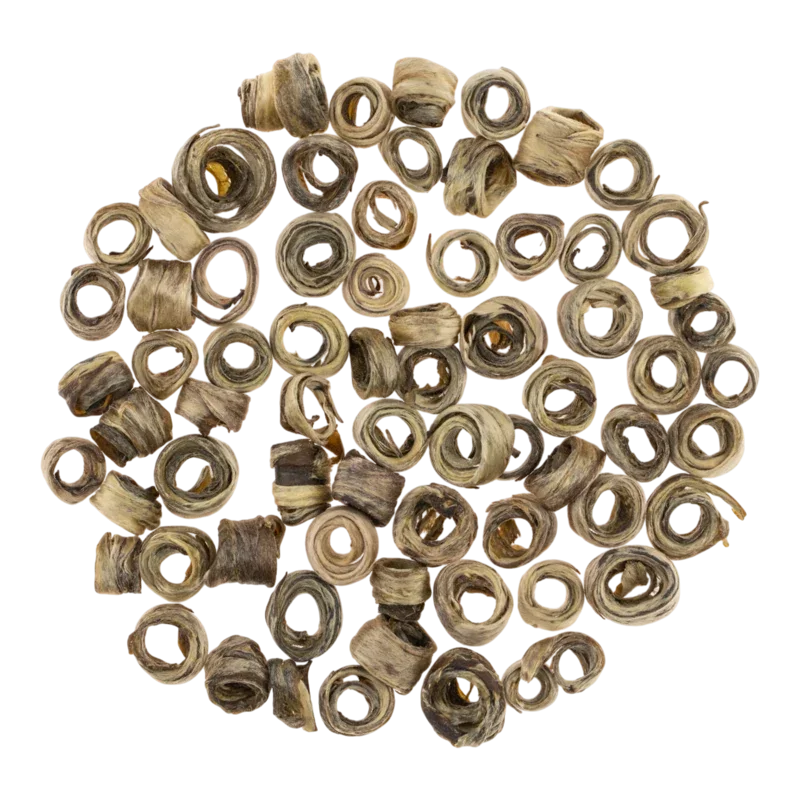
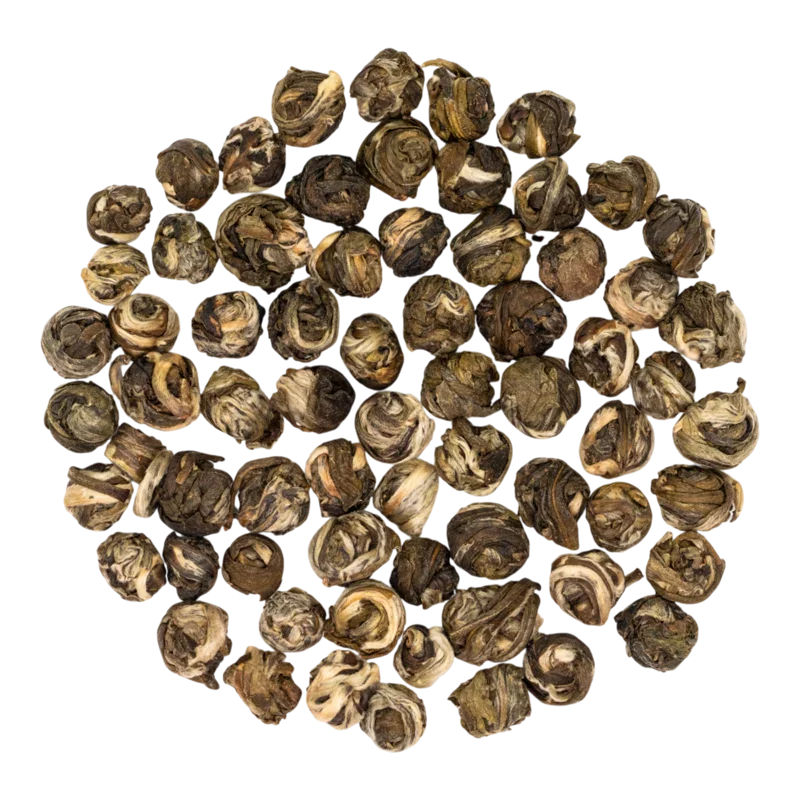
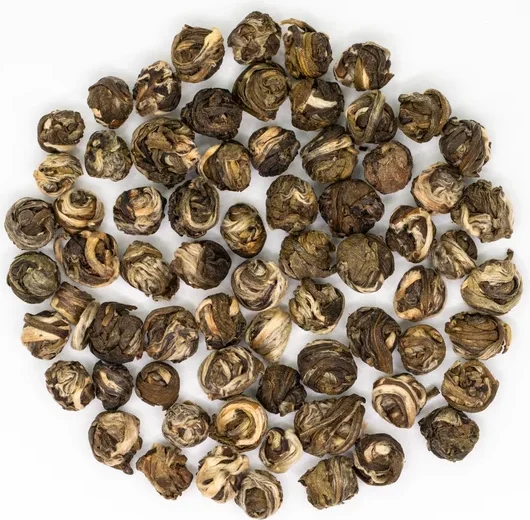
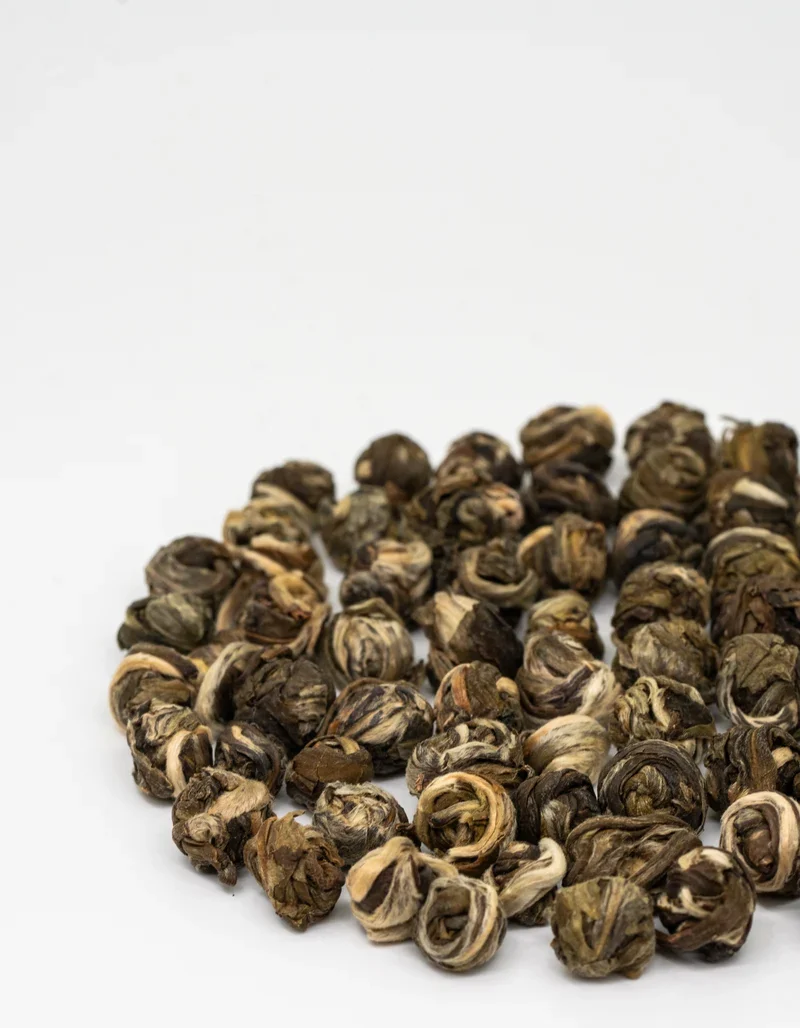
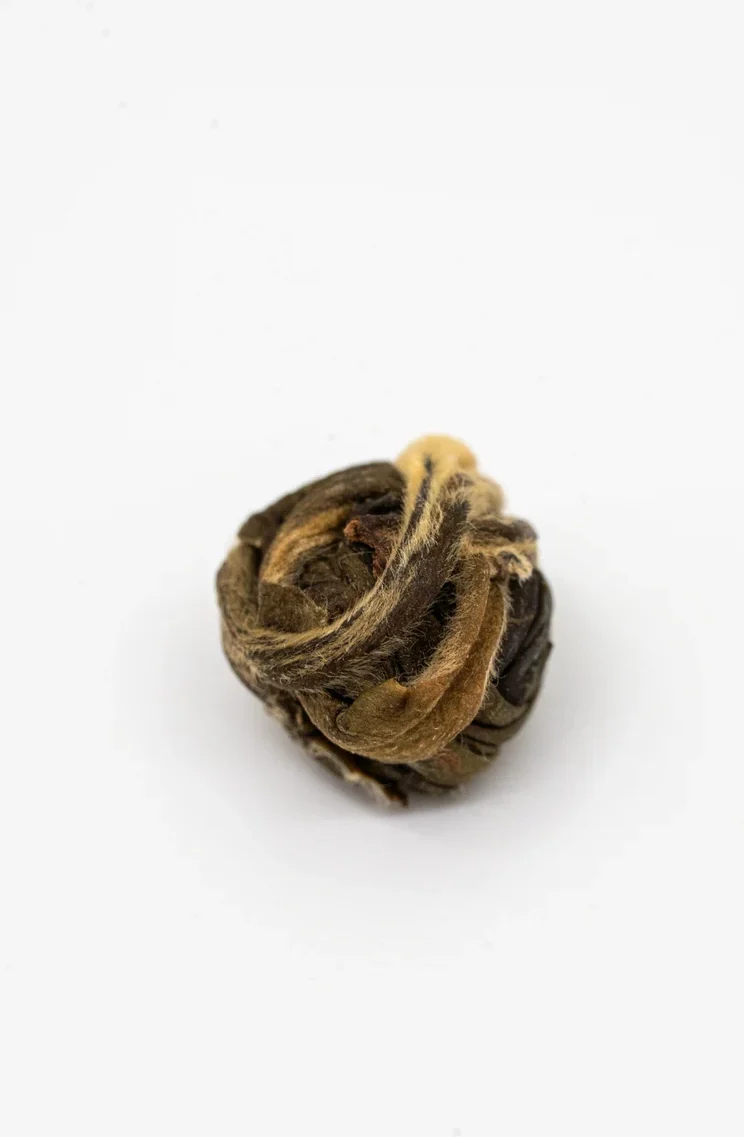
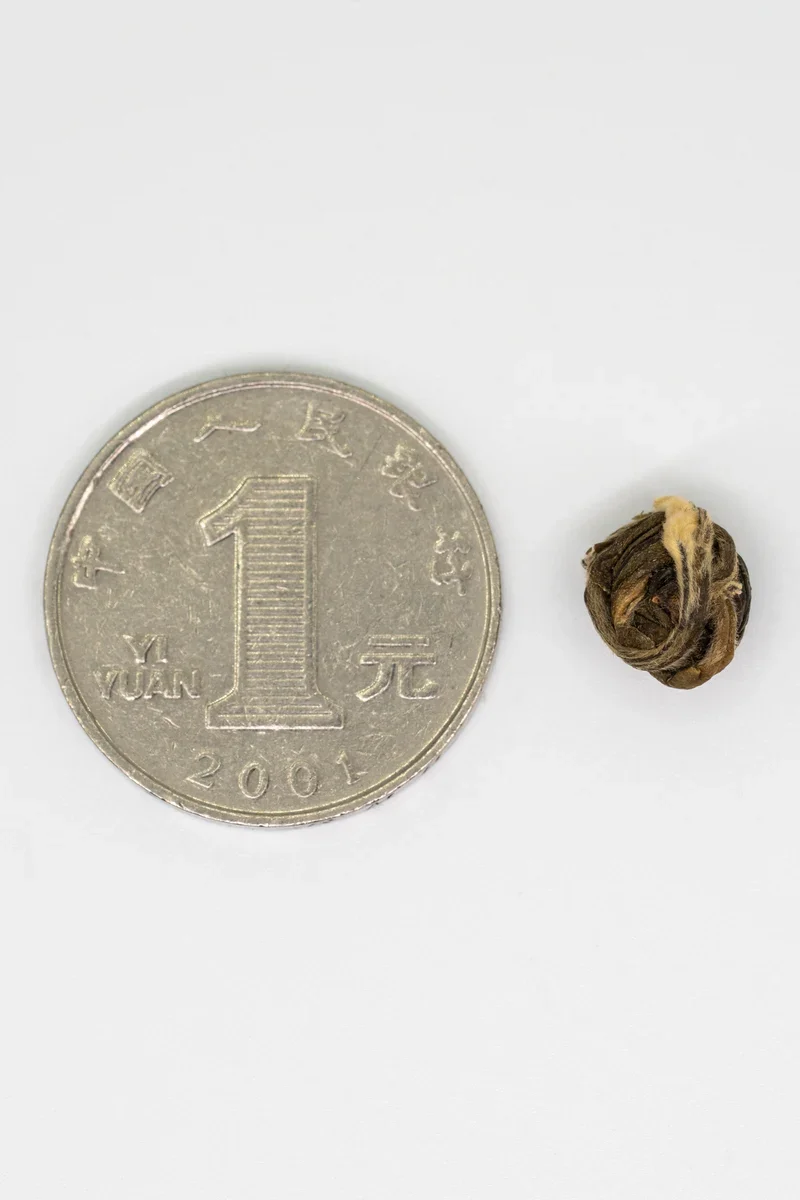
Dry Leaf Appearance: Tightly rolled spherical pearls 8–12 mm in diameter, heavy to the touch — when dropped on a hard surface they produce a characteristic sound. Color — from silvery-green to dark green, surface covered with protruding white tips (白毫, báiháo). Pearls are even in size, without broken leaves, dust and yellow flower petals (presence of petals is a sign of low quality or careless processing).
Dry Leaf Aroma: Intense, sweet, with pronounced jasmine tone and "living freshness" (鲜灵, xiānlíng) — a term used by Fuzhou tasters denoting brightness, purity and naturalness of jasmine spirit. Under the jasmine layer, the green tea base can be detected. The aroma is not sharp, but enveloping, "silky."
Liquor Aroma: Rich, deep, multi-layered jasmine, with notes of fresh greenery, light honey warmth and subtle fruity undertones. Fuzhou samples of the highest class are distinguished by a special characteristic — "ice sugar sweetness" (冰糖甜), soft, rounded jasmine aftertaste without oiliness. The aroma is persistent, lasting through 4–5 steepings.
Liquor Color: Light yellow with golden tint, transparent, clear, with pronounced brightness. With each scenting cycle, the liquor acquires a slightly deeper yellow tone (consequence of polyphenol breakdown during yinhua).
Spent Leaves: When brewed, pearls slowly unfold, opening into whole buds and leaves of tender green or yellow-green color, soft, elastic, uniform in size. The sight of an unfolding pearl in a glass cup is one of the most aesthetic in tea culture.
Taste: Soft, rounded, sweetish, with distinct velvety texture and natural sweetness. Harmonious fusion of green tea tenderness and jasmine floral sweetness — "fragrant but not floating; fresh but not turbid" (香而不浮,爽而不浊, xiāng ér bù fú, shuǎng ér bù zhuó). Medium body, silky texture. Lǒng aftertaste (回甘, huígān), floral-honey, with light refreshing astringency. Bitterness is absent. With each steeping, new facets of taste are revealed.
Alkaloids: Caffeine — 2–4% dry weight (~30–50 mg per 150 ml cup). Theobromine and theophylline — in trace amounts.
Amino Acids: L-theanine — specific tea amino acid, content 1–2% dry weight. A total of up to 26 types of amino acids have been identified. Content is somewhat higher than in regular green teas, thanks to protein breakdown during yinhua.
More than 110 identified aromatic compounds. According to HS-SPME-GC-MS studies, key characteristic substances: linalool (芳樟醇, fāngzhāngchún) — dominant terpenoid with floral-lily aroma; benzyl acetate (乙酸苄酯) — honey-sweet tone; methyl anthranilate (邻氨基苯甲酸甲酯) — sweetish grape-orange undertone; indole (吲哚) — in small concentrations adds depth to aroma; methyl benzoate (苯甲酸甲酯) — fruity tone; methyl salicylate (水杨酸甲酯) — fresh minty note; cis-jasmone (顺式茉莉酮) — unique marker of Fuzhou jasmine, not found in jasmine from other regions; α-farnesene — fruity note; benzyl alcohol (苯甲醇) — affects aroma "liveliness" (鲜灵度).
Minerals: Potassium, magnesium, fluorine, zinc, manganese, phosphorus, selenium.
Polyphenols: Catechins — the main antioxidant group: epigallocatechin-3-gallate (EGCG), epicatechin (EC), epigallocatechin (EGC), epicatechin-3-gallate (ECG). Total polyphenol content — 15–30% dry weight. According to the Chinese Nutrition Society, polyphenol content in jasmine teas is close to pure green tea indicators (average ~31%).
Vitamins: C (ascorbic acid), E, β-carotene, B group (B₁, B₂, B₆).
Green tea catechins combined with jasmine phenolic compounds provide powerful cellular protection from oxidative stress. Research by the Chinese University of Hong Kong confirmed pronounced antioxidant activity of jasmine tea and its ability to reduce oxidative processes in blood.
Jasmine aromatic oils — primarily linalool — exhibit sedative effects, reduce cortisol levels, improve sleep quality and emotional state. Combination with L-theanine enhances this effect.
Caffeine combined with L-theanine provides calm, prolonged alertness without sharp peaks and "caffeine crash," improves concentration and short-term memory.
Polyphenols and jasmine aromatic oils stimulate digestive enzyme secretion and peristalsis, ease digestion of fatty foods. In China, jasmine tea is traditionally drunk after meals.
According to Professor Chen Zhen-yu (Chinese University of Hong Kong), the mechanism of action is related to reducing cholesterol and fat absorption from food. Catechins help lower LDL cholesterol levels and maintain vascular elasticity.
Polyphenols, polysaccharides and amino acids stimulate T- and B-lymphocyte proliferation, increase interleukin IL-2 and IL-3 activity.
Jasmine essential oils possess proven antiseptic properties, especially against oral cavity pathogens.
The antioxidant complex of polyphenols and vitamins helps protect skin from photoaging and improve complexion.
3–5 g pearls per 500 ml cold water, steep in refrigerator 6–8 hours. Result — delicately sweet, refreshing drink, ideal for hot weather.
Tea Amount: 3–5 g (5–8 pearls) per 150–200 ml water. For gongfu method — 5–7 g per 100–120 ml gaiwan.
Teaware: Glass teapot or cup — allows observation of the spectacular pearl unfolding (aesthetic component of brewing). White porcelain gàiwǎn (盖碗, gàiwǎn) — perfectly conveys aroma and liquor color, optimal for gongfu method. Porcelain teapot — for larger volumes. Yixing clay is not recommended — the porous material will absorb jasmine aroma.
Water Temperature: 80–85°C. Overheating destroys delicate jasmine oils and causes bitterness in the green base.
Base — long straight tips (similar to Bai Hao Yin Zhen). Form — needle-like, without rolling into pearls. Aroma — more delicate and "transparent," with emphasis on floral purity. Taste — lighter and more tender than Long Zhu, with honey-floral undertone. Can withstand up to 9–10 scenting cycles thanks to high absorption of large buds. Price category — generally higher.
Fuzhou exclusive — pearls from especially downy raw material with maximum tip content. Lighter color, enhanced sweetness, "creamy" undertone. One of the most expensive jasmine teas.
Mass jasmine tea from standard hongqing without rolling into pearls. Usually 3–4 yinhua cycles. Surface aroma, less persistent. Simpler taste, without complexity. Significantly cheaper.
Sichuan jasmine tea from Emeishan. Key difference — unopened jasmine buds are deliberately left in finished tea for visual effect of "floating snow." Tea base — Sìchuān chǎoqīng (炒青) — gives more grassy-floral, fresh taste, less deep than Fuzhou yinzhi.
Artisanal jasmine tea where leaves are hand-formed into elegant rings. Extremely labor-intensive production. Taste profile close to Long Zhu, but differs in form and unfolding aesthetics.
Pearls rolled in elongated, almond-shaped form. Less tight rolling, unfolds faster when brewed. Less common than Long Zhu.
Pearls should be tightly rolled, even in size, without broken leaves, crumbs and yellow flower petals. Presence of petals in high-quality longzhu is a sign of counterfeit or low class. Abundant silvery tips are a good sign.
Natural, "living" (鲜灵) jasmine aroma without artificial, sharp or cloying-sweet notes. Synthetic scenting produces flat, one-dimensional, quickly disappearing smell. True yinzhi aroma lasts 3–5 steepings.
Clear, transparent, golden-yellow. Cloudy or dark liquor indicates low-quality raw material.
True hand-rolled pearls unfold gradually, maintaining leaf integrity. Machine-made ones are looser and unfold faster.
Quality longzhu with 5+ cycles maintains pronounced jasmine through 3 brewings; cheap with 2–3 cycles loses aroma on the second. Fuzhou jasmine tea is protected by triple geographical indication — purchase is recommended from certified producers.
No reviews yet. Tell us what you think of this tea.
Rate this tea and share your impressions. We review each submission before publishing it.