Brewing
Gongfu brewing
- Water temperature
- 75 °C
- Tea amount
- 5 g
- Water volume
- 100 ml
- First steep
- 10 s
- Time added per infusion
- 5 s
- Infusions
- 3

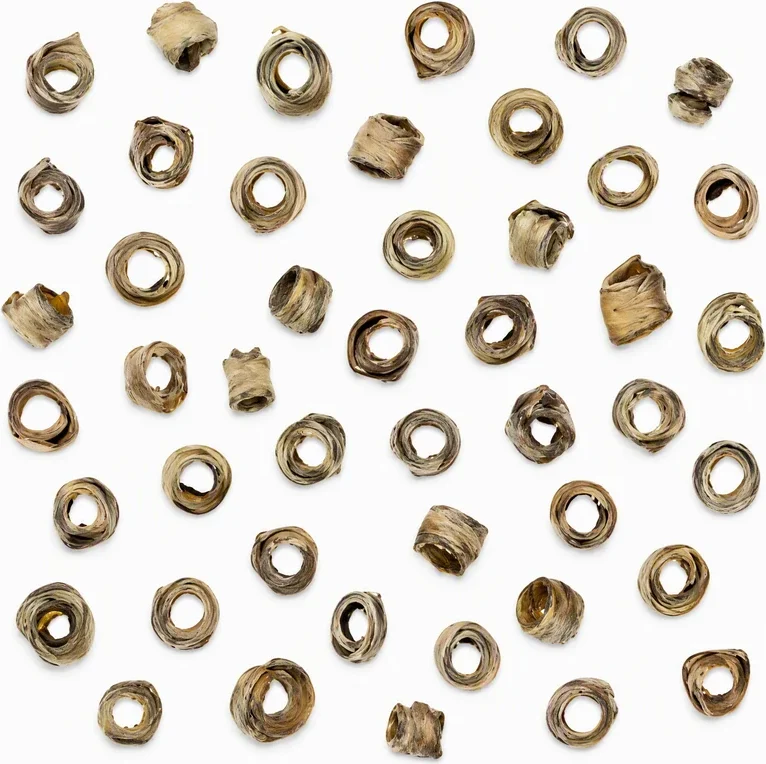

mòlì nǚ'ér huán
Choose a brewing method. Start with the recommended quantities and time, then adjust to taste.
Brewing
Brewing
Taste
Tea encyclopedia
Alt Names: Jīnyú Huán (金玉环, Jīnyù Huán — "Golden Jade Ring"), Nü'er Huán (女儿环, Nǚ'ér Huán — without the "Moli" prefix, emphasizing the shape), Jasmine Maiden's Rings (English).
Alt Names: Jīnyú Huán (金玉环, Jīnyù Huán — "Golden Jade Ring"), Nü'er Huán (女儿环, Nǚ'ér Huán — without the "Moli" prefix, emphasizing the shape), Jasmine Maiden's Rings (English).
Category: High-quality scented teas of China. According to leaf shape classification, belongs to the "circular ring type" (圆环形, yuánhuánxíng) — one of eight standard jasmine tea shape types.
Coordinates: Mengku region (Yunnan) — approximately 23°38′ N, 99°45′ E. Fuzhou (Fujian) — approximately 26°05′ N, 119°18′ E.
Origin: China. Main production regions — Yúnnán Province (云南, Yúnnán), where high-altitude buds of the Měngkù cultivar (勐库种, Měngkù zhǒng) are used, as well as Fújiàn Province (福建, Fújiàn) and Guǎngxī Zhuāng Autonomous Region (广西, Guǎngxī). Yunnan versions are particularly valued for using high-altitude raw material from plantations at 1700–1800 m elevation.
Type: Scented tea (花茶, huāchá) based on green tea (unoxidized), scented with jasmine flowers. Belongs to the subcategory of artistic (工艺, gōngyì) and special-shaped (特型, tèxíng) jasmine teas due to its unique ring form.
Cultural Significance: Nü'er Huan is primarily a gift tea and a tea for decorating tea ceremonies. It is chosen when one wants to surprise the companion not only with taste but also with spectacle: rings slowly unfurling in a transparent glass create the effect of an underwater ballet. In the context of Chinese tea culture, it symbolizes the fineness of handwork (手工, shǒugōng) and belongs to the category of "teas for contemplation" (观赏茶, guānshǎng chá).
History: The tradition of scenting tea with jasmine dates back to the Sōng era (宋朝, Sòng cháo, 960–1279), and the scenting technology (窨制, xūnzhì) was finally established during the Míng dynasty (明朝, Míng cháo, 1368–1644). Shaping tea into rings is a significantly later innovation, connected with the development of artistic teas (工艺花茶) in the last decades of the 20th century, when masters strived to create teas combining high taste qualities with outstanding visual aesthetics. The exact date of Nü'er Huan's appearance is not recorded, however this tea is firmly associated with the Yunnan school of hand tea craftsmanship, where traditions of forming complex figured teas are particularly strong.
The finest spring buds and young leaves of highest quality are used for production. Yúnnán versions are based on the Měngkù cultivar (勐库种, Měngkù zhǒng) — a large-leaf variety of Camellia sinensis var. assamica, growing at 1700–1800 m elevation. This cultivar is distinguished by large, succulent buds with abundant white down. Fujian versions use small-leaf cultivars of Camellia sinensis var. sinensis, such as Fúdǐng Dà Bái Chá (福鼎大白茶) or Fúdǐng Dà Háo Chá (福鼎大毫茶).
Fresh flowers of Jasminum sambac (L.) Ait. — sambac jasmine, collected during the "fuji" period (伏季, fújì) — at the height of summer (July–August). For scenting highest quality Nü'er Huan, select buds are used: large, snow-white, undamaged, with intense aroma.
Pluck Standard: One bud or one bud and one young leaf (一芽一叶, yī yá yī yè). Exclusively spring picking is used — early buds before the Qīngmíng festival (清明, Qīngmíng).
Raw Material: Extremely high — forming thin rings requires long, elastic, undamaged leaves and buds. Any defect in the raw material makes creating an even ring impossible.
Located in the southwestern part of the province, in Shuāngjiāng County (双江, Shuāngjiāng), part of Líncāng Prefecture (临沧, Líncāng). Mountain plantations at 1700–1800 m elevation are located in a zone of subtropical monsoon climate with pronounced vertical zonation. Average annual temperature 16–18°C, abundant precipitation (1200–1500 mm), frequent fogs. Soils — acidic mountain red earths, rich in organic matter. Mengku is one of the oldest tea-producing areas of Yunnan with century-old traditions of cultivating large-leaf tea trees.
Subtropical monsoon climate, alluvial soils of the lower reaches of the Mǐn River (闽江). Tea plantations — 200–800 m above sea level. Jasmine is grown on sandy alluvial plains along rivers — ideal conditions for Jasminum sambac.
China's largest jasmine-growing region. Subtropical climate, temperature 21–23°C, high humidity. Jasmine from Hengxian is used for scenting teas from different provinces.
Rings are sorted by size, integrity, and appearance. Defective (deformed, opened) rings are screened out.
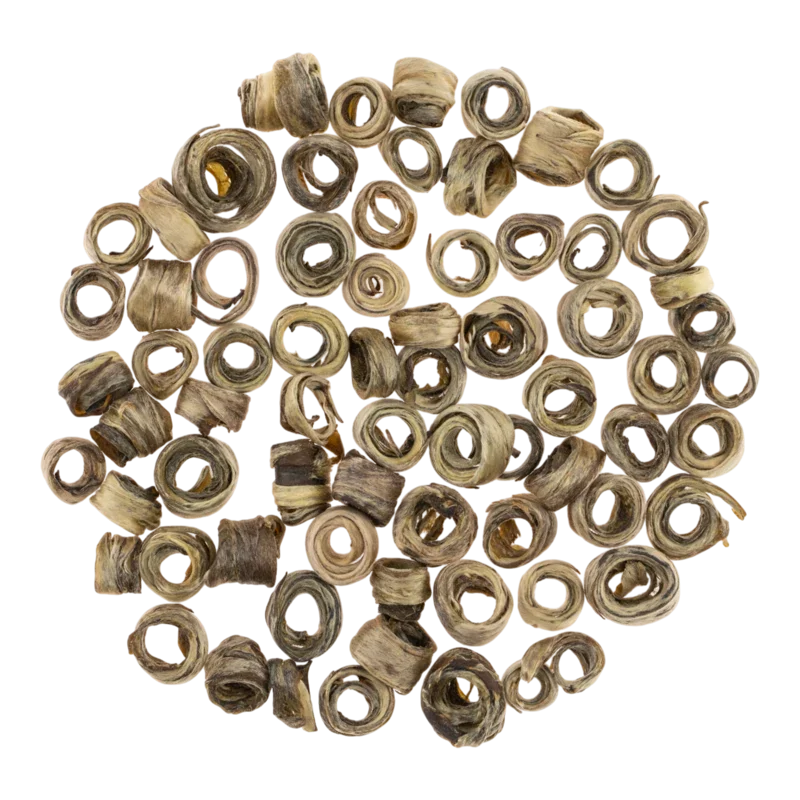
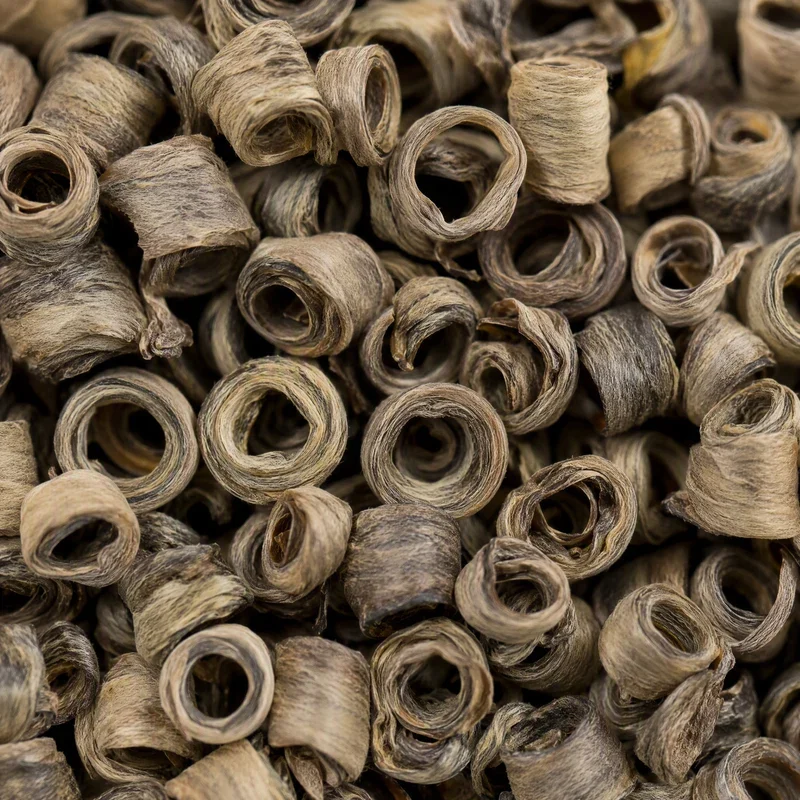
Dry Leaf Appearance: Neat rings 15–25 mm in diameter, even, round, closed. Single and double rings are encountered. Color — tender green with silvery sheen from white down of tips. Surface smooth, "snow-bright and sleek" (雪亮顺滑, xuěliàng shùnhuá). Ring size approximately uniform, each dense and round.
Dry Leaf Aroma: Bright, clean jasmine aroma, intertwining with fresh greenness of the tea base. Aroma natural, without artificial or synthetic notes.
Liquor Aroma: Rich, enveloping, sweet-floral, with dominant jasmine note and fresh vegetal undertone. Aroma "lively" (鲜灵, xiānlíng), not flat.
Liquor Color: Pale yellow or light golden, transparent, clear. Tea from bud material gives lighter liquor.
Spent Leaves: Unfolded leaves and buds of green or yellow-green color. Notably, rings may partially retain their ring shape even after several infusions, which testifies to the skill of formation.
Taste: Soft, tender, refreshing, with natural sweetness. Body light to medium (Yunnan versions — more full-bodied). Balance of green tea and jasmine — harmonious, neither component dominates. Aftertaste prolonged, floral-sweet, with barely perceptible astringency. Bitterness absent.
Alkaloids: Caffeine — 2–4% of dry mass (25–45 mg per 150 ml cup). Caffeine content moderate due to use of tender buds.
Amino Acids: L-theanine — 1–2% of dry mass. High-altitude raw material from Mengku, grown under fog shading conditions, is distinguished by elevated amino acid content, which gives the tea pronounced sweetness and depth of taste.
Complex of more than 100 aromatic compounds, including linalool (芳樟醇), benzyl acetate (乙酸苄酯), methyl benzoate (苯甲酸甲酯), benzyl alcohol (苯甲醇), indole (吲哚), methyl salicylate (水杨酸甲酯), α-farnesene — all forming the characteristic "lively" jasmine aroma.
Minerals: Potassium, magnesium, fluorine, zinc, manganese, selenium (in Yunnan versions — elevated zinc and selenium content due to mountain soils).
Polyphenols: Catechins — EGCG (epigallocatechin-3-gallate), EC (epicatechin), EGC (epigallocatechin), ECG (epicatechin-3-gallate). Total polyphenol content — 15–25% of dry mass. Yunnan versions from assamica variety may contain elevated catechin levels.
Vitamins: Ascorbic acid (C), B-group vitamins (B₁, B₂), vitamin E, vitamin P (rutin).
High EGCG and other catechin content provides neutralization of free radicals, protection of cell membranes and DNA from oxidative damage.
The combination of L-theanine and caffeine creates a state of "calm alertness" — increased concentration without anxiety and nervous excitement.
Jasmine essential oils, especially linalool, have proven anxiolytic effect, reduce cortisol levels, improve sleep quality.
Polyphenols and aromatic oils stimulate digestive juice secretion, facilitate food absorption, have mild antispasmodic effect.
Catechins promote LDL-cholesterol reduction, improve vascular elasticity, have moderate antihypertensive effect.
Jasmine oil components show antimicrobial activity, especially against oral bacteria.
Vitamin C, catechins, and zinc support nonspecific immune response.
Excellent beverage for quenching thirst in hot weather, especially in cold brewing variant.
3–4 g per 500 ml cold water, 6–8 hours in refrigerator. Delicate, refinedly sweet result.
Tea Amount: 3–4 g (2–4 rings depending on size) per 150–200 ml water. When brewing gongfu method — 4–5 g per 100–120 ml gaiwan.
Teaware: Glass cup or teapot — absolute priority, since the main merit of Nü'er Huan is the visual aesthetics of ring unfurling. White porcelain gàiwǎn (盖碗, gàiwǎn) also suitable. Yixing clay not recommended (absorbs aroma).
Water Temperature: 75–85°C. Never boiling water — it damages the delicate ring structure and destroys delicate aromatic compounds.
Container: Airtight opaque container — tin or ceramic jar, foil bag with zip-lock. Special care when storing: rings are fragile and easily deform under pressure, so tea should not be packed tightly in containers.
Enemies: Moisture, light, high temperature, foreign odors, mechanical pressure (destroys rings).
Shelf Life: 12 months with proper storage. Jasmine aroma weakens faster than form, so tea is recommended to be consumed fresh.
Dry, cool, dark place, completely protected from foreign odors, moisture, and light.
Temperature: Optimally — refrigerator (0–5°C) in airtight packaging. Before opening, bring to room temperature.
"Dragon Pearl" — jasmine tea rolled into tight balls. Both teas are hand-formed, but Longzhu is rolled into a sphere, while Nü'er Huan into a ring. Longzhu is more common, its formation simpler and faster, making it cheaper at comparable quality. Taste profiles are close, but Longzhu unfurls more predictably.
"Jasmine Silver Needles" — based on white buds, straight needle shape. More subtle, ethereal aroma and delicate taste. No complex shaping, but high cost of bud base. Visually less effective when brewing than Nü'er Huan rings.
"Floating Snow" — Sichuan jasmine tea with preserved flower petals. Fundamentally different aesthetics (white petals floating on surface vs rings on bottom) and denser, more astringent taste of Sichuan tea base.
"Phoenix Eye" — leaves rolled into elongated almond shape. Less complex formation than Nü'er Huan. Unfurls faster, more accessible in price.
"Jade Spiral" — twisted rolling form. Mass product with fewer scentings, more accessible. Visually less expressive.
Price Category: Suspiciously low price (less than 150 yuan/500 g) with claimed "hand formation" practically guarantees counterfeit — hand labor for ring formation physically cannot cost cheaply.
Rings should be even, closed, uniform size, without breaks and deformations. Shapeless or crumbling "rings" indicate low skill or machine production.
Natural, clean jasmine, without chemical or artificial notes. Scent should be "lively," not one-dimensional.
Soft, balanced, without bitterness and foreign flavors. Green tea and jasmine taste — in harmony.
When brewing, rings should unfurl slowly, maintaining leaf integrity. Quick crumbling — sign of poor formation quality.
No reviews yet. Tell us what you think of this tea.
Rate this tea and share your impressions. We review each submission before publishing it.