Brewing
Gongfu brewing
- Water temperature
- 75 °C
- Tea amount
- 5 g
- Water volume
- 100 ml
- First steep
- 10 s
- Time added per infusion
- 5 s
- Infusions
- 3



mòlì piāo xuě
Choose a brewing method. Start with the recommended quantities and time, then adjust to taste.
Brewing
Brewing
Taste
Tea encyclopedia
Alt Names: Jasmine "Floating Snow", Jasmine Snow Flurry (English). The name "飘雪" (Piao Xue) became generic for an entire direction of Sichuan jasmine teas: there exist "Bi Tan Piao Xue" (碧潭飘雪, Bìtán Piāo Xuě — "Floating snow over jade pond"), "Lin Hu Piao Xue" (林湖飘雪), "Eding Piao Xue" (峨顶飘雪) and other varieties. "Bi Tan Piao Xue" — the most famous trademark, created by master Xú Jīnhuá (徐金华, Xú Jīnhuá) in the 1980s and subsequently transferred to Zhúyèqīng company (竹叶青, Zhúyèqīng).
Alt Names: Jasmine "Floating Snow", Jasmine Snow Flurry (English). The name "飘雪" (Piao Xue) became generic for an entire direction of Sichuan jasmine teas: there exist "Bi Tan Piao Xue" (碧潭飘雪, Bìtán Piāo Xuě — "Floating snow over jade pond"), "Lin Hu Piao Xue" (林湖飘雪), "Eding Piao Xue" (峨顶飘雪) and other varieties. "Bi Tan Piao Xue" — the most famous trademark, created by master Xú Jīnhuá (徐金华, Xú Jīnhuá) in the 1980s and subsequently transferred to Zhúyèqīng company (竹叶青, Zhúyèqīng).
Category: High-quality scented teas of China. Representative of the Sìchuān school of jasmine teas (四川茉莉花茶, Sìchuān mòlìhuāchá), which differs from Fújiàn by using local tea cultivars and chǎoqīng technology (炒青, chǎoqīng — fixation by pan-firing).
Coordinates: Emeishan area — approximately 29°35′ N, 103°20′ E. Jiajiang — 29°44′ N, 103°34′ E. Mengdingshan — 30°04′ N, 103°12′ E.
Origin: China, Sìchuān Province (四川, Sìchuān). The most valuable Piào Xuě is produced in the vicinity of Mount Éméishān (峨眉山, Éméishān) — one of the four sacred Buddhist mountains of China — and in Jiājiāng County (夹江, Jiājiāng). Tea base — from high-altitude plantations of Emeishan, Méngdǐngshān (蒙顶山, Méngdǐngshān) and southern Sichuan regions. Jasmine for scenting was traditionally grown in Sichuan's Qiánwéi County (犍为, Qiánwéi), though modern production also uses jasmine from Guǎngxī (横县, Héngxiàn).
Type: Scented tea (花茶, huāchá) based on green tea (unfermented), scented with jasmine flowers. Characteristic feature — presence of dried jasmine petals in the finished product.
Cultural Significance: Piao Xue became a symbol of Sichuan tea culture and a subject of regional pride. Sichuan — birthplace of the tea house (茶馆, cháguǎn), and jasmine tea in "piao xue" style is traditionally associated with the unhurried lifestyle of Chéngdū (成都, Chéngdū), where tea houses remain centers of social life to this day. Poet and artist Huáng Chúnyáo (黄纯尧, Huáng Chúnyáo), after tasting Xu Jinhua's tea, dedicated poems to it, calling it "heavenly gift from early spring buds".
History: The tradition of scenting tea with jasmine in Sichuan has deep roots, though historically it yielded to the Fujian school in scale and fame. Sichuan — one of China's most ancient tea-growing regions: already in "Huayang Guozhi" (华阳国志, Huáyáng Guózhì), compiled during the Jin era (4th century CE), it is noted that in the Nan'an area (modern Leshan, 乐山) and Emeishan famous tea is produced. However, "Piao Xue" as an independent type of jasmine tea took shape only in the late 20th century. The key figure is considered tea master Xú Jīnhuá (徐金华, Xú Jīnhuá), native of Xīnjīn County (新津, Xīnjīn) in Sichuan Province, who in the 1980s, drawing on historical scenting techniques from the Ming era (including Xu Wei's (徐渭) "langyuan" method and traditions of "Ming tea" by master Mǐn Wenshui (闵汶水)), created "Bi Tan Piao Xue" — jasmine tea from spring buds of Emeishan with preserved jasmine petals. In 1993, at a meeting of the Standing Council of the Sichuan Tea Society, the tea was officially presented and received the name "Bi Tan Piao Xue". In 1995, it passed certification by the Sichuan Tea Standardization Committee, confirming quality at the level of highest class special jasmine teas. Subsequently, in 2008, the brand was transferred to Zhúyèqīng Tea Company (竹叶青茶业), which modernized production. Xu Jinhua was respectfully called "Xu Gong" (徐公, Xú Gōng — "Master Xu"), and his tea — "徐公茶" (Xú Gōng Chá — "Master Xu's tea").
For Piao Xue, tender spring buds and young leaves are used, collected from local Sichuan cultivars of Camellia sinensis var. sinensis. Key varieties — Fúxuǎn Zǎo (福选早), cultivars from Emeishan, Mengdingshan and southern Sichuan (Yibin, 宜宾) areas. The tea base is processed using chǎoqīng technology (炒青, chǎoqīng — fixation by pan-firing), which fundamentally distinguishes Sìchuān Piāo Xuě from Fújiàn jasmine teas on hōngqīng base (烘青). Pan-fired base gives the tea more pronounced "tea" character, body density and characteristic astringency that balance jasmine sweetness.
Fresh flowers of Jasminum sambac (L.) Ait. from summer harvest (伏季, fújì). Traditional Sichuan jasmine — from Qiánwéi County (犍为), though modern large-scale production widely uses jasmine from Guǎngxī (横县). Buds are collected in afternoon hours, during the period of initial opening.
Pluck Standard: One bud and one-two young leaves (一芽一二叶, yī yá yī èr yè). Exclusively spring (before Qingming, 清明) or early spring (明前, míngqián) picking is used. Emeishan plantations at 600–1500 m altitude yield especially tender buds thanks to early vegetation start in conditions of "cloud screen" (华西雨屏, Huáxī Yǔpíng — western Sichuan microclimate with constant fogs and dew).
Raw Material: Tea buds — slender, straight, with pronounced white tips (白毫, báiháo), without damage. Xu Jinhua's original formulation assumed proportion "5 jin (2.5 kg) flowers to 1 jin (0.5 kg) tea base" to achieve deep scenting.
Mount Éméishān (峨眉山, Éméishān) — one of the four sacred Buddhist mountains of China, UNESCO World Heritage site (natural and cultural). Located in southwestern Sichuan Basin, in transition zone from basin to Tibetan Plateau. Main peak Wànfódǐng (万佛顶, Wànfódǐng) — 3099 m. Tea plantations located at 600–1500 m altitude. Climate — humid subtropical, characterized by phenomenon of "Western Sichuan Cloud Screen" (华西雨屏): abundant precipitation (1500–2000 mm annually), constant fogs, prolonged diffused lighting, mild winters. Average annual temperature — 17°C. Soils — acidic mountain yellow earths and brown earths, rich in organics. These conditions are ideal for forming tender buds with high amino acid content and moderate catechin content, ensuring sweet, mild taste of tea base.
Historic tea mountain, celebrated in classical formula: "Water from Yangtze River, tea from Mount Meng peak" (扬子江中水,蒙山顶上茶). Altitude 1000–1400 m, similar climatic conditions.
County in Lèshān Prefecture (乐山), located south of Emeishan. Traditional area for producing green tea base for Piao Xue.
County in Leshan Prefecture where Sichuan jasmine is grown. Subtropical climate, fertile alluvial soils of Mǐnjiāng River (岷江) basin.
Finished tea is sorted by leaf quality, quantity and condition of jasmine petals, mixture uniformity.
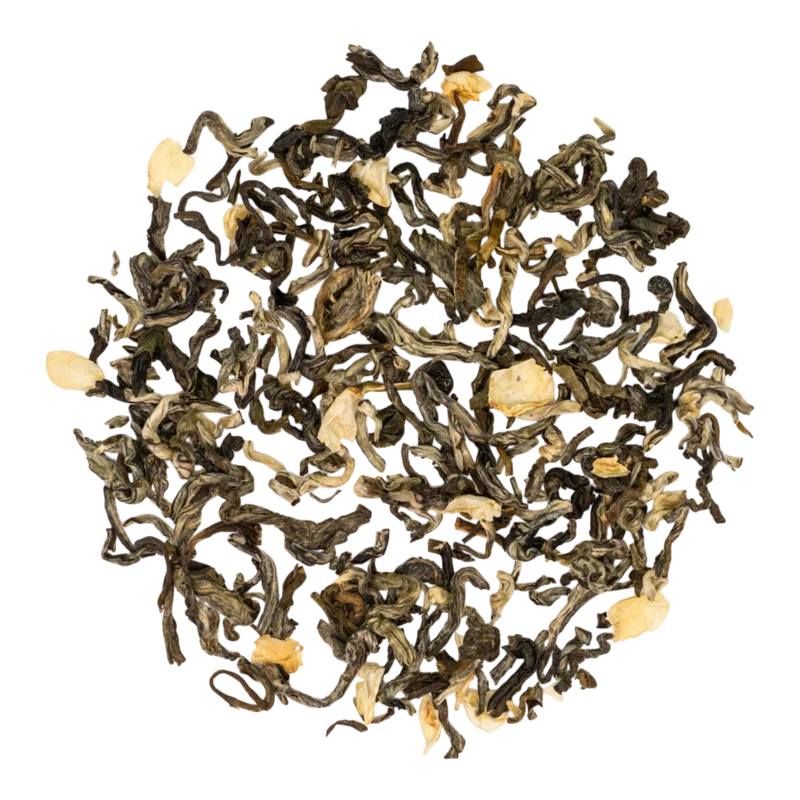
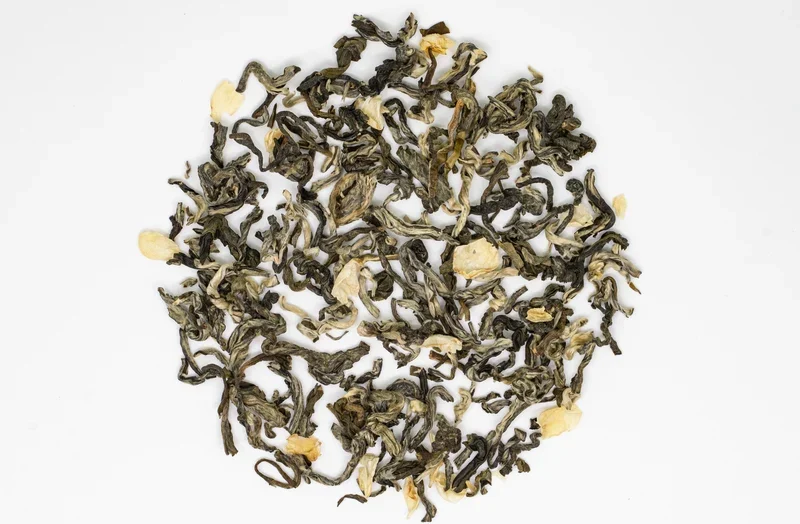
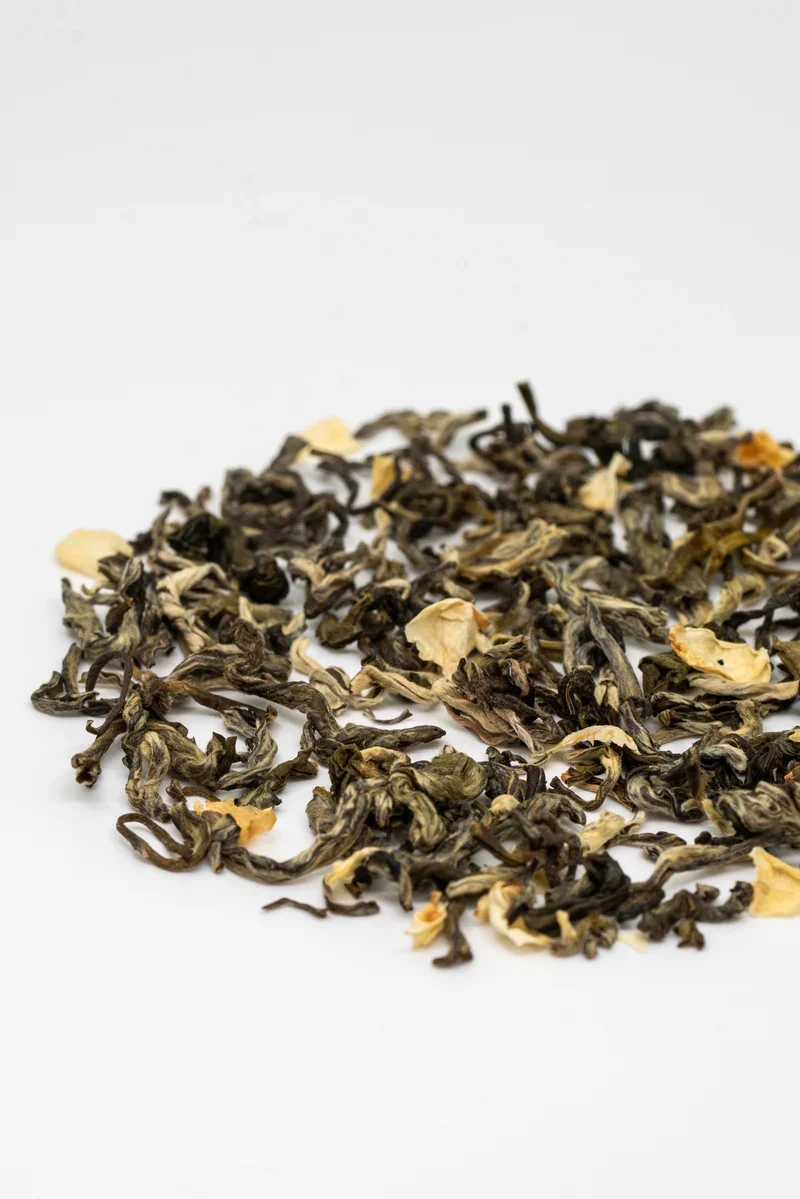
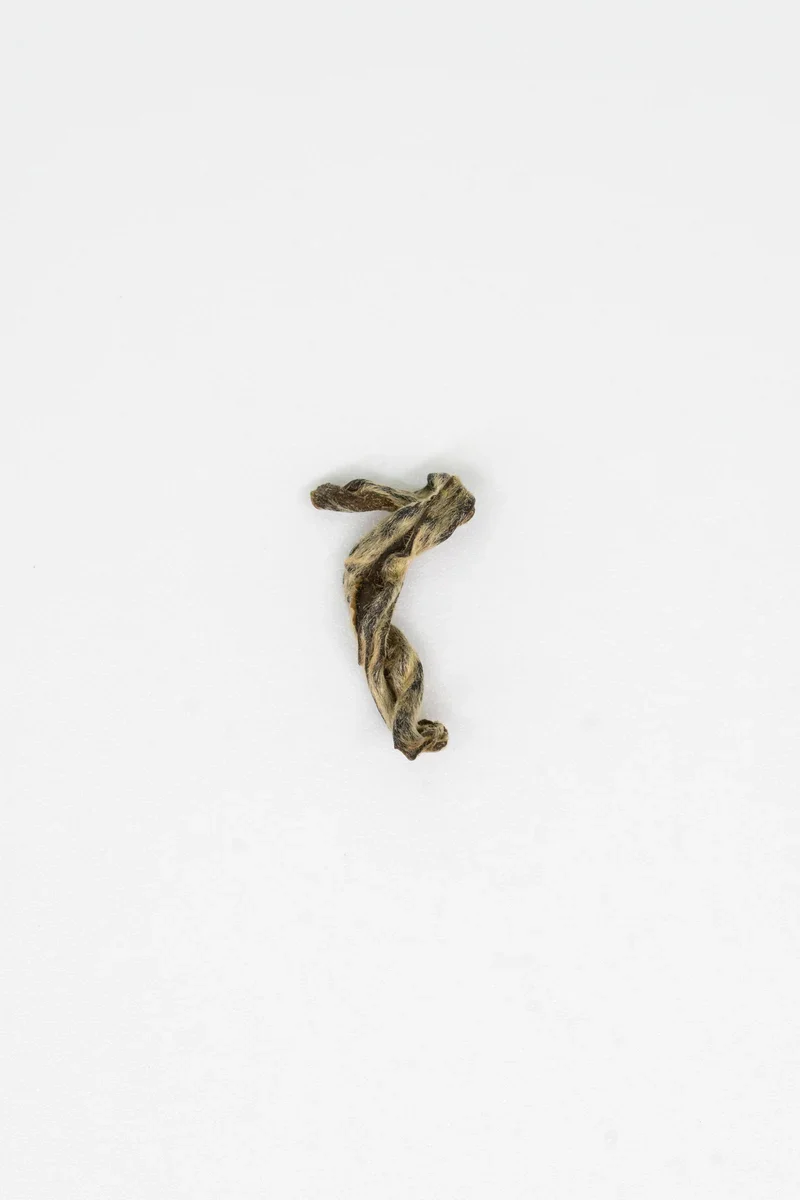
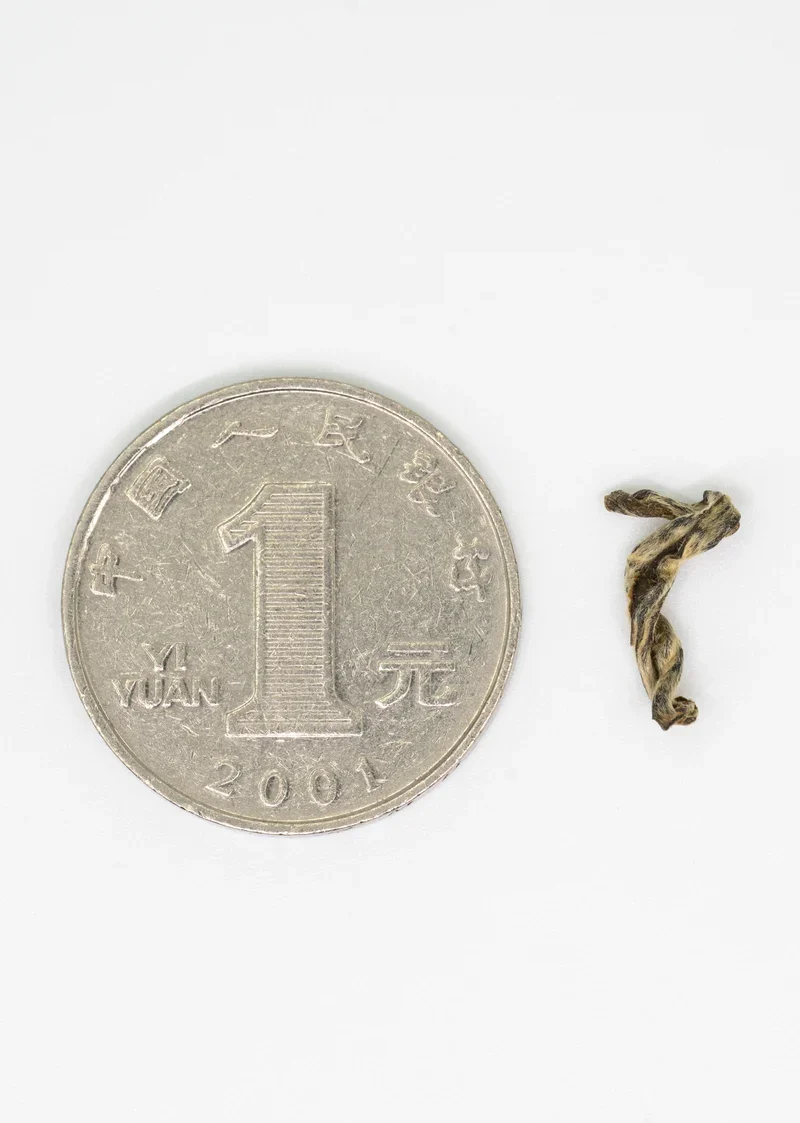
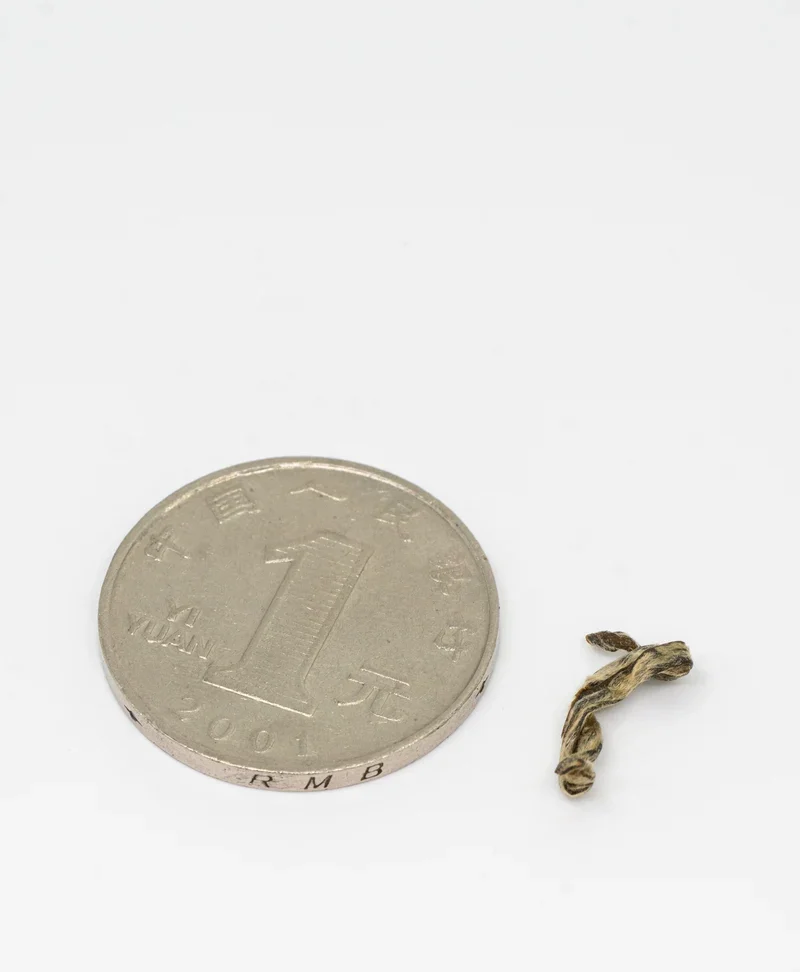
Dry Leaf Appearance: Elongated, slightly twisted tea leaves of dark green color with distinct white tips, among which dried white or slightly cream jasmine petals are clearly visible. Precisely the contrast of green tea leaves and white petals creates the famous "snowfall effect". Leaves whole, without crumbs and dust.
Dry Leaf Aroma: Intense, with pronounced jasmine beginning and substrate of roasted green tea — characteristic "two-layer" aroma where floral note doesn't suppress tea note.
Liquor Aroma: Rich jasmine, complemented by notes of fresh greenery, light chestnut (from roasted base) and honey sweetness. Aroma persistent but less "lively" (鲜灵) than top-class Fujian jasmine teas — this is compensated by depth and "warm" roasted undertone.
Liquor Color: Yellow-green, transparent, bright. Somewhat more saturated than Fujian jasmine teas due to pan-fired base.
Spent Leaves: Unfolded tender green leaves and buds together with moistened jasmine petals that lost aroma but preserved form. When brewing in glass cup, tea leaves sink to bottom while jasmine petals float in water column and on surface — signature visual mark of Piao Xue.
Taste: Dense, refreshing, with good structure and more pronounced "tea" character than Fujian Moli Hua Cha. Body medium to full. Sweetness natural but restrained, balanced by light astringency and characteristic freshness. Aftertaste (回甘, huígān) — clean, with jasmine notes and mild sweetness. Sichuan style: "茶香比花香重" (cháxiāng bǐ huāxiāng zhòng — "tea aroma stronger than floral aroma").
Alkaloids: Caffeine — 2–4% (30–50 mg per 150 ml cup). Theobromine and theophylline — in trace amounts.
Amino Acids: L-theanine — 1.5–2.5% dry mass. High-altitude raw material from Emeishan, growing in fog-shaded conditions, is distinguished by increased amino acid content — up to 484 mg/100 g, confirmed by analytical studies of Sichuan tea raw material.
Characteristic set of aromatic compounds, however studies showed that in Sichuan jasmine tea relative content of "green" (青草气) compounds — such as (Z)-3-hexen-1-ol, 1-octen-3-ol, pentanal and hexanal — is higher than in Fujian and Guangxi. This gives Sichuan Piao Xue fresher, "greener" aroma character, while Guangxi jasmine tea is richer in floral components (benzyl benzoate, cis-jasmone, geraniol, α-farnesene).
Minerals: Potassium, magnesium, fluorine, zinc, manganese.
Polyphenols: Catechins — EGCG, EC, EGC, ECG. Total content — 18–28% dry mass. Pan-firing fixation somewhat reduces content of unstable catechins compared to hongqing base, but forms more complex aromatic profile through Maillard reactions and caramelization.
Vitamins: C, B₁, B₂, E, P (rutin).
Catechins and polyphenols of green base provide pronounced antioxidant effect, protecting cells from free radicals and slowing oxidative aging.
Combination of caffeine and L-theanine gives mild, sustained alertness with improved concentration, without nervousness. Chaoqing base provides somewhat more pronounced tonic effect compared to hongqing teas.
Linalool and other components of jasmine oil reduce anxiety, improve mood, promote relaxation.
Polyphenols and terpenoids stimulate digestive enzymes, ease digestion of fatty and heavy food. In Sichuan cuisine, jasmine tea traditionally serves as ideal accompaniment to spicy dishes.
Regular green tea consumption promotes LDL cholesterol reduction and maintaining vascular elasticity.
Components of jasmine oil possess proven antimicrobial activity.
Excellent summer drink, especially in cold brewing variant.
Green tea catechins moderately activate thermogenesis and fat metabolism.
3–5 g per 500 ml cold water, 6–8 hours in refrigerator. Visually especially attractive in transparent bottle — white petals float among green leaves.
Tea Amount: 3–5 g per 150–200 ml water. When brewing gongfu method — 5–6 g per 100–120 ml gaiwan.
Teaware: Glass cup — absolute priority for Piao Xue: transparent walls allow observing signature "snowfall effect" — floating white petals over green tea leaves. White porcelain gàiwǎn (盖碗) also suitable. Xu Jinhua himself recommended gaiwan, emphasizing that lid concentrates aroma.
Water Temperature: 80–85°C. Don't use boiling water — it damages aromatic compounds and causes excessive astringency.
Container: Airtight opaque packaging — tin can, foil bag.
Enemies: Moisture, light, high temperature, foreign odors.
Shelf Life: 12–18 months. Jasmine aroma weakens over time; dried jasmine petals in composition don't enhance but only visually remind of freshness, so tea is better consumed within 6–12 months after production.
Dry, cool, dark place, away from foreign odors.
Temperature: Refrigerator (0–5°C) in airtight packaging. Before opening — bring to room temperature.
Based on hōngqīng base (烘青 — hot air drying), while Piao Xue — on chaoqing (炒青 — pan-firing). Fujian teas — more "floral", with dominant jasmine and characteristic "icy sweetness" (冰糖甜). Piao Xue — more "tea-like", dense, with astringent freshness and pronounced base character. Fujian — without petals (见茶不见花), Piao Xue — with petals (见茶见花).
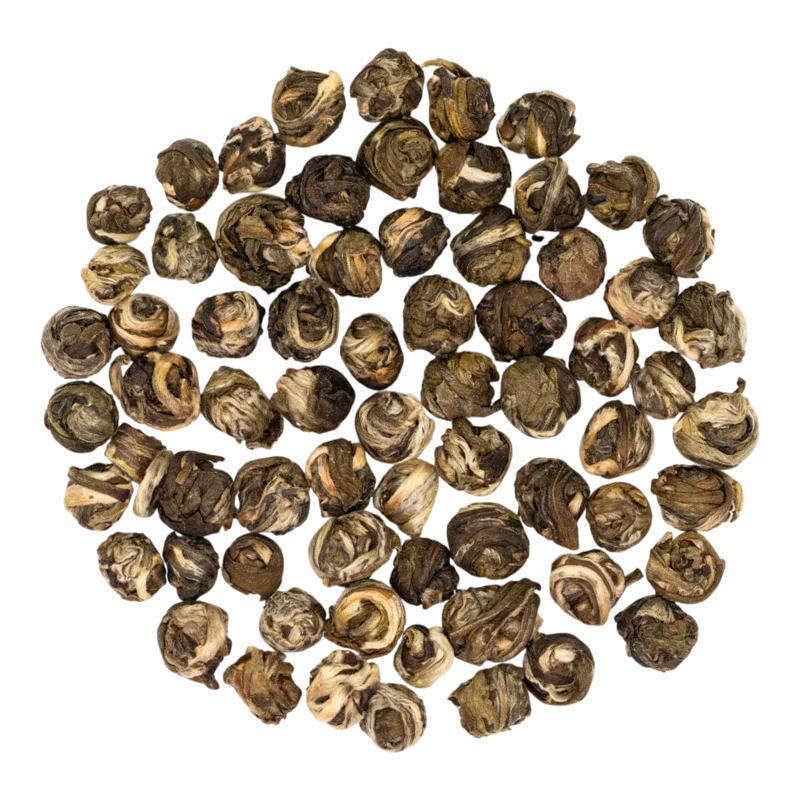
"Dragon pearls" — Fujian jasmine tea in spherical granule form. Differs in form (balls vs loose with petals), base (hongqing vs chaoqing), absence of visible petals. Longzhu — sweeter and "rounder", Piao Xue — more structured and fresh.
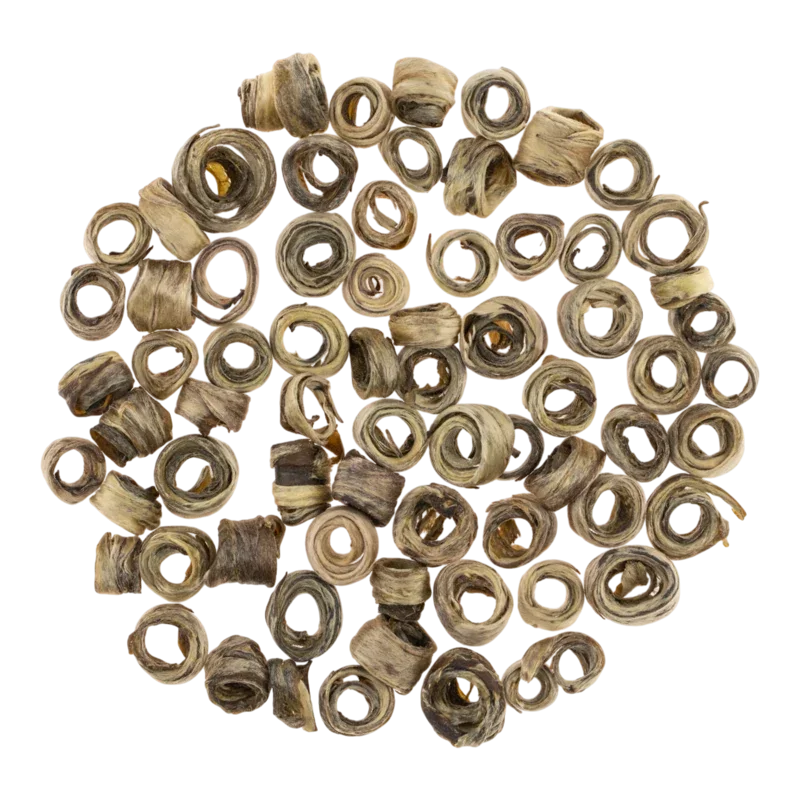
"Maiden rings" — hand-shaped jasmine tea in ring form. Unites with Piao Xue belonging to "artistic teas", but radically differs in form and technology. Nü'er Huan — without visible petals, significantly more labor-intensive.
"Silver needles" — premium jasmine tea based on white buds. More delicate, ethereal, with refined taste. Opposite stylistic pole: minimalism and purity vs visual splendor of Piao Xue.
If Piao Xue occurs in versions from other regions, different tea bases are used, but principle of "petal preservation" remains. Result differs significantly in taste from Sichuan original.
Price Category: Below 80 yuan/500 g with claimed "multiple scenting" — reason for doubt.
Tea leaves — whole, elongated, with white tips. Jasmine petals — white, whole, not crushed. Tea-to-petals ratio — harmonious, not overloaded with flowers (excess petals often masks low base quality).
Natural, two-layered: tea note + floral. Artificial scenting betrays itself with sharp, one-dimensional, "perfumery" smell that quickly dissipates.
Dense, refreshing, with perceptible "tea-ness". If taste is empty and watery despite abundance of petals — this is sign of low base quality.
Authentic Piao Xue — Sichuan product. "Piao Xue" from other regions may be quality but is not authentic representative of style.
No reviews yet. Tell us what you think of this tea.
Rate this tea and share your impressions. We review each submission before publishing it.