Brewing
Gongfu brewing
- Water temperature
- 75 °C
- Tea amount
- 5 g
- Water volume
- 100 ml
- First steep
- 10 s
- Time added per infusion
- 5 s
- Infusions
- 3

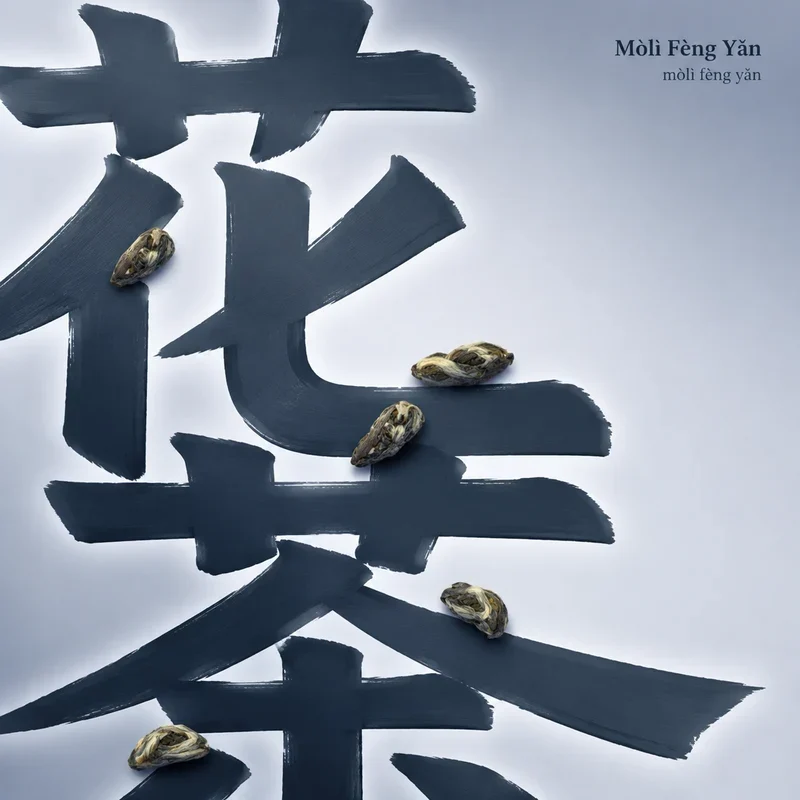
mòlì fèng yǎn
Choose a brewing method. Start with the recommended quantities and time, then adjust to taste.
Brewing
Brewing
Taste
Tea encyclopedia
Category: Artistic jasmine tea (工艺花茶, gōngyì huāchá). Shaped (bound) tea of handcraft. Product of Fuzhou tradition of jasmine tea production.
Category: Artistic jasmine tea (工艺花茶, gōngyì huāchá). Shaped (bound) tea of handcraft. Product of Fuzhou tradition of jasmine tea production.
Coordinates: Fuzhou — approximately 26°04′ N, 119°18′ E.
Origin: China, Fújiàn Province (福建省, Fújiàn shěng), Fúzhōu city (福州, Fúzhōu) — the recognized cradle of jasmine tea making. Fǔzhōu scenting technology (窨制工艺, yìnzhì gōngyì) is a national intangible cultural heritage object of the PRC (since 2014) and part of the "Traditional Chinese Tea Processing Techniques" project, included in the UNESCO Intangible Cultural Heritage List in 2022. Production is also possible in Guǎngxī (广西, Guǎngxī), Yúnnán (云南, Yúnnán), and Sìchuān (四川, Sìchuān) provinces.
Type: Scented tea (花茶, huāchá) — green tea (unfermented), scented with jasmine. Belongs to the class of reprocessed teas (再加工茶, zàijiāgōng chá).
Cultural Significance: The phoenix is one of the four sacred animals (四灵, sì líng) of Chinese mythology alongside the dragon, unicorn-qilin, and turtle. The phoenix's eye is considered the embodiment of insight and clear vision. Moli Feng Yan tea thus carries wishes for wisdom and prosperity. Due to the combination of symbolic depth, visual beauty, and exquisite taste, Feng Yan is highly valued as a gift tea, especially for ceremonial events and business presentations.
History: The tradition of scenting tea with jasmine arose in China during the Sōng era (宋朝, Sòng cháo, 960–1279) and reached its peak under the Míng (明朝, Míng cháo) and Qīng (清朝, Qīng cháo) dynasties. Jasmine itself (Jasminum sambac) was brought to China more than 2000 years ago via the maritime Silk Road from South Asia and firmly took root in the culture of Fujian Province. Míng scholar Qián Xīyán (钱希言, Qián Xīyán) described the bustling jasmine tea market thus: "In the season of tea competitions, flower buying goes at full pace; they choose those that are larger and drier... the southern wind blows for ten days, and the entire curtain is filled with fragrance." During the Qing era, Empress Dowager Cíxǐ (慈禧太后, Cíxǐ Tàihòu) harbored a particular passion for jasmine, declaring it her personal flower at court. Fǔzhōu jasmine tea gained the status of tribute tea (贡茶, gòngchá), and Fuzhou itself became the main scenting center in the country — tea bases were brought here from Anhui, Zhejiang, and Jiangsu for making the highest grade jasmine teas.
High-quality green tea of the hongqing type (烘青, hōngqīng — "dried with hot air"), made from spring harvest in Fujian Province. The hongqing base possesses a porous leaf structure optimal for deep absorption of jasmine aroma during multiple scenting cycles. Bush variety — local small-leaf populations of Camellia sinensis var. sinensis.
Fresh flowers of Jasminum sambac (L.) Ait. (sambac jasmine, 茉莉花, mòlihuā) — a species with the most intense, pure sweet aroma. Specifically sambac is used throughout the Fuzhou school of jasmine tea. The aromatic profile is formed by more than 110 volatile compounds, dominant among which are linalool, benzyl acetate, methyl benzoate, and indole.
Early spring. Bud with one to two young leaves (一芽一叶 / 一芽二叶, yī yá yī yè / yī yá èr yè). Raw material — whole, succulent, without damage.
Summer period (June–September), after 2:00 PM, in accordance with the "three prohibitions" rule (三不采, sān bù cǎi): do not pick in the morning, do not pick in cloudy weather, do not pick within three days after rain. The optimal degree of bud opening is determined by the master visually and by touch.
Raw Material: Highest. Only select buds with pronounced white down (白毫, báiháo) and fragrant, undamaged jasmine buds are used.
Subtropical monsoon climate: average annual temperature +19…+21°C, precipitation 1200–1600 mm. Tea gardens are located at 200–800 m above sea level, on acidic red-yellow soils (红壤, hóng rǎng) rich in organic matter. The mild, humid climate and mountainous terrain favor the formation of tea with delicate, sweetish taste and high amino acid content.
Alluvial sandy soils (冲积土, chōngjī tǔ) with deep fertile layer, located on lowland plains (5–50 m above sea level). The contrast between hot days and relatively cool nights stimulates the synthesis of aromatic substances in flowers. Fuzhou jasmine is famous for its characteristic "icy sweetness" (冰糖甜, bīngtáng tián) — a special shade of aromatic sweetness caused by the unique microclimate. The "Fuzhou Jasmine and Tea Culture" system has been recognized as a Globally Important Agricultural Heritage System (GIAHS) by FAO since 2014.
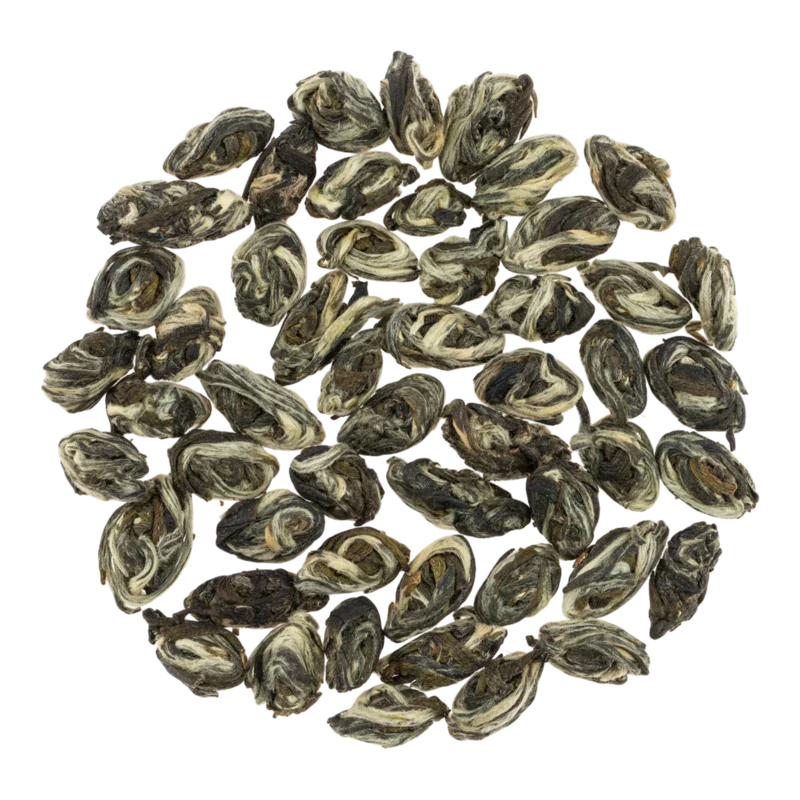
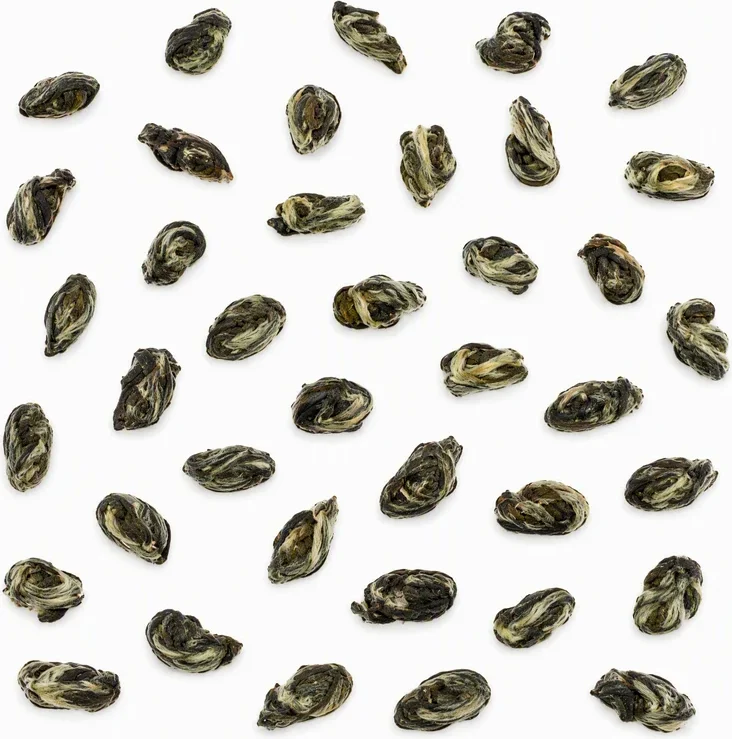
Key difference from other shaped jasmine teas. The master manually binds several scented leaves and buds, forming an elongated, slightly curved oval with a pointed tip, reproducing the characteristic almond-shaped contour of an eye. The figure must be tight, symmetrical, and resistant to opening during transportation. This stage requires considerable mastery: the "eye" shape is more complex to execute than many other figures due to the need for precise control of proportions and curvature.
Finished "phoenix eyes" are sorted by size, density, symmetry, and aroma quality.
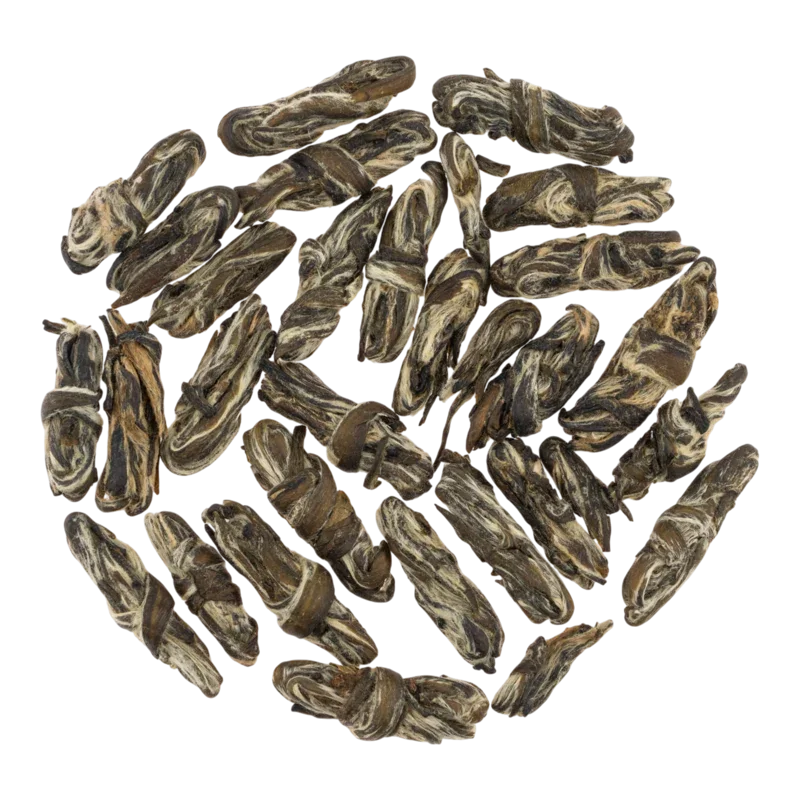
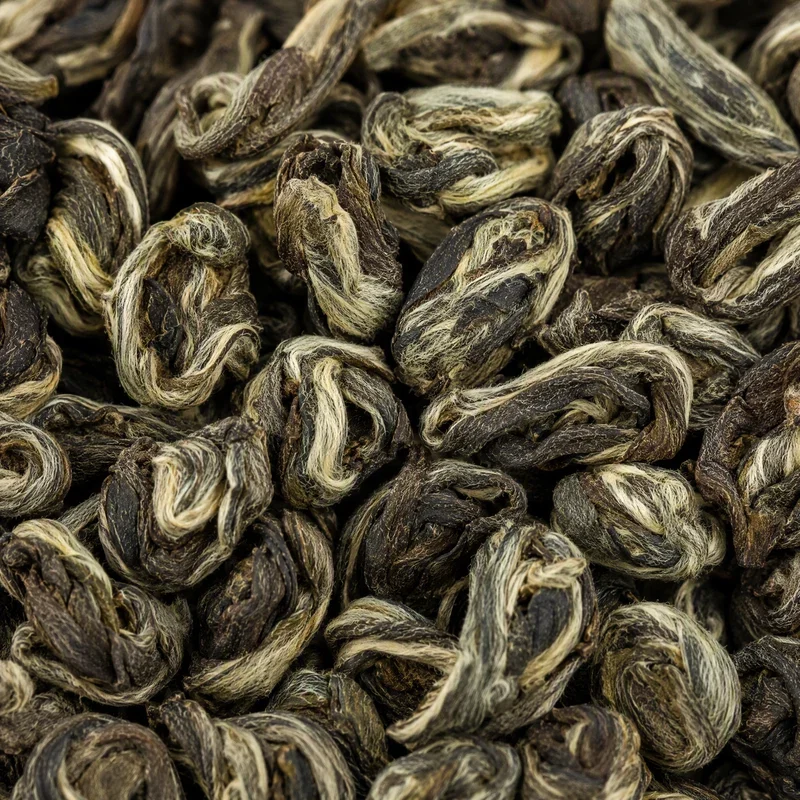
Dry Leaf Appearance: Elongated, slightly curved almond-shaped figures with pointed tips resembling an eye. Size — 3–5 cm in length, 1–1.5 cm in width. Color — from silvery-green to dark green, with visible silvery down (白毫) on buds. Shape is tight, leaves firmly bound. Individual dried jasmine petals may be present.
Dry Leaf Aroma: Bright, intense jasmine aroma with green-grassy undertone. Scent is clean, natural, multi-layered — with notes of fresh flowers, light honey sweetness, and barely perceptible green tea background.
Liquor Aroma: Rich, enveloping jasmine aroma with pronounced "freshness" (鲜灵度, xiānlíng dù) — a characteristic sign of quality natural scenting. Notes of linalool (铃兰花香 — lily-of-the-valley tone) and benzyl acetate (honey sweetness). As it cools, a subtle green shade of the tea base emerges.
Liquor Color: Light yellow with golden tint, transparent, clear. With each subsequent brewing it lightens, acquiring a pale straw tone.
Spent Leaves: Opened leaves and buds of tender green color, soft, elastic. The "eye" figure often maintains integrity even after several brewings, demonstrating shaping mastery. Raw material quality is clearly visible: leaves are whole, evenly colored.
Taste: Soft, delicate, refreshing. Natural sweetness harmoniously interweaves with delicate floral note. Astringency is minimal, bitterness is absent. Body of liquor is medium, texture smooth, silky. Aftertaste is long, clean, floral-honey, with pleasant coolness (回甘, huígān) and light creaminess.
Alkaloids: Caffeine — 2–3% of dry mass (approximately 20–35 mg per 150 ml cup). Theobromine and theophylline — in trace amounts.
Amino Acids: L-theanine — 1–2% of dry mass, responsible for umami-like sweetness and synergistic effect of calm concentration in combination with caffeine.
Linalool (lily-of-the-valley tone, floral aroma base), benzyl acetate (honey sweetness), methyl benzoate (floral-fruity tone), indole (enhances floral perception in small doses), α-farnesene, methyl anthranilate (orange blossom tone), neryl acetate (rose-honey tone). According to gas chromatographic analysis results, more than 145 volatile compounds have been identified in jasmine teas from four main producing regions, of which about 13 are characteristic quality markers.
Preserved thanks to kill-green (shaqing).
Minerals: Potassium, magnesium, fluorine, manganese, zinc.
Polyphenols: 15–25% of tea base dry mass. Dominant catechin — epigallocatechin-3-gallate (EGCG), a powerful antioxidant.
Vitamins: Ascorbic acid (C), riboflavin (B₂), thiamine (B₁), rutin (P).
Green tea catechins, especially EGCG, effectively neutralize free radicals, protecting cells from oxidative damage and slowing aging processes.
Caffeine in combination with L-theanine provides gentle, steady stimulation without nervousness, increases concentration and productivity.
Jasmine aromatic components — primarily linalool — have proven anxiolytic (anti-anxiety) effect. Inhaling jasmine aroma reduces heart rate and promotes emotional relaxation.
Polyphenols stimulate gastric juice and digestive enzyme secretion, promoting metabolism normalization.
Regular green tea consumption is associated with decreased LDL cholesterol levels and blood pressure normalization.
Jasmine essential oils show antiseptic activity against a number of gram-positive bacteria.
The complex of vitamins C, B group, and catechins supports the body's immune function.
Green tea antioxidants combined with jasmine's anti-inflammatory properties contribute to improved complexion and overall skin tone.
Tea Amount: 1 "phoenix eye" (approximately 5–7 g) per 150–200 ml water. For a glass teapot of 300–500 ml volume — 2–3 figures.
Teaware: Glass teapot (玻璃壶, bōli hú) or glass flask — best choice for observing the opening of the "phoenix eye." White porcelain gàiwǎn (盖碗, gàiwǎn) is also suitable. Clay vessels (Yixing teapots) are not recommended: porous clay absorbs jasmine aroma.
Water Temperature: 75–85°C. Overheating water causes bitterness and destroys delicate aromatic substances.
Container: Airtight opaque container — tin can, porcelain jar, or vacuum foil bag. When using glass container — store in complete darkness.
Enemies: Moisture, light, foreign odors, elevated temperature, frequent package opening.
Shelf Life: 12–18 months under proper conditions. Jasmine aroma weakens over time, so it's recommended to consume tea within a year after purchase.
Temperature: Optimally — in refrigerator at 0–5°C, in separate airtight container, isolated from products with strong odors.
Closest analog by class and technology. Difference — in shape: Yu Die has a flat butterfly silhouette with "wings," while Feng Yan has an elongated almond-shaped "eye." Taste-aroma profile is practically identical, differences lie in symbolism and visual impression.
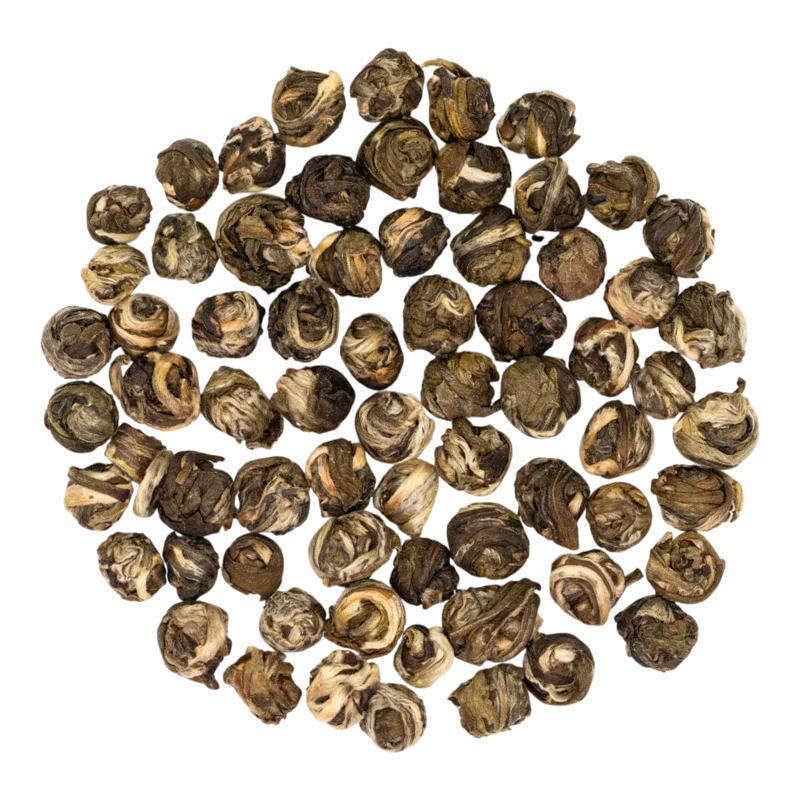
Leaves rolled into tight balls. More compact shape than Feng Yan ensures slower opening and dense, concentrated liquor. Long Zhu is the most common of shaped jasmine teas.
Base — white buds. Taste more delicate and light than Feng Yan. Belongs to the highest price segment of jasmine teas.
Loose tea without figure shaping, usually with 3–4 scenting cycles. Feng Yan significantly surpasses it in raw material quality, aroma depth, and aesthetic impression.
Price Category: Cost significantly below market level for shaped jasmine teas should cause wariness.
"Eyes" should be tight, neat, symmetrical, without broken leaves, dust, and foreign inclusions. Uneven, loose figures are signs of mass or careless production.
Natural jasmine aroma — multi-layered, soft, deep. Sharp, "chemical," cloying smell — sign of artificial flavorings. Quality tea demonstrates harmonious balance of jasmine and green tea notes.
Soft, balanced, with sweetish finish. Bitterness, empty or "flat" taste — indicators of low quality.
Clean, transparent, light golden. Cloudiness or dark shade — warning signal.
No reviews yet. Tell us what you think of this tea.
Rate this tea and share your impressions. We review each submission before publishing it.