Brewing
Gongfu brewing
- Water temperature
- 75 °C
- Tea amount
- 5 g
- Water volume
- 100 ml
- First steep
- 10 s
- Time added per infusion
- 5 s
- Infusions
- 3

mòlì yín háo
Choose a brewing method. Start with the recommended quantities and time, then adjust to taste.
Brewing
Brewing
Taste
Tea encyclopedia
Category: High-quality scented teas of China; special (特种) jasmine tea from the "银毫" (yín háo, "silver down") category.
Category: High-quality scented teas of China; special (特种) jasmine tea from the "银毫" (yín háo, "silver down") category.
Historical birthplace of highest-class jasmine teas. The city of Fúzhōu (福州, Fúzhōu) is recognized as the cradle of jasmine scenting technology. Counties Fúdǐng (福鼎, Fúdǐng) and Zhènghé (政和, Zhènghé) also play significant roles as centers for producing elite bud material. The region is protected by the geographical indication "Fuzhou Moli Hua Cha" (福州茉莉花茶).
Heng County (横县, Héngxiàn, now Hengzhou District of Nanning City) — China's largest center for jasmine cultivation and jasmine tea production.
Uses material from large-leaf varieties, giving the tea a more full-bodied character.
Production of jasmine teas (for example, the "碧潭飘雪" line, Bìtán Piāoxuě).
Coordinates: Fuzhou (main center): 26°04′ N, 119°18′ E. Heng County (Guangxi): 22°41′ N, 109°16′ E.
Origin: China. Main production centers:
Type: Scented tea (花茶, huāchá); green tea based on early bud material (烘青绿茶, hōngqīng lǜchá), scented with fresh jasmine flowers. In Chinese classification, it belongs to the category of 特种茉莉花茶 (tèzhǒng mòlì huāchá) — "special jasmine tea," i.e., the highest grade of jasmine teas produced from elite green tea material with multiple scenting cycles.
Cultural Significance: Moli Yin Hao is considered one of China's most refined jasmine teas, embodying the philosophical idea of "unity of tea and flower" (茶花合一, cháhuā hé yī) — when jasmine aroma and tea leaf flavor merge into a harmonious whole without overpowering each other. Highest-grade jasmine tea was traditionally used as state gift tea (国礼茶, guólǐ chá) — in particular, Fuzhou jasmine tea was repeatedly presented to foreign delegations. In "Zhongguo mingcha zhi" (中国名茶志, "Chronicle of Famous Teas of China"), Fuzhou jasmine tea is listed as the sole representative of jasmine teas among China's historical famous teas.
History: Tea scenting with jasmine (茉莉花茶窨制工艺, mòlì huāchá xūnzhì gōngyì) is one of China's most ancient tea technologies. Its origins trace back to the Sōng era (宋, 960–1279): Southern Sòng scholar Zhào Xigu (赵希鹄, Zhào Xīhú) in the treatise "Tiaoxie leibian" (调燮类编, 1240) described in detail the process of scenting tea with flowers. During the Míng era (明, 1368–1644), jasmine tea gained widespread popularity: Xú Bó (徐勃) in "Mingtan" (茗谭) noted that "residents of Min (Fujian) commonly brew tea with jasmine flowers." The "Fuzhou Prefecture Chronicles" (福州府志) recorded jasmine tea production in Fúzhōu during the Wànlǐ period (万历, 1573–1619). The use of elite bud material (銀毫, yín háo) for highest-grade jasmine tea likely became established in the 19th–20th centuries with growing domestic and export demand for premium batches. In 1982, Ningde's "Tianshan Moli Yinhao" (天山茉莉银毫) was awarded the title of "High-Quality Product" (优质产品) by China's Ministry of Commerce. In 2014, Fúzhōu jasmine scenting technology (福州茉莉花茶窨制工艺) was included in China's National List of Intangible Cultural Heritage, and in 2022 it became part of the element "Traditional tea processing techniques and associated social practices in China" inscribed on UNESCO's Representative List.
For Moli Yin Hao production, high-quality early spring green tea of the 烘青 (hōngqīng, "hot-air dried") class is used, produced from young buds densely covered with silvery down. In Fujian, the following varieties are employed: Fúdǐng Dàbái (福鼎大白, Fúdǐng Dàbái), Fúdǐng Dàháo (福鼎大毫, Fúdǐng Dàháo), Zhènghé Dàbái (政和大白, Zhènghé Dàbái), as well as local Fuzhou tea populations — Róngchūn Zǎo (榕春早), Gǔshān Càichá (鼓山菜茶). Variety selection determines the buds' ability to adsorb jasmine aroma: the more developed the down and the more porous the leaf surface, the deeper the aroma penetrates and is retained.
Fresh, just-opened jasmine sambac flowers (Jasminum sambac (L.) Aiton, family Oleaceae) are used. Jasmine sambac is an evergreen shrub 1–3 m tall, originating from South and Southeast Asia, naturalized in China's subtropical regions. Fuzhou jasmine is distinguished by particularly intense and pure aroma — Beijing University research identified 43 aromatic compounds in its volatile profile, including cis-3-hexenol (a "green freshness" component) unique to Fuzhou, not found in jasmine from other Chinese regions.
In early spring, usually before Qīngmíng (清明前, qīngmíng qián), tender unopened buds or buds with one barely unfurled leaf are picked.
Highest grade — exclusively unopened buds (单芽, dān yá), acceptable standard — one bud with one leaf (一芽一叶初展, yī yá yī yè chūzhǎn).
Flowers are picked in summer (July–August, period 大暑, dàshǔ — "Great Heat"), when jasmine blooms most abundantly and fragrantly. Picking occurs during the day, in the hottest hours, when buds are still half-open (含苞待放, hánbāo dàifàng). By evening, buds fully open, beginning to actively release aromatic oils — precisely at this moment they are used for scenting.
Exceptionally high for both tea base and jasmine. Buds — whole, with dense down, without damage. Jasmine flowers — fresh, healthy, fully opened, without signs of wilting.
Soil: Red-yellow lateritic and mountain yellow soils characteristic of Fujian, with pH 4.5–6.0, rich in organic matter and mineral elements.
Main historical production center. Located in southeastern Fujian, in the lower reaches of the Mǐn River (闽江, Mǐnjiāng). Climate — subtropical monsoon (亚热带季风气候): average annual temperature 19–21°C, precipitation 1200–1600 mm/year. Alluvial plains along the Min River possess slightly acidic or neutral sandy loam soils (pH 5.5–7.0), ideal for jasmine cultivation. During the day temperatures are high, while at night sea breezes from the Taiwan Strait sharply cool the air — this temperature differential stimulates maximum accumulation of aromatic oils in jasmine buds.
200–1000 meters above sea level (depending on district: low mountain zones of Fujian for Fuding/Zhenghe, hilly areas for Fuzhou tea populations).
Key agroclimatic feature — spatial and temporal separation of production: tea material is harvested in spring in mountain areas, while jasmine is grown in warm lowlands; scenting is conducted in summer when jasmine is at peak bloom. This means the tea base is stored for several months (春制茶坯, chūn zhì chá pī — "spring tea semi-finished product"), awaiting summer jasmine — and storage quality critically affects the final result.
Manual, in spring, described above.
Buds are spread in thin layers for 3–5 hours for moderate moisture loss.
Delicate, rapid fixation at 180–220°C to inactivate enzymes. Special care — to avoid damaging down and burning tender buds.
Immediate spreading of hot buds in thin layers for cooling.
For Moli Yin Hao, generally not applied or minimal longitudinal shaping is performed, preserving the natural bud form and silvery down.
Hot-air drying to residual moisture ~6–8% — slightly above final norm, since the tea base must retain adsorptive capacity for subsequent jasmine aroma absorption.
Tea base is stored in dry, cool premises until jasmine season begins (July–August).
Freshly picked jasmine buds are sorted, removing damaged and unopened specimens. Buds are spread for "mellowing" (堆放, duīfàng), awaiting the moment of full opening and maximum aromatic oil release — this usually occurs by evening.
Tea base and opened jasmine flowers are layered alternately in specific proportions (flower-to-tea ratio depends on grade and scenting cycle number). The mass is then thoroughly but gently mixed for even contact.
The tea-flower mixture is left for 8–12 hours. During this time, tea leaves adsorb jasmine's volatile aromatic compounds — linalool, benzyl acetate, methyl jasmonate, indole, jasmone, etc. The process is accompanied by heat and moisture release.
After scenting completion, flowers are separated from tea by sieving.
Tea is dried to remove absorbed moisture and fix aroma, while preserving adsorptive capacity for the next cycle.
The entire cycle (mixing → scenting → separation → drying) is repeated 5–7 times (五窨至七窨, wǔ xūn zhì qī xūn), each time using fresh flower batches. Multiple scenting distinguishes Moli Yin Hao from mass jasmine teas (usually 2–3 cycles) and ensures aroma depth, complexity, and persistence. Each subsequent cycle "drives" the aroma deeper into the tea leaf structure.
Final stage — adding a small amount of highest-quality fresh jasmine flowers without subsequent drying. This ensures brightness and "freshness" of top aroma notes in the finished tea. After tíhuā (提花), flowers are carefully removed (sometimes a few petals are left for decorative effect).
Removal of defective tea particles, flower remnants, stems, and broken pieces.
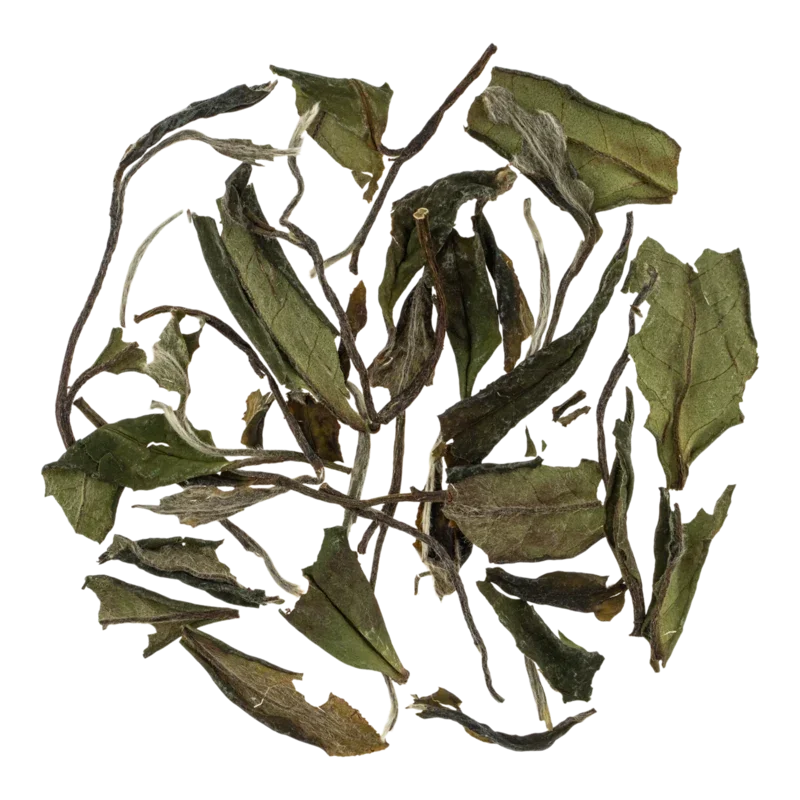
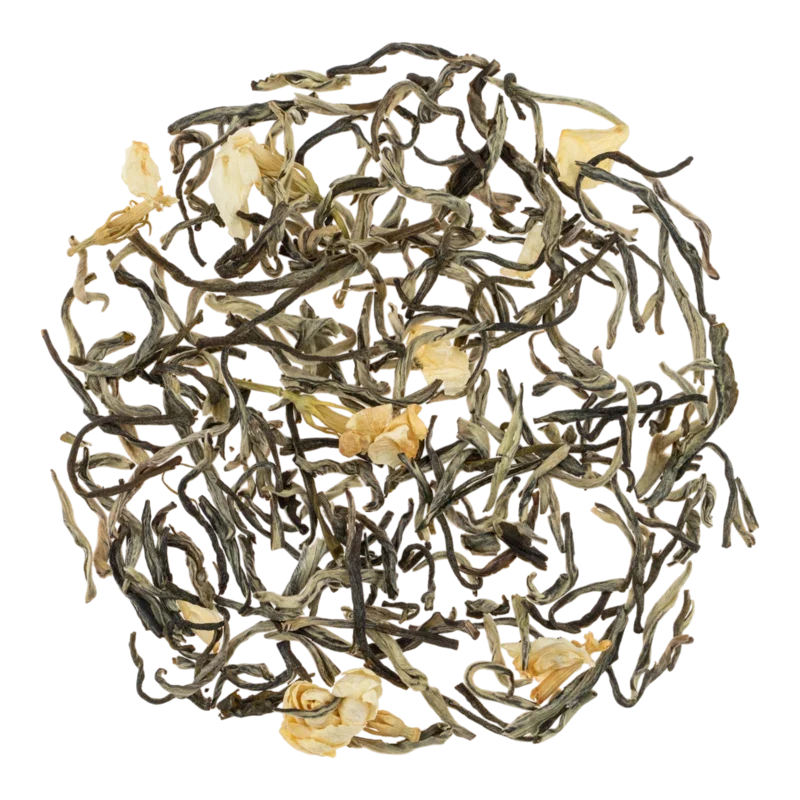
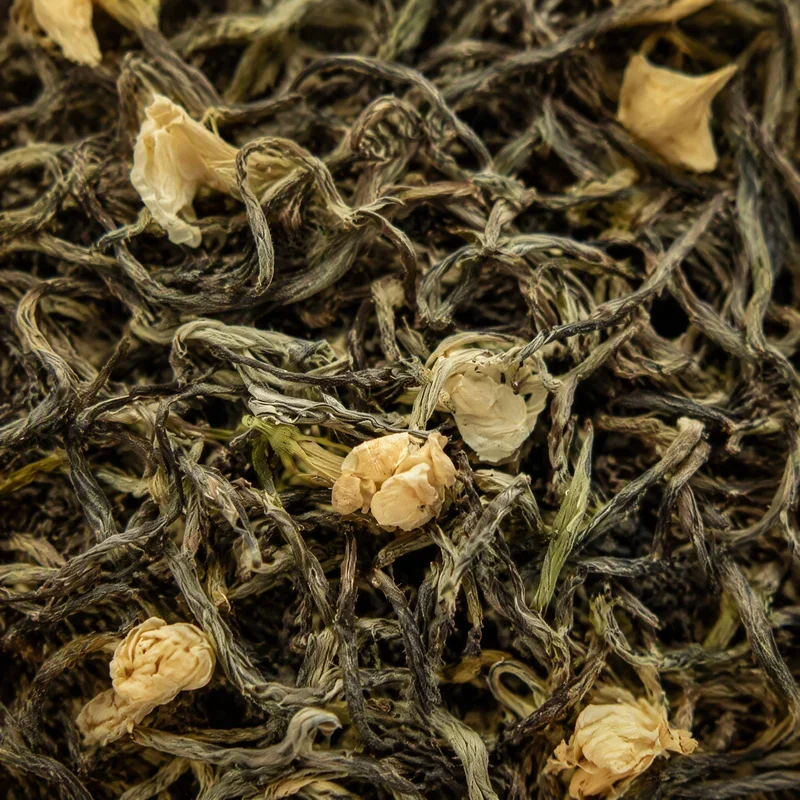
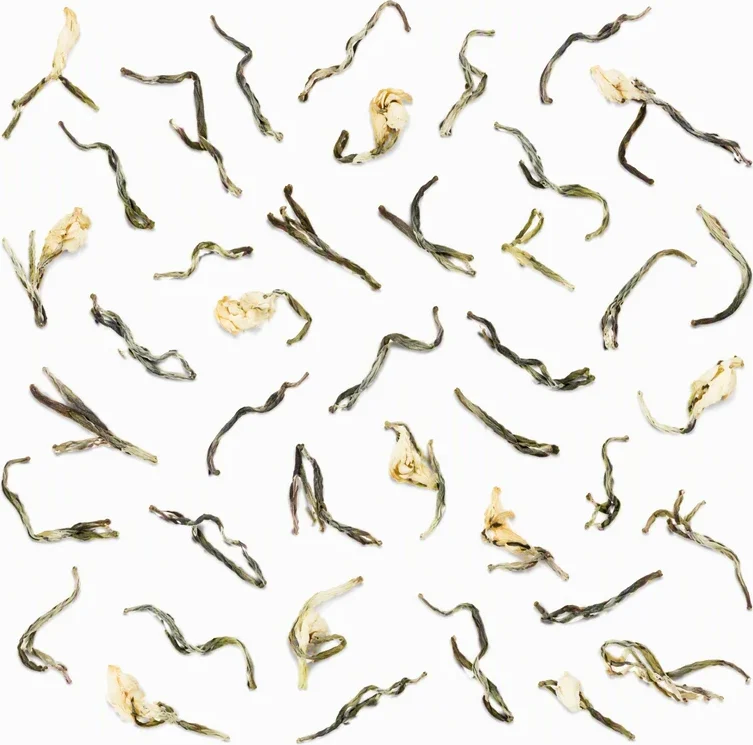
Dry Leaf Appearance: Small, tender, unopened buds densely covered with silvery-white down. Shape — slightly curved or straight, compact. Color — silvery-green with pearlescent luster. Sometimes small inclusions of white jasmine petals are visible in dry tea. Buds should be whole, uniform, without significant breakage.
Dry Leaf Aroma: Refined, multi-layered. Delicate, natural jasmine aroma dominates — sweetish, with honey and slightly "green" overtones — harmoniously intertwining with the delicate aroma of green tea leaf. Aroma should be clean, without synthetic harshness, without mustiness.
Liquor Aroma: Exquisite, delicate jasmine bouquet with subtle notes of honey, lily of the valley, and young greenery. Aroma unfolds gradually: top notes — bright, fresh jasmine; middle — warm, honey-floral; base — soft, tea-like, with light "bread-like" warmth.
Liquor Color: Light yellow, pale golden, crystal clear with bright luster.
Spent Leaves: Whole, resilient buds of tender light green color, retaining silvery down and original form. Spent leaf uniformity is a key quality indicator.
Taste: Soft, tender, exceptionally clean, refreshing, with natural sweetness. Green tea and jasmine flavors are in balance — neither component dominates. Aftertaste is prolonged, floral-sweet (回甘, huígān), with light honey undertones. Bitterness is completely absent with proper brewing. Liquor body — light, with silky texture.
Alkaloids: Caffeine — 2.0–3.0% of dry mass (15–25 mg per 150 ml cup). Moderate caffeine level combined with L-theanine and sedative properties of jasmine aroma provides mild tonic effect.
Amino Acids: 3.0–4.5% of dry mass. L-theanine is the dominant component. Multi-stage yunzhi (窨制) also promotes formation of additional amino acids through partial protein hydrolysis.
Key aromatic compounds transferred from flowers to tea: linalool (floral freshness), benzyl acetate (sweetness), cis-jasmone (deep jasmine tone), indole (in trace amounts — "warm," animal undertone adding depth), methyl jasmonate, nerolidol, farnesol. Total essential oil content in finished tea — approximately 0.5–1.0% of dry mass.
During yúnzhí (窨制), partial hydrolysis of insoluble tea leaf proteins to amino acids occurs, while polyphenols undergo mild oxidation. This explains why jasmine tea is perceived as "softer" and "less astringent" compared to the original green tea base. The phenol-amino ratio (酚氨比, fēn ān bǐ) decreases, shifting the flavor profile toward sweetness and softness.
Minerals: Potassium, magnesium, fluorine, zinc, manganese.
Polyphenols: 15–20% of dry mass. EGCG, EGC, ECG, EC. Content somewhat decreases during multiple scenting (moisture and heat from flowers promotes partial catechin oxidation), which additionally softens taste — bitterness and astringency are lower than in the original green tea.
Vitamins: Vitamin C (partially destroyed during scenting but retained in significant amounts — up to 80–150 mg/100 g), vitamins B₁, B₂, vitamin E.
Green tea catechins (EGCG) combined with jasmine antioxidant components provide cellular protection from oxidative stress.
Jasmine sambac (Jasminum sambac) aroma has scientifically confirmed anxiolytic (anti-anxiety) effects — inhaling jasmine aroma reduces cortisol levels and promotes relaxation. Combined with green tea L-theanine, it creates a state of "calm clarity."
Moderate caffeine improves concentration and cognitive productivity, while L-theanine softens stimulating action, preventing nervousness.
Jasmine tea is traditionally considered a digestive aid. Polyphenols show moderate antibacterial activity in the GI tract.
Regular green tea consumption is associated with LDL cholesterol reduction and vascular tone maintenance.
Jasmine essential oils possess antiseptic properties; linalool and benzyl acetate show anti-inflammatory activity.
Antioxidants (EGCG, vitamin C, vitamin E) and jasmine anti-inflammatory components jointly support skin health.
Light, clean taste and floral aroma make Moli Yin Hao an excellent summer beverage, including cold brewing (冷泡, lěng pào).
Tea Amount: 3–5 grams per 150–200 ml water.
Teaware: Glass teapot or glass tumbler — optimal choice for observing silvery bud unfurling. Fine white porcelain gàiwǎn (盖碗) is also suitable — it allows evaluation of lid aroma (闻盖香, wén gàixiāng) after each infusion.
Water Temperature: 75–85°C. Tender buds require gentle temperature — boiling water (100°C) instantly extracts excess catechins and can "burn" delicate jasmine aroma.
Container: Vacuum bags with aluminum barrier layer (preferable), tin cans with tight lids, porcelain containers. Avoid transparent glass containers — light destroys chlorophyll and accelerates aroma degradation.
Enemies: Oxygen, light, moisture, foreign odors, high temperature.
When refrigerated — up to 18 months. At room temperature — no more than 8–10 months. Best consumption time — first 6 months after production, when jasmine aroma is freshest.
Temperature: Ideally — in refrigerator at 0–5°C in airtight packaging, isolated from strong-smelling products. Cold slows aromatic oil volatilization and polyphenol oxidation.
Tea base — more mature leaf (bud + 1–2 leaves), rolled into tight ball-shaped "pearls". Longzhu has a more intense, full-bodied flavor with pronounced tea character, while Yin Hao is more delicate, refined, with emphasis on sweetness and silkiness.
Elite jasmine tea from Fujian, also produced from downy bud material. Conceptually similar to Yin Hao; differences lie in the specific cultivar of the tea base and nuances in the number of scenting cycles. Dabaihao is often larger in bud size and may be even more downy.
Tea shaped into an oval form resembling a bird's eye. Usually made from more mature material (bud + leaf), has medium body and more pronounced tea flavor.
Sichuan jasmine tea from Emeishan, notable for the presence of white jasmine petals in the dry tea. Piaoxue has a fresher, more "grassy" profile compared to Fujian Yin Hao; its tea base is usually flat or slightly twisted leaf, not bud material.
General name for all jasmine teas. Mass-market varieties are produced from mature leaf of low grades (4–6 class) with 2–3 scenting cycles. Compared to them, Yin Hao differs at a fundamentally different level: bud material, 5–7 cycles of yunzhi (窨制), multi-layered aroma and absence of bitterness.
Price Category: Suspiciously low price almost certainly means substitution (mass jasmine tea from mature leaf with 2–3 scenting cycles or artificial scenting).
Buds whole, uniform, densely covered with silvery down. Abundant breakage, stems, large leaves, and flower fragments — signs of low quality.
Bright, clean, natural jasmine harmoniously combined with tea background. Key test — aroma should be 鲜灵 (xiānlíng, "fresh-lively"), not 浊 (zhuó, "muddy, heavy"). Sharp, "perfumery," or synthetic smell — sign of artificial scenting with essences instead of natural yunzhi (窨制).
Soft, balanced, without bitterness. Jasmine flavor should be "built into" tea body, not felt as external coating.
Clear, light yellow. Cloudy or dark liquor — warning sign.
No reviews yet. Tell us what you think of this tea.
Rate this tea and share your impressions. We review each submission before publishing it.