Brewing
Gongfu brewing
- Water temperature
- 93 °C
- Tea amount
- 5 g
- Water volume
- 100 ml
- First steep
- 10 s
- Time added per infusion
- 5 s
- Infusions
- 4

Zūnyì hóngchá
Choose a brewing method. Start with the recommended quantities and time, then adjust to taste.
Brewing
Brewing
Taste
Tea encyclopedia
Category: Gōngfū red tea (工夫红茶, gōngfū hóngchá) — traditional style of masterful processing. Among the most well-known modern regional red teas of China; at the Xinyang tea exhibition (2011) was included in the top ten red teas of the country alongside Qíhóng (祁红), Diānhóng (滇红) and Chuānhóng (川红).
Category: Gōngfū red tea (工夫红茶, gōngfū hóngchá) — traditional style of masterful processing. Among the most well-known modern regional red teas of China; at the Xinyang tea exhibition (2011) was included in the top ten red teas of the country alongside Qíhóng (祁红), Diānhóng (滇红) and Chuānhóng (川红).
Coordinates: approximately 27°46′ N, 107°29′ E (center of Meitan County).
Origin: China, Guìzhōu Province (贵州省, Guìzhōu Shěng), Zūnyì Prefecture (遵义市, Zūnyì Shì). Main production area — Méitán County (湄潭县, Méitán Xiàn); the geographical protection zone also includes counties Fènggāng (凤冈县), Yuqing (余庆县), Dàozhēn (道真自治县), Zheng'an (正安县), Wuchuan (务川自治县) and Xishui (习水县).
Type: Chinese red tea (black tea) (红茶, hóngchá), fully oxidized.
Cultural Significance: Zunyi Hong Cha became a symbol of the revival of Guizhou tea industry. It is part of the "Three Greens, One Red" program (三绿一红) — four priority tea brands of Guìzhōu Province alongside Méitán Cuìyá (湄潭翠芽), Dūyún Máo Jiān (都匀毛尖) and Lü Bǎoshí (绿宝石). The tea was highly praised by patriarchs of Chinese tea studies — Zhāng Tiānfú (张天福, Zhāng Tiānfú) called it "the best combination of Meitan raw material and Fujian technology," and Chéng Qǐkūn (程启坤, Chéng Qǐkūn) characterized it as "a new discovery in the line of high-quality red teas after Qihong and Dianhong."
History: The tea tradition in the Meitan area dates back to ancient times. Tea sage Lù Yǔ (陆羽, Lù Yǔ) in his treatise "The Classic of Tea" (《茶经》, Chájīng, 760s) noted: "In Qianzhong — in Sizhou, Bozhou, Feizhou, Yizhou — tea is found everywhere, and its taste is excellent." During the Qing era, tea from Méitán was supplied to the court as tribute (贡品, "tribute offering").
Name Breakdown: "Zunyi" (遵义) — the name of the prefecture, firmly connected in Chinese history with the Zunyi Conference of 1935. "Hong" (红) means "red" and has a double reading: it is both the color of tea and an association with the "red" revolutionary history of Zunyi. "Cha" (茶) — "tea." The parallel short name "Zunyi Hong" (遵义红) plays on this duality.
Cultivar: Predominantly medium- and small-leaf cultivars are used, developed at the Guìzhōu Tea Research Institute (贵州省茶叶研究所) based on Meitan Experimental Station. Main varieties: Qianmei 601 (黔湄601, Qiánméi 601) — asexual clone, small tree with large leaf, developed by crossing Zhènníng Tuanyecha (镇宁团叶茶, maternal plant) and Fèngqìng Dàyè Chá (凤庆大叶茶, paternal plant), registered as national variety in 1994 (GS13013-1994); Qianmei 419 (黔湄419); Qianmei 502 (黔湄502); Méitán Táichá (湄潭苔茶, Méitán Táichá) — local indigenous variety with compact leaf and high polyphenol content; Fúdǐng Dàbái Chá (福鼎大白茶, Fúdǐng Dàbái Chá) — widely distributed green cultivar in China, adapted to local conditions. In production, blending of several cultivars is often applied, which allows combining the sweetness of Fuding Dabai tips with the body and persistence of the Qianmei series.
Picking: Predominantly spring, before and around Qīngmíng (清明, early April); summer and autumn leaf is also used for mass batches. Early spring harvest gives the greatest proportion of tips and pronounced sweetness.
Pluck Standard: Supreme grade (特级, tèjí) — single bud (单芽, dānyá) or one bud with one leaf (一芽一叶, yī yá yī yè). Standard grades — one bud with two leaves (一芽二叶, yī yá èr yè).
Raw Material: Leaf must be whole, clean, without coarse stems and damage. Minimal delay between harvest and start of processing to preserve freshness and enzymatic potential.
Altitude: 700–1600 m above sea level; main plantations are located at altitudes of 800–1300 m.
Climate: Mid-subtropical humid monsoon. Average annual temperature about 15°C. Characterized by high cloudiness and frequent night rains (so-called "Guizhou night rain"), providing stable moisture and diffused lighting, ideal for slow bud development with amino acid accumulation. Annual precipitation — about 1000–1200 mm.
Soil: Yellow and yellow-brown soils (黄壤/黄棕壤, huángrǎng / huáng zōngrǎng), acidic, pH 4.5–6.5. Organic matter content ≥1.0%, soil layer thickness ≥50 cm. Soils are rich in minerals (including selenium and zinc — characteristic feature of Guizhou terroirs), which forms the pronounced mineral profile of the tea.
Guizhou is one of the most ecologically clean tea provinces of China. Sources note that Zunyi Hong Cha passes pesticide residue checks according to EU standards. Systemic pesticides in the geographical protection zone must comply with national safety standards.
Hand plucking of early spring buds and tender leaves. For supreme grade — single bud or one bud with one leaf.
Freshly picked leaf is spread in a thin layer for primary withering and removal of excess surface moisture.
Leaf is spread in a layer of 3–8 cm for 14–16 hours. During withering, the grassy smell weakens, the leaf darkens, acquires elasticity and softness — when squeezed in a handful it does not crumble, when opened it slowly straightens.
Leaves are rolled to break cell walls and bring juice to the surface. Degree of rolling — no less than 90% of leaf takes the form of a twist. This stage ensures uniform subsequent oxidation.
Rolled leaf is laid in a layer of 8–12 cm; leaf mass temperature is maintained in the range of 26–33°C for 3–5 hours. By the end of oxidation, the leaf acquires a reddish-yellow tint, the grassy smell is completely replaced by floral-fruity aroma.
Two-stage: primary drying (毛火, máohuǒ) at 110–120°C to moisture content less than 20%, then cooling; final drying (足火, zúhuǒ) at 100–110°C to humidity less than 12%. Double drying fixes aroma and prevents over-drying.
Division by fraction, tip content and appearance. Grades are distinguished: supreme (特级, tèjí), first (一级), second (二级), etc.
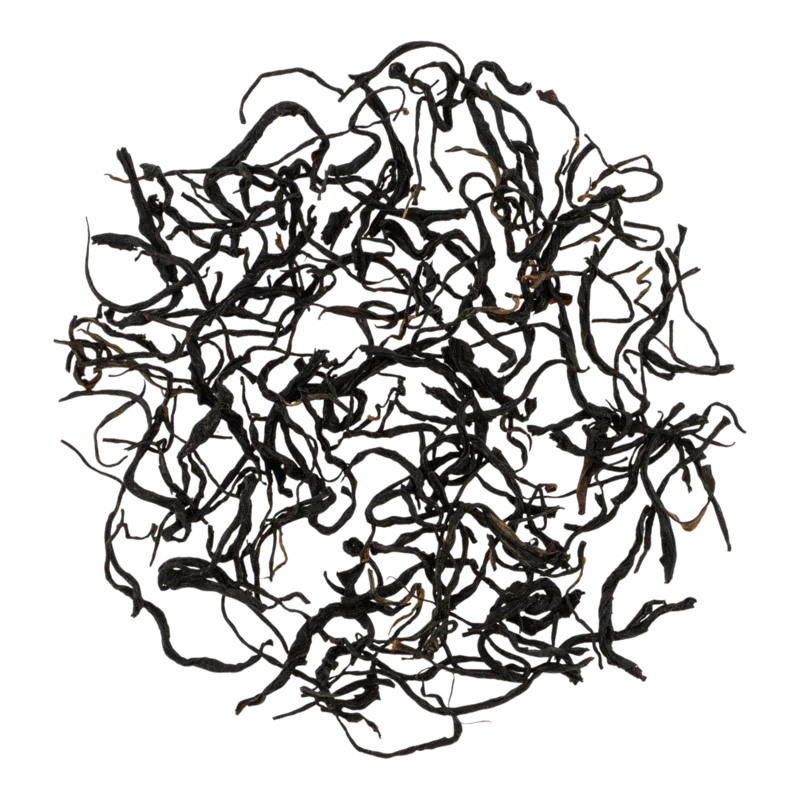
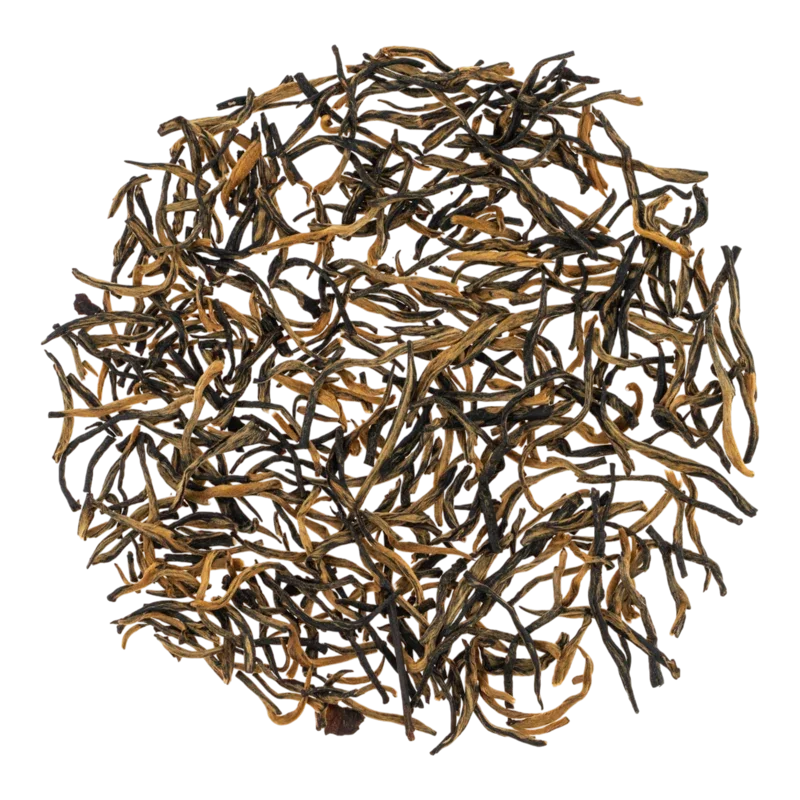
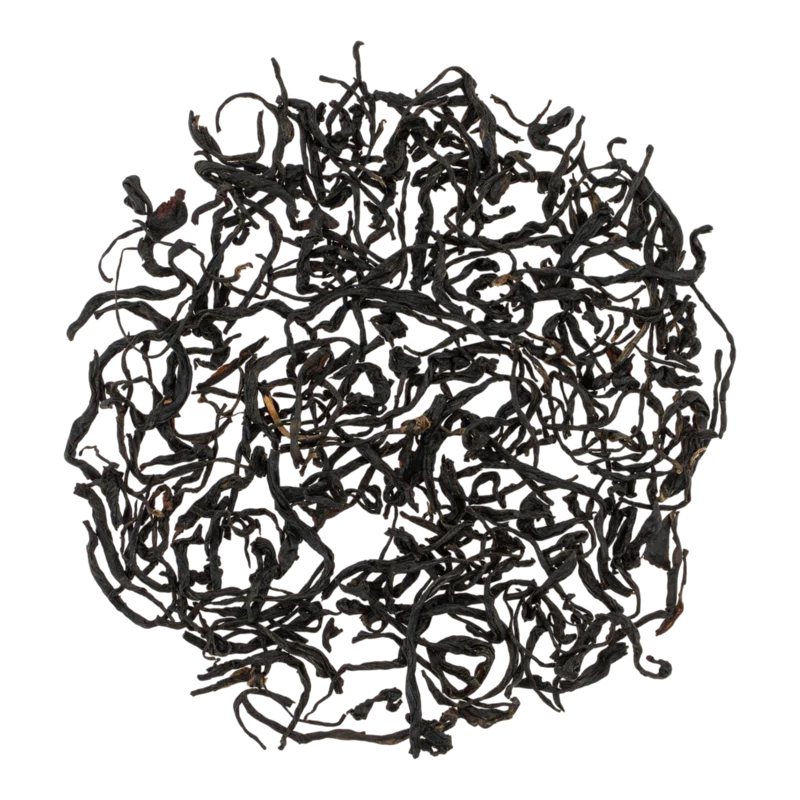
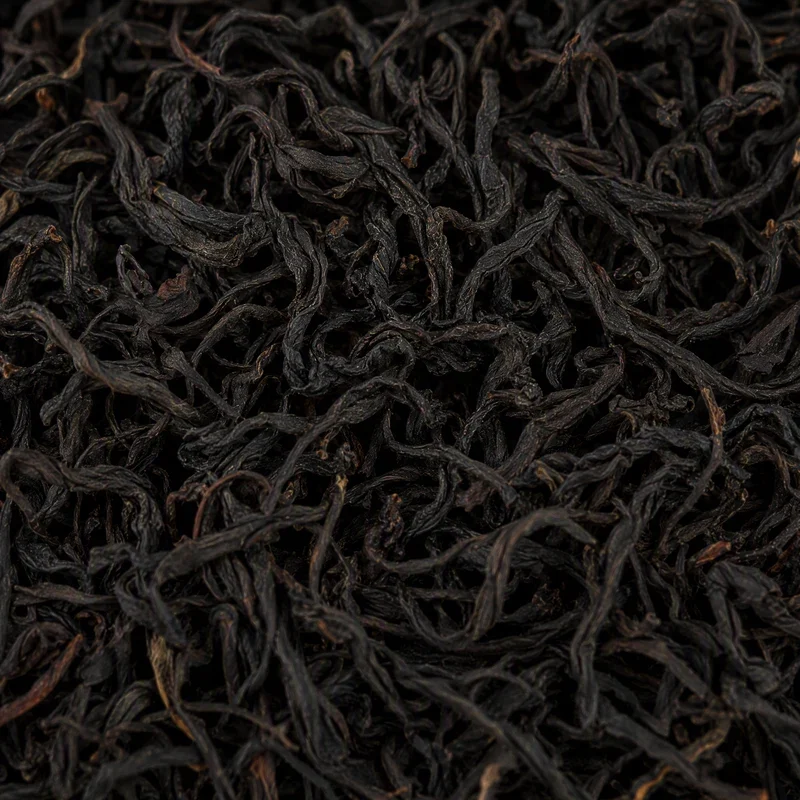
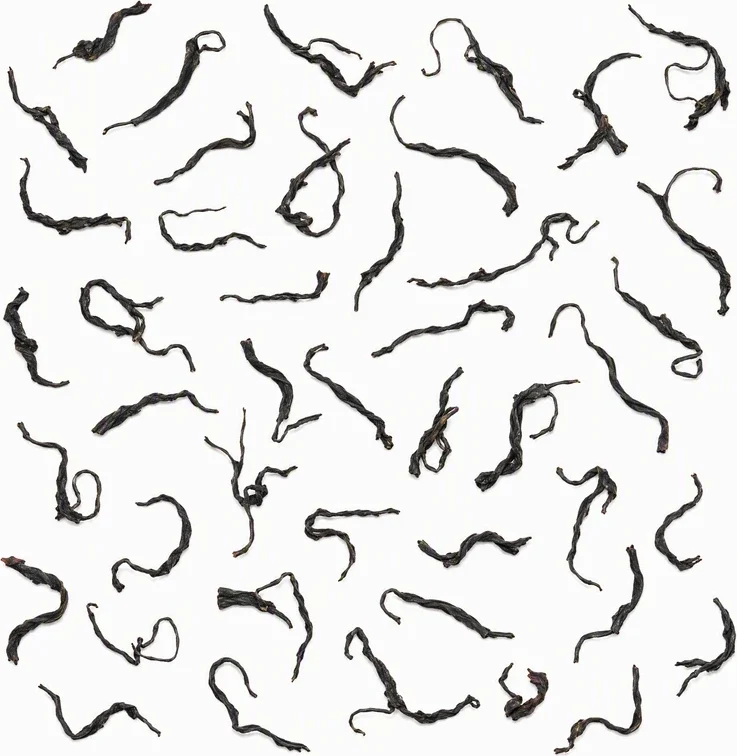
Dry Leaf Appearance: Thin, tightly twisted cords resembling pine needles (松针, sōngzhēn). Color — dark brown with oily luster; golden tips (金毫, jīnháo) are clearly visible on the surface. Supreme grade is distinguished by special fineness, evenness and abundance of golden down.
Dry Leaf Aroma: Sweet, with pronounced fruity note and caramel undertones. Typical "warm" profile of gongfu red tea.
Liquor Aroma: Clean, lasting, with distinct fruity dominance — ripe apricots, baked apples, light honey notes. As it cools, floral overtones appear (osmanthus, wild rose). Aroma is stable throughout 5–7 steeps.
Liquor Color: Bright red, clear and transparent, with golden ring (金圈, jīnquān) around the edge of the cup — sign of high theaflavin content. In supreme grades, the liquor may be orange-red with pronounced luster.
Spent Leaves: Even, tender, reddish-copper color with yellow tint. In supreme grades — leaves are whole, elastic, with uniform texture and characteristic luster.
Taste: Fresh, lively and brisk (鲜爽, xiānshuǎng), with dense body and rounded sweetness. Astringency is mild, quickly transitioning to pronounced sweet aftertaste (回甘, huígān). Notes of honey, dried fruits and light spice stand out. Liquor texture — smooth, velvety. Water extract ≥34.0%.
Alkaloids: Caffeine (咖啡碱, kāfēijiǎn) — main tonic alkaloid, content characteristic of gongfu red tea (about 25–40 mg/g in dry leaf). Theobromine and theophylline are also present in trace amounts.
Amino Acids: L-theanine (L-茶氨酸) — main amino acid, giving softness and "umami" nuance. High-altitude location of plantations and diffused light of Guizhou contribute to increased amino acid accumulation.
Moisture content ≤6.0%; content of water-soluble extractive substances ≥34.0%.
Essential Oils: Linalool, geraniol, cis-3-hexenol and other terpenoids form the characteristic floral-fruity aroma.
Minerals: Potassium, magnesium, calcium, phosphorus, zinc, manganese. Feature of Guizhou terroir — increased content of selenium (硒, xī) and zinc (锌, xīn) in soils, which is reflected in the mineral profile of tea.
Polyphenols: Initial polyphenol content in raw material — medium and above medium (characteristic of Qianmei series, especially Qianmei 419, which has one of the highest phenol-amino coefficients among local cultivars). During full oxidation, a significant part of catechins is converted to theaflavins (茶黄素, cháhuángsù), forming brightness and "liveliness" of the liquor, and thearubigins (茶红素, cháhóngsù), responsible for body and velvetiness.
Vitamins: Vitamin C (partially destroyed during oxidation, but preserved in noticeable amounts), B vitamins (B1, B2), vitamin E.
Caffeine in combination with L-theanine provides mild, prolonged tone without sharp peaks — ideal balance for mental work.
Theaflavins and thearubigins have pronounced antioxidant activity, helping neutralize free radicals.
Red tea (black tea) is traditionally recommended after meals: polyphenols stimulate peristalsis, and warm infusion promotes comfortable digestion.
In traditional Chinese dietetics, red tea (black tea) is considered a "warm" (温性, wēnxìng) beverage, suitable for people with sensitive stomachs and in cold weather.
Theaflavins contribute to normalizing blood lipid levels and maintaining vascular elasticity.
Red tea (black tea) polyphenols suppress the growth of several pathogenic bacteria.
Synergy of caffeine and theanine supports concentration, improves reaction time and reduces mental fatigue.
Tea Amount: 4–5 g per 100–120 ml (gongfu method); 2–3 g per 200–250 ml (European steeping).
Teaware: Porcelain gàiwǎn (盖碗, gàiwǎn) volume 100–120 ml — optimal choice: neutral material allows precise evaluation of aroma and taste. Porcelain or glass teapot suitable for group tea drinking. For dense batches with large leaf, Yíxīng teapot (紫砂壶) from light clay is acceptable.
Water Temperature: 90–95°C. For supreme grades with abundance of tender tips — 85–90°C, to avoid bitterness and reveal sweetness.
Yunnan red tea (black tea) on large-leaf raw material Camellia sinensis var. assamica. Dianhong, as a rule, gives denser, "meatier" body, pronounced honey-malty profile and rich red-orange liquor. Zunyi Hong — lighter, fresher, with more distinct fruity note and "lively" acidity, which is due to medium- and small-leaf raw material and milder terroir.
"Qimen aroma" (祁门香) — standard of floral-honey aromatics in the world of red tea (black tea). Qimen is produced in Anhui from small-leaf raw material C. sinensis var. sinensis. Zunyi Hong adopted part of Qimen technology and also has pronounced aroma, but its profile is shifted toward fruitiness, and body is fuller due to cultivar blending.
Fujian gongfu red tea, one of the "three famous Fujian reds" (闽红三种). Distinguished by dense twist and sweet, "biscuit" profile. Zunyi Hong borrowed technological principles of Zhenghe, but uses completely different raw material, giving different mineral background and different aftertaste structure.
Another "new" regional red tea (black tea) (Henan Province), created approximately at the same time as Zunyi Hong. Both are examples of the modern wave of "green provinces making red tea (black tea)." Xinyang Hong is lighter and more floral; Zunyi Hong — denser and more fruity thanks to richer polyphenolic profile of Guizhou raw material.
No reviews yet. Tell us what you think of this tea.
Rate this tea and share your impressions. We review each submission before publishing it.