Brewing
Gongfu brewing
- Water temperature
- 93 °C
- Tea amount
- 5 g
- Water volume
- 100 ml
- First steep
- 10 s
- Time added per infusion
- 5 s
- Infusions
- 4

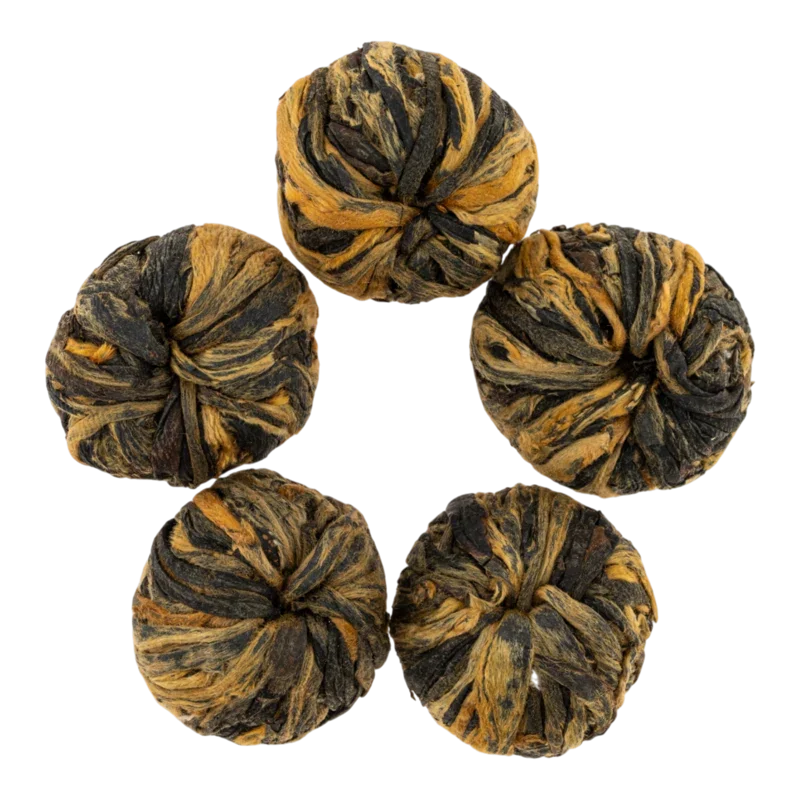
hóng lóngzhū
Choose a brewing method. Start with the recommended quantities and time, then adjust to taste.
Brewing
Brewing
Taste
Tea encyclopedia
Category: Red tea in "dragon pearl" form (龙珠, lóngzhū). Belongs to the category of "shaped" or "artistic" teas, where the rolling form is an important product characteristic. By processing method — gongfu hongcha (工夫红茶, gōngfū hóngchá) with an additional stage of hand-forming into balls.
Category: Red tea in "dragon pearl" form (龙珠, lóngzhū). Belongs to the category of "shaped" or "artistic" teas, where the rolling form is an important product characteristic. By processing method — gongfu hongcha (工夫红茶, gōngfū hóngchá) with an additional stage of hand-forming into balls.
Coordinates: Yunnan — between 21°09′ and 29°15′ N, 97°00′ and 106°00′ E. Main production zones — 22°–25° N, at altitudes of 1000–2100 m.
Origin: Traditionally and most qualitatively produced in Yúnnán Province (云南, Yúnnán), China — primarily in the regions of Líncāng (临沧, Líncāng), Xīshuāngbǎnnà (西双版纳, Xīshuāngbǎnnà), Pu'er (普洱, Pǔ'ěr), Déhóng (德宏, Déhóng). A less common but occurring variant is production in Fújiàn Province (福建, Fújiàn), typically from lower-grade raw material.
Type: Red tea (红茶, hóngchá), fully fermented (in European classification — black tea).
Cultural Significance: Hong Longzhu is valued as a "gift tea" (礼品茶, lǐpǐn chá): beautiful form, dosing convenience, and brewing aesthetics (slow unfurling of the pearl in water) make it an ideal present and tea ceremony decoration. In daily practice, Hong Longzhu is popular as "office tea" — requires no scales or fairness cup, one pearl per cup is sufficient.
History: The "longzhu" (龙珠, "dragon pearl") form for tea has a long prehistory in Chinese tea tradition. Rolling tea into spherical form was practiced as early as the Sōng dynasty (宋, 960–1279), when pressed "tea balls" (团茶, tuán chá) were considered the highest format of tea. However, the modern form of longzhu as hand-rolling leaves into small spheres is predominantly a phenomenon of recent decades, first gaining widespread distribution in the world of pu-erh (普洱龙珠), then transitioning to red tea. Hong Longzhu as a separate market category took shape in the 2000–2010s, when consumer demand for convenient portioned tea formats (一泡一颗, "one pearl — one portion") coincided with the growing popularity of Yunnan red teas in China's domestic market.
Predominantly large-leaf variety Yúnnán Dǎ Yè Zhǒng (云南大叶种, Yúnnán Dàyèzhǒng) — Camellia sinensis var. assamica. The same botanical material used for producing pu-erhs and classic Dian Hongs. For premium Hong Longzhu, raw material from old trees (古树, gǔ shù) aged 100 years and more may be used.
Various local cultivars — Méi Zhàn (梅占, Méi Zhàn), Fu Yun 6 hao (福云6号), rarely — Tiě Guānyīn (铁观音, Tiě Guānyīn) or Jīn Guānyīn (金观音). Fujian Hong Longzhu is typically lighter and less concentrated than Yunnan versions.
Cultivar: Depends on production region:
Picking: Main season — spring (March–April). Summer and autumn harvests are also used, but spring is valued significantly higher.
Pluck Standard: For high-quality Hong Longzhu — bud + 1–2 young leaves. For mass production, more mature leaves (2–4 leaves) are acceptable. The more tender the raw material, the smaller the pearl size and the higher its value.
Raw Material: For elite Hong Longzhu — fresh, undamaged, uniform shoots with high tip content. Pearl size is usually 5–8 g — this strictly determines the amount of leaf needed.
Altitude: Yunnan — 1000–2100 m; Fujian — 300–1200 m.
Climate: Yunnan — subtropical/tropical mountain with alternating wet and dry seasons, average annual temperature 15–20 °C. Fujian — subtropical monsoon, more humid, average annual temperature 17–21 °C.
Mountainous region with unique combination of altitude (1000–2100 m), fertile red and yellow soils, abundant precipitation, and high biodiversity. Yunnan red teas differ from most other Chinese red teas in richness, "body," and power — a direct consequence of the large-leaf nature of local cultivars.
Subtropical monsoon climate, mountainous terrain, high humidity. Fújiàn red teas (闽红, mǐn hóng) are usually more delicate and floral.
For Hong Longzhu production, raw material quality is critically important: the pearl exposes all the leaf's virtues and flaws, since when it unfolds in the cup, every element (bud, leaf, stem) is visible "in plain sight."
Hand-picking fresh shoots (bud + 1–2 leaves) according to quality standard.
Solar or shade withering for 12–18 hours. Leaf moisture reduces to 60–65%. For Yunnan large-leaf raw material, withering may be more prolonged.
Leaf is rolled to damage cell walls and initiate fermentation. At this stage, tea still has traditional longitudinal form.
Full fermentation (oxidation) at temperature 22–28 °C and humidity ≥90%. Duration — 3–6 hours. Leaf acquires copper-red color and characteristic sweet aroma.
Key stage distinguishing Hong Longzhu from other red teas. Fermented (or preliminarily dried) leaf is taken in portions of 5–8 g and hand-rolled into tight balls. For this, the master places a portion of leaf on palm or cloth (白棉纱布) and forms a tight ball with circular movements. The process requires experience, pressure precision, and material sensitivity: too weak rolling — pearl will crumble, too strong — will damage leaf. Each pearl is formed individually, making the process extremely labor-intensive and excluding mass machine production.
Final drying to fix form and remove residual moisture. Two main methods are used: hot air (烘干, 80–110 °C) — for classic red tea; sun-drying (晒干) — for "shai hong longzhu" (晒红龙珠) variant, possessing potential for limited "aging."
Finished pearls are sorted by size, density, uniformity, and quality.
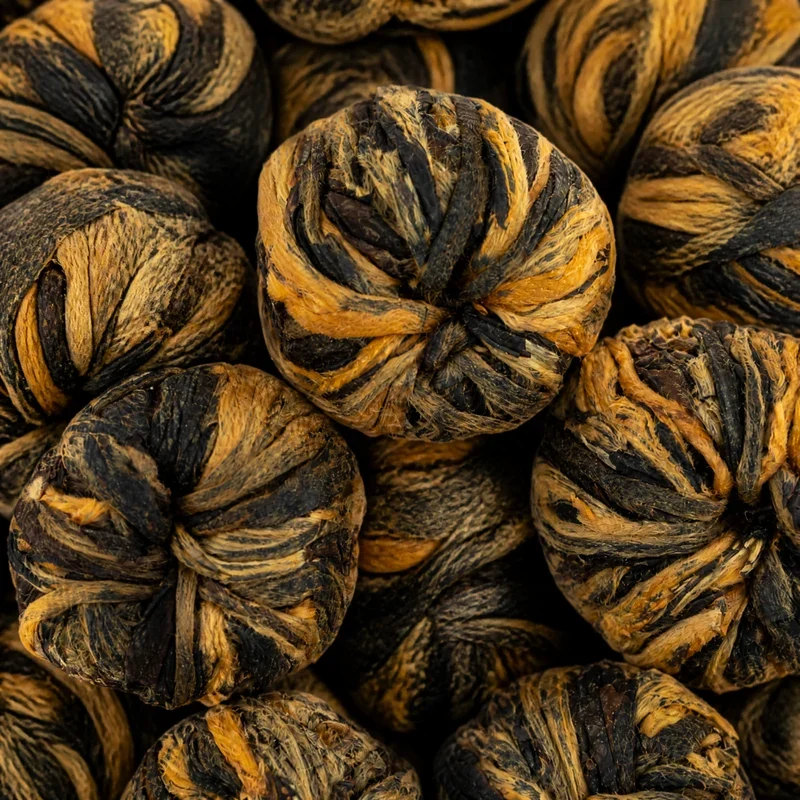
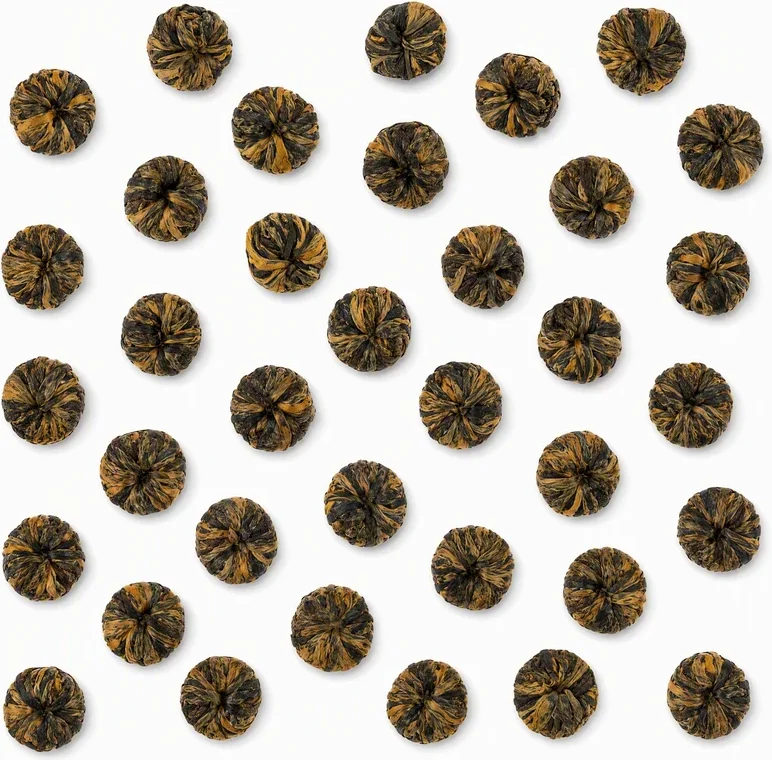
Dry Leaf Appearance: Tightly rolled balls ("pearls") with diameter 0.8–1.5 cm, weight 5–8 g each. Surface — from dark brown to black, with possible golden or reddish inclusions (tips). In quality samples, pearls are uniform in size, dense, without cracks and loose areas. Surface may be slightly oily and glossy.
Dry Leaf Aroma: Rich, dense, sweet. Dominated by notes of dried fruits (prunes, dried apricots, raisins), dark honey, malt, cocoa. Background notes: spices (cinnamon, nutmeg), caramel, baked apple. In Yunnan samples — characteristic "Yunnan" accent: light "earthiness" and woody note.
Liquor Aroma: Bright, enveloping, "warm." Dried fruit-honey complex intensifies and enriches with floral (rose, orchid), caramel, and chocolate nuances. With each infusion, aroma evolves: from sweet and "dense" to lighter and more fruity.
Liquor Color: From amber-red to deep red-brown, transparent, clear, with characteristic golden rim (金圈, jīn quān) at cup edge. Color intensity depends on raw material and fermentation degree.
Spent Leaves: After complete pearl unfurling — whole, soft, elastic leaves and buds of reddish-brown or copper color. Shoot structure is clearly visible: bud, first and second leaf. Leaf uniformity and integrity — indicator of hand-work quality.
Taste: Full, velvety, enveloping, with pronounced natural sweetness and minimal astringency. Base — notes of dried fruits (prunes, dried apricots, figs), dark honey, malt, milk chocolate, caramel. Background shades — spices, light citrus acidity, sometimes — subtle "smokiness." Aftertaste is long, sweet, with fruit-honey trail and sensation of gentle warmth. Liquor texture — oily-smooth, "silky," which is a marker of quality Yunnan red tea from large-leaf raw material.
Alkaloids: Caffeine (咖啡碱) — 3.5–5.0%, theobromine, theophylline. Yunnan large-leaf tea typically contains somewhat more caffeine than small-leaf.
Amino Acids: 2–4%, including L-theanine. Provide sweet aftertaste and mild calming effect.
38–45%, ensuring liquor richness and "body."
Essential Oils: Linalool, geraniol, β-ionone, nerolidol, methyl salicylate, etc. Provide rich sweet-fruity aroma.
Minerals: Potassium, magnesium, manganese, iron, zinc, fluorine.
Polyphenols: 20–30% in dry matter. After full fermentation, significant portion of catechins transforms into theaflavins (2–3%, golden liquor color, "sparkling" taste) and thearubigins (10–15%, color depth, liquor body).
Vitamins: C (partially destroyed during fermentation), B₁, B₂, E, K, PP.
Moderate caffeine content combined with theaflavins provides gentle, prolonged alertness. Red tea is traditionally considered a "warm" (温性, wēn xìng) beverage, improving circulation.
Theaflavins and thearubigins — active antioxidants, contributing to cell protection from oxidative stress.
Red tea polyphenols stimulate digestive enzyme secretion, promote fatty food breakdown. Hong Longzhu is an excellent "after-dinner" tea.
Regular red tea consumption is linked to maintaining vascular elasticity and cholesterol metabolism normalization.
Complex of polyphenols, vitamins, and minerals contributes to increased body resistance.
L-theanine combined with caffeine creates gentle state of "warm concentration" — alertness without nervousness, relaxation without drowsiness.
Observing slow pearl unfurling in water — form of "tea meditation," contributing to stress reduction and emotional balance restoration.
Tea Amount: 1 pearl (5–8 g) per 150–200 ml water. This is one of the format's main conveniences: precise dosing without scales.
Teaware: Porcelain gàiwǎn (盖碗) — for infusion and aroma control. Glass teapot — for aesthetic enjoyment of pearl unfurling process (recommended for first acquaintance with tea). Yíxīng teapot (宜兴紫砂壶) — for denser, richer liquor. Simple brewing in mug is also acceptable — pearl will unfurl and release its taste with any method.
Water Temperature: 90–95 °C. Too hot water on first infusion may give excessive astringency; too cold — won't fully unfurl the pearl.
Container: Airtight packaging — foil bag with zip closure, tin can, ceramic container. Many producers package each pearl in individual foil packet — this is optimal format for freshness preservation.
Enemies: Moisture, light, foreign odors, high temperature.
Shelf Life: Classic Hóng Lóngzhū (烘干, hot air drying) — optimally within 1.5–2 years. Shài hóng lóngzhū (晒红龙珠, sun-drying) — according to some producers' claims, capable of limited "aging" (越陈越香), acquiring rounder, softer taste over 3–5 years. Nevertheless, most experts recommend consuming red tea fresh.
Dry, cool (15–25 °C), dark place, away from foreign odors.
Classic loose-leaf Yunnan red tea. The flavor profile is close to Hong Longzhu (if the raw material is identical), but the loose format releases flavor faster in the first infusions and is less decorative. Hong Longzhu unfolds more gradually and provides a more "even" flavor curve.
Elite red tea from Tóngmù County (桐木), Fujian Province, produced exclusively from buds. The aroma is refined, honey-floral, with pine notes. Compared to it, Yunnan Hong Longzhu is more powerful, sweet and "chocolatey," with pronounced "body."
Classic smoked red tea from Fujian. Hong Longzhu lacks the characteristic "smoky" aroma (松烟香) — its palette is built around sweetness, fruits and chocolate.
Famous red tea from Anhui. It has a more "floral" and "grape-like" profile, with the characteristic "Keemun aroma" (祁门香). Hong Longzhu is simpler and "sweeter," but compensates for this with richness and velvety texture.
If both teas are Yunnan, the difference lies in the character of the raw material and form: Ye Sheng is "wild," powerful, herbaceous, with pronounced astringency; Hong Longzhu from plantation material is more "civilized," sweet and soft. When using wild-grown material for longzhu, the boundaries blur.
No reviews yet. Tell us what you think of this tea.
Rate this tea and share your impressions. We review each submission before publishing it.