Brewing
Gongfu brewing
- Water temperature
- 93 °C
- Tea amount
- 5 g
- Water volume
- 100 ml
- First steep
- 10 s
- Time added per infusion
- 5 s
- Infusions
- 4

Fújiàn xuě yá hóngchá
Choose a brewing method. Start with the recommended quantities and time, then adjust to taste.
Brewing
Brewing
Taste
Tea encyclopedia
Category: High-grade tippy red tea (black tea) of Fujian (gongfu hong cha, 工夫红茶, gōngfū hóngchá). Stylistically, it belongs to the line of elite tippy red teas (black teas) that emerged in the 21st century following Jin Jun Mei.
Category: High-grade tippy red tea (black tea) of Fujian (gongfu hong cha, 工夫红茶, gōngfū hóngchá). Stylistically, it belongs to the line of elite tippy red teas (black teas) that emerged in the 21st century following Jin Jun Mei.
Coordinates: Approximately 25°30′–27°30′ N, 117°00′–120°00′ E (depending on the specific production area within mountainous Fujian). Gaide Village — approximately 800 m above sea level.
Origin: China, Fújiàn Province (福建, Fújiàn). The specific known production area is Gàidé Village (盖德村, Gàidé Cūn), located in the mountainous part of the province. The tea can also be produced in other mountainous areas of northeastern and northern Fujian, including the vicinity of Fúdǐng (福鼎, Fúdǐng) and Zhènghé (政和, Zhènghé), where cultivars with abundant down are grown.
Type: Red tea (black tea) (红茶, hóngchá) — fully fermented (oxidized).
Cultural Significance: Xue Ya Hong Cha embodies the modern trend of Fujian tea cultivation — transferring techniques and raw materials traditionally associated with white tea into the world of red tea (black tea). This "red tea (black tea) with a white soul" blurs the boundaries between categories and demonstrates the versatility of famous Fujian cultivars. It is positioned as an exquisite gift tea, valued for its tenderness, purity and elegance.
History: Fujian Province is the cradle of red tea (black tea): it was here, in the Tóngmùguān area (桐木关, Tóngmù Guān) in the Wǔyí Mountains (武夷山, Wǔyí Shān), in the mid-16th century during the Míng dynasty (明, Míng), that the technology of full fermentation of tea leaves was developed, giving the world Zhèng Shān Xiǎo Zhǒng (正山小种, Zhèng Shān Xiǎo Zhǒng, Lapsang Souchong). For centuries, Fujian masters perfected the art of red tea (black tea) production, creating the famous "trinity" — Tān Yáng Gōngfū (坦洋工夫), Bái Lín Gōngfū (白琳工夫) and Zhènghé Gōngfū (政和工夫), which the Fujian people call "Min Hong" (闽红, Mǐn Hóng) — "red teas (black teas) of the land of Min."
Cultivar: Primarily uses classic Fujian "white tea" cultivars with abundant down on buds:
Picking: Spring or early summer harvest (March–April for spring, until early July for summer). Spring raw material is most valuable due to maximum amino acid content. Summer harvest may produce a slightly stronger, less delicate profile.
Pluck Standard: Exclusively unopened tea buds (单芽, dān yá) — without leaves. This is the strictest harvest standard, requiring jeweler's precision. Each bud is picked by hand, with minimal damage to the down.
Raw Material: Buds must be whole, tender, unopened, densely covered with undamaged silvery down. Absence of damage, spots and opened leaves is a mandatory condition. Raw material must be processed on the day of harvest.
Altitude: 600–900 m above sea level. Gaide Village — approximately 800 m. High-altitude location promotes slowed vegetation, resulting in buds accumulating aromatic substances and amino acids longer, acquiring a more complex and delicate profile.
Soil: Red soils (红壤, hóng rǎng) and yellow soils (黄壤, huáng rǎng) — loose, well-drained, with acidic reaction (pH 4.5–6.0), rich in organic matter and microelements. Parent rock — predominantly granite and gneiss, providing the mineral profile of the tea.
Mountainous part of Fujian Province: hilly and mid-mountain terrain with elevations of 600–900 m above sea level. Climate — subtropical monsoon, with warm humid summers and mild winters. Average annual temperature — 16–19°C. Average annual precipitation — 1,400–2,000 mm. Frequent fogs and cloudiness create diffused lighting favorable for amino acid accumulation and bitterness reduction in tea leaves.
Tea plantations are located on mountain slopes, often surrounded by bamboo groves and broad-leaved trees, creating partial shade. Many producers in the mountainous areas of Fujian practice organic or semi-organic farming, avoiding chemical fertilizers and pesticides.
Hand-picking of unopened buds. The work requires high skill and precision: buds are picked with fingertips, without squeezing and twisting, so as not to damage the delicate down. Harvested raw material is placed in bamboo baskets loosely, without compaction.
Buds are spread in a thin layer on bamboo trays in a room with controlled ventilation or outdoors in shade. Duration — 14–20 hours, depending on humidity and temperature. Goal — reduce moisture content to ~55–60%, make buds soft and pliable, initiate initial enzymatic processes. At this stage, the characteristic honey-floral aroma begins to form.
For purely tipsy raw material, this stage is conducted in the most gentle mode — light hand rolling or extremely delicate machine rolling. Some producers practically completely skip this stage, limiting themselves to minimal impact to initiate fermentation. This is a key difference from leaf red teas (black teas), where intensive rolling is necessary to destroy cellular structure.
Prepared buds are laid out in a room with controlled temperature (24–28°C) and high humidity (85–95%). Fermentation proceeds slower than in leaf red teas (black teas), due to delicate processing and small volume of released cellular juice. Duration — 4–8 hours. The master controls the process by changes in bud color and aroma, striving for complete fermentation, but without over-firing and loss of delicate notes.
Final drying with hot air at temperature 80–100°C to stop fermentation and reduce moisture to 4–6%. Drying is also conducted delicately to preserve bud integrity and down.
Finished tea is sorted, removing substandard elements, broken buds and tea dust. Only whole, undamaged buds with preserved down are selected.
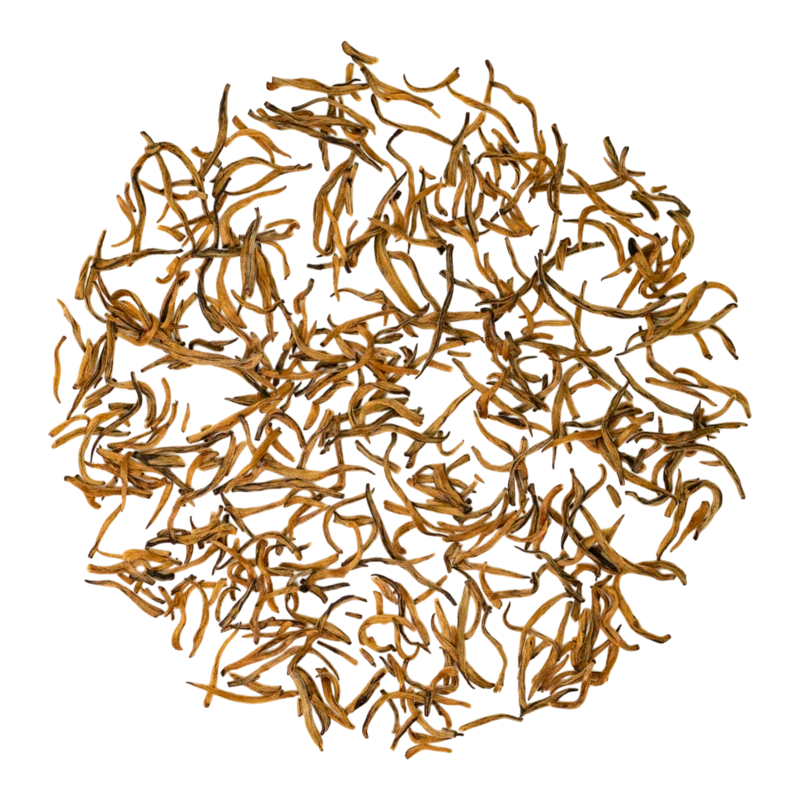
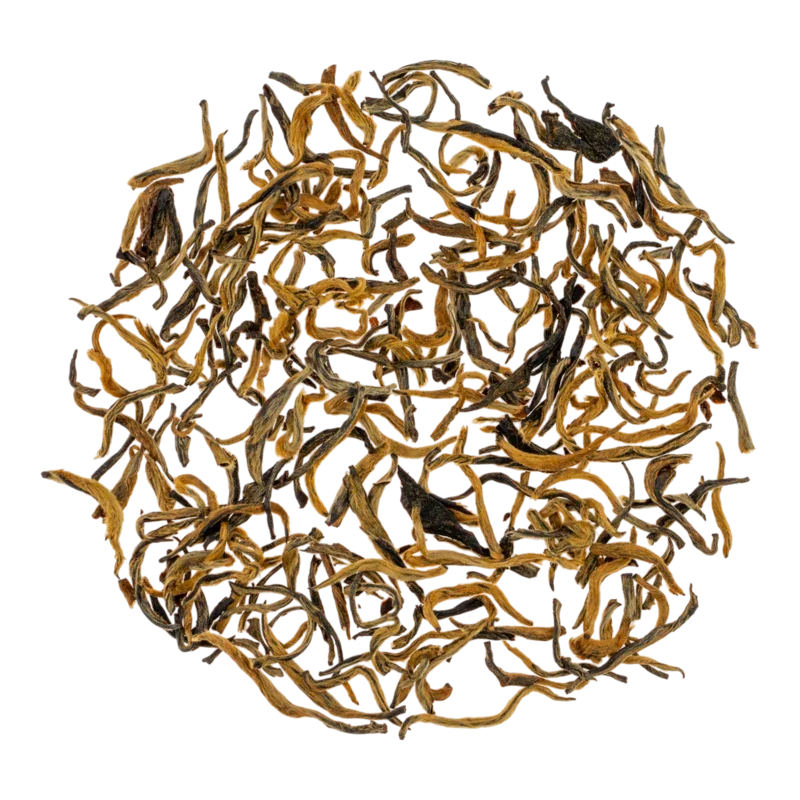
Dry Leaf Appearance: Elegant, thin, whole unopened buds covered with dense silvery or golden-silvery down. Bud color varies from silvery-gray to golden-brown with silvery highlights — precisely this effect creates the "snowy" impression that gave the tea its name. Shape — elongated, needle-like, resembling Bai Hao Yin Zhen, but with a darker basic tone.
Dry Leaf Aroma: Delicate, clean, sweet. Honey notes dominate, with subtle floral shades (honeysuckle, orchid), light fruity tones (apricot, peach). In the background — a barely perceptible milky-creamy nuance and delicate bread note.
Liquor Aroma: Intense but not aggressive. Enveloping honey-floral bouquet with notes of cocoa, sweet pastry, peach and honeysuckle. With cooling, rose and sweet potato shades emerge.
Liquor Color: Bright, clean, transparent, from golden-orange to reddish-amber. The liquor is lighter than most leaf red teas (black teas), which relates it to Jin Jun Mei and other tippy red teas (black teas).
Spent Leaves: Delicate, whole, opened buds of copper or reddish-brown color. Down is preserved, giving buds characteristic velvetiness. Buds are elastic, uniform in color and size.
Taste: Exceptionally soft, silky-smooth, without bitterness and astringency. Sweet honey and floral tones predominate. Texture — creamy, oily, "enveloping." Notes of sweet potato (红薯, hóngshǔ), caramel, peanut oil, bread crust create interesting "confectionery" depth. Light berry acidity and mineral purity provide balance. Aftertaste is long, persistently sweet, with honey trail.
Alkaloids: Caffeine — ~3.5–4.5% of dry mass (bud raw material contains more caffeine than mature leaves). Theobromine and theophylline — in trace amounts.
Amino Acids: Content — ~3.5–5.0% of dry mass — significantly higher than in leaf red tea (black tea). L-theanine dominates and provides characteristic umami sweetness, silky texture and mild relaxing effect. High amino acid content is a key factor in the absence of bitterness and astringency.
Linalool (floral notes), geraniol (rose shades), phenylacetaldehyde (honey aroma), 2-phenylethanol (rose), β-ionone (violet). Abundance of down (bai hao) contributes specific aromatic components, enhancing the "white tea" component of the profile.
Minerals: Potassium (K), magnesium (Mg), manganese (Mn), fluorine (F), zinc (Zn), iron (Fe). Mineral profile depends on soils of the growing region.
Polyphenols: Theaflavins and thearubigins — main polyphenolic compounds formed during full fermentation from catechins. Theaflavins (~0.5–1.2% of dry mass) give brightness to the liquor and light, refreshing astringency. Thearubigins (~6–10%) provide color depth, softness and "body." Total polyphenol content — ~16–22% (lower than in leaf teas, due to high ratio of amino acids to polyphenols in bud raw material).
Vitamins: B-group vitamins (B₁, B₂, B₆), vitamin E, vitamin K, vitamin P (rutin). Vitamin C content is reduced compared to green and white tea.
Synergy of caffeine and L-theanine provides smooth, sustained increase in concentration and performance without nervousness and "caffeine crash." High amino acid content makes the tonic action particularly soft and "meditative."
Theaflavins and thearubigins show pronounced antioxidant activity. Studies indicate potential ability of these compounds to neutralize free radicals and reduce oxidative stress.
Regular moderate consumption of red tea (black tea) is associated with improvement in lipid metabolism indicators (LDL reduction), strengthening vascular elasticity and blood pressure normalization. Rutin (vitamin P) additionally strengthens capillary walls.
Red tea (black tea) has "warm" nature according to Chinese dietology classification, gently warms the body and improves peripheral circulation.
Stimulates secretion of digestive enzymes, promotes digestion of fatty food. Acts more gently on gastric mucosa than green tea.
L-theanine promotes generation of α-brain waves associated with relaxed concentration state, improves memory and cognitive flexibility.
Fluorides and polyphenols show antibacterial activity, contributing to prevention of caries and gum diseases.
Delicate, sweet taste and warm aroma have calming and harmonizing effect on emotional state.
2–3 grams per 200 ml water at 90°C. Steep 3–4 minutes. Suitable for daily tea drinking.
Tea Amount: 3–5 grams per 100–150 ml water for flash brewing method (功夫泡, gōngfū pào); 2–3 grams per 200 ml for steeping in cup.
Teaware: Porcelain gàiwǎn (盖碗, gàiwǎn) — ideal choice: thin walls don't absorb aroma and allow precise control of steeping time. Glass teaware is also suitable and allows admiring the light, golden liquor. Yíxīng clay teapot (宜兴紫砂壶) — acceptable, but light-colored clay with thin walls is preferable.
Water Temperature: 85–90°C. Lower temperature (85°C) will emphasize sweetness and silkiness; higher (90–95°C) — will reveal aromatic depth. Boiling water is not recommended — it may "burn" delicate buds.
Both teas are tippy, both from Fujian, both belong to premium segment. However, Jin Jun Mei is produced from raw material of small-leaf Cǎi Chá (菜茶) population from Tongmuguan and has a more saturated, "dense" profile with notes of baked persimmon, chocolate and malt. Xue Ya, made from "white tea" cultivars with abundant down, is significantly more delicate, "silkier," with more pronounced floral-honey notes and less "body" density.
Traditional gongfu red tea (black tea) from Fuding County, also made from Fuding Da Bai Hao cultivar. Bai Lin Gongfu uses not only buds but also upper leaves, which gives fuller "body" and more pronounced astringency. It is often called "Golden Monkey" on the international market. Xue Ya Hong Cha is more delicate and "pure" in profile due to use of exclusively tippy raw material.
Classic gongfu tea from Zhenghe County, produced from Zhènghé Dà Bái (政和大白) cultivar. Has denser "body," more saturated sweetness and pronounced violet aroma. Xue Ya is lighter, airier and more "transparent" in taste.
Yunnan tippy red tea (black tea) from large-leaf raw material (C. sinensis var. assamica). Significantly more powerful, strong and "brutal," with spicy-malty notes and thick "body." Fujian Xue Ya is at the opposite end of the spectrum: delicate, silky, gentle.
Famous Anhui red tea (black tea). Qi Men has characteristic "Qimen aroma" — complex floral-fruity bouquet with rose and apple notes. Xue Ya is more "simple" in aromatic architecture, but with more pronounced honey sweetness and creamy texture.
Specialized tea shops, direct suppliers from Fujian. Pay attention to indication of specific region of origin and harvest season.
Genuine Xue Ya Hong Cha consists of whole, unopened buds densely covered with silvery-golden down. Presence of broken buds, leaf fragments or non-uniformity — signs of low quality or counterfeit.
Dry tea should have clean, delicate honey-floral aroma without sharp, cloying or chemical notes.
Liquor should be bright, transparent, golden-orange, with soft, sweet taste without bitterness and pronounced astringency. Cloudy or dark liquor, bitterness — warning signals.
Suspiciously cheap tea from "pure buds" almost certainly contains leaf admixtures or is produced from low-grade raw material.
No reviews yet. Tell us what you think of this tea.
Rate this tea and share your impressions. We review each submission before publishing it.