Brewing
Gongfu brewing
- Water temperature
- 100 °C
- Tea amount
- 6 g
- Water volume
- 100 ml
- First steep
- 10 s
- Time added per infusion
- 5 s
- Infusions
- 10

fú zhuān chá
Choose a brewing method. Start with the recommended quantities and time, then adjust to taste.
Brewing
Brewing
Taste
Explore the tea's aroma, flavor and aftertaste.
Click or tap a note to filter matching teas when interaction is enabled.
Tea encyclopedia
Alt Names: Jīngyáng Zhuān (泾阳砖, Jīngyáng Zhuān) — historical name; Fú Chá (茯茶, Fúchá); Fú Zhuān (茯砖, Fú Zhuān); folk names also include Fēng Chá (封茶, Fēng Chá — "packaged tea"), Guān Chá (官茶, Guān Chá — "official tea"), Fù Chá (府茶, Fǔ Chá — "prefectural tea").
Alt Names: Jīngyáng Zhuān (泾阳砖, Jīngyáng Zhuān) — historical name; Fú Chá (茯茶, Fúchá); Fú Zhuān (茯砖, Fú Zhuān); folk names also include Fēng Chá (封茶, Fēng Chá — "packaged tea"), Guān Chá (官茶, Guān Chá — "official tea"), Fù Chá (府茶, Fǔ Chá — "prefectural tea").
Category: Famous dark teas of China; one of the most characteristic and mass-produced representatives of Hunan dark tea (black tea). Part of the "Three Bricks" (三砖, Sān Zhuān) group of Anhua dark tea (black tea) alongside Hēi Zhuān (黑砖, Hēi Zhuān) and Huā Zhuān (花砖, Huā Zhuān).
Coordinates: approximately 28.3–28.8° N, 111.1–112.2° E (Anhua County / Yiyang, Hunan).
Origin: China. Historically, the tea was first pressed in Jīngyáng city (泾阳, Jīngyáng), Shaanxi Province (陕西, Shǎnxī), from raw material supplied from Húnán Province (湖南, Húnán). Since 1953, production was transferred directly to Hunan: Yìyáng Prefecture (益阳, Yìyáng), Ānhuà County (安化县, Ānhuà Xiàn) — the main zone for raw material production and finished product.
Type: Post-fermented tea (dark tea, hei cha — 黑茶, Hēichá).
For three hundred years Fu Zhuan was produced exclusively in Jingyang (Shaanxi), and attempts to transfer production to Hunan failed. Jingyang masters claimed: "Without our water it cannot be done, without our climate it cannot be done, without our technology it cannot be done." The myth was debunked only in 1953, when scientists from Wuhan University helped the Anhua factory master temperature and humidity control during "fahua."
China's national standard (GB/T 9833.3) requires that Eurotium cristatum content in Fu Zhuan be no less than 20 × 10⁴ CFU/g (according to 2013 standard). No other type of tea in the world has such mandatory microbiological criterion.
Governor-General Zuo Zongtang after reconquering Xinjiang in the 1870s used Anhua Fu Zhuan as strategic resource for strengthening ties with local peoples — state purchases reached 73,540 dan (担, about 3,680 tons) per year.
"honey-bread-mushroom" — this unique triad is not found in any other type of tea.
Softness, natural sweetness and practically complete absence of bitterness make it ideal "entry point" into the world of dark teas.
Cultural Significance: Fu Zhuan is one of the key teas of the "Tea Route to the Northwest." Among the nomadic peoples of Xinjiang, Inner Mongolia, Qinghai, Gansu, and Ningxia, there was a saying: "Better three days without food than one day without tea" (宁可三日无粮,不可一日无茶, Nìngkě sān rì wú liáng, bùkě yī rì wú chá). The tea was traditionally used for preparing milk-salt beverages and was considered a necessary aid for digestion with a meat-dairy diet. "Golden Flowers" became a visual marker of quality: in Xinjiang trading regions, buyers evaluated bricks primarily by the abundance and brightness of "flowers."
History: According to one version, Fu Zhuan appeared around 1368 (beginning of the Ming dynasty, 明朝, Míng Cháo), when dark tea from raw materials from southern provinces began to be pressed in Jingyang for shipment to the northwest. Documentary evidence reliably confirms the existence of the technology from the beginning of the Qīng dynasty (清朝, Qīng Cháo): according to the "Draft History of Qing" (清史稿, Qīng Shǐ Gǎo), in the first year of Shunzhi's reign (顺治, Shùnzhì, 1644), a system of tea-for-horses exchange (茶马互市, chámǎ hùshì) was already operating, which featured Jingyang brick tea. Thus, the history of Fu Zhuan spans at least 380 years.
The origin of the character is debatable. Main versions: (1) connection with the name of the medicinal fungus Fuling (茯苓, Fúlíng — Poria cocos), since the tea was attributed similar healing properties, and from "伏茶" (Fúchá) the name was "ennobled" to "茯茶"; (2) consonance with Fù (福, Fú — "happiness, prosperity"); (3) connection with the word Fù (伏, Fú — "hot summer period San Fu, 三伏"), although modern research shows that the height of summer is not the best season for "flower development"; (4) according to some sources — reference to the administrative name Fù (府, Fǔ — "prefecture, district"), since the tea was "official."
"brick" — traditional pressing form.
"tea."
Cultivar: Production uses local large-leaf and medium-leaf cultivars of the tea bush (Camellia sinensis var. sinensis) growing in Anhua and surroundings. Particularly valued is raw material from semi-wild tea trees from "wild mountains" (荒山茶, Huāngshān chá), possessing increased extractability and mineral saturation. The leaf must be sufficiently mature and "dense" — precisely such raw material contains the necessary concentration of substances for successful development of "Golden Flowers."
Picking: Harvest period — from mid-April (Guyu, 谷雨, Gǔyǔ) to the end of June (Mangzhong, 芒种, Mángzhòng). For Fu Zhuan production, predominantly summer harvest is used, spring harvest is also acceptable.
Pluck Standard: One bud with four-five leaves and older (一芽四五叶, yī yá sì wǔ yè), often with part of the stem. This fundamentally distinguishes Fu Zhuan from many teas where exclusively tender buds are valued. For coarse raw material, a special sickle-shaped tool — "tea scissors" (茶摘子, chá zhāizi) is often used, since manually breaking off a mature branch is difficult.
Raw Material: The initial product is Hēi Máochá (黑毛茶, Hēi Máochá) of third-fourth grade. Leaves must be healthy, without mechanical damage, collected in ecologically clean areas. Important is sufficient "fullness" of the leaf to provide a nutritional medium for microorganisms during the "fahua" stage.
Altitude: 300–1000 m above sea level.
Climate: Subtropical monsoon with clearly defined seasons. Average annual temperature is about 16–17°C. High air humidity, frequent fogs and cloudiness provide soft diffused light — ideal conditions for tea bushes.
Soil: Acidic red soils predominate, formed on ancient geological complexes (including glacial deposits). Soils are rich in minerals, particularly selenium — Anhua is among China's regions with elevated selenium content in soil, which is reflected in the tea's mineral profile.
Located in the central part of Hunan Province, on the northern slopes of the Xuěfēng mountain range (雪峰山, Xuěfēng Shān). Hilly terrain with numerous river valleys and gorges creates a unique microclimate favorable for tea plants.
1500–1800 mm per year, abundant and fairly evenly distributed, creating high natural humidity — a favorable factor for fermentation processes.
Forest "belts" around tea gardens protect from wind and pollution, stabilize microclimate. A significant portion of raw material comes from semi-wild trees growing in natural conditions without intensive cultivation.
Mature leaf with four-five leaves is collected manually or with a sickle-shaped tool from April to June.
Pan-firing the leaf at high temperature in a wok to stop enzymatic oxidation. For coarse raw material, the leaf is sprinkled with water before pan-firing to compensate for low moisture content. In some cases, fixation is conducted by combined method: pan-firing in a wok followed by brief steaming.
Rolling is conducted immediately after fixation while the leaf is hot. The goal is to damage cellular structure and release juice for future extraction and fermentation. When rolling coarse raw material, it's important not to allow separation of the leaf blade from veins, otherwise the leaf rolls into "loofah pulp" (丝瓜瓤, sīguā ráng), and stems lose their skin.
The rolled leaf is moistened and laid in piles (heaps) under controlled temperature and humidity. This is primary post-fermentation: microorganisms begin work on transforming polyphenols and other substances. For Fu Zhuan, this stage is shorter than for shu pu-erh.
Additional rolling after piling for denser leaf formation.
The tea is dried, reducing moisture to the level necessary for pressing.
Black maocha is divided into fractions and mixed to ensure batch stability. A certain amount of tea stems (茶梗, chágěng) is added to the blend — they create air channels in the pressed brick structure, providing access to oxygen and moisture necessary for "Golden Flowers" growth.
The prepared blend is steamed for softening and pressed into bricks. Traditional form is rectangular brick. Standard weight is 2 kg (historically 3 kg, i.e., old 5 jin).
Key and unique stage. Pressed bricks are placed in special "hong fang" (烘房, hōngfáng — drying rooms), where optimal temperature of 26–28°C and relative humidity of about 75–85% are maintained. Under these conditions, the fungus Eurotium cristatum develops intensively on the surface and inside the tea leaf, forming golden-yellow "closed fruiting bodies" — enclosed ascus structures (闭囊壳, bìnángké), visually appearing as golden-colored granules. The process lasts from 10 to 20 days. Temperature and humidity control is the most complex part of mastery: with parameter deviations, the product can become moldy and will be rejected.
After sufficient "flower" development, bricks are slowly dried to moisture content of no more than 14%. Fungal structures transition to stable form.
Finished bricks are stored in warehouses where slow transformation of flavor-aromatic components continues. With age, "aged aroma" (陈香, chénxiāng) forms, and taste becomes increasingly rounded and sweet.
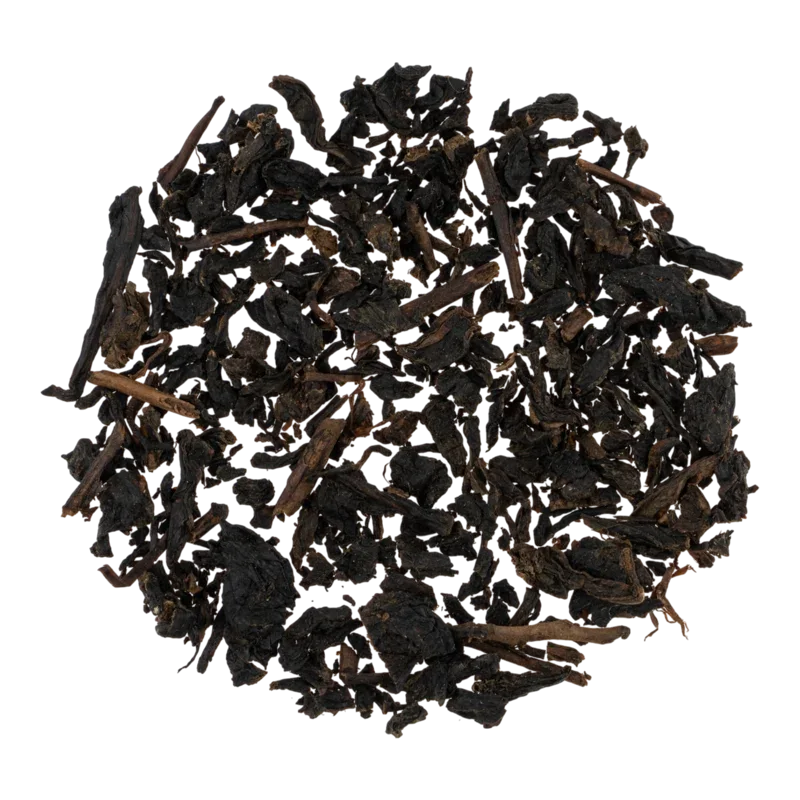
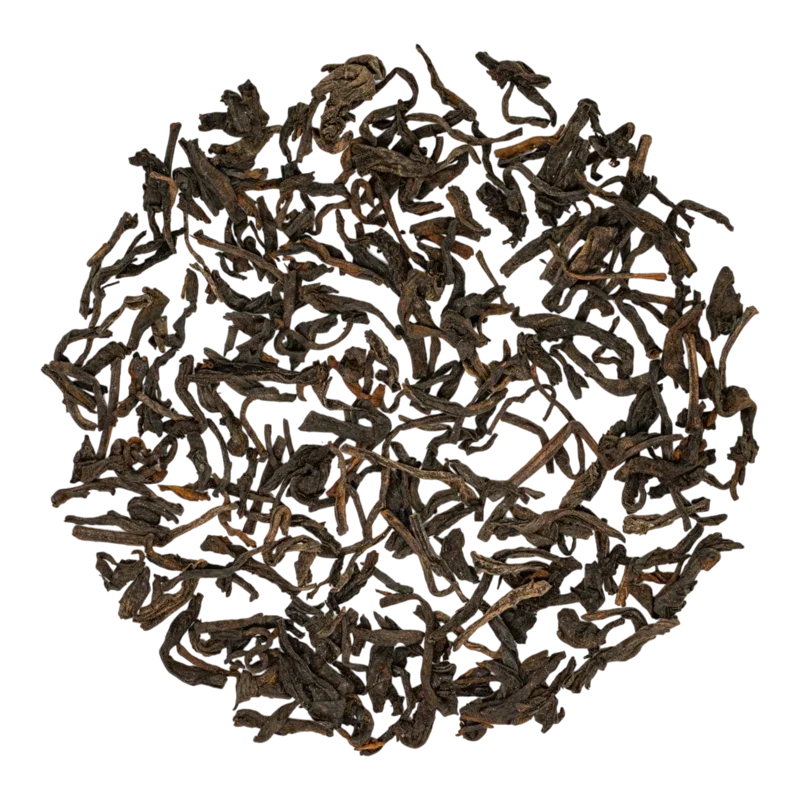
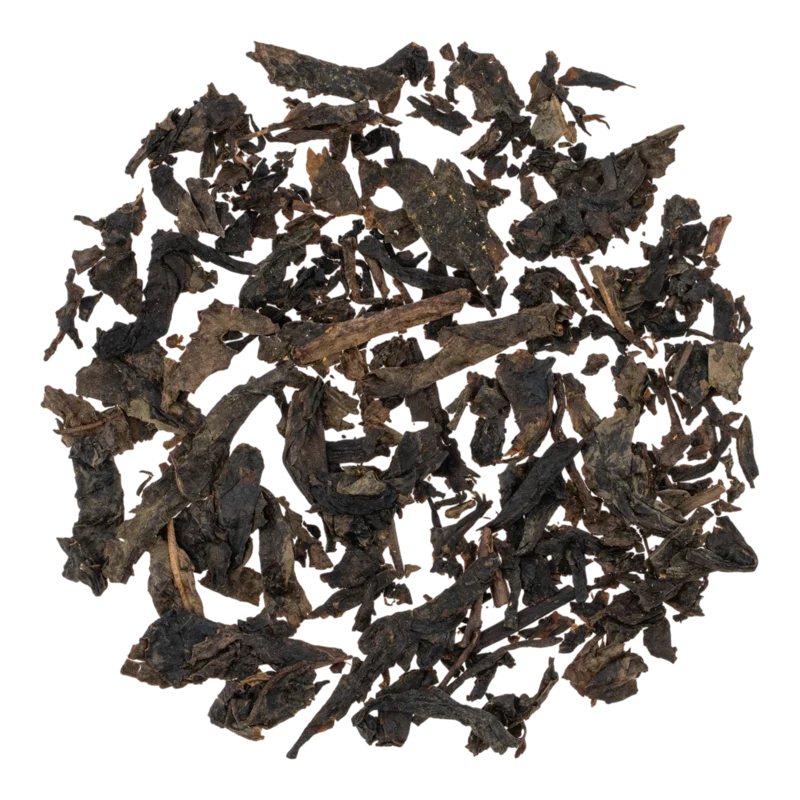
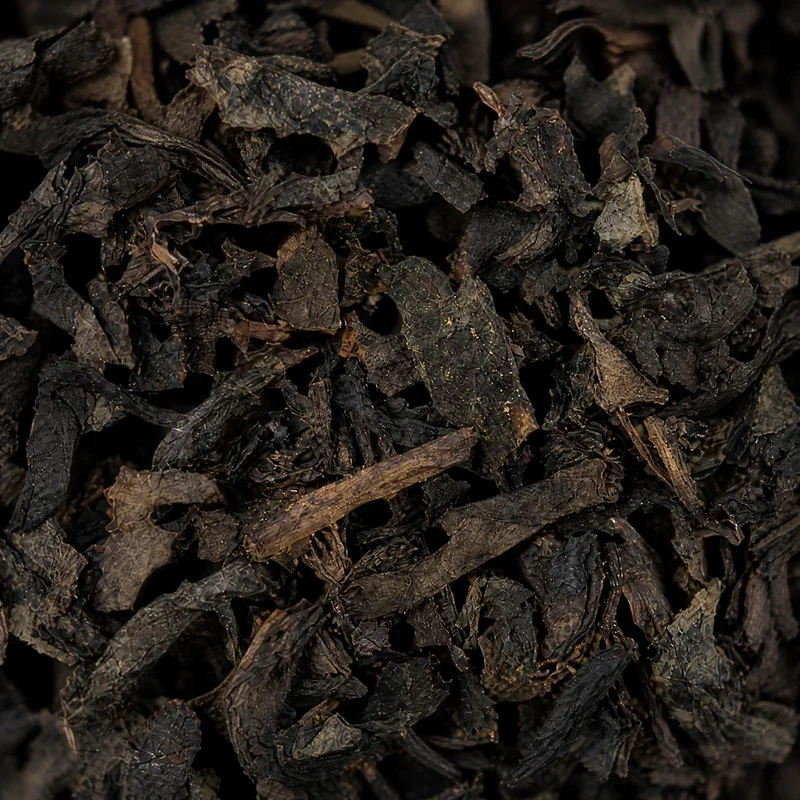
Dry Leaf Appearance: Dense rectangular bricks of dark brown, sometimes black-brown color. On the break, "Golden Flowers" (Jin Hua) are clearly visible — numerous golden-yellow dots and granules evenly distributed throughout the brick's internal structure. Abundance and brightness of "flowers" is the main visual quality marker. Leaf is large, mature; presence of stems is acceptable.
Dry Leaf Aroma: Characteristic "菌花香" (jūnhuāxiāng — "mushroom-floral aroma"): honey, bread, mushroom notes. Dried fruits (prunes, dried apricots), light nutty warmth. Aged specimens acquire camphor-woody nuances. Presence of "Golden Flowers" imparts a characteristic sweet note reminiscent of fresh honey.
Liquor Aroma: Rich, with dominant mushroom-honey line, warm tones of bread crust, dried fruits and nuts. Aged batches reveal notes of old wood, camphor, light spiciness. Aroma is clean, without mustiness or dampness.
Liquor Color: From amber to red-brown (depending on age), clear, with oily sheen. Aged specimens give darker, ruby-chestnut tone.
Spent Leaves: Large, mature leaves of dark brown or black-brown color, soft, uniform in texture. With careful examination, remnants of "Golden Flowers" may be visible.
Taste: Rounded, full, with pronounced natural sweetness and soft, "warm" thickness. Bitterness and astringency are minimal even in young tea — this is the merit of "Golden Flowers," which catalyze starch breakdown to sugars and polyphenol oxidation. In taste — woody, nutty tones, dried fruits, shades of mushrooms and light honey. Long aftertaste with sweet "return" (回甘, huígān) and sensation of "silky smoothness" (滑, huá).
Alkaloids: Caffeine (咖啡因, kāfēiyīn) — moderate content, generally somewhat lower than red tea (black tea), related to use of mature leaf and transformation during post-fermentation. Theobromine and theophylline are also present in small amounts.
Amino Acids: Present in moderate amounts, including L-theanine (L-茶氨酸, L-chá āmīnsuān). During fermentation, part of amino acids is consumed as nutritional substrate for microorganisms.
Important component of dark tea (black tea). Eurotium cristatum increases the proportion of water-soluble polysaccharides (水溶性多糖, shuǐróngxìng duōtáng) by breaking down starch and cellulose. Precisely polysaccharides provide the sensation of "sweetness" and "slipperiness" in the liquor.
Minerals: Potassium, magnesium, manganese, iron, zinc, fluorine. Ānhuà raw material is distinguished by elevated selenium content (硒, xī), related to local soil characteristics.
Polyphenols: Initial raw material contains significant amounts of catechins, however during post-fermentation and "fahua," a significant portion oxidizes and transforms into heavier pigments — theaflavins (茶黄素, cháhuángsù), thearubigins (茶红素, cháhóngsù), and theabrownins (茶褐素, cháhèsù). This softens taste and gives the liquor deep amber-red color. Polyphenol content in finished Fu Zhuan is usually lower than in green tea, but antioxidant activity is preserved due to oxidation products.
Vitamins: B-group vitamins (B₁, B₂), vitamin C (in small amounts, partially destroyed during processing), vitamins E and K.
Traditionally Fu Zhuan is valued for its ability to "remove greasiness" from food (消食去腻, xiāoshí qù nì). Polysaccharides and enzymes produced by "Golden Flowers" promote comfortable digestion. This explains its historical popularity among nomadic peoples eating predominantly meat-dairy food.
Polyphenolic pigments of fermentation, as well as metabolites of Eurotium cristatum demonstrate activity against free radicals. Studies using DPPH and ABTS methods confirm moderate-high antioxidant potential of Fu Zhuan.
A number of studies indicate a connection between regular moderate consumption of Fu Zhuan and more favorable lipid metabolism indicators (reduction of triglyceride levels and "bad" LDL cholesterol). This direction is actively studied, however results do not replace medical recommendations.
Preliminary studies (conducted, among others, within the framework of the Hunan Science and Technology Administration project) examine possible influence of Fu Zhuan polysaccharides on carbohydrate metabolism. Results are still preliminary.
Phenolic metabolites of Eurotium cristatum, particularly orcinol, show inhibitory action against some intestinal pathogens (E. coli, S. aureus, Proteus vulgaris) — according to laboratory research data.
Moderate caffeine content combined with L-theanine provides gentle tonification without sharp excitement characteristic of strong red tea (black tea).
Fu Zhuan has "warm" nature (according to TCM classification), warms well in cold weather.
Caffeine sensitivity; gastritis and peptic ulcer in acute stage — reason for caution. When taking medications, it's recommended to maintain 1–2 hour interval.
Soft or medium mineralization. Too hard water "suppresses" sweetness and reduces liquor "silkiness."
6–10 g per 500–800 ml water. Bring to light boil, hold 1–3 minutes, remove from heat and let steep 2–3 minutes. Boiling particularly well reveals the depth of aged Fu Zhuan.
Tea Amount: 5–7 g per 100–150 ml water (flash steeping method / gongfu); 2–3 g per 250 ml (steeping); 6–10 g per 500–800 ml (boiling).
Teaware: Yíxīng teapot from purple clay (紫砂壶, zǐshā hú) — ideal due to heat capacity and porosity, allowing tea to open more fully. Gàiwǎn (盖碗, gàiwǎn) from ceramics or thick-walled porcelain. For boiling — ceramic or enameled teapot, glass brewer with heating.
Water Temperature: 95–100°C (boiling water).
Container: Best is original paper packaging wrapped in "breathing" material (kraft paper, cotton fabric). Ceramic or clay containers with loose lids also suitable. Not recommended are airtight plastic containers and metal cans — tea needs air access for continuation of microbiological processes.
Enemies: Excessive humidity, direct sunlight, foreign odors, sharp temperature changes.
Humidity: Moderate — about 50–70%. Too dry (below 40%) — tea "freezes" and stops developing. Too humid (above 80%) — risk of undesirable mold appearance.
Dark, dry, well-ventilated room without sharp odors. Away from kitchen, spices, coffee, household chemicals — dark tea (black tea) easily absorbs foreign aromas.
Pressed bricks develop over years. Recommended to taste every 3–6 months to track dynamics. "Golden Flowers" may decrease in size or darken over time — this is normal process, not indicating spoilage.
Temperature: 15–25°C. Without overheating and direct sunlight. Sharp temperature changes are undesirable.
Both from Hunan tradition, however Fu Zhuan is unique in "fahua" stage and "Golden Flowers" aromatics. Qian Liang is primarily form (giant "logs" of 36 kg in bamboo wrapping) and long natural drying. Qian Liang taste is more astringent and rich, Fu Zhuan is softer and sweeter.
Hei Zhuan is "black brick" from the same Anhua raw material, but without "fahua" stage. As result, Hei Zhuan lacks honey-mushroom aromatics of "Golden Flowers," taste is more strict and astringent.
Guangxi dark tea (black tea). Liu Bao more often expresses camphor-woody notes and "wet forest" shade (槟榔香, bīnlángxiāng), while Fu Zhuan is distinguished by honey-mushroom "菌花香."
Yunnan post-fermented tea. Shu pu-erh undergoes more intensive piling (up to 45–60 days), gives dense "earthy" profile. Fu Zhuan is softer and sweeter already at young age, with characteristic floral-mushroom note absent in shu pu-erh.
Loose Anhua dark tea (black tea) of highest grade from tender raw material, without pressing and without "fahua." Tián Jiān possesses characteristic pine smoky aroma (松烟香, sōngyānxiāng) absent in Fu Zhuan.
Aged specimens (10+ years) are valued significantly higher than fresh production.
Spring raw material is more expensive than summer; tea from semi-wild trees is more expensive than plantation.
The more bright, large "flowers," the more even their distribution — the higher the price.
Products from historical enterprises (Baishaxi / 白沙溪, Xiangyi / 湘益) are generally more expensive.
Tea from "clean" storage with documented storage history is valued higher.
They should be golden-yellow, large, without fuzziness. Any green, black or fuzzy areas are signs of undesirable mold, and such brick should be rejected.
Clean honey-mushroom smell without mustiness, dampness, smoke, chemical or unnaturally sharp tones. Artificial flavoring usually betrays itself with unnatural "perfumery" quality.
Color — clear, amber to red-brown. Turbidity, strange shades, bitter or "soapy" taste — reason for suspicion.
Real quality Fu Zhuan, especially aged, cannot be cheap. If price seems too attractive — it's most likely low-grade raw material or violation of "fahua" technology.
No reviews yet. Tell us what you think of this tea.
Rate this tea and share your impressions. We review each submission before publishing it.