Brewing
Gongfu brewing
- Water temperature
- 100 °C
- Tea amount
- 6 g
- Water volume
- 100 ml
- First steep
- 10 s
- Time added per infusion
- 5 s
- Infusions
- 10


qiān liǎng chá
Choose a brewing method. Start with the recommended quantities and time, then adjust to taste.
Brewing
Brewing
Taste
Tea encyclopedia
Alt Names: Huā Juǎn Chá (花卷茶, Huājuǎn Chá — "flower scroll tea"); "World Tea King" (世界茶王).
Alt Names: Huā Juǎn Chá (花卷茶, Huājuǎn Chá — "flower scroll tea"); "World Tea King" (世界茶王).
Category: Famous Teas of China; Húnán dark teas (湖南黑茶, Húnán Hēichá). Belongs to the "hua juan" (花卷, Huājuǎn — "flower scroll") family, which also includes Bái Liàng Chá (百两茶, Bǎi Liǎng Chá — "hundred liang tea") and other size variants.
Coordinates: Anhua County is located within 27°58′–28°38′ N and 110°43′–111°58′ E, in the Xuěfēng Mountains (雪峰山, Xuěfēng Shān), along the middle reaches of the Zīshuǐ River (资水, Zīshuǐ).
Origin: China, Húnán Province (湖南, Húnán), Ānhuà County (安化县, Ānhuà Xiàn), Jiāngnán Town (江南镇, Jiāngnán Zhèn), Biānjiāng Village (边江村, Biānjiāng Cūn) — the historical birthplace and main production area.
Type: Post-fermented tea (dark tea, hei cha — 黑茶, Hēichá). Unlike shu pu-erh, Qian Liang Cha does not undergo artificial wet piling; its post-fermentation occurs naturally — during prolonged drying and subsequent storage.
Focus on stores specializing in Chinese dark teas with good reputation and storage conditions.
Báishāxī Tea Factory (白沙溪茶厂), Yongtaifu (永泰福), and other established Anhua producers.
Reputable tea retailers with detailed product descriptions, storage history, and return policies.
Opportunities to personally evaluate tea before purchase and meet producers.
Experienced collectors often have access to well-aged specimens with documented provenance.
Cultural Significance: Qian Liang Cha is a symbol of the "power of craft" (力量工艺) of Anhua County, embodying collective labor and mastery. For centuries, Anhua dark teas were a vital necessity for nomadic peoples of Tibet, Mongolia, and Northwest China, compensating for vitamin and fiber deficiency in meat-dairy diets. Tea served not only as a beverage but also as currency: "tea-horse exchange" (茶马互市, chámǎ hùshì) was a crucial economic mechanism of imperial China. In 2010, Qian Liang Cha from "Yongtaifu" (永泰福) factory was included among the "100 Elements of China" at the World Expo 2010 in Shanghai.
History: The predecessor of Qiān Liàng Chá is Bái Liàng Chá (百两茶) — a cylinder weighing one hundred liang, first produced in Ānhuà County during the reign of Emperor Dàoguāng (道光, Dàoguāng) of the Qing dynasty, around 1820. Its creation was dictated by logistics: the cylindrical form is convenient for transport, and standardized weight simplifies trade calculations.
Cultivar: The main raw material is Ānhuà group population varieties (安化群体品种, Ānhuà qúntǐ pǐnzhǒng), the leading one being Yúntáishān Dàyèzhǒng (云台山大叶种, Yúntáishān Dàyèzhǒng — "Large-leaf [variety] from Yuntai Mountain"). This is Camellia sinensis var. sinensis, a large-leaf variety officially recognized as a state variety in 1985 (code GS13024-1985) and included among China's 21 best group varieties. The leaves are unusually large and fleshy — in Anhua they say: "A tea leaf can wrap salt, and a tea stem can serve as an oar." Besides Yuntaishan Dayezhong, other local lines are also used: Zhūyèqí (槠叶齐, Zhūyèqí), Báimáozǎo (白毛早, Báimáozǎo).
Picking: For Qian Liang Cha, raw material from summer and autumn harvests is used, when leaves reach sufficient maturity and density.
Pluck Standard: Mature leaves of 2nd-3rd grade (二三级黑毛茶, èrsānjí hēimáochá) with stems included. This is a fundamental difference from many elite teas that value tender buds: for Qian Liang Cha, mature leaves with stems provide structural strength during pressing, contain more polysaccharides and minerals, and create potential for long aging.
Climate: Subtropical monsoon, with clearly defined seasons. Average annual temperature 16–17°C, precipitation 1,600–1,800 mm per year, high humidity and frequent fogs. The tea bush vegetation period exceeds 7 months.
Ānhuà County is located on the northern slopes of the Xuěfēng Mountains (雪峰山), in the middle reaches of the Zishui River. The county area is 4,950 km², mountainous terrain with 63 peaks above 1,000 m (highest — 1,622 m). Tea gardens are located at altitudes of 300–1,000 m above sea level.
Anhua is one of the world's largest concentrations of glacial (tillite) deposits (冰碛岩, bīngqìyán), about 600 million years old: here is concentrated up to 85% of the world's reserves of these rocks. Weathering of glacial rocks forms acidic, well-drained soils rich in organics and trace elements, including selenium: the average selenium content in Anhua tea is 0.22 ppm — twice the Chinese average and 7 times the world average.
Traditional gardens often represent semi-wild plantings (荒山茶, huāngshān chá) — tea trees growing in forest "belts" without intensive cultivation. Joint planting with flowering and forest cultures provides natural protection from pests and stabilizes the microclimate.
Mature leaves with stems — summer and autumn harvest.
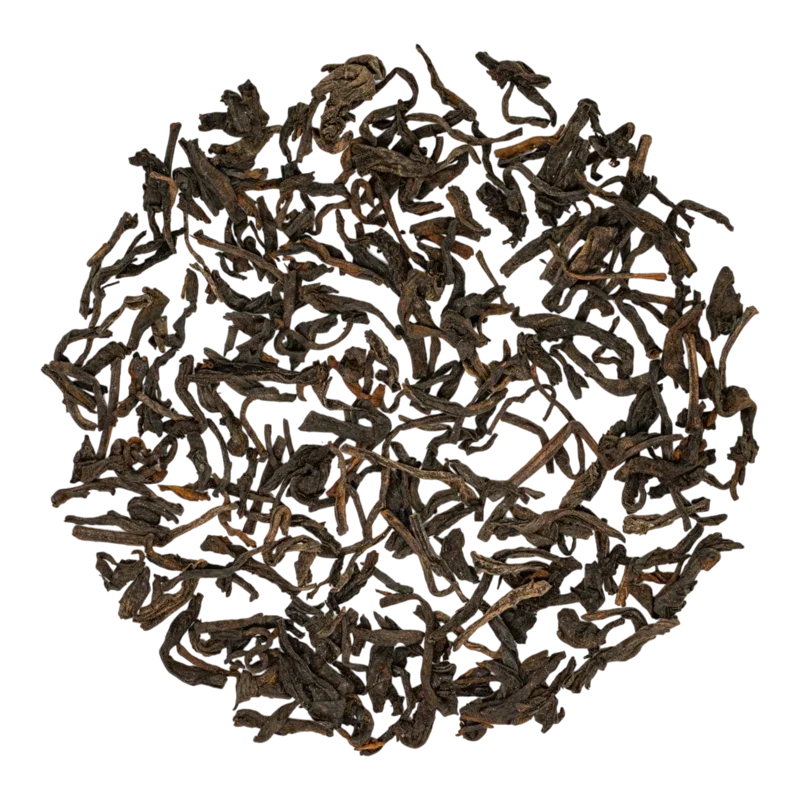
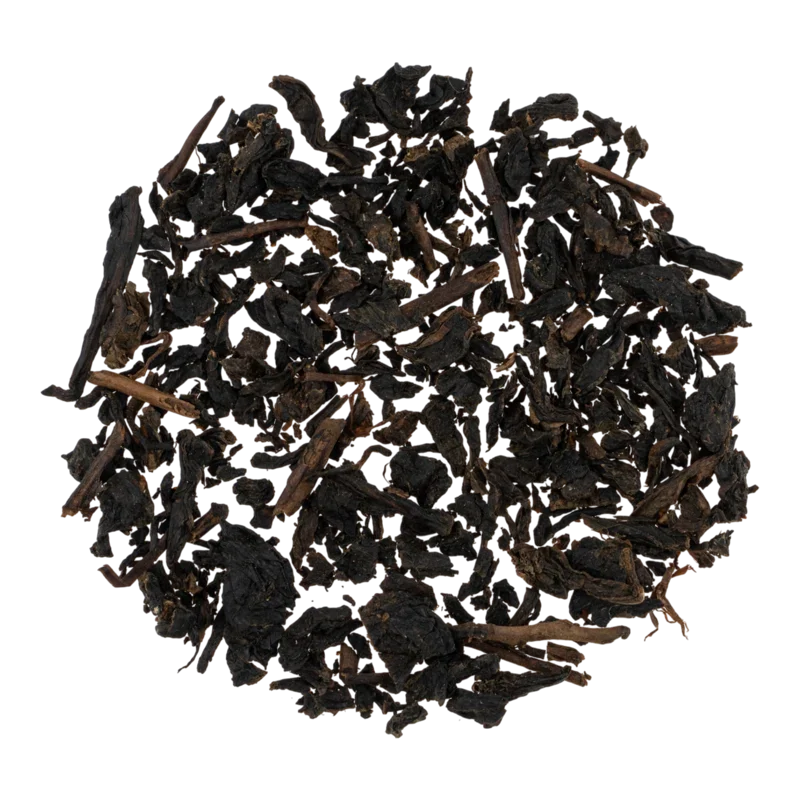
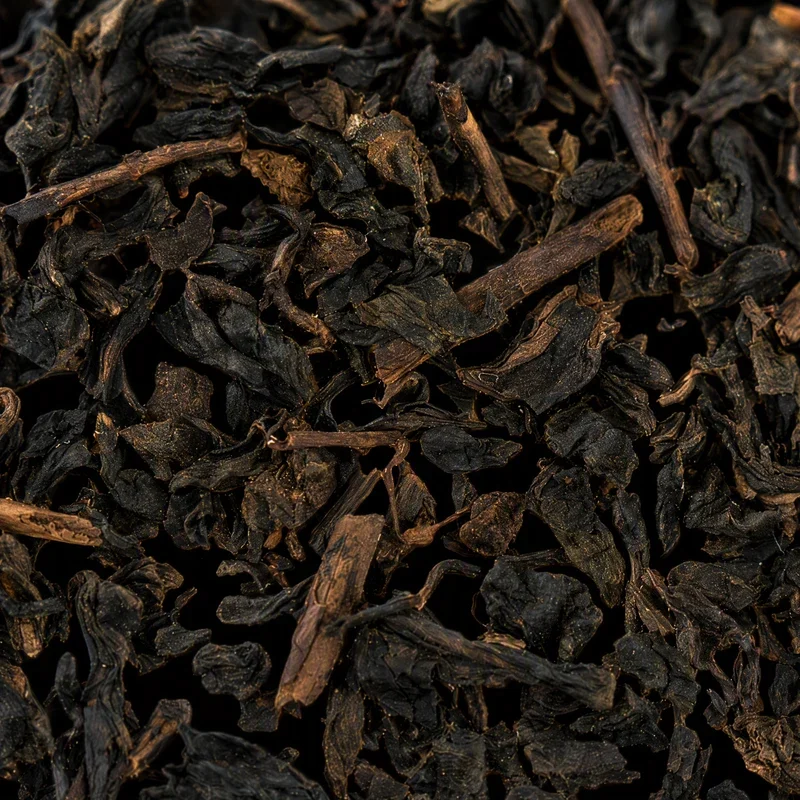
Dry Leaf Appearance: Cylinder approximately 1.5 m long, 0.2 m in diameter, net weight 36.25 kg (for standard Qian Liang; formats Bai Liang — 3.625 kg, Shi Liang — 362.5 g, etc. are also produced). Outer surface — bamboo weaving with diamond pattern. When cut: densely compressed mass of dark brown, almost black leaves with visible stems; cut surface oily-black, with gloss; quality cylinder is so dense that, according to legend, Shanxi merchants submerged it in water — and after seven years the core remained dry.
Dry Leaf Aroma: Complex, multi-layered. In young tea — woody and spicy tones, light smokiness from pine drying, notes of dry herbs. With age, dried fruits, prunes, mushroom depth, nutty shades appear. In old batches (10+ years) honey-camphor and "medicinal" nuances develop.
Liquor Aroma: Rich, with pronounced "chenxiang" (aging aroma). Dominants: wood, nuts, spices, dried fruits. From bamboo wrapping — subtle "green" bamboo background. In well-aged batches — honey, fruity and "mushroom" overtones.
Liquor Color: From dark amber to red-brown; in aged specimens — deep ruby-chestnut. The liquor is clear, oily, maintains brightness for a long time.
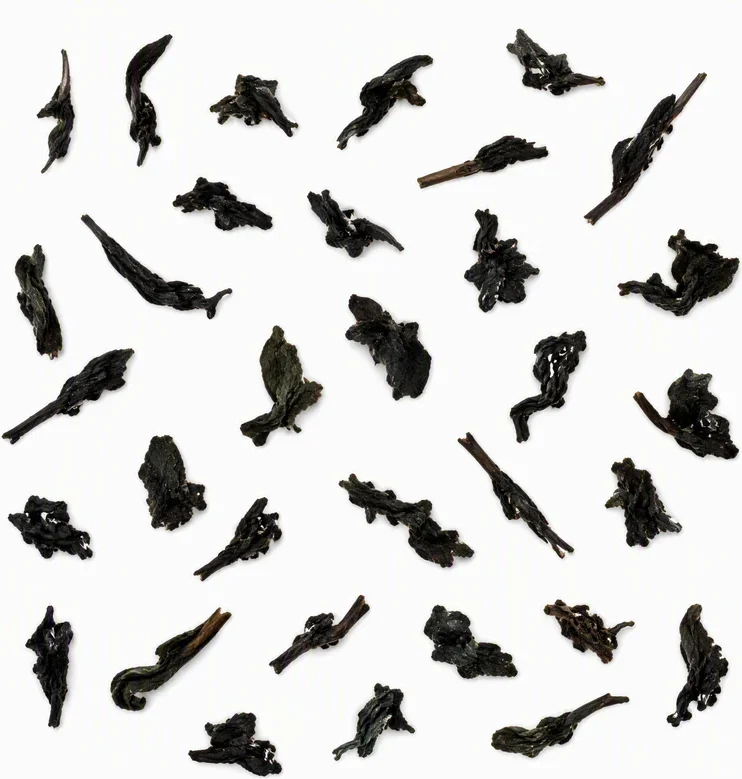
Spent Leaves: Large, whole leaves with stems of dark brown color, resilient, with uniform texture. Absence of foreign odors and "cleanliness" of the spent leaves is a quality indicator.
Taste: Full, thick, dense, with pronounced "body." Sweetness appears from the first steeps and builds toward the finish. Soft astringency without aggression. Woody-nutty and spicy notes dominate with nuances of dried fruits and prunes. Long, sweet aftertaste with "huigan" (回甘, huígān — "returning sweetness"). The tea tolerates boiling excellently — the decoction is rich but soft.
Alkaloids: Caffeine (咖啡碱) ~80–98 mg/g in extract (lower than in green and red teas), theobromine, theophylline. Thanks to post-fermentation, caffeine level in dark tea is noticeably lower than in non-fermented teas, making it comfortable for evening consumption.
Amino Acids: Total content in raw material ~1.5–2.9% (depending on season). Include L-theanine (L-茶氨酸), which has mild relaxing action without sedative effect. During fermentation, free amino acid content somewhat decreases.
Content significantly higher than in green and red teas. Water-soluble polysaccharides form the "slickness" and "sweetness" of the liquor, and are also considered in scientific literature as potential regulators of carbohydrate metabolism.
During post-fermentation, the proportion of oxygen-containing heterocyclic compounds responsible for characteristic "aged" aroma increases; the proportion of plant essential oils (linalool, geraniol) decreases.
Minerals: Potassium, magnesium, manganese, iron, fluorine, zinc, selenium. Mineral content in dark tea is generally higher than in teas from young leaves, since mature leaves and stems accumulate more inorganic elements. Selenium is the calling card of Anhua teas.
Polyphenols: Content in raw material (Yuntaishan Dayezhong, spring harvest, one bud + two leaves) — about 22.6–23.4%. During post-fermentation, part of catechins transforms into thearubigins (茶红素) and theabrownins (茶褐素), which softens taste and darkens the liquor. Characteristically, in Ānhuà dark teas (百两茶 / Bai Liang Cha) the ratio of complex (酯型) to simple catechins is higher than in pu-erh and Liu Bao, which determines more pronounced antioxidant activity.
Vitamins: C (in raw material; partially destroyed during fermentation), B group (B₁, B₂), E, K.
Dark teas are traditionally valued for their ability to "cut grease" (解油腻, jiě yóunì) — bioactive components stimulate peristalsis, aid digestion of heavy food. Especially relevant for diets rich in meat and dairy products.
Polyphenols, thearubigins and polysaccharides have the ability to neutralize free radicals. Effectiveness is linked to high ratio of complex catechins.
Caffeine combined with L-theanine provides alertness without sharp stimulation; due to reduced caffeine content, the tea does not cause insomnia with moderate evening consumption.
A number of studies link regular moderate consumption of Anhua dark teas with more favorable cholesterol and triglyceride levels, however this does not replace medical recommendations.
Polyphenolic compounds help strengthen vessel walls and maintain their elasticity.
Qian Liang Cha has "warm" nature (性温, xìng wēn) according to traditional Chinese medicine classification, making it especially appropriate in cold weather.
Trace elements (especially selenium), polysaccharides and trace polyphenols contribute to maintaining the body's protective functions.
People with increased caffeine sensitivity, gastritis exacerbation or peptic ulcer should exercise caution. It is recommended to maintain a 1–2 hour interval between taking medications and consuming tea.
Soft or medium mineralization. Too hard water "blocks" sweetness and makes the liquor flat.
Tea Amount: 5–7 g per 100–150 ml water (gongfu / steeping method); 2–3 g per 250 ml (infusion); 6–10 g per 500–800 ml (boiling).
Teaware: Clay teapot from Yíxīng clay (宜兴紫砂壶, Yíxīng zǐshā hú) — ideal choice: porous clay "remembers" tea and enhances its depth. Gàiwǎn (盖碗, gàiwǎn) is suitable for tasting and evaluating individual steeps. For boiling — enameled, ceramic or thick-walled glass teapot.
Water Temperature: 95–100°C (boiling water).
Container: Best stored in original bamboo packaging, ensuring air access. Ceramic or clay containers, paper and fabric bags from natural materials are also suitable. Hermetic packaging — only for brief storage of already stable batches.
Humidity: Moderate — approximately 50–70%. Too dry — tea "freezes" and loses development dynamics; too humid — risk of unwanted mold.
Dark, well-ventilated room without sharp odors. Proximity to spices, coffee, fish and other aromatic products is inadmissible — dark tea easily absorbs foreign odors.
Tasting once every 6–12 months helps track maturation dynamics and timely detect problems.
Temperature: 15–25°C, without overheating and direct sun. Sharp temperature fluctuations negatively affect the maturation process.
Both are Hunan hei cha, but Fu Zhuan is a brick with characteristic "golden flowers" of the fungus Eurotium cristatum (金花, jīnhuā), imparting mushroom and nutty notes. Qian Liang Cha is a cylinder without "jinhua," with a more pronounced woody-spicy palette and potential for honey-fruity sweetness with long aging. (Note: in recent years, several producers have mastered the technology of "金花花卷" — Qian Liang Cha with inoculated golden flowers, however this is a modification, not the classic version.)
Guangxi hei cha with characteristic "wet-earthy" notes (槟榔香, bīnláng xiāng — betel aroma) and different microbiological storage profile in humid climate. Qian Liang Cha is drier, "cleaner," with more pronounced woody-sweet structure.
Shu pu-erh undergoes accelerated post-fermentation using the Wò Duī (渥堆) method, which gives an "earthy" taste of decomposed leaves. Qian Liang Cha ferments naturally, like Sheng Pu-erh — its profile is more woody-spicy, less "earthy," with growing honey sweetness.
Sichuan border tea for the Tibetan market — more austere, strong, with pronounced "drinkability" for milk-salt beverages. Qian Liang Cha is usually sweeter and more "honey-like" when aged, with more nuanced aromatics.
The older — the more expensive; vintage specimens (20–50+ years) can cost tens of thousands of yuan per cylinder.
Spring > summer; wild-grown > plantation; whole leaf > fragments.
Famous brands — Báishāxī (白沙溪), Yongtaifu (永泰福), Jinfenghou (晋丰厚), etc.
Carefully stored specimens are valued many times higher.
Specialized tea shops ready to name year, factory, batch and storage conditions. Ask for photos of cylinder cross-section.
Bamboo wrapping should be neat; tea body on cut — dense, uniform, without voids, oily-black with gloss.
Dry tea should have clean woody-spicy smell. Mustiness, "dampness," chemical shades, unnatural flavorings — signs of problems.
Color — clean, from dark amber to red-brown, clear. Cloudiness and foreign taste — alarming signal.
Real Qian Liang Cha cannot cost cheaply — this is manual labor of master teams and long natural drying.
No reviews yet. Tell us what you think of this tea.
Rate this tea and share your impressions. We review each submission before publishing it.