Brewing
Gongfu brewing
- Water temperature
- 92 °C
- Tea amount
- 6 g
- Water volume
- 100 ml
- First steep
- 10 s
- Time added per infusion
- 5 s
- Infusions
- 8

dòng dǐng wūlóng
Choose a brewing method. Start with the recommended quantities and time, then adjust to taste.
Brewing
Brewing
Tea encyclopedia
Category: Famous Taiwanese oolongs of traditional (roasted) profile. Belongs to semi-spherical bao-zhong teas (半球形包種茶, bànqiúxíng bāozhǒng chá).
Category: Famous Taiwanese oolongs of traditional (roasted) profile. Belongs to semi-spherical bao-zhong teas (半球形包種茶, bànqiúxíng bāozhǒng chá).
Coordinates: ≈23°45′ N, 120°45′ E.
Origin: Táiwān (臺灣, Táiwān), Nántóu County (南投縣, Nántóu Xiàn), Lùgǔ Township (鹿谷鄉, Lùgǔ Xiāng), Dòng Dǐng Mountain (凍頂山, Dòng Dǐng Shān). Main production villages: Dòngdǐng (凍頂村, Dòngdǐng Cūn), Zhāngyǎ (彰雅村, Zhāngyǎ Cūn), Yǒnglóng (永隆村, Yǒnglóng Cūn), Fènghuáng (鳳凰村, Fènghuáng Cūn). Later production spread to Guangxing (廣興村), Neihu (內湖村), Heya (和雅村) and other villages; tea gardens spread across altitudes of 600–1200 m. For the mass market, oolongs made using Dong Ding technology from raw materials from other regions (Alishan, Shanlinxi) may also be sold under this name, however connoisseurs recognize as authentic only tea from the core — approximately 40 hectares on the mountain peak near Zhangya village.
Type: Oolong (semi-oxidized tea, 青茶, qīngchá). Traditional oxidation is medium — 35–50%, with pronounced roasting (焙火, bèihuǒ). In modern production, versions with light oxidation (20–30%) and lighter roasting are encountered.
Cultural Significance: Dong Ding Oolong is one of the symbols of Taiwanese tea cultivation and an important element of cultural connection between Taiwan and mainland China: its lineage traces directly back to Wuyi oolongs of Fujian. In Taiwan, Dong Ding enjoys the status of a "classic" — this is the tea with which many begin their acquaintance with Taiwanese oolongs. The annual Lugu competitions have become an important social and commercial event, and competition teas of "special" (特等, tèděng) and "first" (頭等, tóuděng) categories are instantly bought up by collectors at high prices. The tea has become an integral part of daily life: it is served at family gatherings, in tea workshops, and at official events.
History: According to the most widespread version, in the fifth year of Emperor Xianfeng's reign (清咸豐五年, 1855), a resident of Lùgǔ Township named Lín Fèngchí (林鳳池, Lín Fèngchí) traveled to Fujian Province to participate in state examinations. Having successfully passed the examinations and received the degree of juren (舉人), he visited the Wuyi Mountains, where the abbot of Tiānxīn Yǒnglè Monastery (天心永樂禪寺, Tiānxīn Yǒnglè Chánsì) gifted him 36 saplings of the Qīng Xīn Oolong (青心烏龍) variety. Returning to Taiwan, Lin Fengchi gave 12 of them to his benefactor Lín Sānxiǎn (林三顯, Lín Sānxiǎn), who had helped him pay for the journey. Lín Sānxiǎn planted the saplings on the slope of Dòngdǐng Mountain near Qílíntán Pond (麒麟潭, Qílíntán). The trees took root, produced excellent raw material, and gradually tea gardens spread throughout the mountain. According to legend, Lin Fengchi later presented this tea to Emperor Guangxu, who, appreciating the taste, ordered it to be called "Dongding Tea" (凍頂茶). An alternative version exists: the Sù family (蘇) from Zhāngyǎ village had been growing tea on Dòngdǐng Mountain since the Qiánlóng era (乾隆, 1735–1796), and their ancestors had migrated to Taiwan from the mainland during the Kāngxī period (康熙). Whichever version is closer to truth, by the mid-20th century Dong Ding production remained modest: the area of tea gardens in Dongding, Yonglong and Fenghuang villages did not exceed 155 hectares, and annual output was about 18 tons. The turning point came in 19
Cultivar: The historical and main cultivar is Qīng Xīn Oolong (青心烏龍, Qīngxīn Wūlóng), also known as "Oolong with Green Heart". This is Camellia sinensis var. sinensis, a small-leaf bush type with compact, fleshy shoots and high content of aromatic substances. In 1990, Taiwanese specialists led by Wu Zhenduo confirmed that Qing Xin Oolong is a direct descendant of "Dwarf Oolong" (矮腳烏龍, ǎijiǎo wūlóng) from Guìlín village (桂林村) in Jian'ou County (建甌) of Fujian Province — those very trees from which saplings were taken in the 19th century. In modern production, besides Qing Xin Oolong, cultivars Jīn Xuān (金萱, Jīn Xuān, TTES №12), Cuì Yǔ (翠玉, Cuì Yù, TTES №13) and other breeding lines are also used, although for competition tea preference is traditionally given to Qing Xin.
Picking: Tea is harvested in four seasons. Spring harvest (春茶, chūnchá) takes place from late March to late May, summer (夏茶, xiàchá) — from late May to late August, autumn (秋茶, qiūchá) — from late August to late September, winter (冬茶, dōngchá) — from mid-October to late November. Spring Dong Ding is considered most valuable: high amino acid content ensures rich aroma and sweet aftertaste. Winter tea is also highly valued for its characteristic softness and depth of flavor. Optimal harvest time is daily from 10:00 to 14:00, when morning dew has already evaporated.
Pluck Standard: Unopened bud and 2–3 upper leaves (一心二葉 / 一心三葉, yī xīn èr yè / yī xīn sān yè). Uniform maturity of shoots is important: the bud provides high amino acid content and returning sweetness (回甘), while the second and third leaves contribute body to the liquor, aroma and sweetness.
Raw Material: Leaves must be whole, without mechanical damage and signs of disease. For traditional "old" style (老式烏龍) slightly more mature leaf is used, giving dense body to the liquor and pronounced throat rhyme (喉韻, hóuyùn). For "new" style (新式烏龍) more tender leaf is preferable, providing light, volatile aroma.
Altitude: Core — about 600–800 m above sea level (mountain peak ≈ 750 m); extended area — up to 1200 m.
Climate: Subtropical monsoon. Average annual temperature about 22 °C, average annual precipitation ≈ 2200 mm. The mountain is shrouded in clouds and fog almost year-round, diurnal temperature variation exceeds 10 °C. High humidity and diffused light slow shoot growth, promoting accumulation of amino acids and aromatic compounds.
Soil: Brown and red-yellow soils (棕色高粘性紅黃壤) with high viscosity, containing fragments of weathered soft rock. Acidic to strongly acidic reaction, rich in organic matter. Excellent water-holding capacity with good drainage — an ideal combination for tea bushes.
Dòng Dǐng Mountain (凍頂山) is a branch of the Fènghuáng Range (鳳凰山, Fènghuáng Shān), located in central Taiwan. Tea gardens spread across slopes and ridges northeast of Qilintan Pond. Despite relatively low absolute elevation, complex microrelief and constant cloud cover create conditions close to high-mountain.
Tea gardens are annually fertilized with organic fertilizers, soil acidity is controlled and deficient elements are replenished. Despite moderate altitude, the combination of fogs, fertile soils and traditional processing mastery has formed a unique terroir signature that is not reproduced in other regions.
Upper shoots (bud + 2–3 leaves) are picked by hand during 10:00–14:00 and immediately delivered to the workshop, avoiding overheating and mechanical damage.
Fresh leaves are spread outdoors and held for 20–30 minutes under the sun. The leaf loses part of its moisture, becomes pliable; solar energy triggers initial oxidation and lays the foundation for aroma. In too bright sun, shading nets are used.
The leaf is moved indoors, where the enzymatic process continues under controlled temperature. Duration — about 2 hours; during this time the characteristic floral and fruity aroma base is formed.
Key stage in forming Dong Ding's aroma and flavor. Leaves are gently shaken on bamboo trays in several cycles with breaks for "rest". When leaf edges collide, cell walls are damaged, triggering oxidation around the perimeter — thus the phenomenon of "green leaf with red edge" (綠葉紅鑲邊, lǜ yè hóng xiāngbiān) arises. Oxidation degree of traditional Dong Ding — 35–50%; in new style — 20–30%.
High-temperature pan-firing (usually in a wok) stops enzymatic processes and fixes the achieved oxidation level. Temperature and time are selected by the master considering the batch.
The stage that distinguishes Dong Ding from most other oolongs. After primary rolling, the leaf is wrapped in cotton cloth and formed into a tight ball, which is repeatedly kneaded, then opened, checked and rolled again. This cycle (揉捻 → 攤開 → 包揉) is repeated 20–30 to 40–60 times (depending on desired density) with intermediate drying stages. As a result, the leaf acquires its characteristic semi-spherical form, dense and neat.
Intermediate drying between shaping cycles to stabilize form and remove excess moisture.
Bringing leaf moisture to a level safe for storage.
Defining stage for traditional Dong Ding. Roasting can be performed in ān electric oven or traditional method over charcoal (炭焙, tànbèi), usually from longan (龍眼炭, lóngyǎn tàn). Traditional roasting is conducted multiple times — up to three times — at controlled low temperature for extended periods. It rounds out the flavor, removes "green" taste, forms characteristic notes of roasted nuts, caramel and honey, and significantly increases tea's storage stability. For competition tea, exclusively hand charcoal roasting is used.
Finished tea is sorted by size, density and appearance using wind separators (風選機).
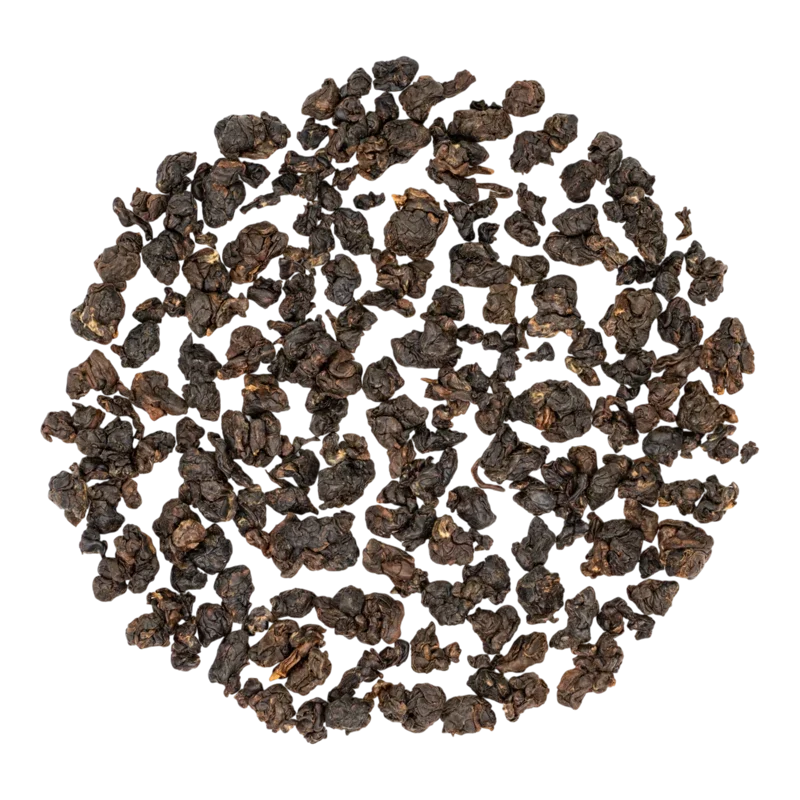
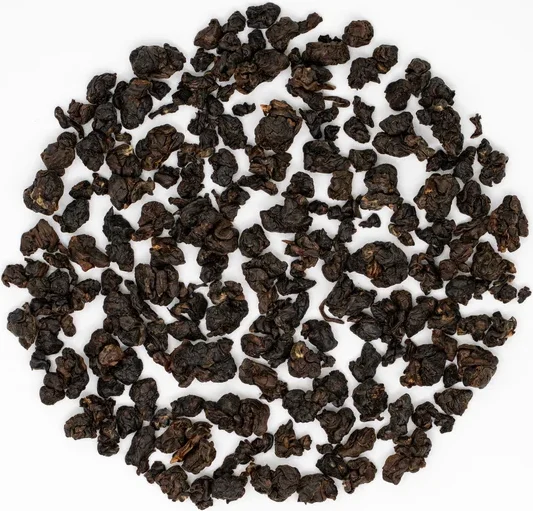
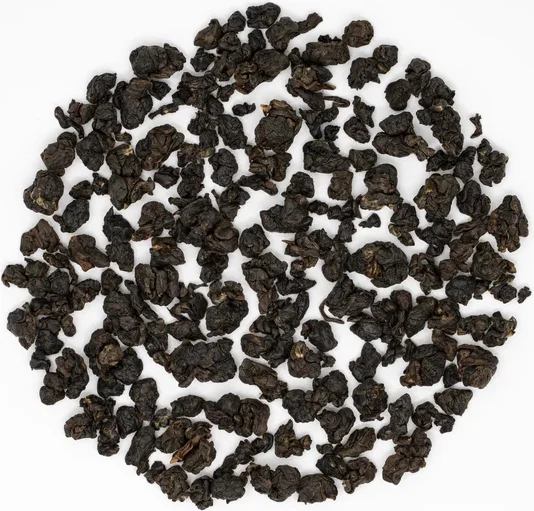
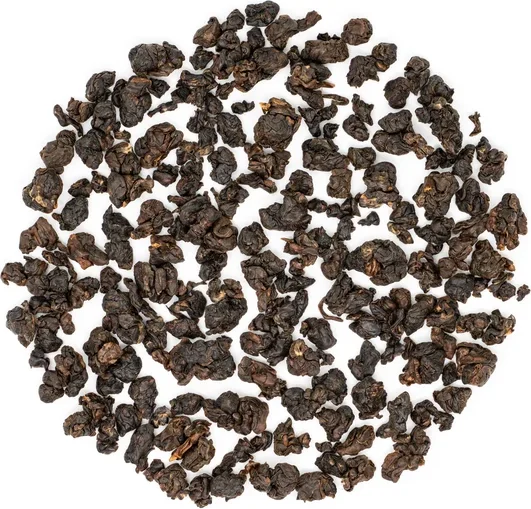
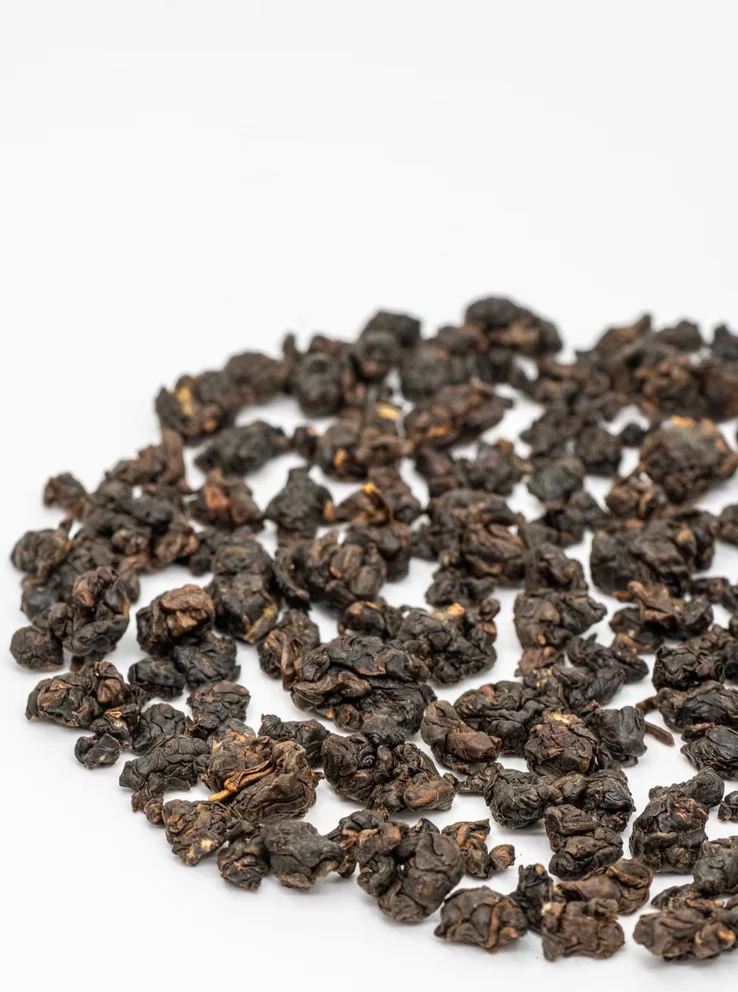
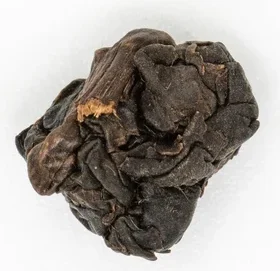
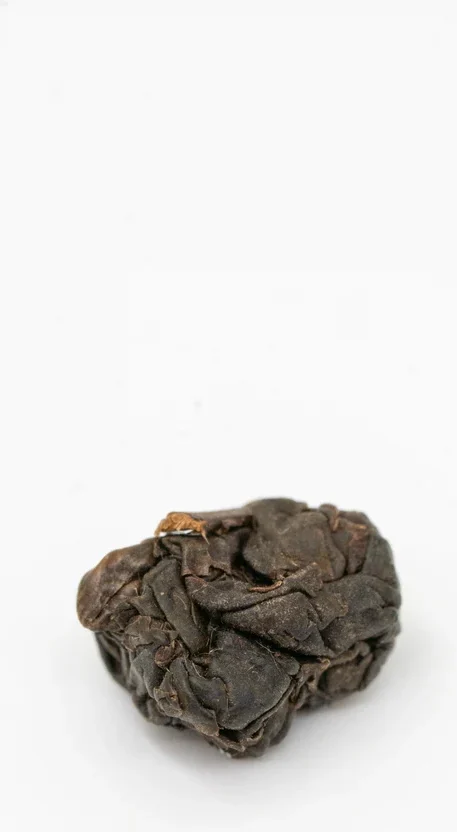
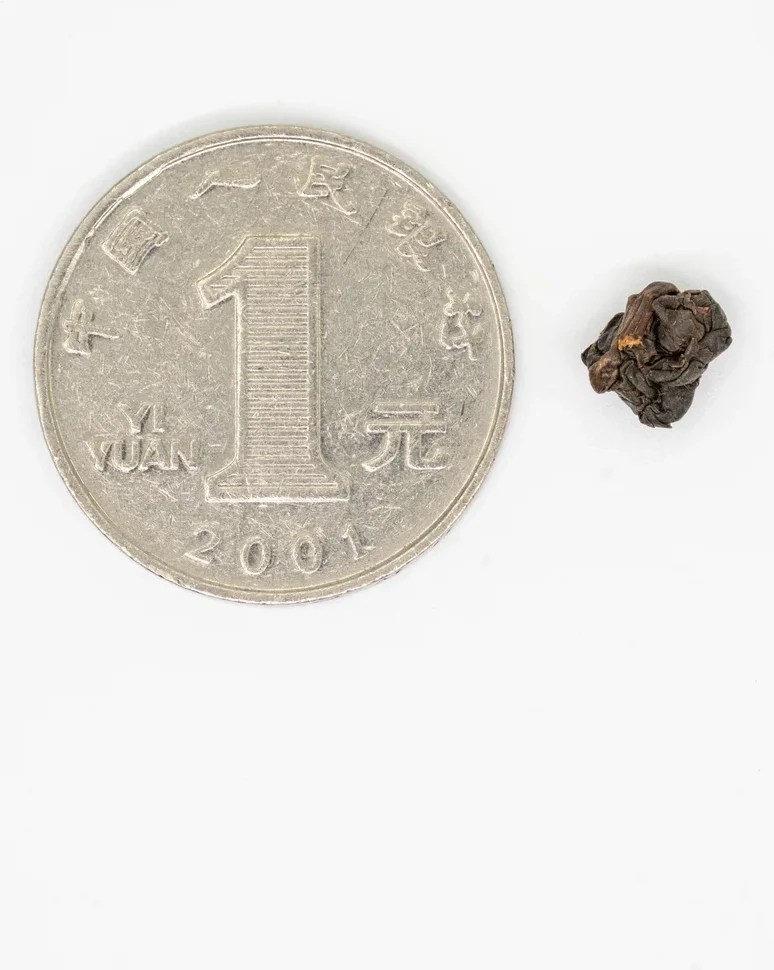
Dry Leaf Appearance: Tightly rolled semi-spherical granules (balls), medium size, uniformly calibrated. Color — dark green (墨綠) with characteristic grayish-white speckles resembling frog skin (青蛙皮狀, qīngwā pí zhuàng) — Dong Ding's calling card. Some tea leaves show a distinguishable golden rim around the leaf edge. Surface with light oily sheen.
Dry Leaf Aroma: Rich and warm. Notes of roasting, roasted nuts (walnut, almond), caramel and baked fruits (dried apricots, prunes) dominate. Undertone — sweetly floral, with osmanthus nuances (桂花香, guìhuā xiāng). In heavily roasted versions — light smokiness and woody depth.
Liquor Aroma: Multifaceted, developing from infusion to infusion. First steeps — bright floral-fruity spectrum with growing caramel sweetness; as the leaf opens, osmanthus, ripe fruit and honey notes intensify. Roasted versions are complemented by nutty-chocolate nuances. Characteristic sign of quality Dong Ding — persistent aroma remaining at the bottom of the cup after drinking the liquor (杯底留香, bēi dǐ liú xiāng).
Liquor Color: From golden-yellow to dark amber with slight reddish tint (紅水, hóngshuǐ); transparent and clear. Color depends on degree of oxidation and roasting: light versions give light golden liquor, traditional roasted ones — rich amber.
Spent Leaves: Whole, elastic leaves, fully opened from semi-spheres. Central part of leaf — greenish-olive to green-brown; around edges — distinct reddish rim. Classic description: "green stem, green belly, red edge" (青蒂、綠腹、紅鑲邊, qīng dì, lǜ fù, hóng xiāngbiān).
Taste: Full, oily, enveloping. Liquor body is dense, with pronounced sweetness and soft, unobtrusive astringency. Flavor profile: roasted nuts, caramel, baked fruits, honey, with floral and creamy overtones. Aftertaste is long, with bright returning sweetness (回甘, huígān) and expressive throat rhyme (喉韻, hóuyùn). Taste noticeably evolves from infusion to infusion: initial sweetness gradually gives way to deep minerality. In less roasted versions, the accent shifts to the floral-creamy register.
Alkaloids: Caffeine (咖啡因, kāfēiyīn) — 20–35 mg/g dry leaf (moderate level characteristic of oolongs). Theobromine and theophylline — in trace amounts.
Amino Acids: L-theanine (茶氨酸, chá ānjīsuān) — key amino acid responsible for sweetness, softness and calming effect. Total free amino acid content — about 2–3% of dry mass; in spring harvest the indicator is higher.
More than 300 volatile aromatic compounds: linalool and its oxides (floral notes), nerol, geraniol (rose and geranium tones), methyl salicylate, indole. During roasting, Maillard reaction products are formed — pyrazines and pyrroles, forming nutty and caramel notes. It is precisely this complex bouquet of volatile compounds that makes Dong Ding one of the most aromatically rich oolongs.
The combination of high amino acid content (thanks to mountain terroir) and pronounced aromatic profile (thanks to multi-stage processing) creates the balance between sweetness, body and aroma characteristic of Dong Ding.
Minerals: Potassium, magnesium, manganese, fluorine, zinc, selenium — in trace amounts. Fluorine content in oolongs is somewhat higher than in green teas, which provides protective effect on tooth enamel.
Polyphenols: Tea polyphenol content in dry leaf — about 15–20% (lower than green teas due to partial oxidation). Main forms — catechins (EC, ECG, EGC, EGCG) and their oxidation products. With medium oxidation, part of catechins transforms into dimeric and oligomeric compounds, providing characteristic softness and depth of flavor.
Vitamins: Vitamin C (ascorbic acid) — in small amounts, partially destroyed during roasting; B-group vitamins (B1, B2), vitamin E, vitamin K.
Caffeine combined with L-theanine provides gentle, prolonged alertness without sharp spikes — "calm concentration".
Polyphenols (catechins and their derivatives) neutralize free radicals, supporting the body's antioxidant status.
Roasted oolongs are traditionally considered gentle on the stomach. Dong Ding's warm, "rounded" profile pairs well with fatty and abundant food.
Thanks to pronounced roasting, Dong Ding has a "warm" nature according to traditional Chinese medicine concepts — it warms well in cold weather.
Studies link regular oolong consumption with lowering LDL cholesterol levels and strengthening vascular walls (results are preliminary).
Increased fluorine content in oolongs and antibacterial action of polyphenols may contribute to caries prevention.
Medium-oxidized oolongs are traditionally associated with metabolism acceleration — effect is individual and depends on diet.
L-theanine stimulates generation of brain alpha waves, promoting relaxation and improving concentration quality without causing drowsiness.
Hot drinking at 60–70 °C best reveals osmanthus aroma and roasting notes. Cooled liquor reveals pleasant "cold aftertaste" effect (冷後甜, lěng hòu tián). For the fullest impression, attention should be paid to the aroma remaining at the bottom of the empty cup.
Tea Amount: 5–8 g per 100–150 ml water (gongfu method). For European method — 3–4 g per 200–250 ml.
Teaware: Gàiwǎn (蓋碗, gàiwǎn) of white porcelain — universal choice, allowing observation of leaf opening and precise time control. For traditional roasted Dong Ding, a small Yíxīng clay teapot (宜興紫砂壺) of about 100–200 ml volume is also excellent — clay accumulates heat and emphasizes the depth of "fiery" character.
Water Temperature: 90–100 °C. For lightly roasted versions — closer to 90 °C; for traditional heavily roasted — up to boiling water (100 °C).
Container: Airtight container — tin can, vacuum bag with foil layer, ceramic teapot with fitted lid.
Enemies: Moisture, high temperature, direct sunlight, foreign odors (especially spices and household chemicals).
Shelf Life: Thanks to pronounced roasting, traditional Dong Ding stores well for 1–3 years without quality loss. Lightly roasted versions are better consumed within 6–12 months.
Dry, cool, dark place, away from foreign odors. Optimal temperature — 15–25 °C, humidity — no more than 60%.
There is a tradition of aging Dong Ding — "Aged charcoal-roasted tea" (陳年炭焙茶, chénnián tànbèi chá): each year the tea is re-roasted at high temperature over slow fire, which over years intensifies honey sweetness and aftertaste depth. Aged Dong Ding (5 years and older) is valued by connoisseurs for softness, depth and "medicinal" note.
North Taiwanese oolong with light oxidation (15–20%) and minimal roasting. Unlike Dong Ding, has conditionally strip-shaped leaf form, transparent greenish-golden liquor and pronounced floral aroma (lily of the valley, gardenia). The pair "Baozhong — Dong Ding" embodies two poles of Taiwanese oolong: lightness vs. depth.
High-mountain oolong (1000–1600 m) with light oxidation and minimal roasting, emphasizing freshness, viscosity and floral-creamy aroma. Dong Ding is more "warm", with pronounced roasting depth and dense body; Alishan — more "cool" and ethereal.
Same Lugu terroir, but leaf damaged by leafhoppers, giving pronounced honey and fruity aroma with 20–30% oxidation. Differs from classic Dong Ding with sweeter, less "fiery" profile.
Another Taiwanese roasted oolong, but from different cultivar (Tie Guanyin) and different region (Taipei). Has more pronounced "acidity", minerality and characteristic ripe fruit aroma. Dong Ding is softer and sweeter.
One of the highest-altitude Taiwanese oolongs (1600–2500 m), practically without roasting. Maximally "clean", cold-floral profile — antipode to roasted Dong Ding.
Price Category: Dong Ding Oolong belongs to the medium and upper price segment of Taiwanese oolongs. Price is determined by multiple factors: raw material origin (Dongding core vs. adjacent areas), harvest season (spring and winter more expensive), cultivar (Qing Xin Oolong — premium), degree of handwork, master's reputation and competition awards. Competition teas of "special" (特等) and "first" (頭等) categories reach significant prices and sell out at auctions.
No reviews yet. Tell us what you think of this tea.
Rate this tea and share your impressions. We review each submission before publishing it.