Brewing
Gongfu brewing
- Water temperature
- 93 °C
- Tea amount
- 5 g
- Water volume
- 100 ml
- First steep
- 10 s
- Time added per infusion
- 5 s
- Infusions
- 4



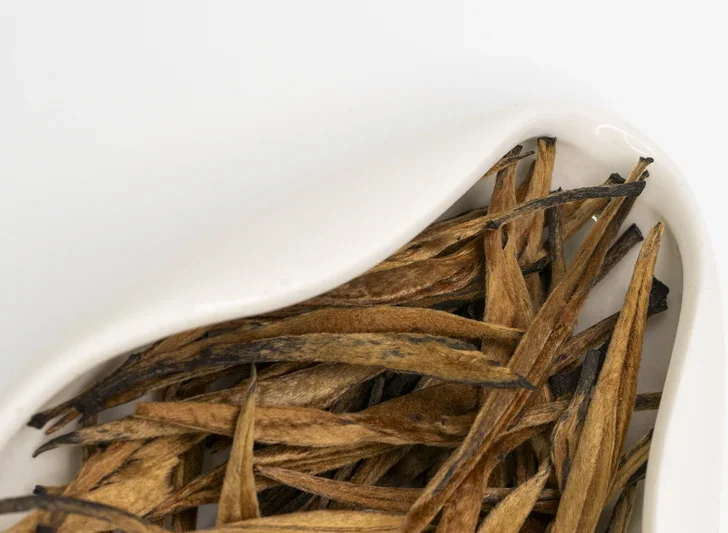
Diānhóng jīn zhēn
Choose a brewing method. Start with the recommended quantities and time, then adjust to taste.
Brewing
Brewing
Taste
Tea encyclopedia
Category: High-quality red tea of the Diān Hóng (滇红, Diānhóng) group. Belongs to "ming you hong cha" (名优红茶, míngyōu hóngchá)—famous high-quality red teas. Within the Dian Hong lineup, it represents the category of "special shape" (特形茶, tèxíng chá)—teas that have undergone machine or hand shaping.
Category: High-quality red tea of the Diān Hóng (滇红, Diānhóng) group. Belongs to "ming you hong cha" (名优红茶, míngyōu hóngchá)—famous high-quality red teas. Within the Dian Hong lineup, it represents the category of "special shape" (特形茶, tèxíng chá)—teas that have undergone machine or hand shaping.
Coordinates: Fengqing—approximately 24°35′ N, 99°55′ E. Baoshan—25°07′ N, 99°10′ E.
Origin: China, Yúnnán Province (云南省, Yúnnán shěng). Main regions: Fèngqìng County (凤庆县, Fèngqìng xiàn)—"birthplace of Dian Hong," as well as Líncāng Prefecture (临沧市, Líncāng shì) and Bǎoshān (保山, Bǎoshān). Fengqing Jin Zhen is considered the quality standard.
Type: Red tea (black tea) (红茶, hóngchá), fully oxidized (by European classification—black tea). Degree of oxidation—85–95%.
Among tea experts, Jin Zhen is often recommended as the ideal tea for first acquaintance with Yunnan reds—it brightly demonstrates the signature "Yunnan sweetness," but at the same time possesses sufficient fullness and complexity to leave a deep impression.
The appearance of shaped Diān Hongs (特形茶)—Jin Zhen, Jīn Sì (金丝, "golden threads"), Sōng Zhèn (松针, "pine needles")—fundamentally changed the Yunnan red tea market, moving it from "mass production export commodity" to the category of "elegant teas for connoisseurs."
Among Dian Hongs, Jin Zhen is considered one of the best food companions. Its full, rich flavor with light astringency excellently complements chocolate desserts, nut pastries, medium-aged cheeses, as well as hearty dishes—roasted meat, duck, Yunnan cuisine dishes.
Needle shape is not only aesthetics but also function: dense, uniform rolling ensures predictable, stable extraction from infusion to infusion, making Jin Zhen one of the most "technological" and convenient red teas to brew.
Jin Zhen is one of the best red teas for cold brewing: needle shape ensures slow, uniform extraction in cold water, and the result is a refreshing sweet infusion with pronounced fruity notes and minimal astringency.
Cultural Significance: Dian Hong Jin Zhen is one of the most recognizable and popular Yunnan red teas both in China and abroad. Its characteristic needle shape has become a distinctive calling card of Dian Hong in general. Unlike elite Jin Ya, Jin Zhen is more democratic in price and positioned as an everyday tea—but still quality and beautiful enough to be used as a gift. It became an important ambassador of Yunnan tea in the domestic Chinese market after 1985, when Dian Hong transitioned from an almost exclusively export format to mass domestic consumption.
History: Dian Hong Jin Zhen is a product of the evolution of Yunnan red tea, whose history began in 1938 when tea specialist Fēng Shàoqiú (冯绍裘, Féng Shàoqiú, 1900–1987) arrived in Shùnníng County (顺宁, now Fengqing) and created the first samples of red tea from large-leaf Yunnan tree material. In 1939, the Shùnníng Experimental Tea Factory (顺宁实验茶厂) was established, and the first batch of Dian Hong was sold in London at a record price. For decades, Dian Hong was produced predominantly in the classic "gongfu" (工夫) format—leaf red tea without special shaping.
Cultivar: Large-leaf variety Yúnnán Dǎ Yè Zhǒng (云南大叶种, Yúnnán Dàyèzhǒng)—Camellia sinensis var. assamica. Main cultivars:
Picking: Predominantly in spring (March—April), also summer and autumn. Spring (春茶) is most valued. Harvest period in Fengqing—from late February to November, but material for the best Jin Zhen is collected in spring.
Pluck Standard: Bud and one upper leaf (一芽一叶, yī yá yī yè) for highest grades; bud and two leaves (一芽二叶, yī yá èr yè) for standard. This is a key difference from pure Jin Ya (buds only)—the presence of one or two leaves gives a fuller flavor and allows shaping the tea leaves into characteristic needle form.
Raw Material: High. Young, undamaged, juicy buds and leaves covered with golden down. Hand-picked in dry weather.
Altitude: 800–2000 m above sea level. A wider range than pure bud Jin Ya, reflecting the greater accessibility of this tea. High-altitude lots (above 1500 m) are especially valued—they produce more aromatic, delicate tea with pronounced sweetness.
Climate: Subtropical mountain. Average annual temperature—13–18°C. Precipitation—1000–1500 mm/year. Humidity—about 70%. Frequent fogs are characteristic (especially morning and evening), pronounced daily temperature fluctuations (10–15°C), abundant dew. These conditions slow the growth of tea leaves and promote the accumulation of aromatic and flavor substances. The combination of factors—"fogs, mountains and valleys" (云雾山谷, yúnwù shāngǔ)—creates what Chinese tea growers call "mountain rhyme" (山韵, shānyùn).
Soil: Red and yellow lateritic soils, acidic (pH 4.5–5.5), with high organic content. The soil layer forms under the canopy of subtropical forests, providing rich mineral composition. In Fengqing, particularly high polyphenol content in local raw material is noted, which is considered the "calling card" of its soils.
Southwest China, Yunnan-Guizhou Plateau—birthplace of the tea tree. The territory is distinguished by colossal landscape diversity: from tropical valleys of Xishuangbanna (less than 1000 m) to high-altitude plateaus (more than 3000 m). It is precisely the vertical zonation that creates multiple microclimatic niches, each forming its own tea character.
Hand-picked, gentle.
Raw material is spread in thin layers on bamboo trays in open air (shade or sun withering) or in ventilated rooms. Duration—12–18 hours and more. Moisture content decreases to 50–60%, leaves become soft and elastic, suitable for rolling. At this stage, initial enzymatic processes begin, and the raw material starts to emit a light floral aroma.
More intensive than for pure bud Jin Ya. Withered leaves are rolled by hand or on rollers, destroying cellular structure and releasing juice, which activates oxidation. To form the needle shape, rolling is conducted in longitudinal direction—tea leaves are stretched, thinned and pointed.
Additional stage distinguishing Jin Zhen from classic Gongfu. Partially rolled tea leaves are passed through a special shaping machine (理条机, lǐtiáo jī), which gives them the characteristic straight, needle-like form. This stage requires precise adjustment—too aggressive shaping can damage the down and disrupt leaf structure. It is precisely thanks to "li tiao" that Jin Zhen acquires its recognizable appearance—thin, straight, shiny "golden needles."
Shaped tea leaves are spread in rooms with controlled temperature (22–28°C) and humidity (90–95%). Duration—4–6 hours. The master controls the degree of oxidation by color and aroma. Jin Zhen oxidation is typically slightly deeper than pure Jin Ya, giving a more "dense," astringent flavor.
Multi-stage: primary at 100–110°C, secondary at 80–90°C. Moisture is brought to 4–6%.
Separation into tips, whole leaves, broken fractions. For highest quality Jin Zhen, only even, thin, straight "needles" with abundant golden down are selected.
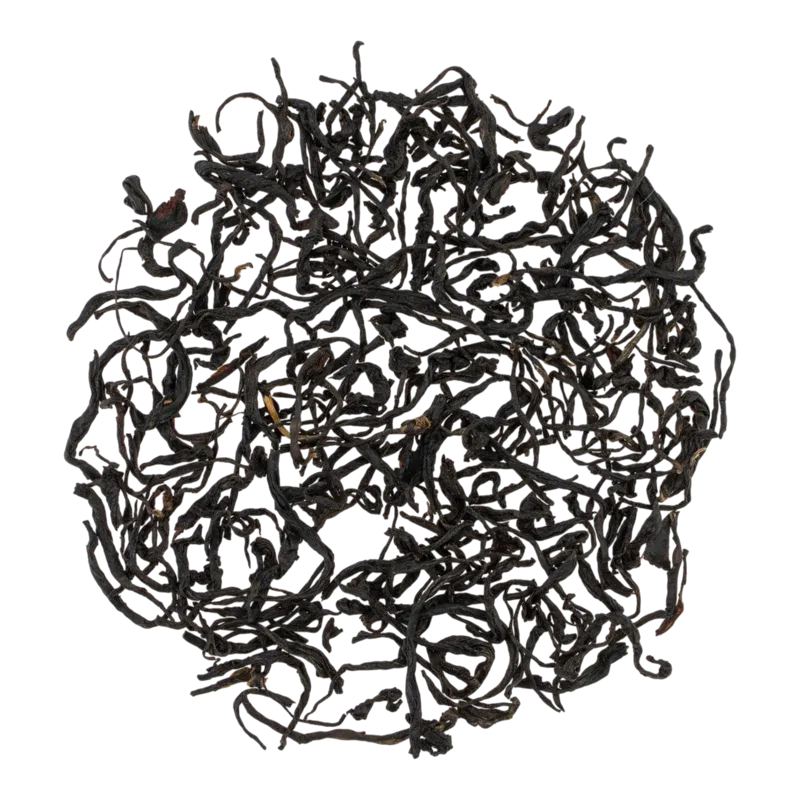
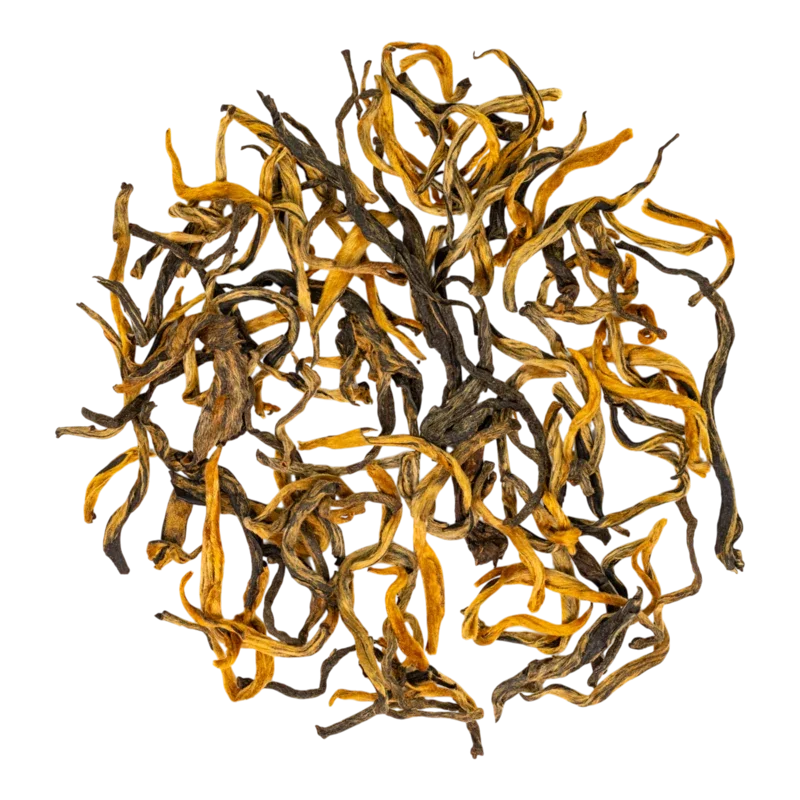
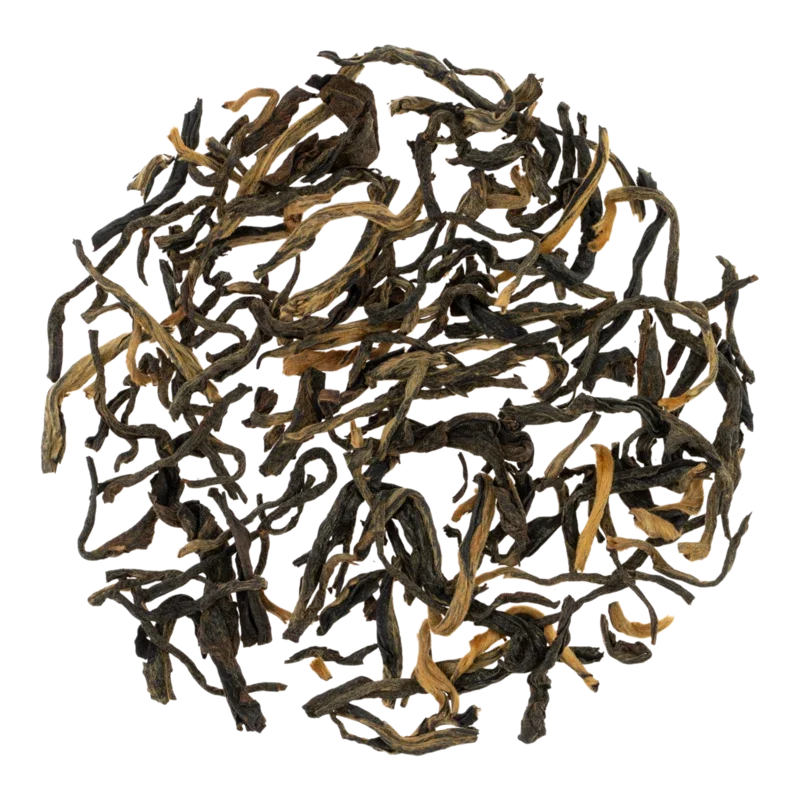
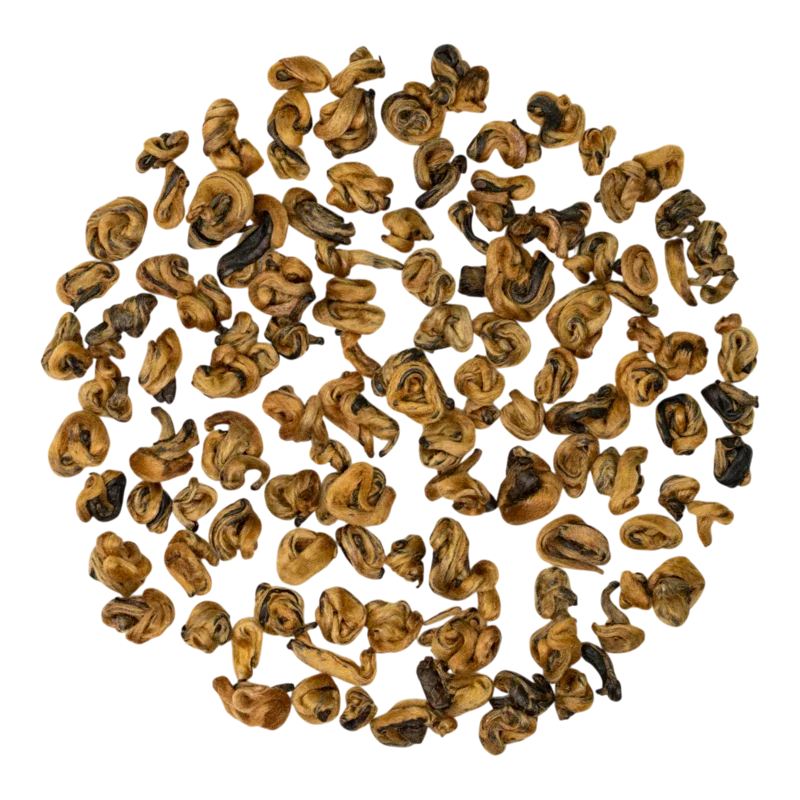
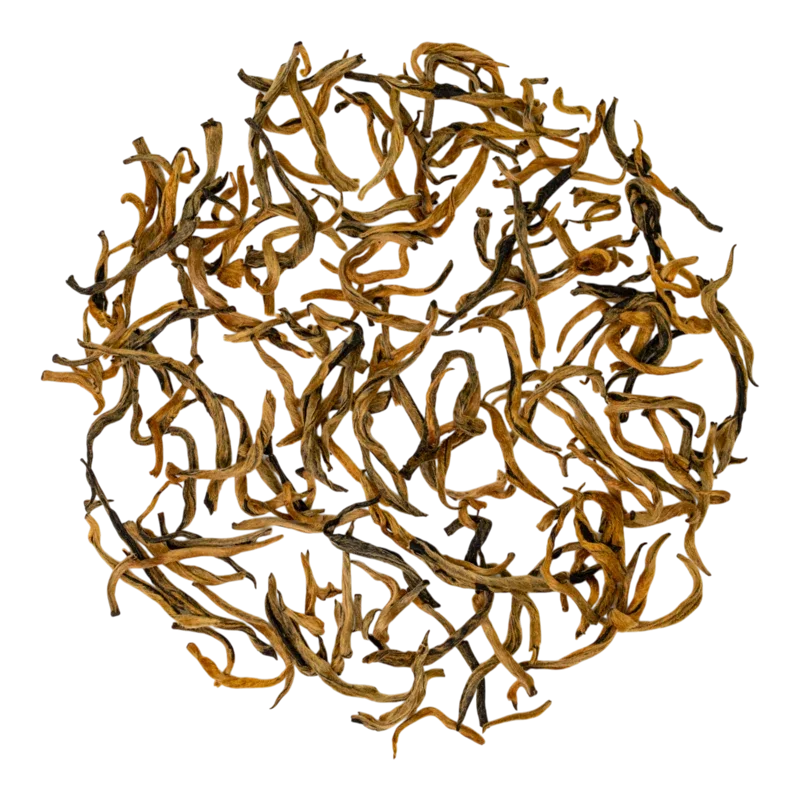
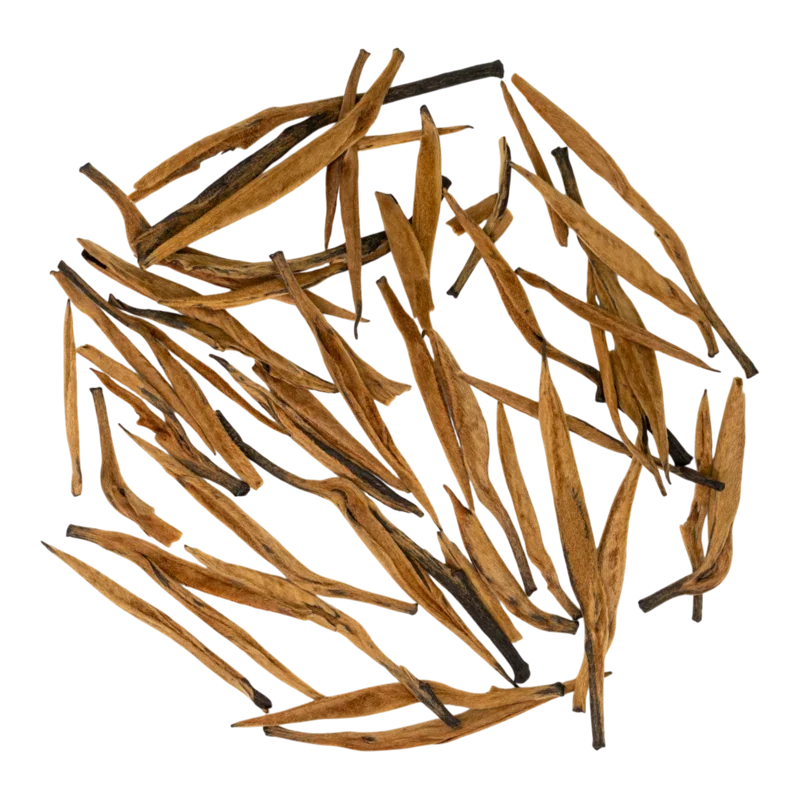
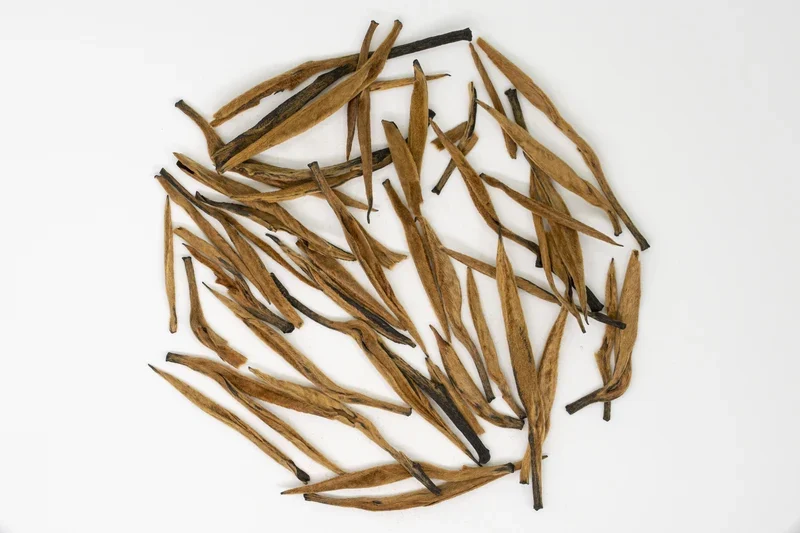
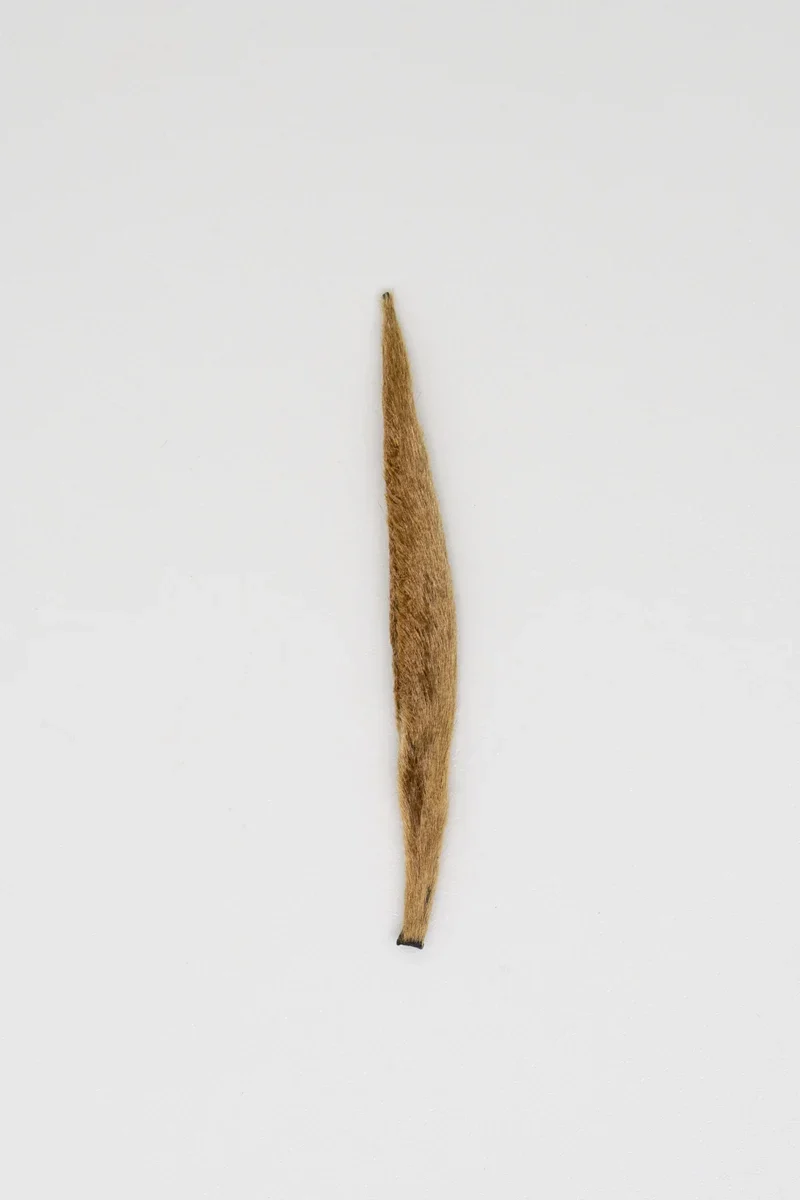
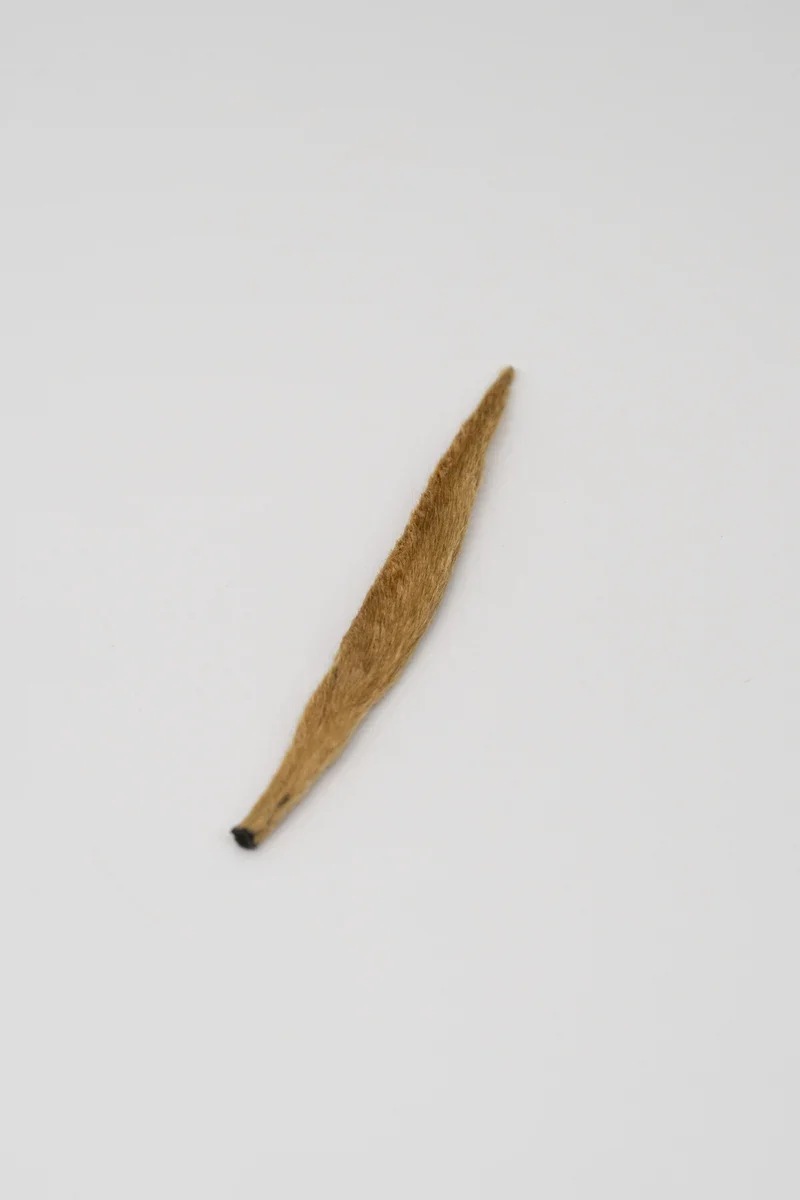
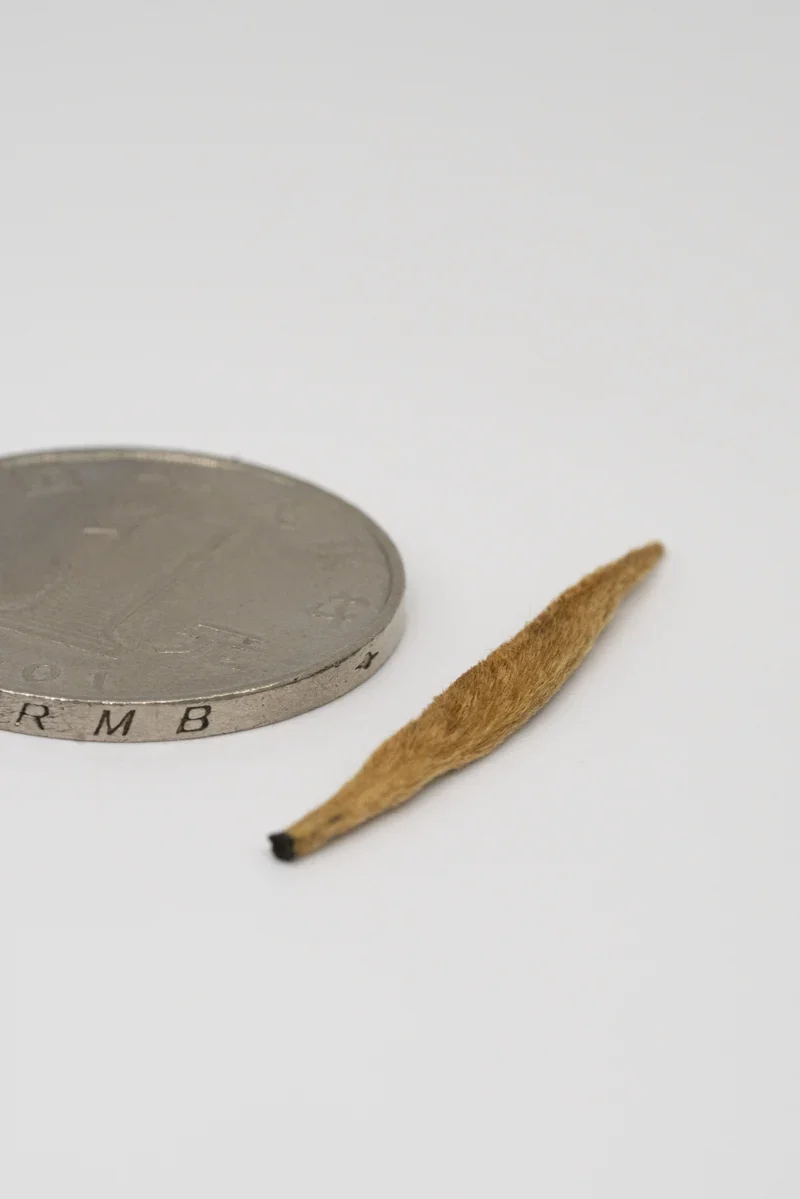
Dry Leaf Appearance: Thin, straight, tightly rolled tea leaves of needle shape. Color—from dark brown to black with abundant golden or reddish inclusions (tips covered with down). Tea leaves are even, uniform in size, with noticeable luster. Visual impression—strict geometric elegance, "forest of golden needles."
Dry Leaf Aroma: Rich, warm, abundant. Notes of honey, malt, dried fruits (prunes, apricots, raisins), chocolate dominate. Spicy (cinnamon), floral and light woody nuances are present. Depending on the degree of roasting, thin smoky notes may appear. The aroma is persistent and recognizable.
Liquor Aroma: Bright, enveloping. Honey-malt notes interweave with dried fruits, chocolate, caramel, flowers, spices. Light acidity is possible, adding complexity. When cooling, nuances of burnt sugar and leather appear.
Liquor Color: From amber-red to red-brown, rich, transparent, clear, with deep shade and characteristic luster. "Golden ring" (金圈, jīnquān) around the cup edge—indicator of quality oxidation.
Spent Leaves: Opened buds and leaves, elastic, reddish-brown or copper colored. Golden buds are well distinguished against darker leaves. Uniformity of form and color—sign of good quality.
Taste: Full, rich, velvety, with pronounced structure. Liquor body—dense, with noticeable "grip." Light, pleasant astringency is present—more noticeable than in pure bud Dian Hongs. Notes of honey, malt, dried fruits, chocolate, caramel predominate. Thin acidity may appear. Bitterness is minimal or absent. Aftertaste (回甘, huígān)—long, sweetish, with honey-caramel trail.
Alkaloids: Caffeine—2–4% (about 14–15 mg/g). Theobromine and theophylline—in trace amounts. Caffeine content may be somewhat higher than pure bud teas due to leaf presence.
Amino Acids: 2.5–3.5% of dry matter. L-theanine dominates, but its ratio to polyphenols is somewhat lower than pure Jin Ya—this shifts the balance from "sweetness" to "richness."
Deeper oxidation and leaf presence create increased thearubigin content, giving Jin Zhen a more "dense," concentrated flavor and deep liquor color.
Essential Oils: Rich aromatic complex: linalool, geraniol, β-ionone, phenylethanol, nerolidol, methyl salicylate. Leaf presence enriches aroma with malty and spicy notes.
Minerals: Potassium, magnesium, manganese, fluorine, iron, zinc, selenium. Water extract—38–44%.
Polyphenols: Content in raw material—30–35%. In finished red tea after oxidation—15–17%. Main oxidation products: theaflavins (0.4–0.7%), thearubigins (5–8%), theabrownins (10–12%). Higher proportion of leaves increases polyphenol content compared to pure Jin Ya, explaining the more pronounced astringency and "body" of the liquor.
Vitamins: C (partially), B₁, B₂, B₆, E, K, PP.
Pronounced but gentle vigor thanks to caffeine and L-theanine. Increased work capacity, concentration, mental clarity.
Fully oxidized tea with "warm nature" (性温) according to TCM. Improves blood circulation, warms in cold seasons. Especially valued in winter and autumn.
High content of theaflavins and thearubigins provides powerful protection against free radicals, slowing cellular aging.
Stimulates gastric juice secretion, improves peristalsis, helps digest fatty and heavy food. Red tea with its "warm" nature acts more gently on the stomach than green tea.
Red tea polyphenols promote normalization of lipid profile—lowering LDL and raising HDL. Thearubigins bind with cholesterol, promoting its elimination. Flavonoids strengthen vessel walls.
L-theanine promotes relaxation, anxiety reduction, mood improvement without drowsiness.
Polyphenols possess antibacterial and antiviral properties, support immune function.
Red tea polyphenols show anti-inflammatory activity, which may be beneficial for chronic inflammatory processes.
Tea Amount: 3–5 g per 150–200 ml water.
Teaware: Porcelain or glass gaiwan (盖碗, gàiwǎn), glass teapot (for visual effect of opening "needles"), thin-walled porcelain teapot, Yíxīng teapot from zhūní (朱泥) or hongni (红泥)—clays that well reveal red teas.
Water Temperature: 90–95°C. Jin Zhen is more "strong" and temperature-resistant than pure bud Dian Hongs, so it allows slightly hotter water.
Container: Airtight opaque container—tin can, foil bag, vacuum packaging.
Enemies: Moisture, light, heat, oxygen, foreign odors.
Shelf Life: 2–3 years under proper conditions. Like other red teas, Jin Zhen reaches optimal flavor 1–3 months after production.
Dry, cool, dark place without foreign odors. Temperature—15–25°C, humidity—no more than 60%.
"Golden buds"—pure bud tea, without leaves. Significantly softer, sweeter, more delicate than Jin Zhen. More expensive. Brewed at lower temperature (85–90°C). Jin Zhen is fuller, "stronger," with more pronounced body and astringency.
Classic leaf Dian Hong without special shaping (bud + 2–3 leaves). More astringent and "brutal," with pronounced malty and spicy notes. Difference from Jin Zhen—absence of "li tiao" (理条) stage, due to which tea leaves have classic "rolled" form, not needle-like. Cheaper.
"Golden spirals"—bud tea rolled in spiral form. Sweeter and more floral than Jin Zhen, but with less pronounced astringency. Spirals open faster than needles, giving brighter first infusions.
"Pine needles"—tea from bud and one leaf, rolled into thicker, "pine" needle. Flavor profile close to Jin Zhen, but may be slightly coarser. One of the most affordable positions in the lineup, excellent price-quality ratio.
"Golden threads"—thinly rolled tea from buds and one leaf, resembling finest golden threads. Closer to Jin Zhen, but even thinner and more delicate. Aroma—more floral.
Price Category: Too cheap "Jin Zhen" may turn out to be ordinary Gongfu that underwent shaping without raw material selection.
Specialized shops with information about origin and producer.
Tea leaves—thin, straight, whole, needle-shaped, with noticeable golden tips. Uniformity of size and shape. Abundance of fragments, "sticks," dust, uneven tea leaves—signs of low quality.
Rich, natural, honey-dried fruit with malty notes. Sharp, artificial or musty smell—reason to refuse.
Bright, clear, amber-red. Cloudy, dull—low quality.
No reviews yet. Tell us what you think of this tea.
Rate this tea and share your impressions. We review each submission before publishing it.