Brewing
Gongfu brewing
- Water temperature
- 75 °C
- Tea amount
- 5 g
- Water volume
- 100 ml
- First steep
- 10 s
- Time added per infusion
- 5 s
- Infusions
- 3


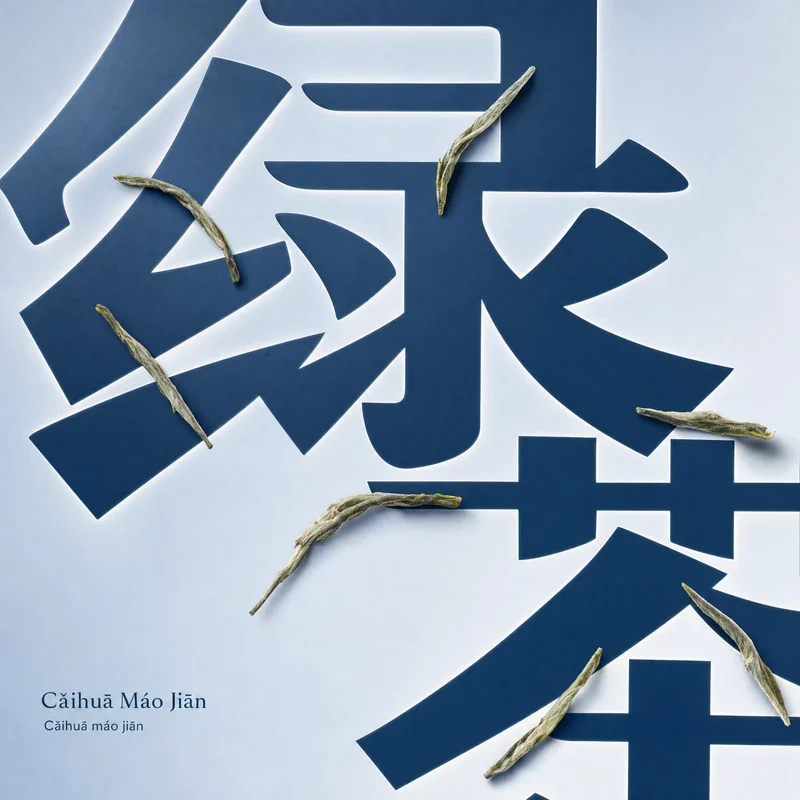
Cǎihuā máo jiān
Choose a brewing method. Start with the recommended quantities and time, then adjust to taste.
Brewing
Brewing
Taste
Tea encyclopedia
Category: National Geographical Indication Product (国家地理标志产品, 2017). First in Hubei "Famous Brand Agricultural Product of China" (中国名牌农产品, 2006). Tea of Diaoyutai State Guesthouse (钓鱼台国宾馆特供茶, 2020). Multiple gold medal winner at China Agricultural Exhibition. Production regulated by regional standard DB42/T 182-2011.
Category: National Geographical Indication Product (国家地理标志产品, 2017). First in Hubei "Famous Brand Agricultural Product of China" (中国名牌农产品, 2006). Tea of Diaoyutai State Guesthouse (钓鱼台国宾馆特供茶, 2020). Multiple gold medal winner at China Agricultural Exhibition. Production regulated by regional standard DB42/T 182-2011.
Coordinates: 110°15′ East longitude, 30°42′ North latitude.
Origin: China, Húběi Province (湖北, Húběi), Yíchāng City (宜昌市, Yíchāng Shì), Wufeng Tujia Autonomous County (五峰土家族自治县, Wǔfēng Tǔjiāzú Zìzhìxiàn). Core terroir — southern slope of Songfengshan Mountain (松峰山, Sōngfēng Shān), Cǎihuā Township (采花乡, Cǎihuā Xiāng), at elevations of 600–900 m — the "cloud zone".
Type: Green tea (non-oxidized). By shape — straight, slender, needle-like (条索形, tiáosuǒ xíng). By technology — pan-fired and heated with innovative "double fixation" (汽热-滚筒双杀青).
Cultural Significance: Cǎihuā Máo Jiān is the calling card of tea province Húběi and the pride of the Tujia people (土家族, Tǔjiāzú) — one of the largest ethnic minorities of southwestern China. The status of "Diaoyutai tea" is the highest recognition of quality at the state level: this tea is served to foreign heads of state visiting Beijing.
History: Tea cultivation traditions in Wufeng date back to the Tang era: Lu Yu in "The Classic of Tea" (茶经) noted that "south of Xia Gorge produces excellent tea" (峡州山南出好茶) — "Xia Gorge" (峡州) referred precisely to the territory of modern Wufeng. During the Qing era, under Emperor Kangxi, the local "Song of Tea Picking" (采茶歌, Cǎichá Gē) described in detail scenes of spring harvesting.
Cultivar: Foundation — Wǔfēng Local Group Variety (五峰本地群体种) — indigenous medium-leaf and small-leaf variety of Camellia sinensis var. sinensis, with many bushes over 100 years old. Additionally: Echa 1 (鄂茶1号) and Echa 7 (鄂茶7号) — Hubei breeding cultivars; Fúdǐng Dàbáichá (福鼎大白茶) — to increase down density. Weight of one hundred "one bud, one leaf" shoots — about 45 g. "Tenderness retention period" (持嫩期) — 7–10 days longer than standard varieties.
Picking: Early spring. For supreme grade (特级) — whole buds (单芽, ≥90%). For first grade — one bud with one leaf in initial opening stage (一芽一叶初展, ≥80%). For second grade — one bud with two small leaves.
Raw Material: Tender, uniform, undamaged shoots. Processing — on the day of harvest.
Altitude: 400–1200 meters above sea level. Core — "cloud zone" 600–900 m on the southern slope of Songfengshan.
Climate: Average annual temperature — 13.1°C (one of the lowest among tea-growing regions of central China). Annual precipitation — 1500 mm. Average annual number of foggy days — over 180. Diffused light (散射光) predominates, which stimulates amino acid accumulation: spring tea contains ≥3.32% amino acids.
Soil: Yellow-brown soils (黄棕壤) and red soils (红壤), pH 4.5–6.5, naturally enriched with zinc (锌, xīn) and selenium (硒, xī). Organic matter content — ≥2.0%. Forest coverage — 89% — one of the highest among tea-growing counties in China. Negative air ion concentration — 20,000/cm³. Wufeng County is certified as "China's Natural Oxygen Bar" (中国天然氧吧).
30th degree North latitude — "golden belt of world tea cultivation", uniting the best tea-producing regions of the planet (Darjeeling, Uji, Huangshan).
Tea gardens are irrigated by mountain springs, surrounded by forests. Industrial pollution — absent.
4–6 hours.
Innovative stage. First — steam fixation (汽热, 130–150°C): gentle, careful heating, preserving maximum amino acids and aromatic substances. Then — roller drum (滚筒, 260–280°C): rapid high-temperature "tempering", stopping oxidation and fixing bright aroma. The double approach — "gentle + harsh" — ensures depth and persistence of aromatic profile, unattainable with single fixation.
Three-stage — "light → heavy → light" (轻-重-轻), duration — 20 minutes. Degree of strip formation (成条率) — ≥80%.
At 160–180°C.
Hand straightening and rolling — creating characteristic slender shape with silvery down.
At 60–80°C — gentle heating, preserving down and fixing aroma.
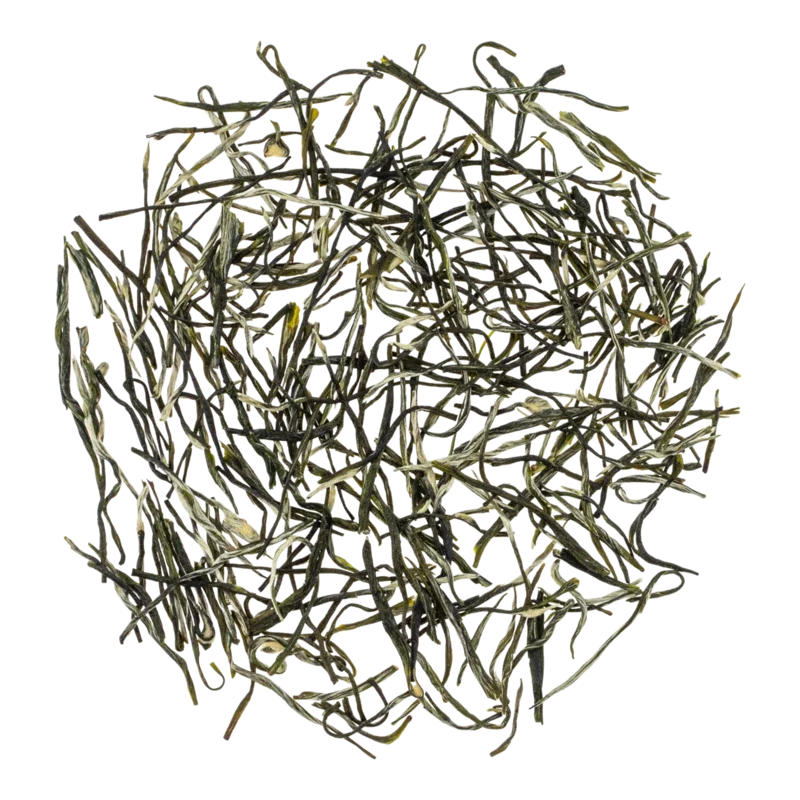
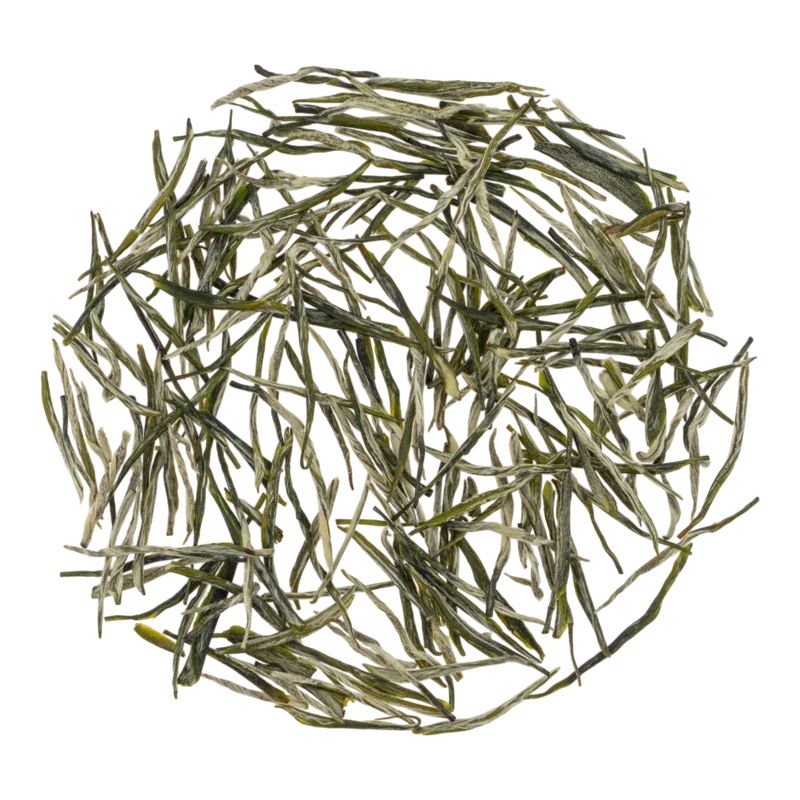
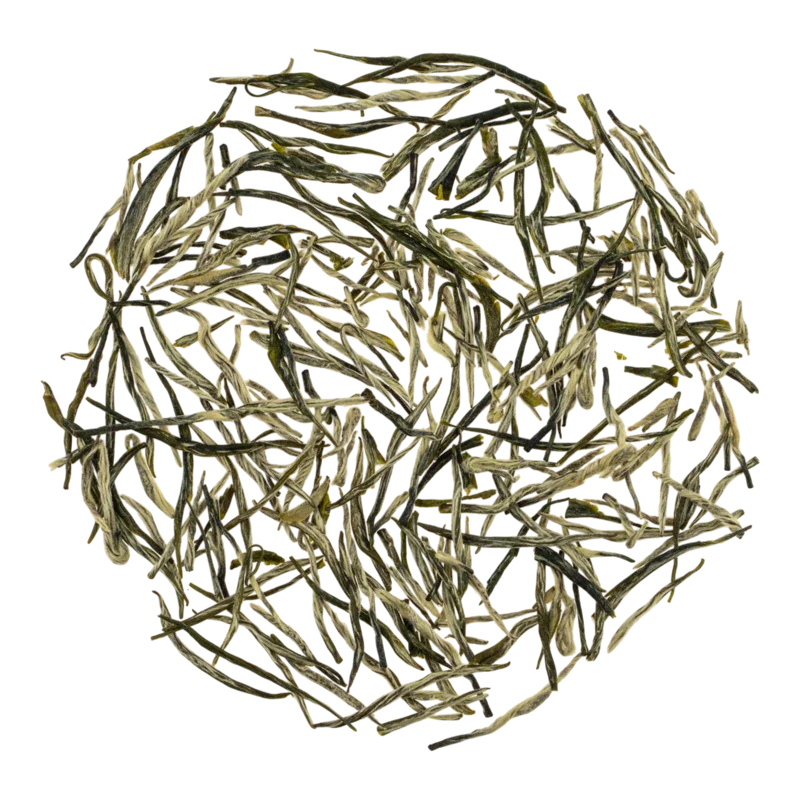
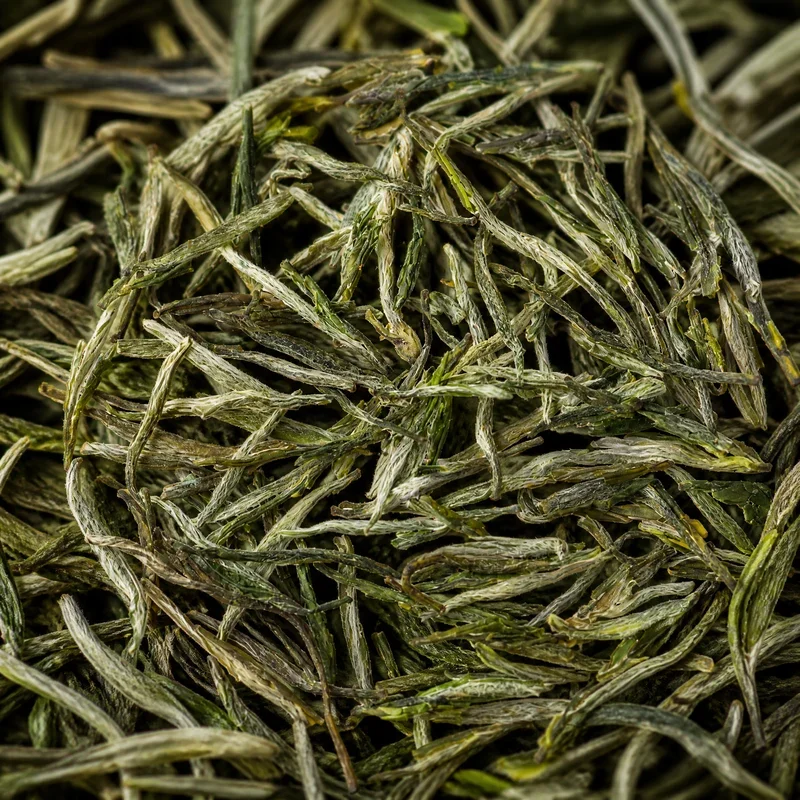
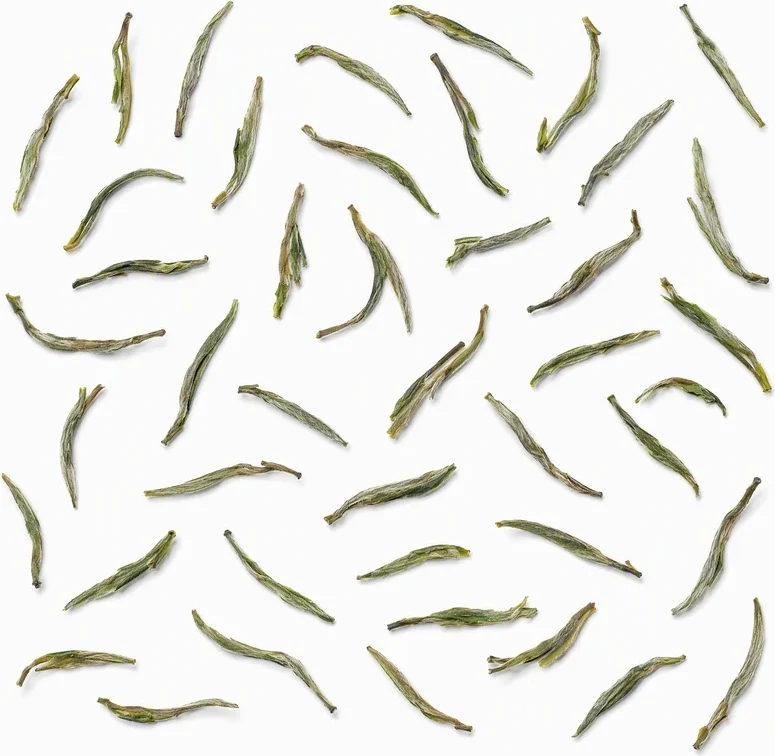
Dry Leaf Appearance: Thin, slender, straight shoots (细秀匀直), with exposed silvery down (显露/显毫). Colour — bright emerald-green with oily lustre (翠绿油润).
Dry Leaf Aroma: Delicate, high and persistent (嫩香高而持久). Supreme grade — chestnut note (栗香). Clean green freshness (清香).
Liquor Aroma: Persistent, high, with chestnut-green profile.
Tender green, clean, bright and clear (嫩绿清澈明亮).
Spent Leaves: Tender green, uniform, elastic shoots (嫩绿明亮匀齐).
Taste: Fresh and brisk (鲜爽, xiānshuǎng), mellow and rich (醇厚, chúnhòu) — noticeable "oiliness" of the liquor (粘稠感强). Pronounced returning sweetness (回甘, huígān) — stable and long-lasting.
Alkaloids: Caffeine — moderate content. Theobromine, theophylline.
Amino Acids: Spring tea — ≥3.32%. L-theanine — dominant component, responsible for freshness and sweetness.
For supreme grade — ≥36% — above standard, indicating exceptional taste richness.
Naturally elevated content — result of growing on selenium-zinc soils of Wufeng.
Noticeable content — contributes to tooth enamel protection.
Polyphenols: For first grade — ≥30% (according to standard DB42/T 182-2011). Provides powerful antioxidant potential.
Vitamins: Vitamin C, B-group vitamins.
Polyphenols absorb radioactive substances with efficiency 5 times higher than vitamin C, mitigating electromagnetic radiation effects from electronic devices.
Catechins accelerate fat breakdown with efficiency 30% higher than average green tea.
Fluorine suppresses cariogenic bacteria and prevents dental plaque formation.
Polyphenols (≥30%) neutralize free radicals.
Selenium and zinc combined with amino acids support immune function.
Caffeine and L-theanine.
the listed properties are based on publicly available data and are not medical recommendations.
pour water slowly, along the glass wall (缓流沿杯壁), not directly onto the tea — otherwise the down "washes away" and the liquor becomes cloudy. Freshly purchased tea is recommended to "air" for 7 days in a dark place. After opening — store in refrigerator, consume within a month.
Teaware: Glass tumbler or white porcelain gaiwan.
From Henan. "Ten Famous". More needle-like, with pronounced chestnut aroma of "double wok". Xinyang — more dense and "northern"; Caihua — more fresh and "cloudy", with selenium-zinc terroir character.
From Guizhou. Curved "fishing hooks" with "three greens penetrated by yellow". Duyun — more chestnut-structured; Caihua — more slender and "clean".
From Hunan. Needle-like, with exceptional persistence (up to 15 infusions). Guzhang — champion in persistence; Caihua — champion in official recognition (Diaoyutai).
Closest "relative" — essentially, general regional name for teas from Wufeng. Caihua Mao Jian — specific leading brand from Caihua Township.
slender, straight "needles" with silvery down. Loose or crooked — suspicious.
delicate, high, persistent. Coarse or "hay-like" — sign of counterfeit.
supreme grade — 3–4 infusions; second grade — 5+.
"Diaoyutai tea" — sign of highest recognition.
No reviews yet. Tell us what you think of this tea.
Rate this tea and share your impressions. We review each submission before publishing it.