Brewing
Gongfu brewing
- Water temperature
- 75 °C
- Tea amount
- 5 g
- Water volume
- 100 ml
- First steep
- 10 s
- Time added per infusion
- 5 s
- Infusions
- 3

Xìnyáng máo jiān
Choose a brewing method. Start with the recommended quantities and time, then adjust to taste.
Brewing
Brewing
Taste
Tea encyclopedia
Category: Famous Teas of China (中国十大名茶, Zhōngguó Shí Dà Míng Chá). Included among the "Ten Great Teas of China" since 1958.
Category: Famous Teas of China (中国十大名茶, Zhōngguó Shí Dà Míng Chá). Included among the "Ten Great Teas of China" since 1958.
Cheyun Mountain (车云山), Jiyun Mountain (集云山), Yúnwù Mountain (云雾山), Tianyun Mountain (天云山), Lianyun Mountain (连云山); Heilongtan Lake (黑龙潭) and Bailongtan Lake (白龙潭); Hejiazhai Stockade (何家寨). New key micro-regions — Shihegang Township (浉河港镇) and Dongjiehe Township (董家河镇), where high-altitude plantations are located above 500 m.
Coordinates: Approximately 32°07′ N, 114°04′ E.
Origin: China, Hénán Province (河南省, Hénán Shěng), Xìnyáng Prefecture (信阳市, Xìnyáng Shì). The geographical indication zone encompasses eight administrative units: Shihe District (浉河区) and Pingqiao District (平桥区), as well as Luoshan County (罗山县), Guangshan County (光山县), Xinxian County (新县), Shāngchéng County (商城县), Gushi County (固始县), and Huangchuan County (潢川县).
Type: Green tea (non-oxidized). Leaves are fixed with heat in a wok («kill-green» (杀青)), oxidation is almost completely stopped.
Cultural Significance: Xinyang Maojian is the pride and calling card of Henan Province, one of the cradles of Chinese civilization. The tea occupies a crucial place in local gift-giving culture and official receptions. Xìnyáng annually hosts the International Tea Culture Festival (信阳国际茶文化节) dedicated to this tea. Since 1994, all teas from the prefecture produced using unified technology and meeting quality standards have been united under the "Xinyang Maojian" brand, making the region China's largest production base for this famous tea.
Cultivar: The production base (approximately 70%) consists of the local population variety — Xìnyáng Quntichong (信阳群体种, Xìnyáng Qúntǐ Zhǒng), belonging to the bush form Camellia sinensis var. sinensis with medium-sized leaves. The plant is distinguished by high frost resistance; buds and leaves are light green, fleshy, densely covered with down. Weight of one hundred buds with one leaf — approximately 32 g. Auxiliary cultivars include Fúdǐng Dàbáichá (福鼎大白茶, Fúdǐng Dà Bái Chá), Wūniú Zǎo (乌牛早, Wūniú Zǎo) and other early introduced varieties, allowing extension of the picking period.
Picking: Main picking season — spring, from late March to early May. Traditional gradation by seasons:
Pluck Standard: For highest grades — «珍品» (treasure) and «特级» (extra) — exclusively single buds or "one bud — one leaf at initial opening" (一芽一叶初展) are used. For 1 kg of finished tea category «珍品», more than 100,000 buds are required. For first grade — "one bud — two leaves at initial opening." For second and third — "one bud — two-three leaves." Picking is done in dry weather, in the morning after dew has cleared.
Raw Material: Buds and leaves must be young, undamaged, juicy, uniform in size, covered with white down. Coarse leaves, tea stems, purple shoots, and foreign matter are not permitted. Water content in fresh leaf — approximately 70%.
Altitude: 300–800 m above sea level. Best plantations — above 500 m (Shihegang and Dongjiehe townships).
Climate: Average annual temperature — 15.1 °C. Annual precipitation — approximately 1200 mm. Relative humidity — 76%. Significant diurnal temperature variation. Average annual number of cloudy and foggy days — approximately 200, providing abundant diffused light (漫射光) and suppressing formation of coarse fiber in leaves. Winters are relatively mild, summers hot and humid with pronounced monsoon regime.
Soil: Yellow-brown forest soils (黄棕壤, huáng zōng rǎng) with acidity pH 4.5–6.0, rich in humus (organic matter content ≥ 2.5%). High humus content ensures enhanced nitrogen metabolism, increasing amino acid levels in leaves.
The Xinyang region is known as the "land of mountains and waters" (山水之乡). The combination of cool high-altitude nights, prolonged fog, acidic soils, and extended growing season produces leaves with elevated free amino acid content and moderate tea polyphenol levels, forming the mild, sweet-fresh taste characteristic of northern green teas.
Fresh leaves are spread in thin layers (~3 cm) on bamboo trays in shade for 4–10 hours. During this process, some moisture is lost (to ~70% humidity), light oxidation of polyphenols occurs, protein hydrolysis to amino acids and starch breakdown to soluble sugars; some grassy volatile compounds dissipate. This improves aroma and softens bitterness of the future tea.
An inclined iron cauldron (at 30–35° angle) is heated to ~140 °C (according to some sources — up to 160–200 °C for different batches). Leaves are processed manually using the "strip grasping" technique (手工抓条, shǒugōng zhuā tiáo) — vigorous palm and finger movements tossing and mixing the material. Goal — quickly inactivate enzymes (polyphenol oxidase), preserve green color and fix fresh aromatics.
Cauldron temperature is reduced to ~80–100 °C. The tea master sequentially performs technical methods: "wrapping strips" (裹条, guǒ tiáo), "fanning" (扇条, shàn tiáo), "driving" (赶条, gǎn tiáo) to straighten tea leaves and break up clumps, and final "arranging" (理条, lǐ tiáo) by hand — repeated grasping and releasing of strips, giving them the characteristic thin, straight, round, and smooth form. This stage determines the appearance of «细圆光直» — thin, round, smooth, and straight tea leaves. Tea is unloaded at 33–35% moisture.
Over charcoal at initial temperature ~120 °C with gradual reduction to ~90 °C. Drying to ~15% moisture.
Tea is spread for moisture equalization between surface and core of tea leaves. Time — at least 40 minutes.
Slow gentle drying at ~60 °C to ≤ 6% moisture. Tea leaves when compressed should crumble to powder, color — emerald green, down — well expressed.
Manual removal of non-standard tea leaves, tea stems, and foreign inclusions.
Key distinction — the «生熟双锅» technique (two sequential woks with different temperatures and tasks). Nine manual operations in the complete cycle. Critical technology — «提毫保翠» (tí háo bǎo cuì) — "raise down, preserve emerald": special movements during shaping that allow "lifting" white down to the tea leaf surface and protecting chlorophyll from destruction.
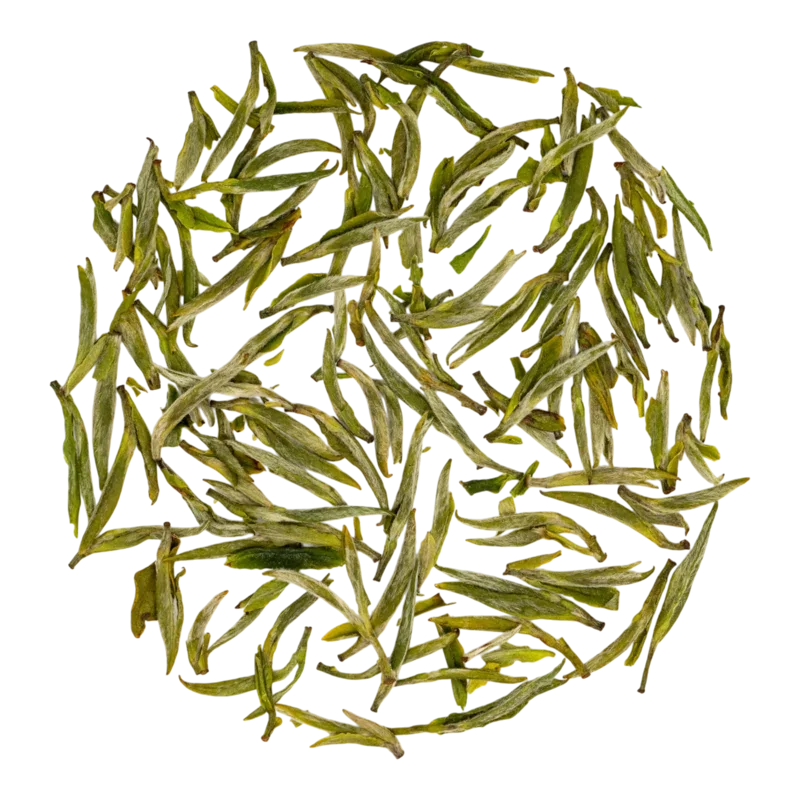
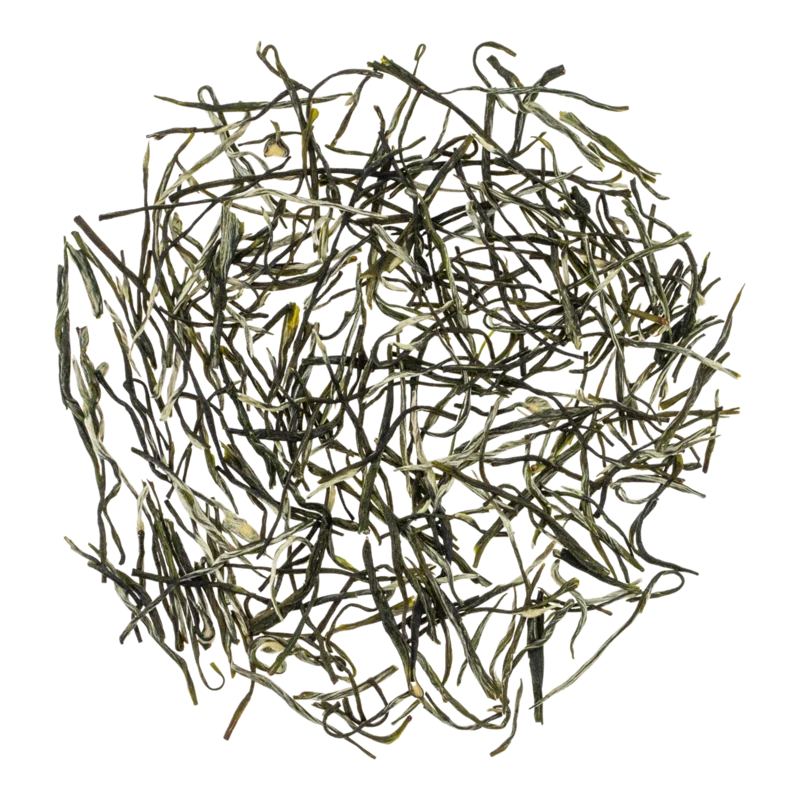
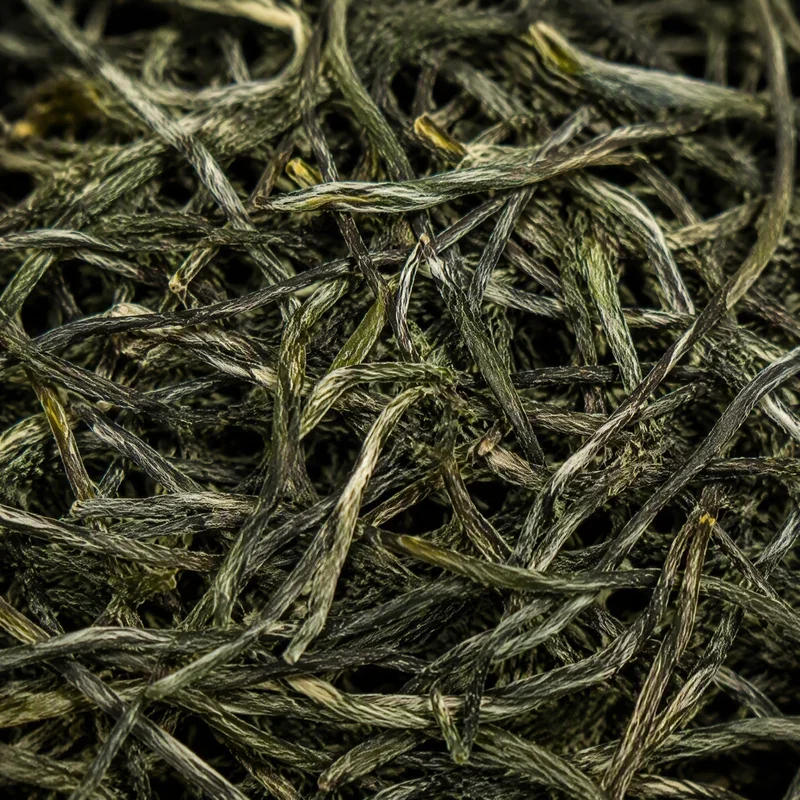
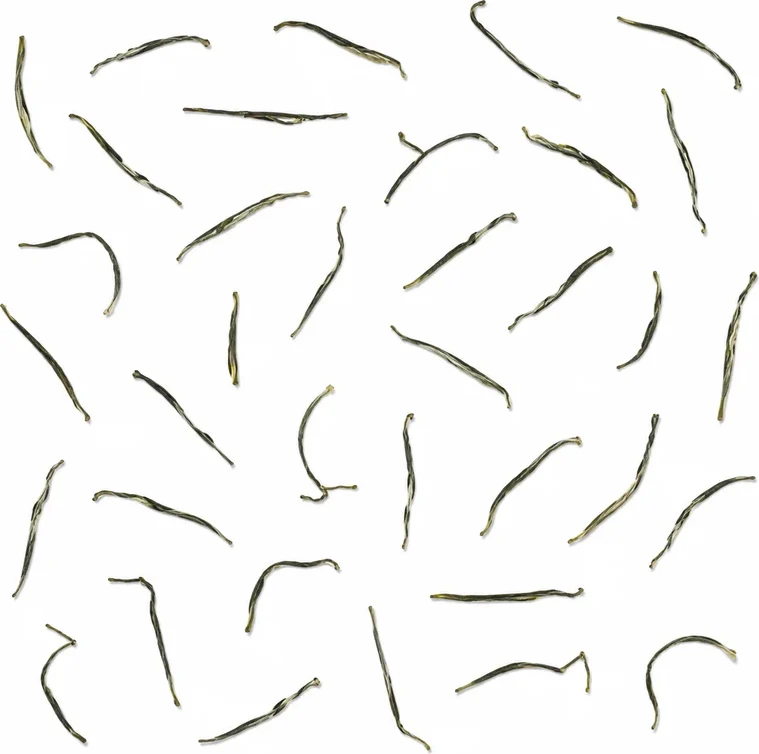
Dry Leaf Appearance: Thin, tightly rolled, straight, pointed needle-shaped tea leaves (细直针芽状). By standard — "straight, thin, firm, even, tender" (直、细、挺、匀、嫩). Color — bright emerald green (翠绿) with abundant silvery-white down (白毫显露), giving a light grayish sheen. Tea leaves are whole, unopened.
Dry Leaf Aroma: Dominant — pronounced roasted chestnut aroma (板栗香, bǎnlì xiāng), complemented by clean green freshness (清香) and "downy" note (毫香), reminiscent of young corn or boiled beans. In highest grades, light floral notes (orchid) and delicate creamy nuances may appear.
Liquor Aroma: Clean, high, and persistent. Chestnut note remains leading but becomes softer; floral-herbal tones with light roasted undertone come to the foreground. Aroma rises from the cup distinctly and does not dissipate for a long time.
Liquor Color: Light green with lively yellowish tint, clean and transparent, with bright luster. During brewing, light opalescence from suspended down may be noticed — this is a normal sign, not a defect.
Spent Leaves: Tender, whole, elastic buds and leaves, bright green, uniform color, with soft texture. Well opened but not overcooked. High raw material quality is evident: shoots are uniform, without coarse leaves and stems.
Taste: Pronounced freshness (鲜爽, xiān shuǎng), due to high amino acid content. Body — dense and round (醇厚, chún hòu). Characteristic sweet aftertaste with salivation (回甘生津, huí gān shēng jīn). The bouquet interweaves notes of chestnut, greenery, and light florality. Astringency is minimal in highest grades, increases in summer-autumn pickings. Bitterness is absent with proper brewing.
Alkaloids: Caffeine — 4.06–4.73% (37.59–45.19 mg/g); theobromine and theophylline are also present. GABA (γ-aminobutyric acid) content detected in noticeable quantities — it promotes smooth muscle relaxation in blood vessels.
Amino Acids: Free amino acid content — 2.95–4.34%, which is high among Chinese green teas. According to HPLC analysis, concentration — 53.21–61.07 mg/g. L-theanine — dominant amino acid, responsible for pronounced «鲜» (fresh/umami) taste character. High amino acid level is due to northern cool climate with prolonged cloudiness, suppressing photosynthetic conversion of amino acids to polyphenols.
GC-MS analysis identified 85 volatile compounds. Key aroma-forming substances (by ROAV — relative odor activity value): linalool, naphthalene, δ-cadinene, geraniol, β-ionone, cis-jasmone, benzaldehyde, β-cyclocitral, and 2-n-pentylfuran.
indicators vary significantly depending on picking season (spring vs. summer), grade, plantation altitude, and specific year. Spring high-altitude pickings demonstrate the highest amino acid to polyphenol ratio, correlating with best taste qualities.
Minerals: Contains fluorine (200–400 ppm, significant for caries prevention), potassium, magnesium, zinc, manganese, selenium, and other trace elements. Water extract — 43–46.5%, exceeding the standard ≥ 39% according to GB/T 22737.
Polyphenols: Total tea polyphenol content — 20–28% (according to various sources: 20.02–21.87% for spring samples of first grade from core terroir; 25.97–27.87% — for wide range of grades). Total catechin content — 117.71–184.18 mg/g, with EGCG (epigallocatechin gallate) predominating — the main antioxidant. Relatively high polyphenol level for northern green tea provides good antioxidant activity with moderate bitterness.
Vitamins: Rich in vitamin C (especially spring picking), B vitamins (B₁, B₂), as well as vitamins P, PP (nicotinic acid), K.
Catechins (especially EGCG) effectively neutralize free radicals, slowing oxidative stress and cellular aging.
Caffeine in synergy with L-theanine provides gentle, prolonged alertness without sharp peaks and drops; improves attention concentration, memory, and reaction speed.
Catechins and GABA help reduce "bad" cholesterol (LDL) levels, strengthen vascular wall elasticity, and normalize blood pressure.
Tea polyphenols can bind some radioactive elements (strontium-90 and others), accelerating their elimination from the body.
High fluorine content (200–400 ppm) strengthens tooth enamel and suppresses bacteria causing caries.
Stimulates gastric juice secretion and intestinal peristalsis, helps break down fatty foods.
Vitamin C, polyphenols, and trace elements (zinc, selenium) support immune response and resistance to infections.
Excellently quenches thirst in hot weather by stimulating salivation and thermoregulation.
this is general information about tea component properties, not medical recommendation. For health conditions, consult a physician.
Tea Amount: 3 g per 150 ml water (1:50 ratio). For more concentrated liquor — up to 4–5 g per 150–200 ml.
Teaware: Glass tumbler (cup) or gaiwan (盖碗, gàiwǎn) of thin porcelain. Glass allows observing the "dance" of tea leaves and leaf opening — one of the aesthetic pleasures when drinking Maojian. Porcelain teapot is also acceptable.
Water Temperature: 80–85 °C. Absolutely do not pour boiling water — this destroys vitamin C, makes the liquor cloudy, and increases bitterness.
Container: Airtight, opaque container. Ideal are tin cans with tight lids, vacuum aluminum foil bags, or double zip bags. Silica gel can be placed inside to absorb residual moisture.
Enemies: Light (destroys chlorophyll and vitamins), moisture (causes mold and oxidation), heat (accelerates aromatic degradation), foreign odors (tea easily absorbs them).
Under proper conditions (refrigerator, airtight container) — 12–18 months. Opened package should be consumed within 1–2 months. Over time, chestnut aroma weakens, leaf color dulls — these are aging signs.
Temperature: 0–5 °C (refrigerator, in separate airtight compartment). For long-term storage (more than 3 months) — freezer.
Guizhou Province. Also among the "Ten Great Teas." Raw material — small-leaf Guizhou cultivars. Distinguished by more twisted (hook-like) tea leaf shape, more pronounced floral note, and less evident chestnut aroma. Taste — mild and delicate, less "dense" than Xinyang Maojian.
Anhui Province, Huangshan Mountains. "Maofeng" ("fuzzy peak") — different shaping type: tea leaves are wider, slightly curved, resembling "sparrow tongue." Aroma — floral-orchid, less "roasted." Taste — lighter, more tender, with pronounced sweetness and without chestnut tones.
Zhejiang Province. "Dragon Well" — flat-shaped tea (扁形), without down. Aroma — beany, "roasted peas." Compared to Xinyang Maojian — lighter and "smoother" in taste, with less body fullness, but with elegant long aftertaste.
Zhejiang Province. Formally green tea, but from albino cultivar with record amino acid content (up to 6–7%). Taste — extremely mild and «鲜» (fresh), without chestnut notes. Compared to Xinyang Maojian — less rich, less astringent, more "transparent."
Specialized tea shops, authorized dealers of major Xinyang tea cooperatives. Presence of geographical indication marking (地理标志) — important indicator.
Genuine highest quality Maojian — thin, straight, even needles with abundant white down and bright emerald color. Dull, uneven color, large and coarse leaves, absence of down — signs of low quality or counterfeit.
Dry leaf should smell of fresh roasted chestnut with clean green note. Mustiness, grassy "cooked" quality, foreign odors — bad signs.
Color — transparent, light green with lively luster. Cloudy, dark, or yellowish-brown liquor indicates poor quality material or improper storage.
If price is significantly below market rate, this is almost certainly counterfeit (tea from another region processed by similar technology) or lowest grade material passed off as highest.
No reviews yet. Tell us what you think of this tea.
Rate this tea and share your impressions. We review each submission before publishing it.