Brewing
Gongfu brewing
- Water temperature
- 75 °C
- Tea amount
- 5 g
- Water volume
- 100 ml
- First steep
- 10 s
- Time added per infusion
- 5 s
- Infusions
- 3

Wǔfēng máo jiān
Choose a brewing method. Start with the recommended quantities and time, then adjust to taste.
Brewing
Brewing
Taste
Tea encyclopedia
Category: Historical regional tea; product with protected geographical indication (地理标志产品, dìlǐ biāozhì chǎnpǐn). Belongs to the "mao jian" (毛尖, máo jiān) category—"hairy tips," uniting green teas with abundant down on thin, straight tea leaves.
Category: Historical regional tea; product with protected geographical indication (地理标志产品, dìlǐ biāozhì chǎnpǐn). Belongs to the "mao jian" (毛尖, máo jiān) category—"hairy tips," uniting green teas with abundant down on thin, straight tea leaves.
Coordinates: Approximately 30.20° N, 110.67° E (center of Wufeng County). The entire county is mountainous territory at the junction of the Wǔlíng Mountains (武陵山, Wǔlíng shān) and the Yungui Plateau.
Origin: China, Húběi Province (湖北, Húběi), Yíchāng City (宜昌, Yíchāng), Wǔfēng Tujia Autonomous County (五峰土家族自治县, Wǔfēng Tǔjiāzú Zìzhìxiàn). Key production townships: Cǎihuā (采花乡, Cǎihuā xiāng)—the core of the district, Wǔfēng (五峰镇), Yuyangguan (渔洋关镇), Changleping (长乐坪镇), Xingyanping (星岩坪).
Type: Green tea (unoxidized). Kill-green fixation (杀青, shāqīng) completely stops oxidation; the primary method is wok-firing (炒青, chǎoqīng).
Cultural Significance: Wufeng bears the honorary title "Hometown of Chinese Famous Tea" (中国名茶之乡, Zhōngguó míngchá zhī xiāng). The region is historically connected with the Great Tea Road (万里茶道, Wànlǐ chá dào): the ancient tea trail in Wufeng with stone bridges, postal stations, caravanserais, and tea shops is part of an object included in UNESCO's tentative World Heritage list. Tea drinking is closely intertwined with the culture of the Tujia people (土家族, Tǔjiāzú), who comprise a significant portion of the county's population: local tea festivals and tasting competitions are held annually and accompanied by national songs and rituals.
History: Wufeng's tea history extends back more than two millennia. In Lu Yu's "The Classic of Tea" (《茶经》, Chá Jīng), written during the Táng dynasty (唐, Táng), the Xiázhōu (峡州, Xiázhōu) district—which includes Wufeng, Changyang, Yidou, and Yichang—is mentioned as territory where giant tea trees grow. In the chapter "Eight—Production" (八之出, bā zhī chū), Lù Yǔ places tea from Xiázhōu first among teas of the Shānnán (山南) region: "Shannan—Xiazhou is best, Xiangzhou and Jingzhou follow." The Qing "Chronicle of Changle County" (清《长乐县志》)—Changle being the old name for Wufeng—records that "in March all women go out to pick tea; tea picked at Qingming is yuqian-xicha; picked at Guyu is guyu-xicha; there are also Bai Mao Jian, Ronggou and other famous teas." In 1853, the county already produced tea considered renowned. The modern history of the "Wufeng Mao Jian" brand is connected with the activities of "Caihua Tea Company" (采花茶业), which in the 1980s combined traditional hand techniques with mechanized processing. In 1991, Yichang's tea industry reached production volume of more than 5,400 tons, of which green tea comprised about 4,350 tons. In 2009, the technology for making Cǎihuā Máo Jiān (采花毛尖) entered the list of intangible cultural heritage of Hubei Province. In 2020, standards for "Yichang Mao Jian" (《宜昌毛尖》) and "Technical Regulations for Processing Yichang Mao Jian" were published, and the regional public brand "Yichang Mao Jian" was officially presented. Wufeng County, with total tea
Name Breakdown: Wǔfēng (五峰, Wǔfēng) literally means "Five Peaks," the county name reflecting the mountainous terrain of the locality. Máo (毛, máo)—"down," "fuzz": indicates white down (白毫, báiháo) on the surface of tea leaves. Jiān (尖, jiān)—"tip," "point": refers to the thin, pointed tip of the bud. Thus, the full name can be translated as "hairy tips from Five Peaks."
Cultivar: The raw material base consists primarily of local population varieties (群体种, qúntǐ zhǒng)—genetically diverse plantings adapted to Wufeng's mountain terroir over centuries. A number of ancient trees in the protected zone of Nánmùqiáo Village (楠木桥村, Nánmùqiáo cūn) reach ages exceeding 100 years. Additionally, provincial varieties have been developed in the county: Wufeng 212 (五峰212), Wufeng 310 (五峰310), and E Cha 7 (鄂茶7号, È chá 7 hào), distinguished by increased amino acid content.
Picking: Predominantly spring. Harvest begins in mid-March and continues until early May. Most valuable is the early spring harvest before Qīngmíng (清明, Qīngmíng) and between Qīngmíng and Gǔyǔ (谷雨, Gǔyǔ).
Pluck Standard: For special grade (特级, tèjí)—one bud and one leaf in initial opening stage (一芽一叶初展, yī yá yī yè chūzhǎn). For first grade—one bud and two leaves in initial opening stage (一芽二叶初展). For second grade—one bud and two leaves (一芽二叶). For third grade—one bud and two to three leaves, opposite leaves permitted (对夹叶, duìjiā yè).
Raw Material: Fresh, intact, without mechanical damage or overheating. Delivery from plantation to production facility in the shortest possible time to avoid spontaneous oxidation.
Altitude: From 150 m (river valley bottoms) to 2,320 m (highest point of the county). Main tea plantations are located at altitudes of 600–1,200 m, ensuring the classic "mountain" character of the tea.
Climate: Subtropical monsoon with pronounced influence from the Yangtze River valley. Average annual temperature 13–17°C. Annual precipitation—about 1,600 mm (over ~166 rainy days). Frost-free period—about 240 days. High air humidity and abundant fog—up to 200 cloudy days per year—create diffused light conditions under which leaves accumulate more amino acids and fewer catechins, forming a mild, sweetish taste.
Soil: Acidic yellow-brown mountain soils (mountain yellow earths) predominate, rich in organic matter and enriched with microelements—zinc (Zn) and selenium (Se). Acidic reaction (pH 4.5–5.5) is optimal for tea bushes.
The county emphasizes ecological plantation management. A national-level green food raw material base of 100,000 mu (~6,670 ha) and an export base certified for EU supplies—25,000 mu—have been established. Integrated plant protection (green pest control) and unified preventive management are applied.
Hand selection of shoots in morning hours, before heat sets in. Raw material is delivered to the factory in bamboo baskets (竹篮, zhúlán) to maintain ventilation.
Fresh leaves are spread in a thin layer in a cool, ventilated room to equalize moisture and begin light evaporation, usually for 2–4 hours. This stage prepares leaves for fixation by reducing excess moisture.
Key stage. Leaves are fired in a heated wok or mechanical drum at 160–200°C. High temperature inactivates polyphenol oxidase, stopping oxidation, and forms the basis of chestnut aroma. Duration—6–8 minutes. A characteristic feature of the technology is emphasis precisely on firing (炒青技术, chǎoqīng jìshù) rather than steaming, which explains the pronounced nutty tone.
Fired leaves are briefly spread for cooling and stabilization before rolling.
Leaves are rolled to break cell walls and release juices, ensuring full extraction during brewing and forming the characteristic needle-straight shape of tea leaves.
Giving tea leaves a thin, straight, needle-like shape with pointed tips. Techniques used include: straightening (理条, lǐtiáo), shaking (抖, dǒu), pressing (捺, nà).
Conducted in three stages: initial drying (初烘) at ~80°C, intermediate drying (复烘) at ~70°C, and final drying (足烘) at ~50°C, lasting 60–90 minutes. The three-stage scheme ensures even moisture removal without over-drying and fixes the aroma.
Removal of substandard tea leaves, fragments, stems; final calibration; hermetic packaging.
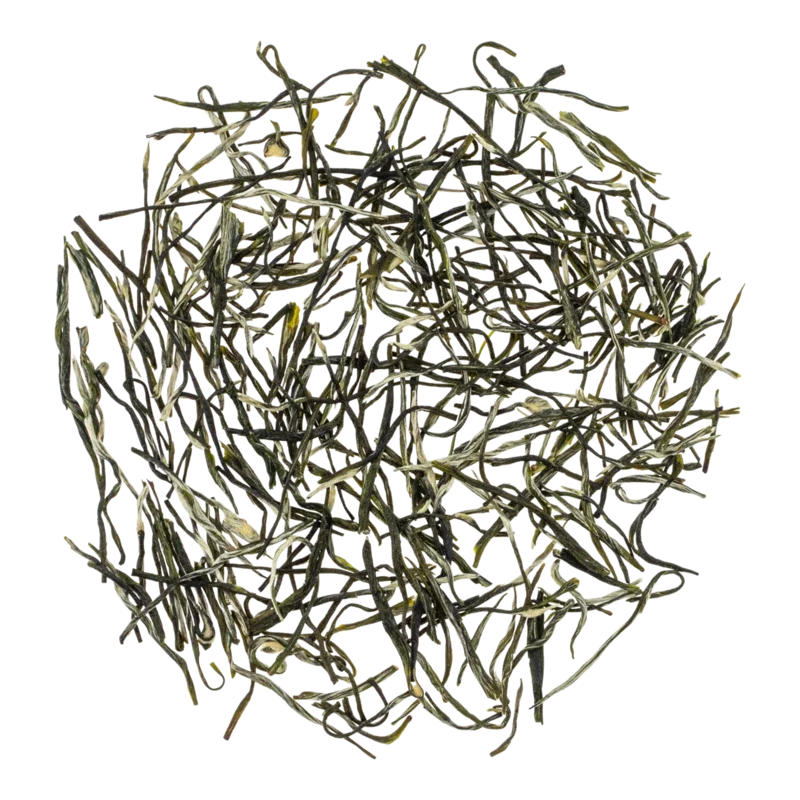
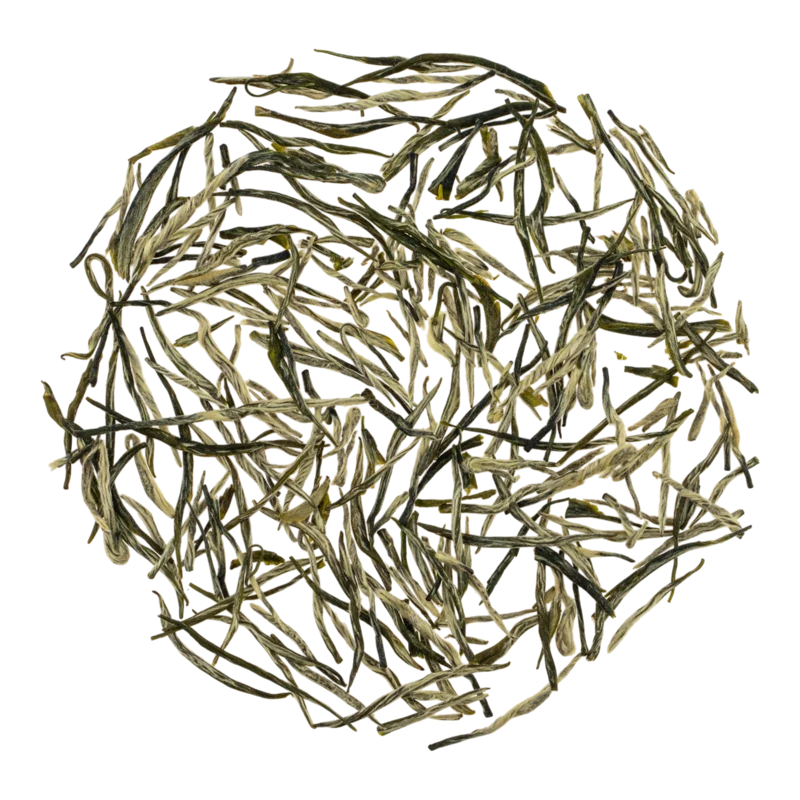
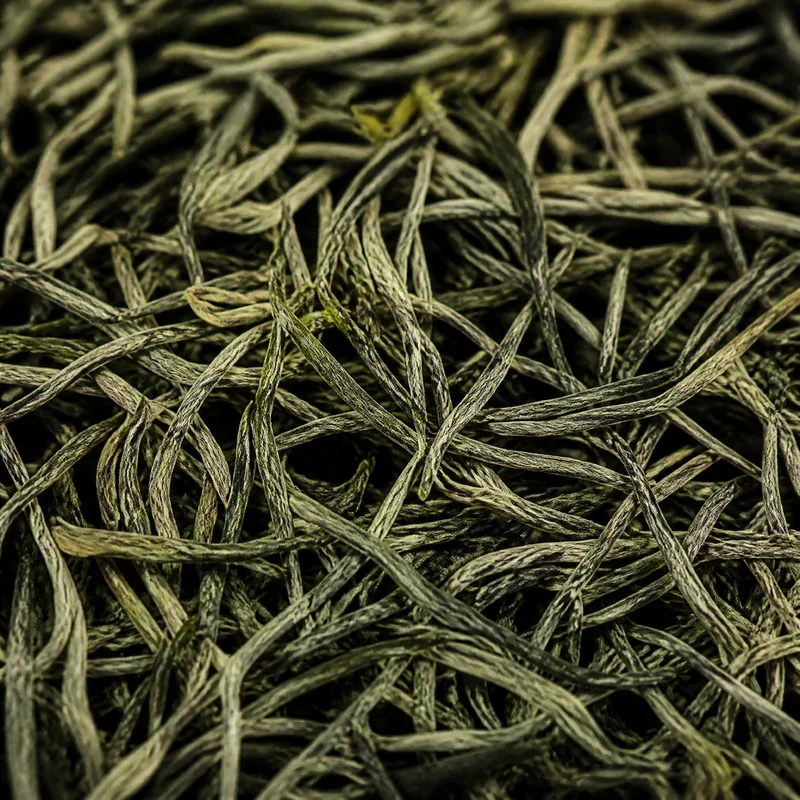
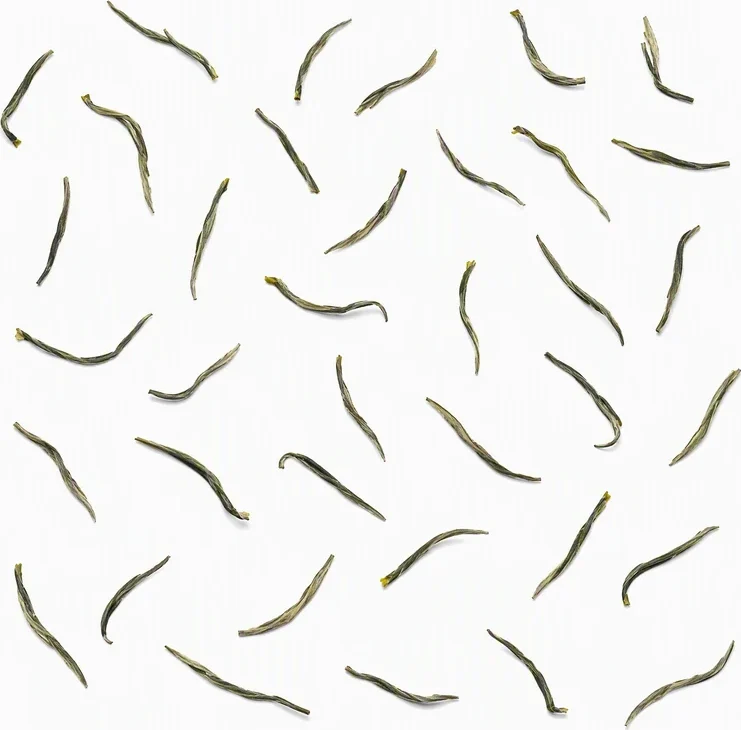
Dry Leaf Appearance: Thin, straight, tightly twisted tea leaves (条索紧结, tiáosuǒ jǐnjié), uniform in size (匀整, yúnzhěng). Color—tender green with oily luster (嫩绿油润, nènlǜ yóurùn). White down (白毫, báiháo) noticeably covers the surface, especially in higher grades.
Dry Leaf Aroma: Clean, fresh, with distinct chestnut-nutty note (熟栗香, shú lì xiāng), characteristic of Wufeng. Premium batches have a light floral undertone reminiscent of orchid (兰花香, lánhuā xiāng).
Liquor Aroma: High, persistent chestnut aroma, complemented by gentle sweetness of fresh greenery. In the best samples—a complex combination: chestnut + orchid (嫩栗香和兰花香的复合香型).
Liquor Color: Tender green, bright and clear (嫩绿明亮, nènlǜ míngliàng). Light suspension of down is visible in the cup (茶毫浮动, cháháo fúdòng).
Spent Leaves: Tender green, glossy, elastic (嫩绿润亮, nènlǜ rùnliàng). Leaves are uniform, without coarse stems; light pressure reveals elasticity.
Taste: Dense, rich (浓厚, nónghòu), noticeably more "full-bodied" than most mao jians. Withstands multiple brewings well (耐泡, nàipào). Sweetness is perceptible from the first sip; in the mouth—cleanliness and freshness (鲜爽, xiānshuǎng), without bitterness or roughness. Pronounced sweet aftertaste (回甘, huígān) lasts long.
Alkaloids: Caffeine (咖啡碱, kāfēi jiǎn)—2.5–4% of dry mass, relatively low for green tea. Some batches have caffeine content below 1%, opening potential for low-caffeine product production. Theobromine and theophylline are present in trace amounts.
Amino Acids: Content—about 6.5% of dry mass, exceeding the average for ordinary varieties by ~30%. High L-theanine content (L-茶氨酸, L-chá ānjīsuān) provides pronounced sweetness and mildness of taste, as well as synergistic effect of "calm alertness" in combination with caffeine.
Not less than 36%, ensuring richness and "density" of liquor.
Essential Oils: The aromatic complex is formed primarily by linalool, geraniol, and pyrazines (the latter responsible for the chestnut-nutty note typical of pan-fired green teas).
Minerals: Wufeng soils are enriched with zinc (Zn) and selenium (Se), which transfer to leaves and determine the tea's special mineral profile.
Polyphenols: Content—about 34% of dry mass, which is ~5% higher than average for ordinary green teas. Catechins predominate (儿茶素, ér chásù): epigallocatechin gallate (EGCG), epicatechin gallate (ECG), epicatechin (EC). Catechins determine antioxidant activity and moderate astringency.
Vitamins: Vitamin C (ascorbic acid), B-group vitamins (B₁, B₂), vitamin E (tocopherols).
High catechin content, especially EGCG, helps neutralize free radicals and slow cellular aging.
Moderate caffeine combined with high L-theanine levels provides alertness without nervousness—the effect of "calm concentration," valuable for mental work.
Catechins and flavonoids help reduce "bad" cholesterol (LDL) levels and maintain vascular elasticity.
Polyphenols and moderate astringency stimulate gastric juice secretion; tea pairs well with light to medium-density foods.
Natural zinc and selenium from mountain soils—important microelements for immunity and the body's antioxidant system.
Catechins have antibacterial action, helping maintain gum health and breath freshness.
L-theanine increases brain alpha-wave activity, promoting relaxed attention and improving working memory.
People with increased caffeine sensitivity should limit intake, especially in the afternoon. Strong tea on an empty stomach is not recommended.
Tea Amount: 3 g per 150 ml (glass/cup) or 5 g per 200–250 ml. For flash steeps in gaiwan—3–4 g per 100–120 ml.
Teaware: Glass tumbler (玻璃杯, bōlí bēi)—allows observation of leaf opening and down movement in liquor. Porcelain gàiwǎn (盖碗, gàiwǎn)—for more controlled multiple brewing. Porcelain teapot—for larger volumes.
Water Temperature: 80–85°C. For especially delicate material (special and first grades)—75–80°C. Boiling water will damage amino acids and give the liquor unwanted bitterness.
One of the "Ten Famous Teas of China," from Henan Province. Liquor is lighter and more refined, aroma—high, floral-grassy, without pronounced chestnut note. Aftertaste is long, but liquor body is thinner. Wufeng Mao Jian is denser, more "full-bodied," and noticeably more affordable.
Famous tea from Guizhou Province. Distinguished by characteristic white down and thin, delicate aroma of fresh greenery with light sweetness. Compared to Wufeng—less concentrated, more "airy" in body.
Also from Guizhou, rolled into balls. Completely different form and presentation: Wufeng is needle-like and straight, Lu Zhu is round and compact. In aroma, Wufeng is more chestnut-like, Lu Zhu more floral.
Essentially the "younger brother"—produced in the same Wufeng County (Changleping township). Very close in profile but typically slightly less pronounced in taste and more affordable. Both teas are part of the unified "Yichang Mao Jian" brand.
No reviews yet. Tell us what you think of this tea.
Rate this tea and share your impressions. We review each submission before publishing it.