Brewing
Gongfu brewing
- Water temperature
- 75 °C
- Tea amount
- 5 g
- Water volume
- 100 ml
- First steep
- 10 s
- Time added per infusion
- 5 s
- Infusions
- 3

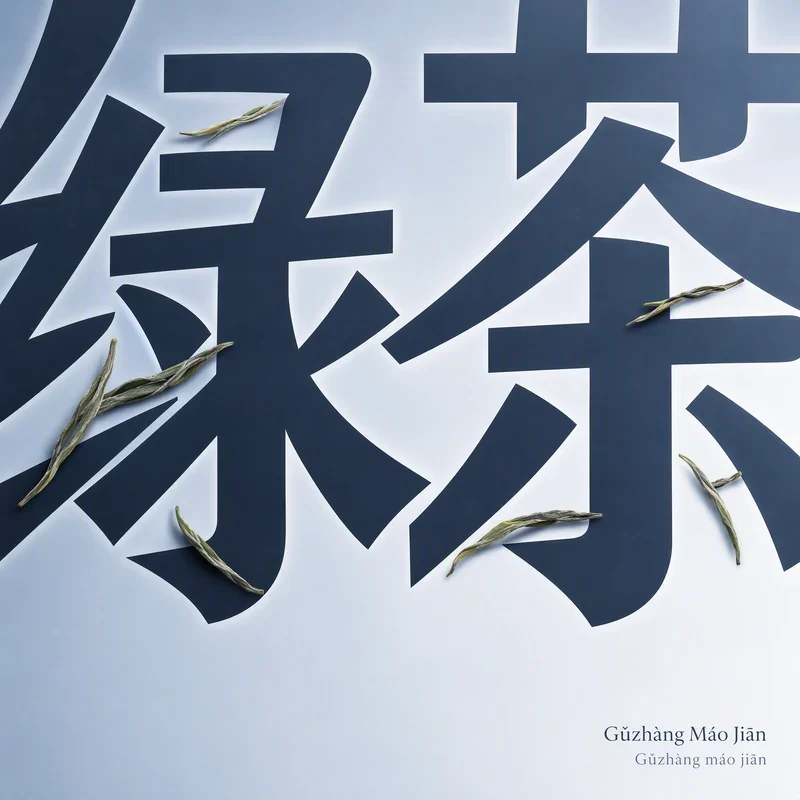
Gǔzhàng máo jiān
Choose a brewing method. Start with the recommended quantities and time, then adjust to taste.
Brewing
Brewing
Taste
Tea encyclopedia
Category: National Geographical Indication Protection Product (国家地理标志保护产品, 2007). China Famous Trademark (中国驰名商标, 2011). In 1982, it was included in the list of "Ten Famous Teas of China" (according to one version of the ranking).
Category: National Geographical Indication Protection Product (国家地理标志保护产品, 2007). China Famous Trademark (中国驰名商标, 2011). In 1982, it was included in the list of "Ten Famous Teas of China" (according to one version of the ranking).
"Golden tea cultivation belt" of the thirtieth degree north latitude along the Wuling Mountain Range, crossing Hunan, Hubei, Chongqing and Guizhou provinces.
Coordinates: Approximately 28°37′ North latitude, 109°57′ East longitude.
Origin: China, Húnán Province (湖南, Húnán), Xiāngxī Tujia and Miáo Autonomous Prefecture (湘西土家族苗族自治州, Xiāngxī Tǔjiāzú Miáozú Zìzhìzhōu), Gǔzhàng County (古丈县, Gǔzhàng Xiàn). Core production area — Guyangzhen Township (古阳镇), tea mountains of Dōngfāng (东方), Longtianping (龙天坪) and Niujiaoshan (牛角山).
Type: Green tea (non-oxidized). Belongs to pan-fired green teas (炒青绿茶, chǎoqīng lǜchá) with straight needle-like shape.
Cultural Significance: Guzhang Mao Jian is the pride of Xiangxi, a region known as the "land of mountains and rivers" (山水之乡), birthplace of writer Shen Congwen and artist Huang Yongyu. The tea is inextricably linked with the cultures of the Tujia and Miao — peoples who have inhabited the Wuling Mountains for millennia. For Guzhang County, where tea gardens occupy a significant portion of agricultural land, tea is the foundation of economy and cultural identity.
History: Tea cultivation in Guzhang County can be traced back to the Eastern Han period (25–220 CE): in the ancient pharmacological treatise "Tongjun Lu" (桐君录, Tóngjūn Lù), the Guzhang area was already designated as a tea-producing territory. During the Tang dynasty (618–907), local tea was included in the list of imperial tributes (贡品, gòngpǐn).
Whole buds or one bud with one leaf. Abundant white down, fresh taste.
One bud with one leaf. Even, elegant shoots, persistent aroma.
With small admixture of tender stems. Dense taste, outstanding resistance to brewing.
Cultivar: Local indigenous medium-leaf and small-leaf bush variety Camellia sinensis var. sinensis — Gǔzhàng Quntichong (古丈群体种), with predominance of the Zhueyezhong subtype (槠叶种, Zhūyè zhǒng). Distinguished by high "tenderness retention" (持嫩性强) and abundance of down (茸毛多). It is precisely the local cultivar groups, adapted to the mountain conditions of Wuling Mountains, that ensure the tea's characteristic resistance to multiple infusions.
Picking: Early spring picking before Qīngmíng (清明, ~April 5). For the highest grade — whole buds or one bud with one barely opened leaf (一芽一叶初展). Shoots must be plump, downy, and uniform in size.
Pluck Standard: Three grades:
Raw Material: Tender, uniform, undamaged shoots. Processing — on the day of picking.
Altitude: Main plantations — above 1000 meters above sea level. Forest coverage — 80%. Mountains are cut by numerous streams and waterfalls, industrial pollution is absent.
Climate: Subtropical mountain monsoon climate. Average annual temperature — 16°C. Abundant cloud cover, little direct sunlight, predominance of diffused light (漫射光). These conditions slow polyphenol synthesis and promote amino acid accumulation — result: mild, sweetish taste without pronounced bitterness.
Soil: Unique feature — soils developed on purple shales (紫色板页岩, zǐsè bǎnyèyán), naturally enriched with phosphorus and selenium (硒, xī) — selenium content is significantly higher than in most tea-growing regions of China. Soils with nitrogen content >1% comprise 83% of the territory — an exceptional fertility indicator.
Guzhang County is located in the "golden tea cultivation belt" of the 30th parallel — the latitude that unites the world's best tea-producing regions (Darjeeling, Uji, Huangshan). The purity of air, water and soils makes this terroir one of the most ecologically favorable in China.
Brief spreading to remove excess moisture.
At 180°C — stopping enzyme oxidation, fixing fresh aromatics.
Intensive rolling (揉捻力度重) — stronger than most green teas, which ensures deep opening of cellular structures and explains the exceptional resistance to multiple infusions.
At 120°C — intermediate drying and further aroma development.
Additional structure compaction.
Final pan-firing to set the shape.
The master manually shapes the shoots, combining techniques of "straightening" (理, lǐ), "stretching" (拉, lā) and "rolling" (搓, cuō), giving the tea leaves a straight, elegant, needle-like form.
Final stage — at precisely controlled temperature, the master "draws out" the silvery down to the surface of the tea leaf, preventing its shedding. This requires exceptional precision — the slightest overheating destroys the down, underheating leaves it "pressed in."
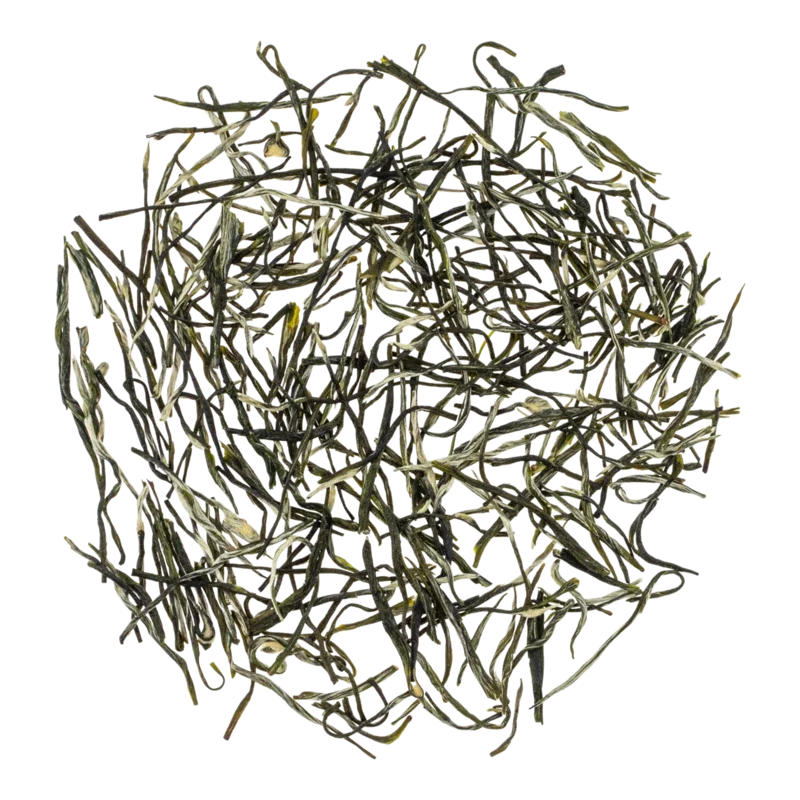
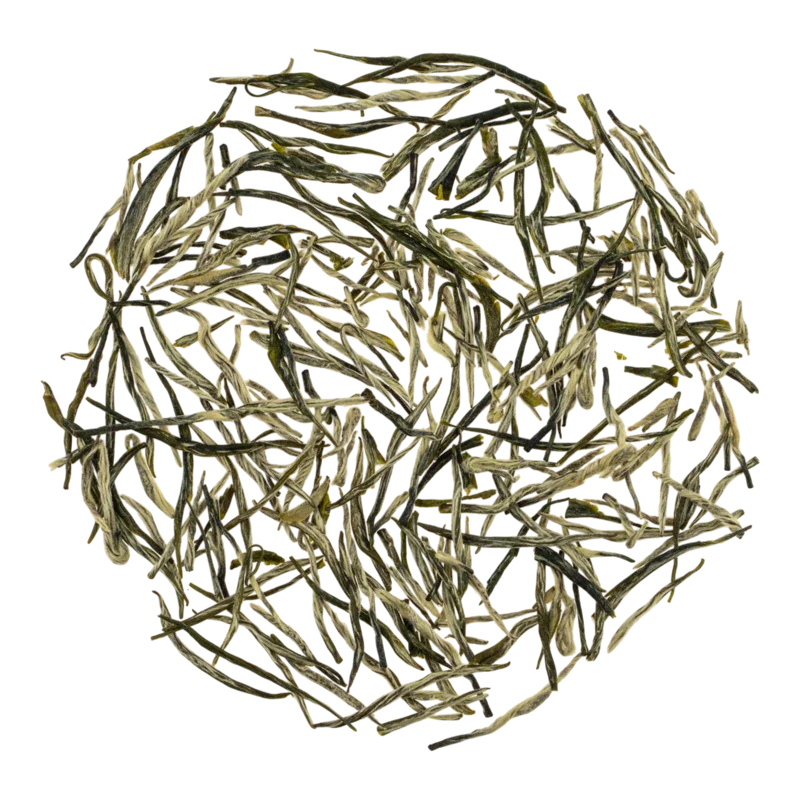
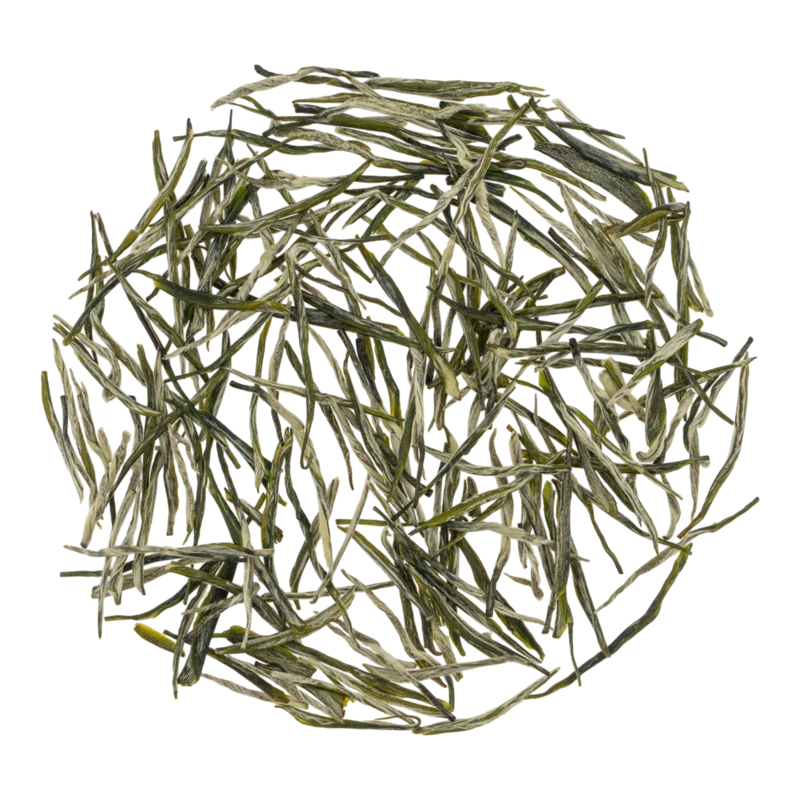
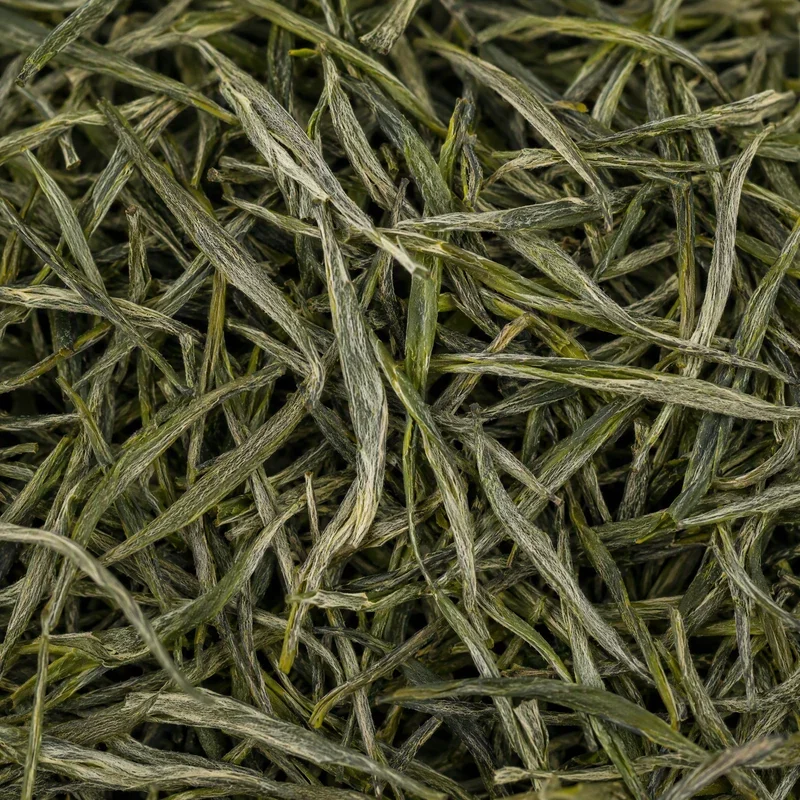
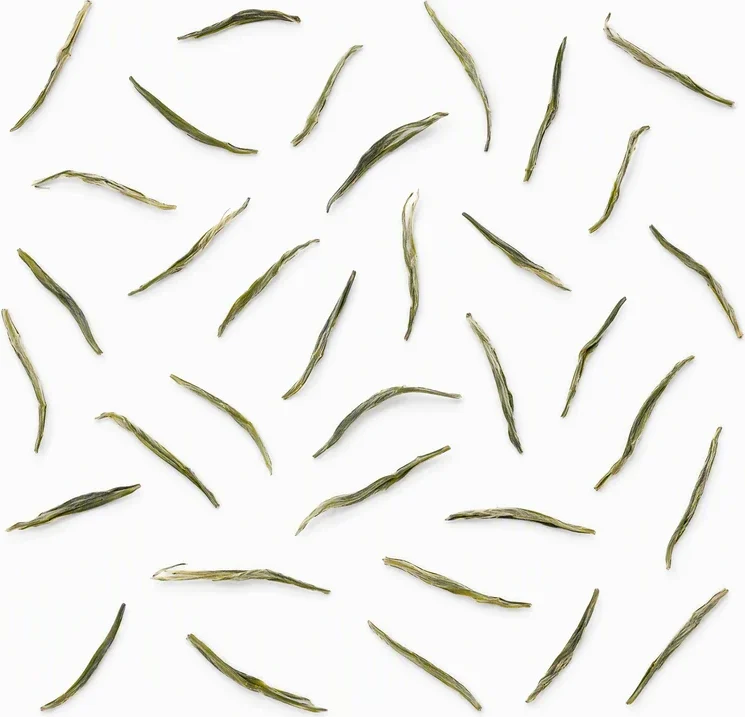
Dry Leaf Appearance: Thin, tight, straight and elegant shoots (条索紧细圆直), with graceful pointed tips (锋苗挺秀). Color — emerald green with oily luster (翠润), abundantly covered with silvery down (显毫).
Dry Leaf Aroma: Pure, high, fresh (清香, qīngxiāng). Delicate aroma of young buds (嫩香高悦, nènxiāng gāoyuè) — "delighting tenderness." Residual aroma in empty cup (冷杯留香) persists for long.
Liquor Aroma: Persistent, high, with pure floral tone. Unfolds gradually over many infusions.
Liquor Color: Tender green, clear and transparent, with lively luster.
Spent Leaves: Tender, elastic, uniform shoots of green color. Whole, without damage.
Taste: Fresh and brisk (鲜爽, xiānshuǎng), mellow and rich (醇厚, chúnhòu), with pronounced returning sweetness and salivation-inducing (回甘生津, huígān shēngjīn). Main feature — exceptional resistance to brewing: quality Guzhang Mao Jian withstands up to 15 infusions, maintaining aroma and taste — an indicator almost impossible for ordinary green tea. Tasting formula: "First 3 infusions — pure freshness; from the 4th — depth and returning sweetness."
Alkaloids: Caffeine — moderate content. Theobromine, theophylline.
Amino Acids: Elevated content — result of abundant diffused light and nitrogenous soils (83% of territory with nitrogen content >1%). It is amino acids that ensure freshness and mildness.
Naturally elevated content — Guzhang Mao Jian belongs to the category of "fuxi cha" (富硒茶, fùxī chá — "selenium-rich tea"). Selenium is a powerful antioxidant and immunomodulator.
Minerals: Potassium, magnesium, phosphorus, zinc, manganese, selenium.
Polyphenols: Significant content — provides powerful antioxidant potential and structural depth of taste.
Vitamins: Vitamin C, B-group vitamins, carotenoids.
High polyphenol content combined with selenium provides enhanced protection against oxidative stress.
Caffeine and L-theanine provide mild, focused alertness.
Polyphenols stimulate fat breakdown — an effect particularly pronounced according to research.
Thirst quenching, removal of internal heat.
Selenium and polyphenols support immune function.
The infusion stimulates salivation.
the listed properties are based on publicly available data and are not medical recommendations.
the first 3 infusions reveal pure freshness and aroma; starting from the 4th — depth, body and returning sweetness. Avoid "steeping" (闷泡) — this increases astringency. Not recommended to drink on empty stomach; optimal — 30 minutes after meals.
Tea Amount: 3–4 g per 120–150 ml water (1:40 ratio).
Teaware: White porcelain gàiwǎn (白瓷盖碗) or glass tumbler.
Water Temperature: 90°C (boiling water, slightly cooled). Guzhang Mao Jian is one of the few green teas for which relatively high temperature is recommended, thanks to the dense leaf structure.
From Henan Province. More dense, straight "needles" with pronounced chestnut aroma. Xinyang is more "northern" in character, with powerful astringency; Guzhang is milder, sweeter and significantly more resistant to brewing.
From Guizhou Province. Curved "fishing hooks" with "three greens penetrated by yellow." Duyun is richer in polyphenols; Guzhang is more elegant in shape and with better resistance.
From Hubei Province. Neighbor along the Wuling Mountain Range. Milder and more delicate; Guzhang is denser and with pronounced "selenium" character.
thin, elegant, straight "needles" with abundant down. Loose, uneven tea leaves — sign of counterfeit.
authentic Guzhang Mao Jian withstands 10+ infusions. "Exhaustion" after 2–3 — sure sign of counterfeit.
pure, high, without harshness. Mustiness or "grassiness" — reason for doubt.
suspiciously low price — sign of counterfeit.
No reviews yet. Tell us what you think of this tea.
Rate this tea and share your impressions. We review each submission before publishing it.