Brewing
Gongfu brewing
- Water temperature
- 90 °C
- Tea amount
- 6 g
- Water volume
- 100 ml
- First steep
- 10 s
- Time added per infusion
- 5 s
- Infusions
- 8

Ālǐshān hóngchá
Choose a brewing method. Start with the recommended quantities and time, then adjust to taste.
Brewing
Brewing
Taste
Tea encyclopedia
Category: Taiwanese high-mountain teas (高山茶, Gāoshān Chá). Belongs to a new direction—high-mountain red teas (高山紅茶, gāoshān hóngchá), which has been actively developing in Taiwan since the beginning of the 21st century.
Category: Taiwanese high-mountain teas (高山茶, Gāoshān Chá). Belongs to a new direction—high-mountain red teas (高山紅茶, gāoshān hóngchá), which has been actively developing in Taiwan since the beginning of the 21st century.
Coordinates: Approximately 23°30′ N, 120°48′ E.
Origin: Táiwān (台灣, Táiwān), Chiayi County (嘉義縣, Jiāyì Xiàn), Ālǐshān mountain region (阿里山, Ālǐshān). Tea gardens are located within the Alishan National Scenic Area and adjacent townships—Méishān (梅山, Méishān), Zhúqí (竹崎, Zhúqí), Fānlù (番路, Fānlù), as well as in the Shízhuō (石棹, Shízhuō) and Ruìlǐ (瑞里, Ruìlǐ) zones.
Type: Red tea (black tea) (紅茶, hóngchá), fully oxidized. According to European classification—black tea.
Alishan Hong Cha demonstrates fundamental principle of tea mastery: tea type is determined not by bush variety but by processing technology. The same Qing Xin Oolong bush can become light oolong, dark oolong, red tea, or even white tea—depending on master's will.
Semi-spherical rolling of Alishan Hong Cha is direct heritage of region's oolong technologies. This makes tea more resistant to repeated brewings and visually unlike most red teas in the world.
Alishan Hong Cha became one of favorite teas of Taiwanese youth precisely due to its excellent compatibility with fresh milk—soft, sweet, without bitterness, it creates delicate milk tea requiring no added sugar.
Some farmers purposely allow tea green leafhopper (小綠葉蟬) bites on summer leaves—damaged leaves trigger defensive reaction, accumulating aromatic compounds with intense honey-muscat profile. From such leaves, "Alishan Mixiang Hong Cha" (阿里山蜜香紅茶)—honey red tea—is produced.
Absolute majority of world's red teas are produced at altitudes below 600 m. Red tea from 1200–1600 m altitude is exceptional rarity, and Alishan is one of few regions where this became sustainable practice.
The most prestigious and traditional Alishan cultivar. Small-leaf variety (Camellia sinensis var. sinensis), with dark green glossy leaves and purple shoots. Distinguished by high L-theanine content, which gives a soft, sweet taste even with prolonged brewing. With full oxidation, reveals delicate fruit-honey notes with floral undertones. Considered the best raw material for premium-class Alishan Hong Cha.
Cultivar developed by the Taiwan Tea Research and Extension Station (TTES) in 1981. Medium-leaf type with elliptical, thick, dark green leaves. Famous for its characteristic creamy-milky aroma (奶香, nǎi xiāng) in the oolong version. With full oxidation, retains light creamy notes, complemented by honey and caramel tones.
Developed by TTES, characterized by fresh, "green" aroma with notes of jasmine and lily of the valley. In the red version, gives a clean, refreshing profile.
"Four Seasons Spring"—undemanding, high-yielding small-leaf variety with bright floral aroma (gardenia, orchid). Used for more accessible versions of Alishan Hong Cha.
Cultivar: For Alishan Hong Cha production, the same cultivars are used as for the region's famous oolongs—this is its uniqueness. Main varieties:
Picking: Spring (春茶, 3rd–5th month) and winter (冬茶, 10th–12th month) provide the highest quality raw material. Summer harvest (夏茶) is used for mass categories; sometimes honey red tea (蜜香紅茶, mì xiāng hóngchá) is produced from summer leaves damaged by the tea green leafhopper (小綠葉蟬, xiǎo lǜ yè chán)—analogous to Dong Fang Mei Ren technology.
Pluck Standard: One bud and two-three top leaves (一芽二、三葉). For some versions, more mature leaves are used, similar to oolong harvest standards.
Climate: Cool, humid, with frequent fogs and cloudiness. Average annual temperature 16–20°C, significantly lower than lowland tea regions. Daily temperature fluctuations reach 10–15°C, slowing shoot growth and promoting accumulation of amino acids, aromatic substances, and soluble sugars.
Soil: Predominantly mountain-forest, well-drained, with high organic matter and mineral content. Acidic reaction (pH 4.5–5.5), optimal for tea bushes.
Extensive territory with elevations from 800 to 2600 m above sea level. Main tea gardens are located in the 1000–1600 m belt, which classifies the tea as "high-mountain" (高山茶—category for teas grown above 1000 m). The region is famous for picturesque landscapes, century-old cypress forests, and the famous Ālǐshān Forest Railway (阿里山森林鐵路).
The famous "sea of clouds" of Alishan not only attracts tourists but also creates natural diffused light, reducing catechin content (responsible for bitterness and astringency) and increasing L-theanine content (responsible for sweetness and umami). This is precisely why Alishan high-mountain teas are distinguished by softness and sweetness.
Low catechin content in raw material means that even with full oxidation, the tea retains softness and does not acquire excessive astringency and bitterness—the main drawback of lowland red teas. High amino acid content ensures sweetness and "throat rhyme" (喉韻, hóu yùn), atypical for red teas.
Hand picking is mandatory for all quality categories. Standard: one bud and two-three leaves.
Begins with solar withering (日光萎凋, rìguāng wěidiāo) on bamboo trays—a stage borrowed from Alishan oolong tradition. Continues indoors (室內萎凋, shìnèi wěidiāo) for 12–18 hours. Total moisture loss—up to 60–70%. At this stage, partial oxidation begins and aromatic precursors form.
Important feature—rolling form. Unlike most mainland red teas (longitudinal strip), Alishan Hong Cha is often rolled into semi-spherical form (半球形, bànqiú xíng)—analogous to the region's oolongs. This makes the tea more compact and significantly more resistant to repeated brewings.
Full oxidation at controlled temperature (22–28°C) and high humidity (90–95%). Duration—4–6 hours. The master determines readiness by leaf color (reddish-brown) and aroma (sweet, fruity).
Two-stage drying in electric dryers: high-temperature to stop oxidation and low-temperature to fix aroma.
Hand selection and sorting by quality.
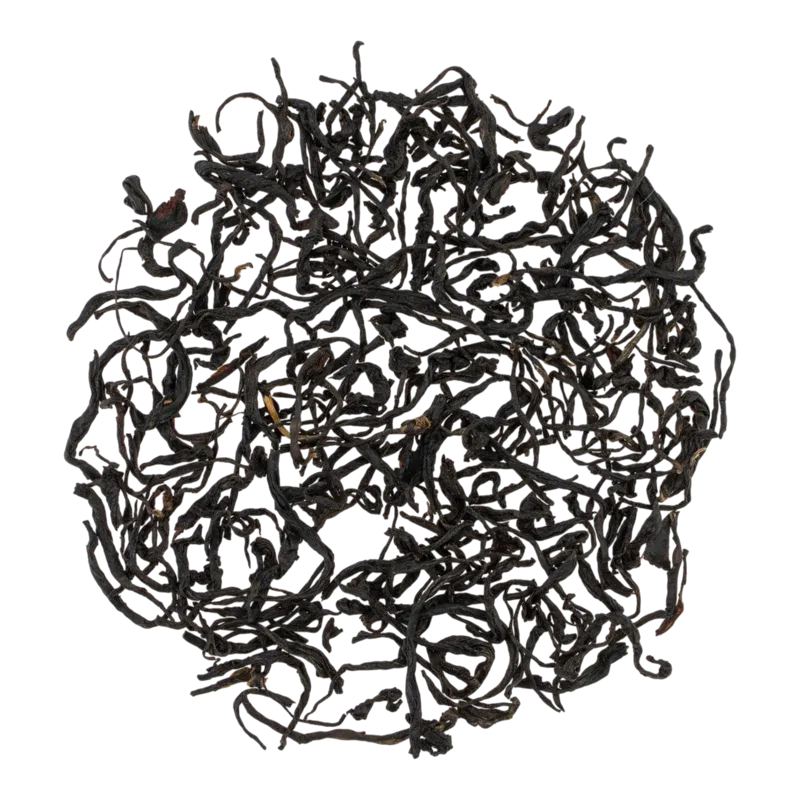
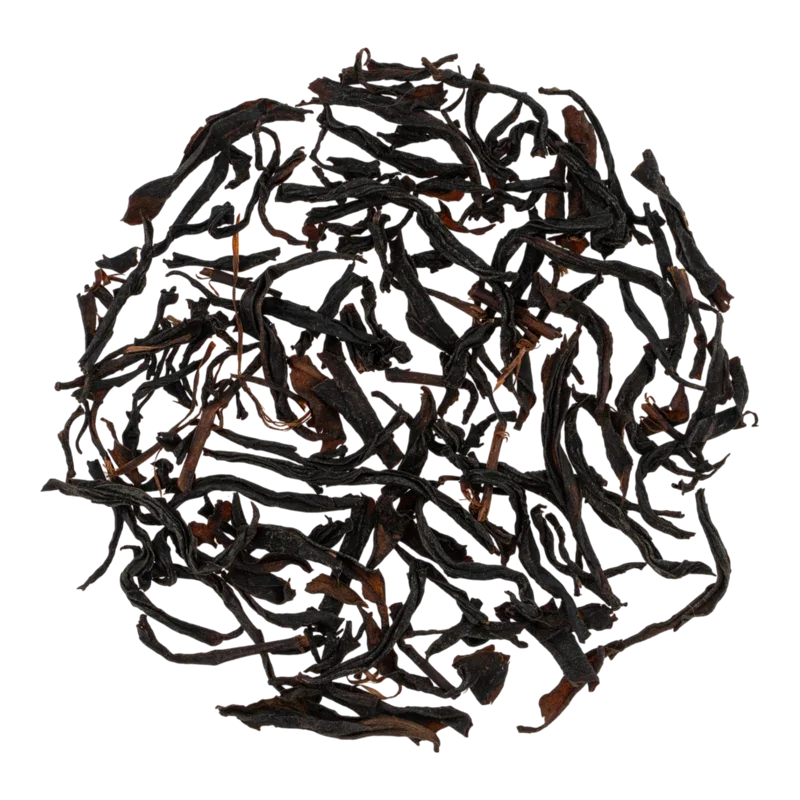
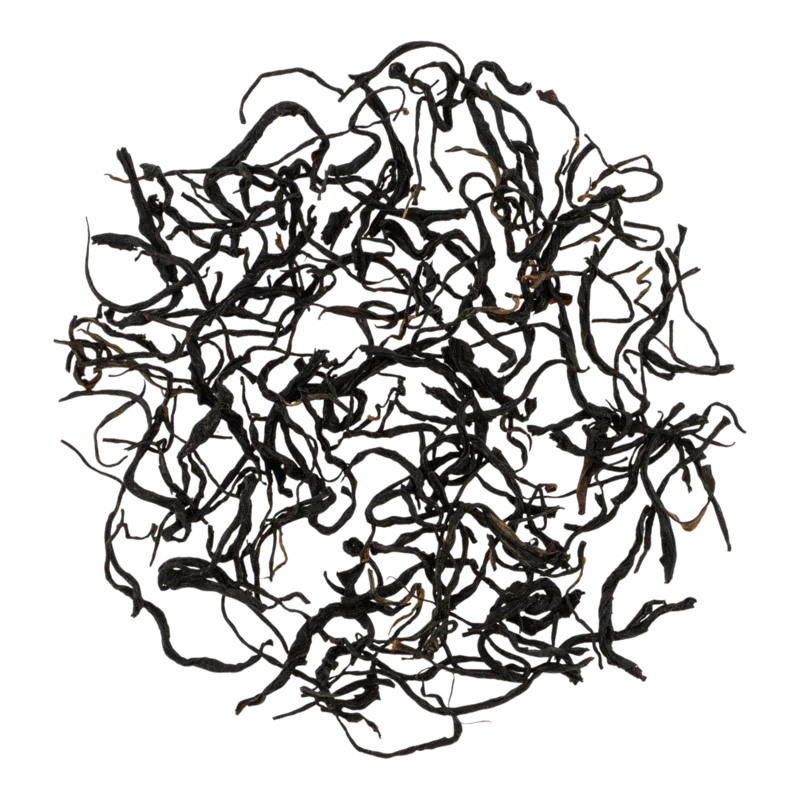
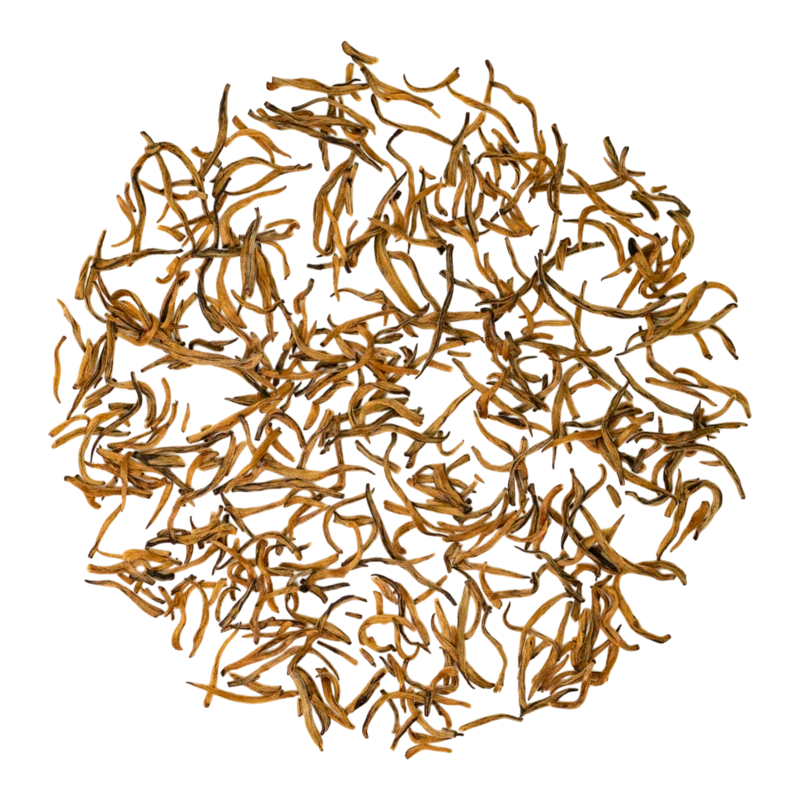
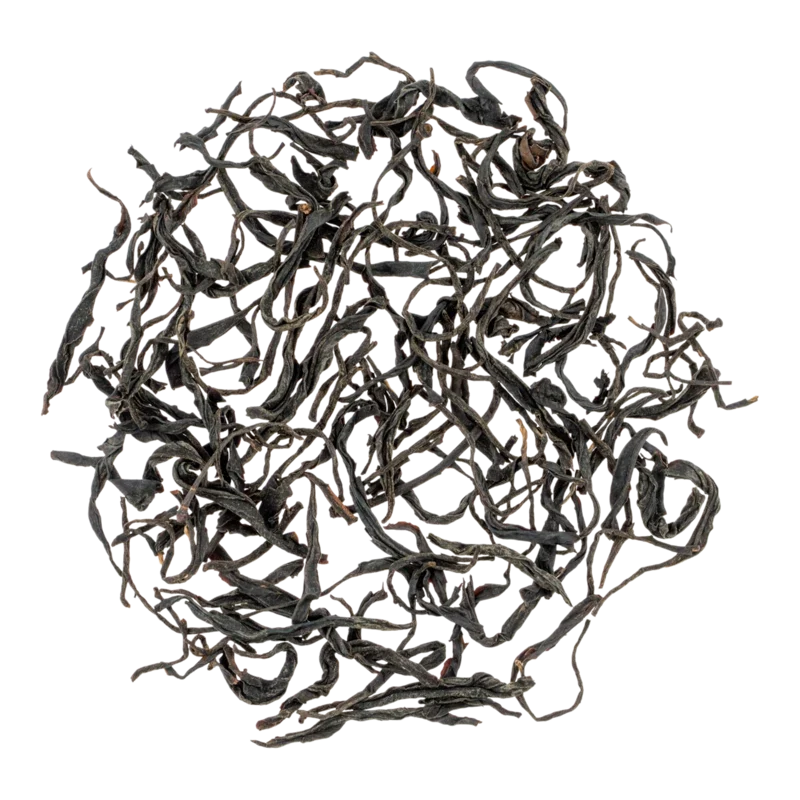
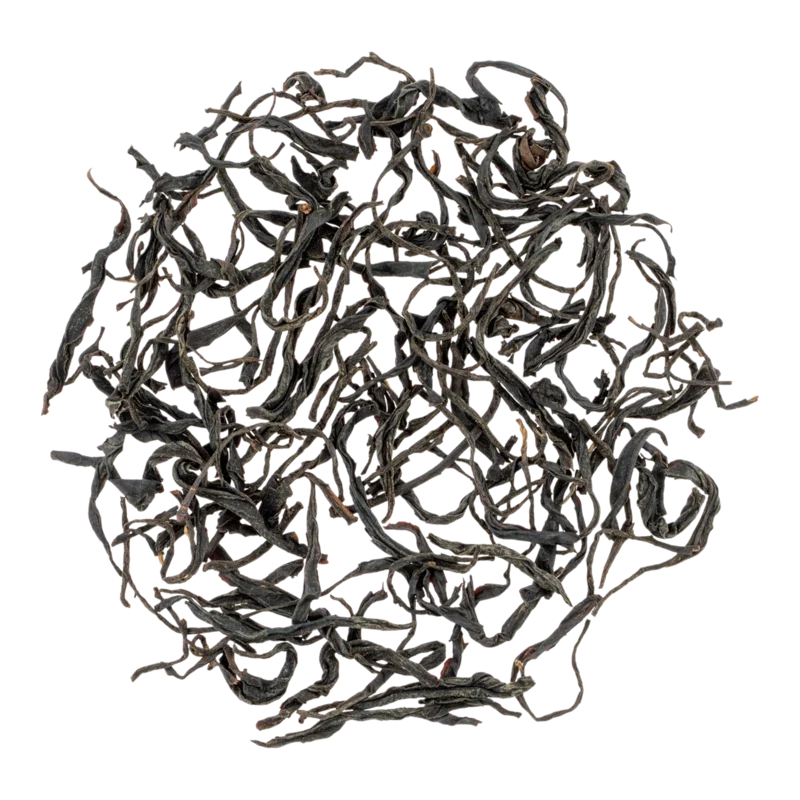
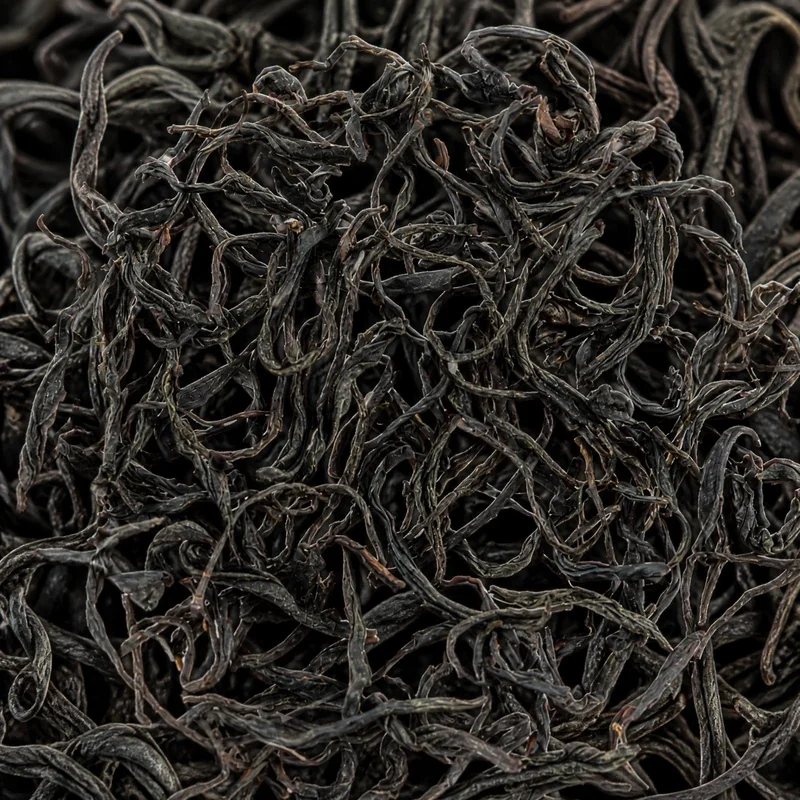
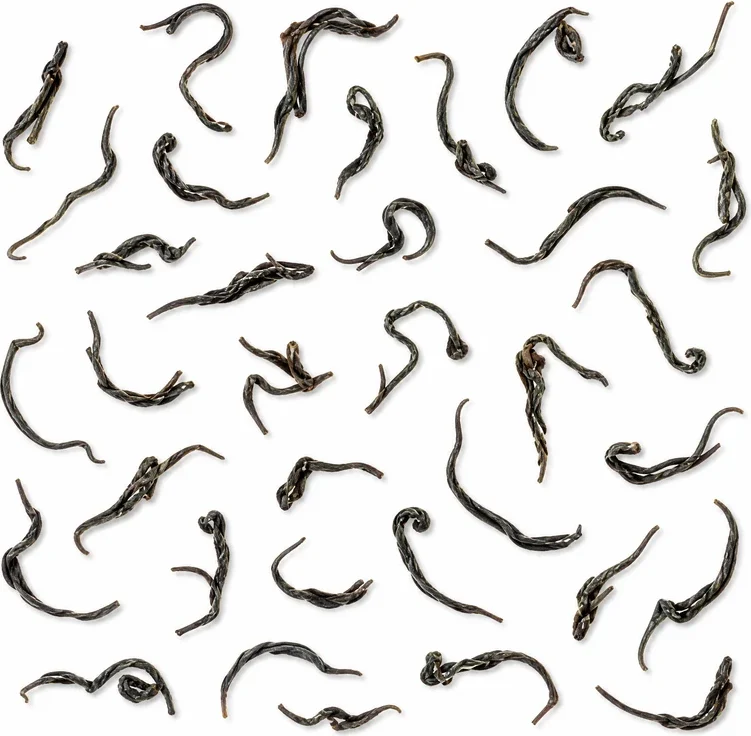
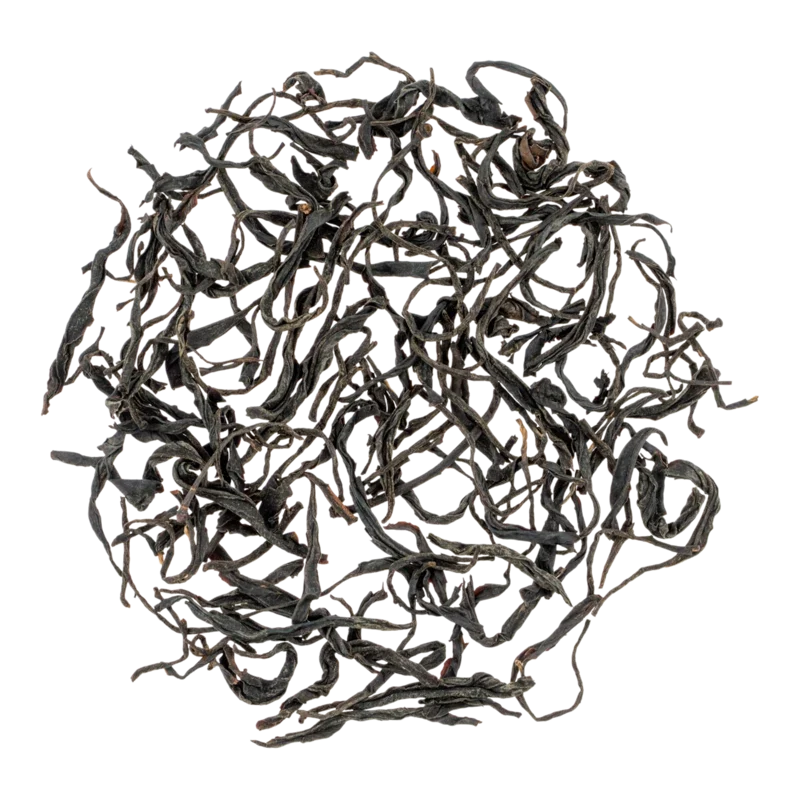
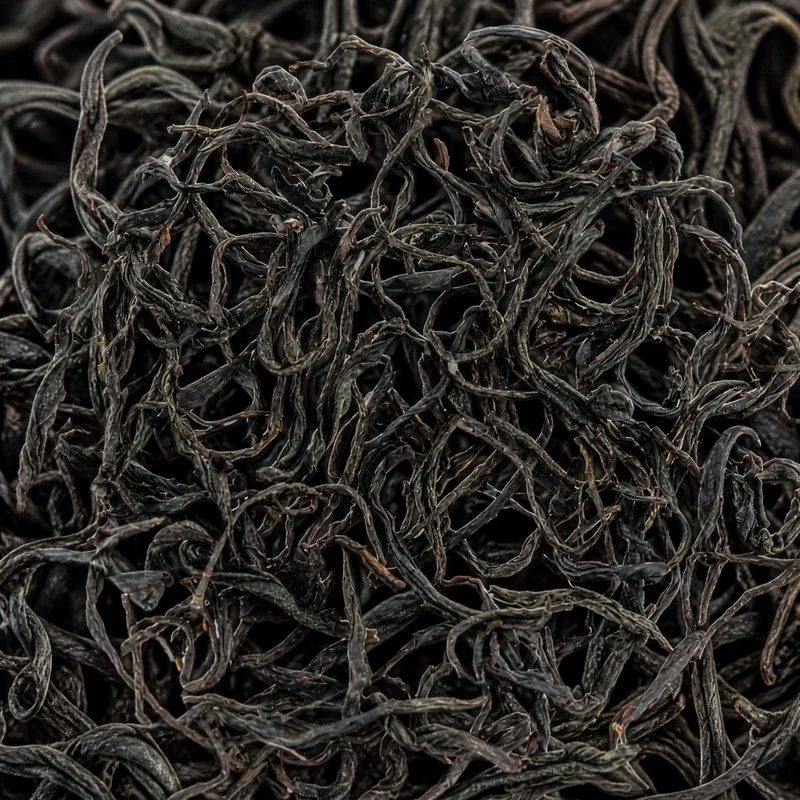
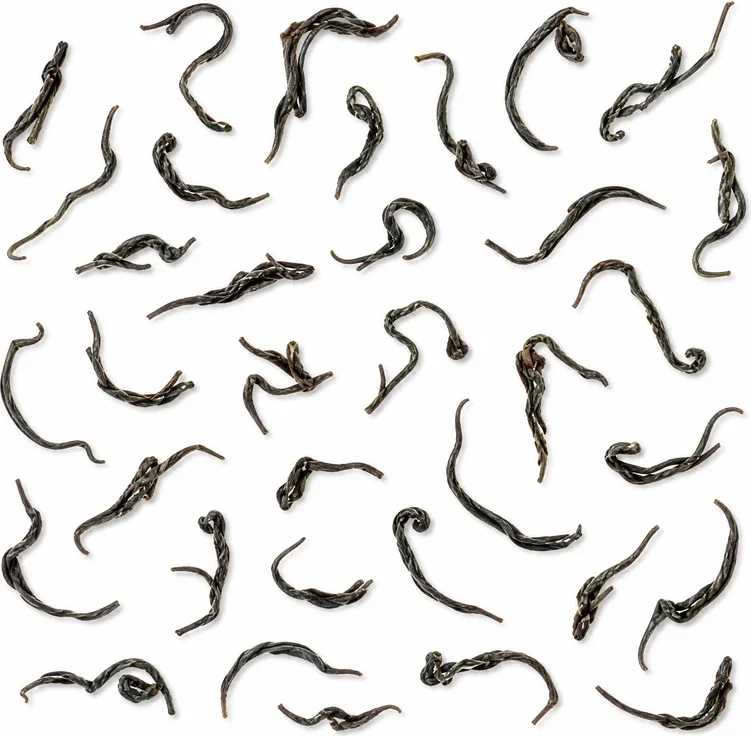
Dry Leaf Appearance: Depends on rolling method: either dense semi-spherical granules of dark brown color with golden tips inclusions (semi-spherical rolling, characteristic of Alishan), or slightly curved strips (longitudinal rolling). Leaf is even, uniform, with light oily luster.
Dry Leaf Aroma: Delicate, sweet, with predominance of honey and fruity notes (ripe plum, peach, dried apricot). In versions from Qing Xin Oolong—delicate orchid and floral shades; from Jin Xuan—light creaminess; from Si Ji Chun—bright floral note (gardenia). Characteristically present "high-mountain character"—clean, cool, almost menthol note, atypical for lowland red teas.
Liquor Aroma: Bright, multi-layered. Leading notes: honey, ripe fruits (apricot, plum, lychee), caramel. In middle notes—floral shades (orchid, rose), light spices. In aftertaste—sweetish woody note and "mountain freshness."
Liquor Color: Clear, from light amber to red-amber, with warm, honey shade. Lighter and clearer than most lowland red teas.
Spent Leaves: Whole, elastic leaves of reddish-brown color, often retaining semi-spherical form for the first 1–2 infusions. As they unfold, demonstrate even oxidation and tender, elastic texture.
Taste: Full, but surprisingly soft for red tea. Medium-dense body, silky texture. Bitterness practically absent—this is the main difference from lowland red teas. Sweetness pronounced, natural (honey, cane sugar). Aftertaste long, "throat rhyme" (喉韻, hóu yùn)—characteristic usually associated with Alishan oolongs, here transferred to red tea. Returning sweetness (回甘, huí gān) rapid and distinct.
Alkaloids: Caffeine (咖啡鹼) and theobromine content is lower than in large-leaf lowland red teas (consequence of high-mountain cultivation of small-leaf cultivars). This makes the tea gentler on the stomach and less stimulating.
Amino Acids: Increased content—key feature of high-mountain raw material. L-theanine (L-茶氨酸)—main component, providing sweetness, "throat rhyme," and relaxing effect. Polyphenol/amino acid ratio is lower than in lowland red teas, which biochemically explains softness and sweetness.
Rich profile: linalool, geraniol, nerolidol, methyl salicylate, β-ionone (fruity and floral notes). In versions from Jin Xuan, specific lactones are present, responsible for creamy aroma.
Increased content (consequence of slow growth and high accumulation)—provides natural sweetness.
Minerals: Potassium, magnesium, manganese, zinc, fluorine.
Polyphenols: Content in raw material is lower than in large-leaf lowland varieties (due to reduced insolation and cool climate), which explains the softness of the finished tea. During full oxidation, catechins transform into theaflavins and thearubigins, forming liquor color and astringent taste component.
Vitamins: C (partially preserved), B group, E.
Thanks to balanced ratio of caffeine and L-theanine, the tea provides calm alertness and cognitive function improvement without excessive stimulation.
Theaflavins and thearubigins possess antioxidant activity, contributing to cell protection from oxidative stress.
Red tea is traditionally considered "warm" (性溫, xìng wēn)—gently stimulates digestion without irritating stomach mucosa. Especially relevant for people with sensitive stomachs.
Full oxidation gives the tea pronounced "warm" properties according to traditional Chinese medicine canons, making it an ideal beverage for cold season.
High L-theanine content promotes α-wave brain production, associated with relaxed concentration state.
Regular consumption may contribute to improved vascular elasticity and cholesterol level normalization.
Polyphenols and flavonoids possess immunomodulating action.
Alishan Hong Cha is excellent for cold brewing: 5 g tea per 500 ml room temperature water (10–15°C), refrigerate for 6–8 hours. Result—delicate, sweet liquor with fruit-floral notes.
Tea Amount: 5 g per 150 ml water (gongfu method); 3 g per 200 ml (European method).
Teaware: Porcelain gàiwǎn (蓋碗, gàiwǎn)—best choice for revealing multi-layered aroma; porcelain teapot; Yixing teapot is suitable, but clay may muffle delicate high-mountain notes.
Water Temperature: 90–95°C.
Container: Airtight—aluminum bag with valve, tin can, or vacuum packaging.
Enemies: Moisture, light, oxygen, high temperature, foreign odors.
Shelf Life: Optimal consumption—within 12–18 months after production. Tea does not improve with aging.
Dry, cool, dark place, away from foreign odors.
Temperature: Room temperature (15–25°C). Refrigerator storage not required.
Another famous Taiwanese red tea, but from completely different raw material—large-leaf Tai Cha No. 18 (Assam-Taiwanese hybrid). Sun Moon Lake Hong Cha is grown at significantly lower altitude (600–800 m) and possesses stronger, more robust character with signature cinnamon and mint notes. Alishan Hong Cha, conversely, is softer, sweeter, with high-mountain freshness and absence of menthol shades.
Yunnan large-leaf red tea—strong, dense, with pronounced chocolate-spicy notes. Alishan Hong Cha is its complete opposite: softness instead of strength, freshness instead of spiciness, fruity sweetness instead of chocolate depth.
Both teas are small-leaf, both delicate, but Keemun possesses famous "Qi men xiang"—complex aroma of rose, dried fruits, and cotton candy, while Alishan Hong Cha more brightly manifests mountain freshness and "throat rhyme."
Fujian premium from single buds—more refined, sweet, with floral-honey profile. Alishan Hong Cha with less refinement compensates with greater body density and endurance in multiple infusions.
Indian high-mountain black tea from South India, also grown at 1000–2500 m altitudes. Both teas possess high-mountain softness, but Nilgiri is more "European" in profile (brilliant clarity, light citrus), while Alishan Hong Cha is more "Asian" (honey sweetness, throat rhyme, florality).
Price Category: Alishan Hong Cha belongs to high-quality Taiwanese teas of medium and above-medium price segment. Cost depends on growing altitude (higher—more expensive), cultivar (Qing Xin Oolong more expensive than Si Ji Chun), harvest season (spring and winter—premium), and farmer reputation. Approximately: from 400 to 2500 New Taiwan dollars (NT$) per liang (37.5 g), equivalent to roughly 1000–6700 NT$ per 100 g.
Authentic Alishan Hong Cha often has semi-spherical rolling, atypical for mainland red teas. Longitudinal strips also occur but should be neat and even.
Main difference from lowland red teas—absence of bitterness and astringency even with prolonged brewing. If tea becomes bitter on second infusion—likely not high-mountain product.
Should have "high-mountain character"—clean, cool note, uncharacteristic of lowland red teas.
Real Alishan Hong Cha from zones above 1200 m cannot be cheap. Suspiciously low price indicates lowland raw material with Alishan labeling.
No reviews yet. Tell us what you think of this tea.
Rate this tea and share your impressions. We review each submission before publishing it.