Brewing
Gongfu brewing
- Water temperature
- 75 °C
- Tea amount
- 5 g
- Water volume
- 100 ml
- First steep
- 10 s
- Time added per infusion
- 5 s
- Infusions
- 3

zhēngméi chá
Choose a brewing method. Start with the recommended quantities and time, then adjust to taste.
Brewing
Brewing
Taste
Tea encyclopedia
Category: Yunnan large-leaf steamed green tea. Product with protected geographical indication of the PRC (since 2010).
Category: Yunnan large-leaf steamed green tea. Product with protected geographical indication of the PRC (since 2010).
Coordinates: Approximately 23°–24° N, 98°30′–100° E.
Origin: China, Yúnnán Province (云南省, Yúnnán shěng), Líncāng Prefecture (临沧市, Líncāng shì). Main production area — Gěngmǎ County (耿马县, Gěngmǎ xiàn); also produced in Cāngyuán County (沧源县, Cāngyuán xiàn), Yùn County (云县, Yúnxiàn), Zhènkāng County (镇康县, Zhènkāng xiàn) and four other counties in Lincang Prefecture — seven counties total.
Type: Green tea — steamed (蒸青绿茶, zhēngqīng lǜchá). Formally classified as green tea, however the presence of wet piling (渥堆, wòduī) brings the technology closer to certain elements of dark tea and yellow tea production, making Zhengmei Cha a unique "borderline" style.
Cultivar: Yunnan large-leaf populations (Camellia sinensis var. assamica), of seed origin. Main cultivars: Měngkù Dàyèzhǒng (勐库大叶种, Měngkù Dàyèzhǒng) and Fèngqìng Dàyèzhǒng (凤庆大叶种, Fèngqìng Dàyèzhǒng) — both among China's national elite tea varieties. The core plantations in Gěngmǎ include ancient trees (古茶树, gǔcháshù) aged 30+ years, comprising up to 40% of plantings in the Mengsa area (勐撒镇).
Picking: Spring (March–April) — main and most valuable period; summer and autumn harvests are permitted.
Pluck Standard: Varies by grade: for special grade (特级, tèjí) — exclusively single buds (单芽, dānyá); for first grade — bud with one leaf; for second grade — bud with two leaves.
Raw Material: Fresh, intact shoots without defects. Polyphenol content in spring leaves — ≤ 20% (lower than standard Yunnan large-leaf raw material, explained by altitude and cloudiness); vitamin C content — up to 121 mg/100 g dry matter, twice higher than ordinary green teas.
Altitude: 1,000–1,800 m above sea level. Optimal zone — 1,200–1,600 m.
Soil: Red and red-brown lateritic soils (红壤、赤红壤, hóng rǎng, chìhóng rǎng), pH 4.5–6.0, enriched with microelements — selenium (Se) and zinc (Zn). Forest cover in the core production zone ≥ 80%. The ecological cycle "pig farming — biogas — tea cultivation" (猪-沼-茶) is practiced; use of chemical fertilizers and pesticides is prohibited.
High-altitude areas of the Lancang River basin (upper Mekong) in the 23°–24° N zone. Average annual temperature 18–22°C, relative humidity ≥ 80%, over 200 foggy days per year, significant diurnal temperature variation.
Water: Abundant irrigation from the Lancang River basin. Cloudy and foggy microclimate provides predominance of diffused light (漫射光, mànshè guāng), stimulating amino acid accumulation: spring harvest amino acid content reaches ≥ 6% — an exceptionally high indicator.
Fresh leaves are spread for brief drying.
Key stage: leaves are treated with sharp steam at 100°C for 30–60 seconds. Steam instantly inactivates polyphenol oxidase, preserving up to 90% of chlorophyll — significantly more than traditional pan-firing. This gives the liquor a bright emerald-green color, uncharacteristic of Yunnan green teas.
Forms tight, straight strips.
The most unusual stage: rolled leaves are placed in bamboo baskets, covered with damp cloth and kept at 27–30°C for 18–24 hours. Under these conditions, residual enzymes gently transform polyphenols, reducing bitter catechin content and forming a smooth, sweetish profile. This stage — Tang Renliang's know-how — solves the "bitterness problem" of Yunnan large-leaf green tea.
Final drying at ≤ 60°C over pine wood charcoal. Low temperature preserves vitamin C and aromatic compounds; light smoky background from pine charcoal adds a subtle nuance to the aroma.
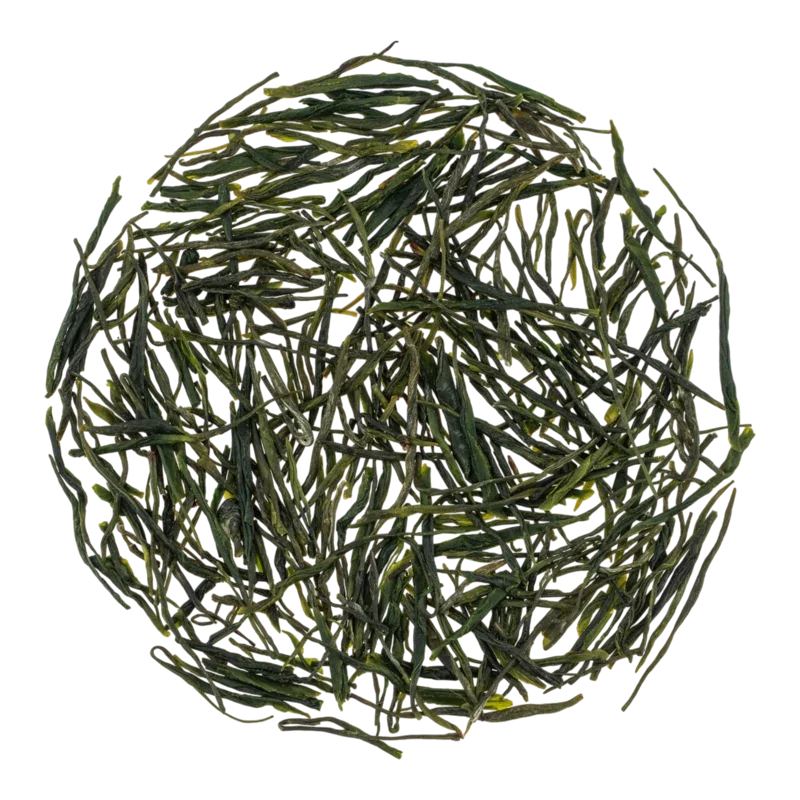
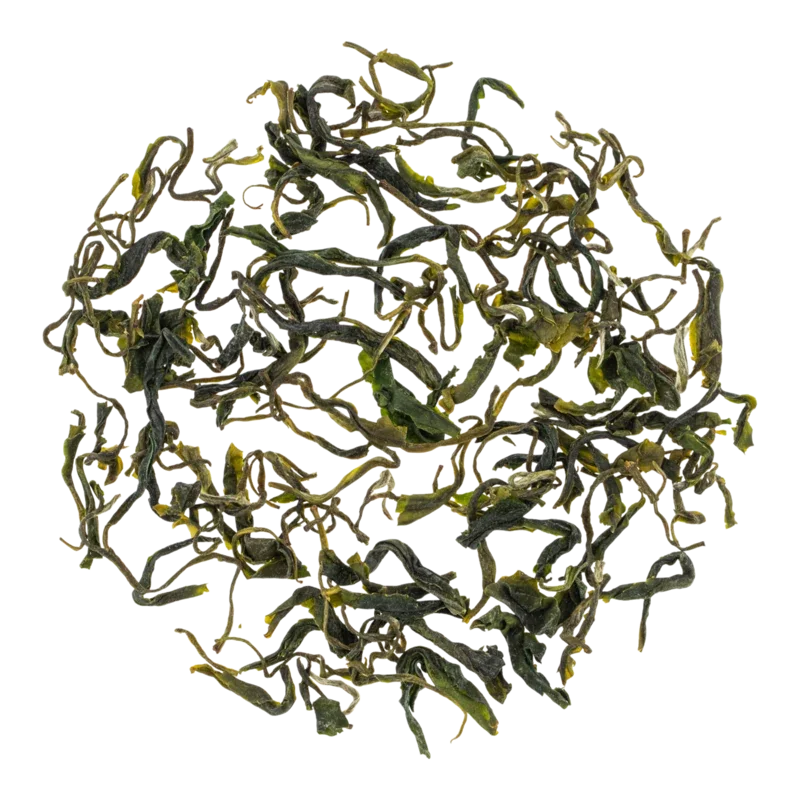
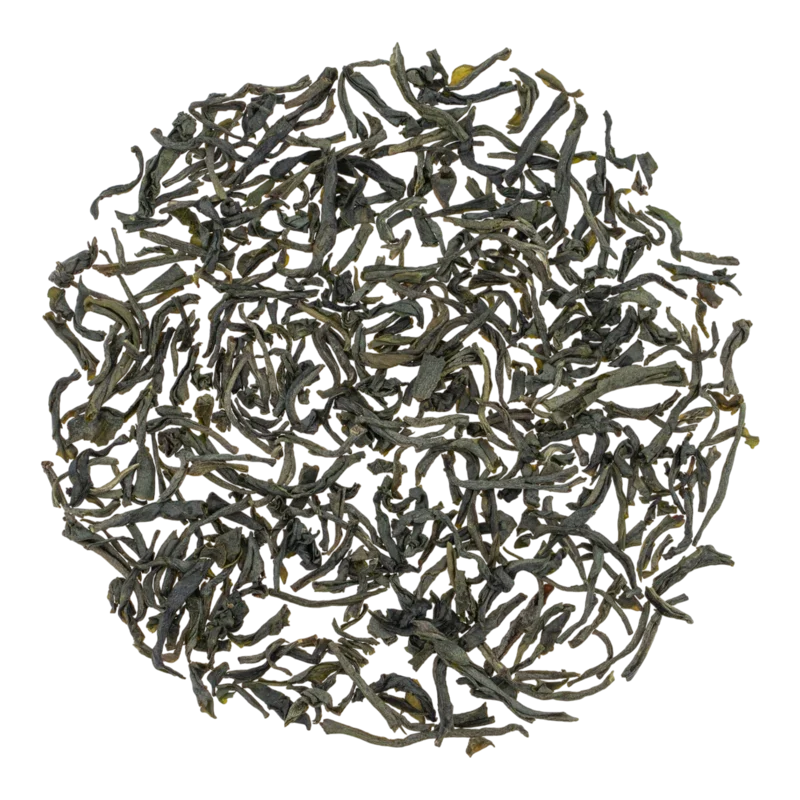
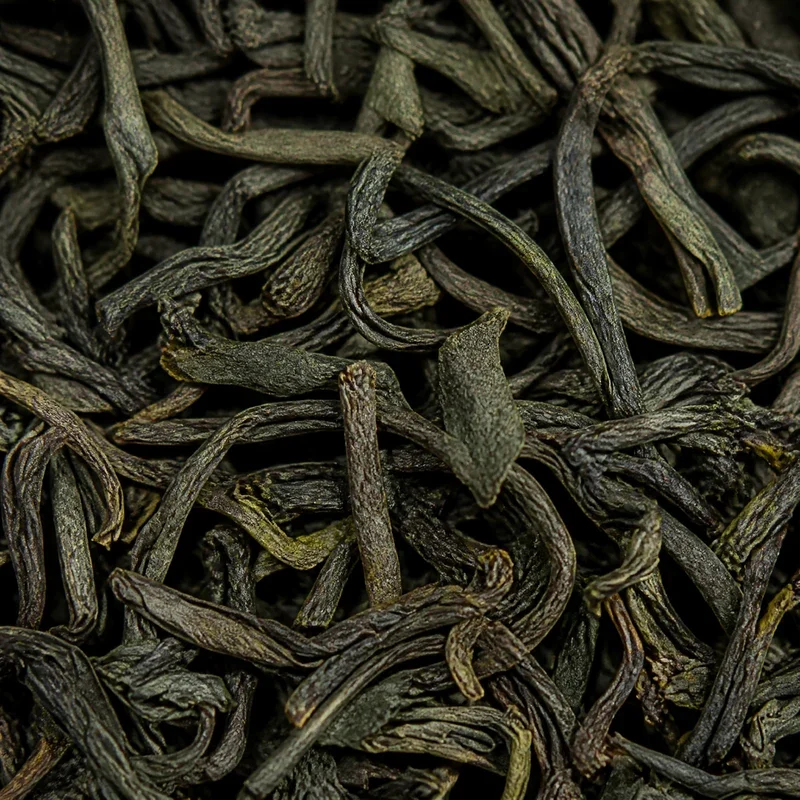
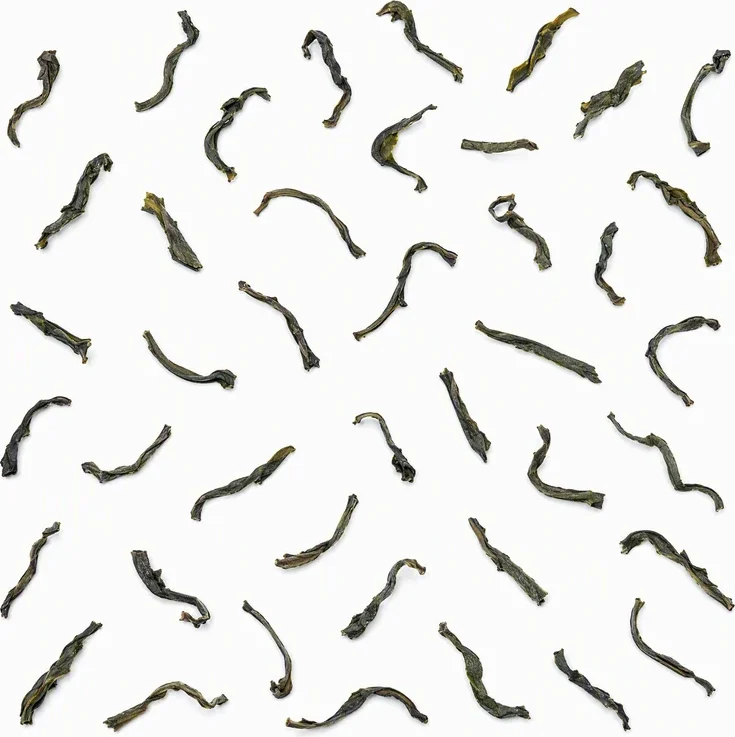
Dry Leaf Appearance: Tight, straight strips (条索紧直, tiáosuǒ jǐnzhí), silvery-gray with noticeable "frost" (银灰显霜, yínhuī xiǎn shuāng). Even, neat, with clearly visible down.
Dry Leaf Aroma: Clean, high, with predominant fresh "green" note and light chestnut undertone.
Liquor Aroma: Main tone — clean high freshness (清香, qīngxiāng); special grade has delicate "bud aroma" (嫩香, nènxiāng); spring tea has chestnut shade (栗香, lìxiāng). Distinctive feature — characteristic "corn" note (玉米香, yùmǐ xiāng), specific to steamed green teas and absent in pan-fired ones.
Liquor Color: Bright emerald-green, clear (汤色碧绿清澈, tāngsè bìlǜ qīngchè) — significantly "greener" than pan-fired Yunnan green teas, thanks to chlorophyll preservation during steam fixation.
Spent Leaves: Tender green, even, with fully opened buds and leaves (叶底嫩绿匀整,芽叶舒展).
Taste: Fresh, with pronounced umami (鲜爽, xiānshuǎng), dense and round (醇厚, chúnhòu), with long saccharine sweetness in aftertaste (回甘, huígān), resembling cane sugar. Bitterness and astringency are minimal (苦涩度低, kǔsè dù dī) — direct result of wet piling stage, where catechins degrade more completely than in standard processing.
Alkaloids: Caffeine — in standard green tea range (2–3%).
Amino Acids: ≥ 6% — exceptionally high indicator, one of the highest among Chinese green teas. Provides pronounced umami and freshness.
121 mg/100 g — twice higher than standard green teas. Due to combination of gentle steam fixation (without contact heating) and low-temperature drying (≤ 60°C).
≥ 160 mg/100 g — unusually high indicator, presumably due to wet piling stage under anaerobic conditions. For comparison: specialized GABA teas (GABA oolongs) contain 150–300 mg/100 g. GABA presence gives Zhengmei Cha mild sedative properties.
Elevated content, formed during wet piling process; contributes to mild sweetness of aftertaste.
Preservation ≥ 90% thanks to steam fixation — ensures bright emerald liquor color.
Minerals: Selenium (Se), zinc (Zn), fluorine — due to geochemistry of red lateritic soils.
Polyphenols: After wet piling, content is significantly reduced compared to original raw material: in spring special grade — ≤ 20%. Polyphenols are partially transformed into less bitter forms, ensuring mild, "non-burning" taste.
Despite reduced catechin content (compared to unprocessed raw material), remaining polyphenols combined with high vitamin C provide pronounced antioxidant action.
High GABA content (≥ 160 mg/100 g) provides mild anxiolytic action, helps reduce anxiety and improve sleep quality — rare property for green tea.
Tea polysaccharides accelerate fat breakdown; effectiveness, according to some data, 30% higher than standard green teas.
Double dose of vitamin C compared to ordinary green tea supports immunity and skin health.
Reduced astringency and mild taste profile make Zhengmei Cha more "friendly" to sensitive stomachs than most green teas.
High L-theanine improves concentration and attention; GABA additionally promotes "calm focus."
Fluorine suppresses growth of cariogenic bacteria.
Tea Amount: 3 g per 150 ml for glass method; 5–7 g per 100–120 ml gaiwan for gongfu.
Teaware: Glass tumbler (for observing emerald liquor color and leaf unfurling); white porcelain gaiwan; porcelain teapot.
Water Temperature: 80–85°C. Boiling water above 90°C destroys L-theanine and ascorbic acid, shifting taste toward bitterness.
Shelf Life: Loose tea — best taste in first 6–12 months. Fresh tea should rest 15 days in darkness to remove "fire character." After opening — consume within 7 days.
Airtight, opaque container. Away from light, moisture, heat, and odors.
Zhēngméi Chá is also produced as cakes (饼茶, bǐngchá) and bricks (砖茶, zhuānchá), which allow longer storage and development of aged aroma (陈香, chénxiāng).
Temperature: Refrigerator, 0–5°C — optimal for preserving vitamin C and chlorophyll.
Direct "ancestor" of the technology; Hubei steamed green tea from small-leaf raw material. Profile — more "marine," grassy, with high umami. Zhengmei Cha — from large-leaf Yunnan raw material, denser, sweeter, with corn note and minimal astringency thanks to wet piling stage absent in Yulu.
Also steamed green tea; typical profile — marine, with pronounced umami and light bitterness. Zhengmei Cha — significantly sweeter and "rounder," with dense body of large-leaf tea; bitterness practically absent.
Yunnan large-leaf green tea, but pan-fired. Chestnut aroma, dense body, pronounced astringency. Zhengmei Cha — milder, "greener" in liquor color, with corn note and practically no astringency.
Sichuan green tea with delicate, "dewy" profile. Zhengmei Cha — significantly denser, with different aromatic palette (corn vs. floral), but comparable sweetness.
Specialized teas with high GABA. Zhengmei Cha contains comparable GABA amounts but is produced by different technology and gives completely different — "green," fresh — taste profile instead of "dark," oxidized character of GABA oolongs.
No reviews yet. Tell us what you think of this tea.
Rate this tea and share your impressions. We review each submission before publishing it.