Brewing
Gongfu brewing
- Water temperature
- 75 °C
- Tea amount
- 5 g
- Water volume
- 100 ml
- First steep
- 10 s
- Time added per infusion
- 5 s
- Infusions
- 3

Ēnshī yùlù
Choose a brewing method. Start with the recommended quantities and time, then adjust to taste.
Brewing
Brewing
Taste
Tea encyclopedia
Category: Famous teas of China. In 1965, it was included in the list of "Ten Great Teas of China" (中国十大名茶). In 2014, the production technology was inscribed in the National Registry of Intangible Cultural Heritage of the PRC. Since 2007, it has been protected by geographical indication (地理标志产品保护).
Category: Famous teas of China. In 1965, it was included in the list of "Ten Great Teas of China" (中国十大名茶). In 2014, the production technology was inscribed in the National Registry of Intangible Cultural Heritage of the PRC. Since 2007, it has been protected by geographical indication (地理标志产品保护).
Coordinates: Approximately 30°16′ N, 109°28′ E.
Origin: China, Húběi Province (湖北, Húběi), Ēnshì City (恩施市, Ēnshì Shì), Ēnshì Tujia and Miáo Autonomous Prefecture (恩施土家族苗族自治州, Ēnshì Tǔjiāzú Miáozú Zìzhìzhōu). Main production areas — Bājiāo Township (芭蕉侗族乡, Bājiāo Dòngzú Xiāng) with center in Huángliánxī (黄连溪, Huángliánxī) and the eastern suburb of Enshi — Wufengshan Mountain (五峰山, Wǔfēng Shān).
Type: Green tea (unoxidized). Fixation method — steaming (蒸青, zhēngqīng), unlike the overwhelming majority of Chinese green teas where pan-firing in a wok is used (炒青, chǎoqīng).
Cultural Significance: Ēnshī Yùlù occupies a unique place in the history of Chinese tea cultivation as the only surviving representative of the ancient tradition of zhēngqīng (蒸青) — steam processing of green tea. It was precisely this technology that was borrowed by Japan during the Tang era and became the foundation for producing sencha and gyokuro. Enshi Yulu is a kind of "living fossil" (活化石, huó huàshí) of Chinese zhēngqīng (蒸青) tea, a bridge between ancient tea art and modernity. It has been awarded the title "First Historical Tea of Hubei Province" (湖北第一历史名茶, 2008). The master-keeper of tradition — Yáng Shèngwěi (杨胜伟, Yáng Shèngwěi), is recognized as a national inheritor of intangible cultural heritage.
Cultivar: The main traditional variety is the local group cultivar Taizi Cha (苔子茶, Tái zǐ chá), belonging to Camellia sinensis var. sinensis. This is a bush variety with small and medium leaves, well adapted to the conditions of the Enshi mountain region, distinguished by high amino acid content and cold resistance. Since the late 1990s, asexual (vegetatively propagated) varieties have been actively introduced, such as Elongjing (鄂龙井), E Cha 1 hao (鄂茶1号), Fúdǐng Dàbái (福鼎大白) and others, however the standard prescribes the use of varieties suitable for producing Enshi Yulu and growing within the autonomous prefecture.
Picking: Spring harvest — from mid-March to the Gǔyǔ period (谷雨, Gǔyǔ, "Grain Rain," around April 20). The active harvest period is about 30 days. Harvesting is conducted in clear weather.
Pluck Standard: For highest grades — one bud and one leaf (一芽一叶, yī yá yī yè), for standard grades — one bud and two beginning-to-unfurl leaves (一芽二叶初展, yī yá èr yè chū zhǎn). Uniformity in size and degree of maturity is required: short internodes, densely arranged leaves, bud longer than leaf, rich green color of leaves.
Raw Material: Leaves must be whole, tender, fresh. Damaged, wilted, or non-uniform in size shoots are excluded.
Altitude: Main plantations are located at 600–1200 m above sea level; average altitude — about 600 m.
Climate: Subtropical monsoon mountain humid climate. Mild winter (average January temperature not below +5°C), not hot summer (average July temperature slightly above +27°C). Average annual temperature above +16°C. Annual precipitation — about 1400 mm. High relative humidity. Sunshine hours — more than 1200 per year. Frost-free period — about 276 days. Active temperature (≥10°C) totals at least 5000°C. Frequent fogs are characteristic, especially morning and evening, creating natural shading.
Soil: Predominantly sandy loams and yellow-brown soils (黄棕壤, huáng zōng rǎng). Deep fertile layer, rich in organic matter, pH 4.5–6.5. Unique feature — high selenium content, which determines the accumulation of this microelement in tea leaves.
Ēnshī is located deep in the Wulingshan mountain range (武陵山, Wǔlíng Shān), on the eastern extension of the Yunnan-Guizhou Plateau. Along the 30th parallel north — a region known for unique biodiversity. Enshi bears the unofficial title "World Selenium Capital" (世界硒都, Shìjiè Xī Dū) thanks to exceptionally high selenium content in local soils.
Warm humid climate with abundant fogs and diffused light promotes accumulation of amino acids, chlorophyll, and other nitrogen-containing compounds in leaves, which determines the bright green color, fresh aroma, and sweetish taste of Enshi Yulu.
Hand picking in morning hours during clear weather. For highest grades — one bud with one leaf, uniform in size.
Freshly picked raw material is spread in a thin layer in a cool room for brief withering, removing excess moisture from the leaf surface.
Key and unique stage. Leaves are processed with hot steam at about 100–105°C for 40–50 seconds. Steam inactivates oxidative enzymes (polyphenol oxidase), stopping oxidation. Unlike pan-firing in a wok (杀青, shāqīng), steaming maximally preserves chlorophyll, amino acids, and vitamins, ensuring characteristic "three greens" (三绿, sān lǜ): green dry leaf, green liquor, green spent leaves.
Immediately after steaming, leaves are quickly cooled with an air stream (fan or ventilator) to remove surface moisture and prevent overheating.
Leaves are placed on a special heated furnace-brazier (焙炉, bèi lú) and dried with scraping palm movements at moderate temperature, reducing moisture to about 55–60%.
Dried leaves are rolled, giving them initial shape and breaking cellular structure to release juices. Rolling should be gentle to avoid damaging tender leaves.
Repeated drying on the brazier at about 80°C, further reducing moisture to about 30–35%.
The most responsible and labor-intensive stage, lasting about 80 minutes. It is divided into two sub-stages:
Final drying at reduced temperature to remove residual moisture to standard 4–6%.
Hand sorting — removal of broken, non-standard tea leaves, ensuring uniformity of finished product.
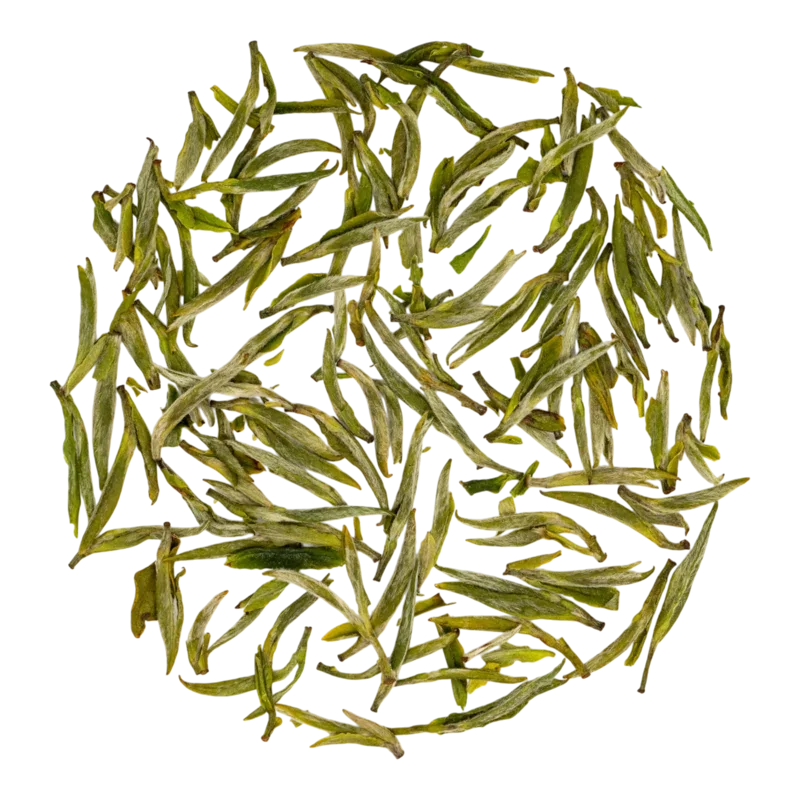
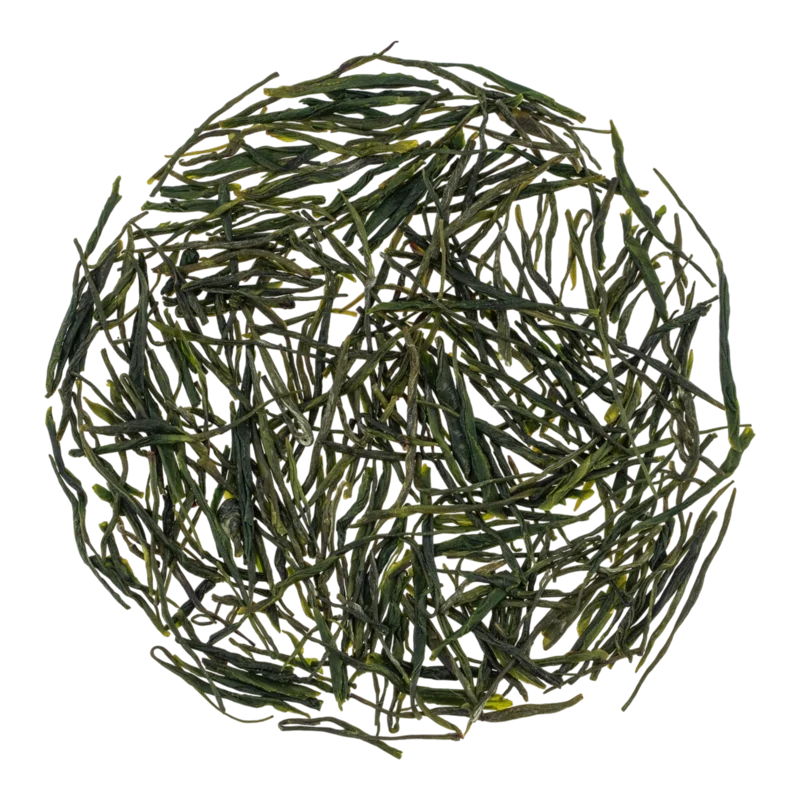
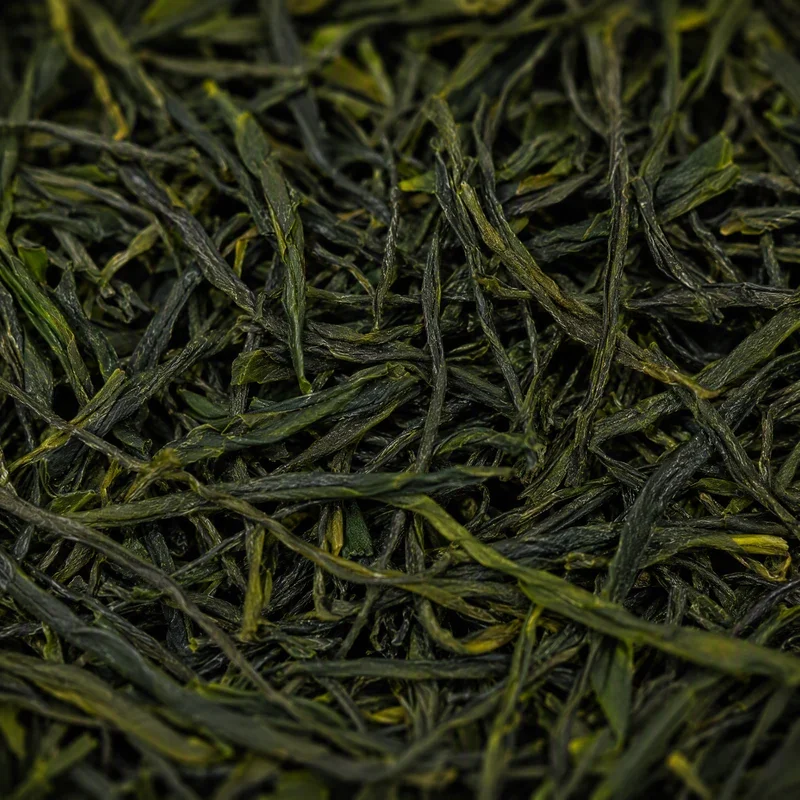
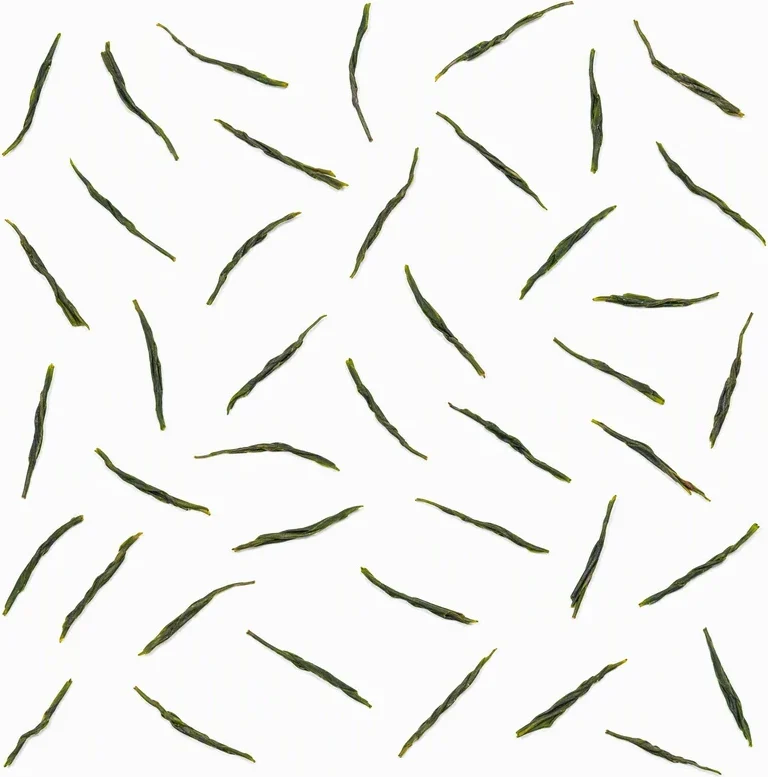
Dry Leaf Appearance: Thin, straight, tightly twisted needles about 1.5–2 cm long, resembling pine needles. Surface smooth, with glossy shine. Color — rich emerald green with distinct silvery-white down (白毫, báiháo) covering tea leaves like frost.
Dry Leaf Aroma: Fresh, clean, with pronounced tones of spring greenery, light floral notes, and characteristic for zhengqing (蒸青) teas note of seaweed (海苔香, hǎitái xiāng).
Liquor Aroma: Clean, fresh, high and persistent (清香持久, qīngxiāng chíjiǔ). Predominant notes of spring grass, freshly cut meadow with light sweetness and barely perceptible nori shade.
Liquor Color: Clear, bright, tender green or light emerald (嫩绿明亮, nènlǜ míngliàng), resembling liquid jade.
Spent Leaves: Tender, whole, elastic leaves and buds of bright green color (嫩匀明亮, nèn yún míngliàng), with characteristic "third green" — green leaf bottom. When brewing in a glass cup, tea leaves first elegantly "dance" in the water column, then smoothly sink to the bottom, opening like living shoots.
Taste: Bright, refreshing, with pronounced sweetness (甘醇, gānchún) and umami note (鲜, xiān). Body — medium, soft, enveloping. Aftertaste — clean, long-lasting, with mineral and sweetish shades (回甘, huígān). Bitterness and astringency are practically absent.
Alkaloids: Caffeine (咖啡因, kāfēiyīn) — moderate content, providing mild tonic effect, softened by the presence of L-theanine. Theobromine and theophylline are also present.
Amino Acids: Significant content of L-theanine (L-茶氨酸), providing sweetish taste, umami note, and mild relaxing effect. Foggy mountain climate and partial natural shading promote increased accumulation of amino acids.
Unique feature of Enshi Yulu. Selenium content in dry tea — about 3.47 mg/kg (according to data from the Chinese Tea Research Institute at the Academy of Agricultural Sciences). In liquor — 0.01–0.52 mg/kg, which corresponds to the "fuxi cha" standard (富硒茶, "selenium-enriched tea"): 0.3–5.0 ppm. Selenium content in fresh leaf — 0.03–4.1 mg/kg.
High content thanks to steam fixation, which preserves it to a significantly greater degree than pan-firing, ensuring bright green color of tea and liquor.
Essential Oils: Responsible for fresh, clean aroma. Steam fixation preserves a more "green," grassy-seaweed aromatic profile compared to pan-fired green teas.
Minerals: Besides selenium, contains zinc, manganese, potassium, fluorine, magnesium.
Polyphenols: High content, predominantly epigallocatechin gallate (EGCG) — a powerful antioxidant. Steam fixation preserves catechins to a significantly greater degree than pan-firing.
Vitamins: Rich in vitamins C, E, B₁, B₂, carotene. Vitamin C is preserved especially well during steam processing.
High content of catechins (especially EGCG) and selenium provides powerful protection of cells from oxidative stress and free radicals.
Selenium is a key microelement for normal immune system function. Regular consumption of Enshi Yulu helps replenish its reserves in the body.
Synergistic action of L-theanine and caffeine enhances concentration, improves mental clarity, while not causing excessive stimulation — theanine softens the stimulating effect of caffeine.
Green tea polyphenols promote improvement of vascular elasticity and normalization of lipid metabolism.
Promotes toxin elimination, supports normal metabolism.
Moderate consumption after meals aids digestion.
Catechins and vitamin C help protect skin from harmful UV radiation effects.
L-theanine stimulates alpha wave production in the brain, promoting a calm, focused state.
Tea Amount: 3–5 g per 150–200 ml of water.
Teaware: Glass cup or flask (best choice — allows observing "tea leaf dance"), porcelain gaiwan (盖碗, gàiwǎn), porcelain teapot. Clay teaware (Yixing teapots) is not recommended as it absorbs the delicate aroma of zhengqing (蒸青) tea.
Water Temperature: 80–85°C. Too hot water can "burn" tender leaves and give the liquor bitterness.
Vietnam also produces zhēngqīng (蒸青) green teas, however they typically have less pronounced shaping, less bright down and do not possess the unique selenium profile.
Despite the matching characters "玉露" in the name, the technologies differ significantly. Gyokuro undergoes prolonged shading (20+ days), which radically changes its chemical composition (theanine increases sharply, catechins decrease). Enshi Yulu is not intentionally shaded — its softness is due to natural mountain mist.
Long Jing is a 炒青 tea (pan-firing fixation), has a flat shape, nutty aroma and pronounced chestnut sweetness. Enshi Yulu differs with its needle-like shape, grassy-seaweed aroma and fresher, more "green" flavor profile.
Also a delicate spring green tea from a mountain region, but — 烘青 (oven-drying fixation), with a more floral and orchid-like aroma. Enshi Yulu possesses a more "marine," fresh character.
No reviews yet. Tell us what you think of this tea.
Rate this tea and share your impressions. We review each submission before publishing it.