Brewing
Gongfu brewing
- Water temperature
- 75 °C
- Tea amount
- 5 g
- Water volume
- 100 ml
- First steep
- 10 s
- Time added per infusion
- 5 s
- Infusions
- 3

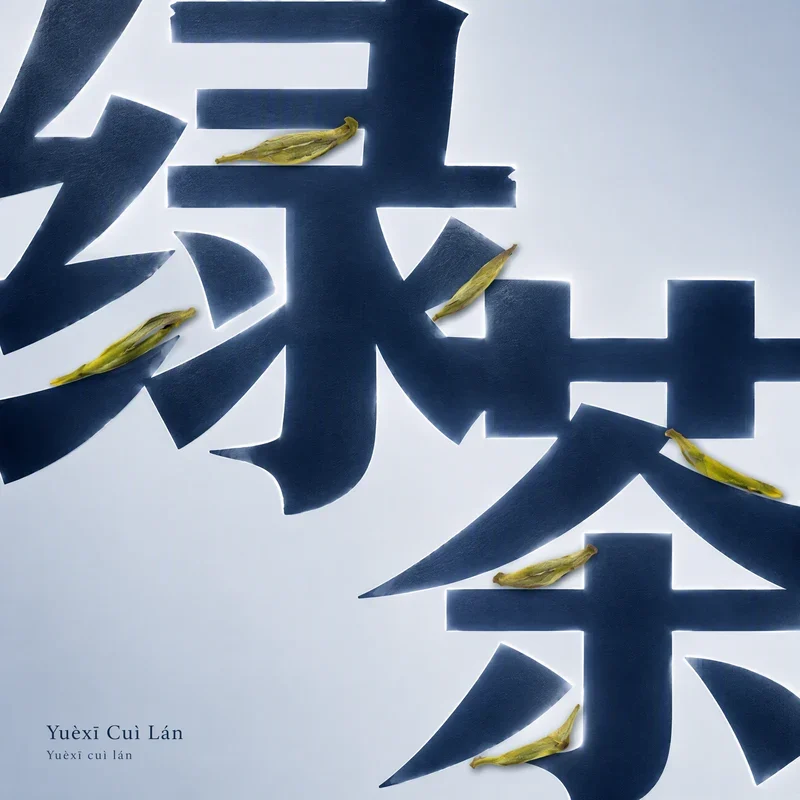
Yuèxī cuì lán
Choose a brewing method. Start with the recommended quantities and time, then adjust to taste.
Brewing
Brewing
Taste
Tea encyclopedia
Category: National geographical indication product (国家地理标志产品, 2013). One of the "Ten New Famous Teas of China" (1985). Four-time "state gift" (2010–2012). Gold award at Agricultural Exhibition (1996). In 2020 — intangible heritage of Anhui Province. Brand value — 19.63 billion yuan (2024).
Category: National geographical indication product (国家地理标志产品, 2013). One of the "Ten New Famous Teas of China" (1985). Four-time "state gift" (2010–2012). Gold award at Agricultural Exhibition (1996). In 2020 — intangible heritage of Anhui Province. Brand value — 19.63 billion yuan (2024).
Coordinates: Approximately 30°50′ North latitude, 116°20′ East longitude.
Origin: China, Ānhuī Province (安徽, Ānhuī), Yuèxī County (岳西县, Yuèxī Xiàn) — located in the very center of the Dabie Mountains. Geographical indication zone — 24 townships and 182 administrative villages of the county. Three core micro-districts: Yaohe Xianglu Chōng (姚河香炉冲) (Yaohe, Toutuo, Huangwei townships); Baojia Shifosi (包家石佛寺) (Baojia, Gufang, Hetu townships); Tiantou Mínshān (田头闵山) (Tiantou, Wuhe, Changpu townships).
Type: Green tea (non-oxidized). By form — "opened bud": shoots with connected bud and leaf, opening when brewed into "orchid flowers" (芽叶相连舒展成朵,形似兰花). By technology — pan-fired and heated with charcoal drying.
Cultural Significance: Yuexi Cui Lan is the pride of mountainous Yuexi County and all of western Anhui. Four-time diplomatic use is an absolute record among "new" green teas. The tea embodies the philosophy of "三绿" (three greens: green leaf, green liquor, green spent leaves) — visual purity that has become the region's trademark.
History: Yuexi Cui Lan is a young tea, but with an instantly soaring reputation. In the early 1980s, tea masters Chéng Dongming (程东明) and Zha Daosheng (查道生) based on the traditional technology of "little orchid" (小兰花茶, xiǎo lánhuā chá) — a historical style of Anhui green tea — created a new type of tea in two core zones: Shifosi Temple (石佛寺, "Stone Buddha Temple") in Baojia township and Zhúshān Mountain (竹山) in Yaohe township.
Exclusively whole buds (单芽, ≥95%). For 500 g — 40,000 buds. Straight, slender, with abundant down.
One bud with one leaf (≥90%). Twisted "bud" form. Persistent pure aroma.
One bud with two leaves. "Opened bud." Mild, persistent flavor.
Cultivar: Foundation — local Qúntǐzhǒng (地方群体种, dìfāng qúntǐzhǒng) — indigenous small-leaf variety of Camellia sinensis var. sinensis from sexual reproduction, distinguished by pronounced orchid aroma (兰花香显著). Additionally: Shífócuì (石佛翠, Shífócuì), Shūchá Zǎo (舒茶早, Shūchá Zǎo), Longjing 43 (龙井43), Wūniú Zǎo (乌牛早) — clonal varieties that increase yield and stability. Chemical profile of spring raw material: amino acids ≥6.3%, polyphenols ≤19.5% — one of the most favorable ratios among green teas; vitamin C — 121 mg/100 g — twice the average.
Picking: Early spring. Three grades:
Altitude: 400–1000 meters above sea level.
Climate: Average annual temperature — 16.4°C, relative humidity — ≥77%, average annual number of foggy days — >200. Daily temperature fluctuations — significant. Abundance of diffused light (漫射光) — key factor for record amino acid content.
Soil: Red-yellow soils (红黄壤), pH 4.5–6.5, with high organic content, naturally enriched with selenium and zinc. Forest coverage — 74%. Core zones — water protection areas (水源保护区): use of chemical fertilizers and pesticides prohibited.
Center of the Dàbié Mountains (大别山腹地) — main watershed between the Yangtze and Huai River basins, one of the most ecologically clean regions of eastern China.
Amino acids ≥6.3% with polyphenols ≤19.5% — this "phenol-amino acid ratio" (酚氨比, fēn'ān bǐ) is about 3:1, while for most green teas it's 5–8:1. Result: minimal bitterness and astringency, maximum sweetness and freshness.
Brief spreading.
With bamboo broom (竹帚抛炒, zhúzhǒu pāochǎo) at 240°C. Using bamboo tools instead of metal is a principled choice: bamboo does not catalyze polyphenol oxidation, preserving maximum freshness and greenness.
Straightening and shaping shoots by hand.
At 80°C over charcoal.
Cooling and moisture redistribution.
At 60°C — slow "dark" drying (暗火慢烘). Precisely charcoal drying forms the characteristic "cold note" (冷韵, lěngyùn) — a subtle overtone that cannot be reproduced with electric drying.
Complete cycle — on bamboo and wooden tools (全程竹木器具避金属氧化). At no stage does the tea contact metal.
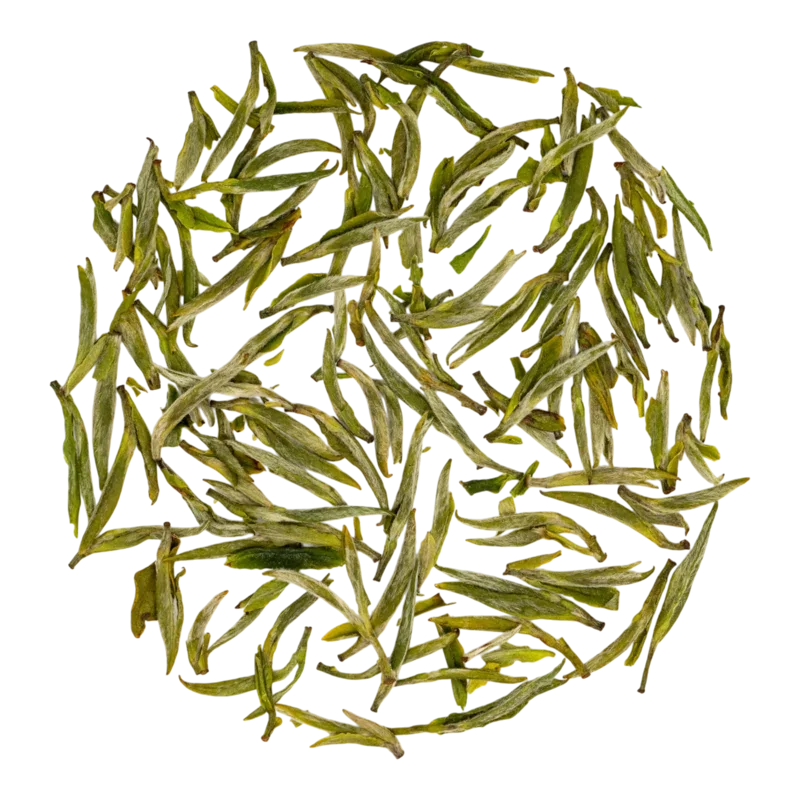
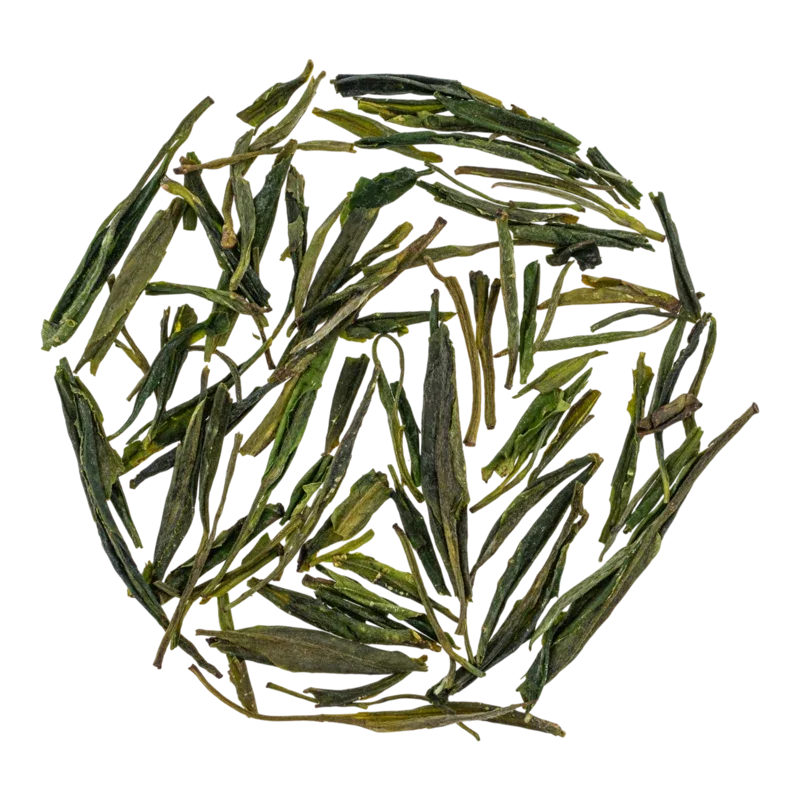
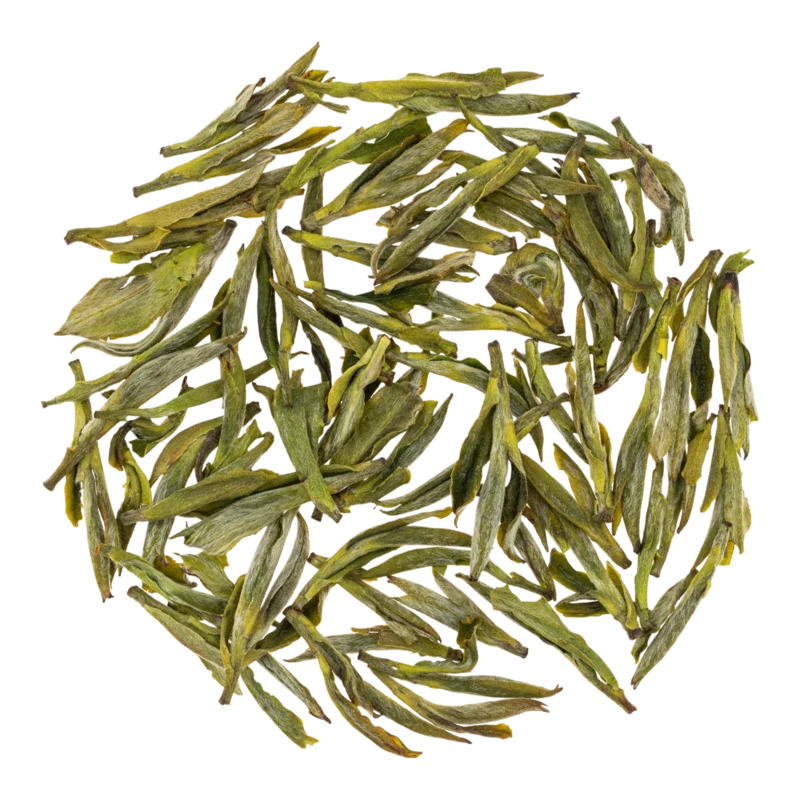
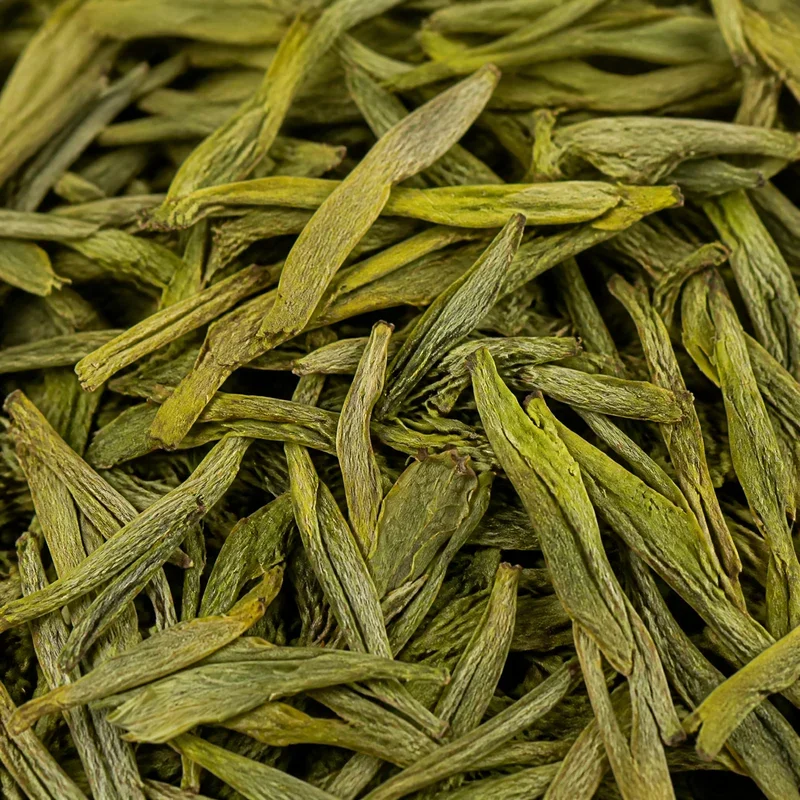
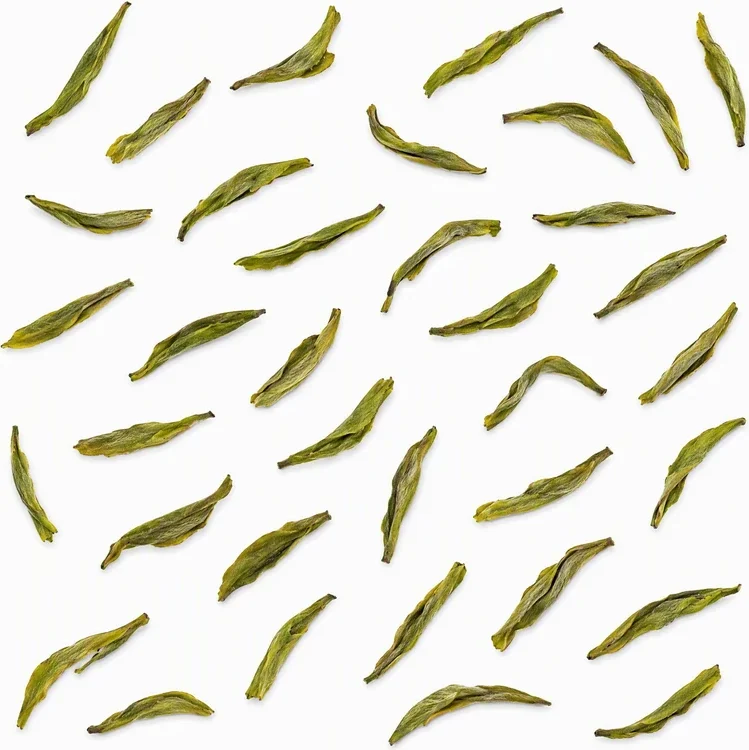
Dry Leaf Appearance: Bud and leaf connected (芽叶相连), covered with emerald down (翠绿显毫). When brewed, they open into "buds" resembling orchid flowers (舒展成朵,形似兰花).
Dry Leaf Aroma: Pure, high (清香). Orchid note (兰花香, lánhuā xiāng) — signature, from the local indigenous cultivar. Chestnut overtone (嫩栗香) — from spring picking and charcoal drying.
Liquor Aroma: Orchid-like, persistent and elegant. "Cold note" (冷韵) — subtle overtone of charcoal drying.
Liquor Color: Emerald green, bright and clear (碧绿明亮).
Spent Leaves: Tender, green, uniform shoots, "opened into buds" (嫩绿匀整成朵).
Taste: Fresh and brisk (鲜爽, xiānshuǎng) — record amino acid content (≥6.3%). Mellow and rich (醇厚). Returning sweetness — long and "velvety" (回甘绵长). Bitterness and astringency practically absent (苦涩度低) — result of record-low polyphenol content (≤19.5%).
Alkaloids: Caffeine — 2.8–3.5%. Tonic effect — 30% above average.
Amino Acids: ≥6.3% — one of the highest indicators among Chinese green teas. For comparison: most famous green teas have 3–5%. Record amino acid level ensures exceptional freshness and "umami."
121 mg/100 g — twice the average for green teas. Result: powerful antioxidant protection.
Naturally elevated content — from Dabie Mountains soils.
Minerals: Potassium, magnesium, manganese, phosphorus.
Polyphenols: ≤19.5% — significantly below average (usually 20–30%). Precisely the low polyphenol content explains the absence of bitterness and astringency.
Vitamin C (121 mg/100 g — ×2) combined with catechins.
Catechins accelerate metabolism and fluid elimination.
Caffeine (2.8–3.5%) — 30% above average.
Polyphenols stimulate enzymes.
Selenium, zinc, vitamin C.
the listed properties are based on publicly available data and are not medical recommendations.
do not use boiling water (>90°C) — destroys amino acids and gives yellowness. After opening — consume within 7 days for maximum aroma freshness.
Heated, "sparrow tongue," orchid-chestnut. Mao Feng is more "elegant"; Cui Lan is more "sweet" and mild (amino acids 6.3% vs. ~3–5%).
From pure leaves, without buds. Gua Pian is more grassy and rich; Cui Lan is more tender and "orchid-like."
Fellow from Anhui. Te Jian is more chestnut-mineral, with record selenium; Cui Lan is more orchid-sweet, with record amino acids.
From Zhejiang. Also record amino acids (6–7%), also minimal bitterness. Anji is "pure sweetness" without down; Cui Lan is "orchid sweetness" with down and "bud" form.
Anti Counterfeit: Buy with GI marking from Yuexi County; evaluate "orchid buds" when brewing; check orchid aroma; suspiciously low price — sign of counterfeit.
No reviews yet. Tell us what you think of this tea.
Rate this tea and share your impressions. We review each submission before publishing it.