Brewing
Gongfu brewing
- Water temperature
- 93 °C
- Tea amount
- 5 g
- Water volume
- 100 ml
- First steep
- 10 s
- Time added per infusion
- 5 s
- Infusions
- 4

yīng hóng 1 hào
Choose a brewing method. Start with the recommended quantities and time, then adjust to taste.
Brewing
Brewing
Taste
Tea encyclopedia
Category: Red teas of Guangdong Province, Yīngdé Hóngchá (英德红茶, Yīngdé Hóngchá) group. National tea plant cultivar (国家级茶树良种, guójiā jí cháshù liángzhǒng), registration number GS13017–1987.
Category: Red teas of Guangdong Province, Yīngdé Hóngchá (英德红茶, Yīngdé Hóngchá) group. National tea plant cultivar (国家级茶树良种, guójiā jí cháshù liángzhǒng), registration number GS13017–1987.
Coordinates: Approximately 24°10′ N, 113°25′ E (Yingde area).
Origin: China, Guǎngdōng Province (广东省, Guǎngdōng Shěng), Qingyuan Prefecture-level City (清远市, Qīngyuǎn Shì), Yingde County-level City (英德市, Yīngdé Shì). Also cultivated in Zhànjiāng (湛江, Zhànjiāng) within Guangdong territory, with small experimental plantings in Fújiàn (福建), Húnán (湖南), and Sìchuān (四川) provinces.
Type: Red tea (black tea) (红茶, hóngchá), fully oxidized (oxidation degree ~95–100%). In European classification — black tea.
Unlike Yinghong No. 9, bred from Yunnan large-leaf population (essentially the same Assam forms but brought through Yunnan), Yinghong No. 1 was obtained directly from Assam material. This makes it one of few Chinese national cultivars with direct Assam lineage.
Yield up to 350 kg dry tea per mu (about 5250 kg/ha) — one of the highest indicators among red tea cultivars, which determined its significance for mass production of export red tea in 1960–1980s.
Yingde is located practically on the Tropic of Cancer line — at the same latitude as famous Assam (India) and Kandy (Sri Lanka) plantations, creating similar climatic conditions for large-leaf cultivars.
Yingde Hongcha, including tea from Yinghong No. 1 cultivar, has been exported to more than 70 countries since the 1960s, received gold medals at international exhibitions and was supplied for receptions at Buckingham Palace.
Although Yinghong No. 9 became the series star, No. 1 was approved as national cultivar earlier, preceding No. 9 by one year (1987 versus 1988), and in strict sense is the "firstborn" of Guangdong Tea Institute's breeding program.
Cultural Significance: Yinghong No. 1 occupies an important place in the history of Guangdong's tea industry development. Although it yields to Yinghong No. 9 in commercial recognition, this cultivar was one of the pioneers that proved the possibility of obtaining high-class red tea from large-leaf raw material in South China's subtropical conditions. Yingde itself, thanks to such cultivars, received the honorary title "Hometown of China's Red Tea" (中国红茶之乡) in 2008, and in 2020 Yingde Hongcha was included in the first China-EU list of protected geographical indications.
History: Selection of Yinghong No. 1 began in 1959 (according to some sources — in 1958) at the Tea Research Institute of Guǎngdōng Province (广东省农业科学院茶叶研究所, Guǎngdōng Shěng Nóngyè Kēxuéyuàn Cháyè Yánjiūsuǒ), located in Yingde. The source material consisted of specimens of the Assam variety of tea plant (Camellia sinensis var. assamica). Through individual selection breeding (单株育种法, dānzhū yùzhǒng fǎ), a promising clone was isolated from the Assam plant population, which underwent field and production trials for nearly three decades. In 1987, the cultivar was officially approved by the National Committee for Crop Variety Approval (全国农作物品种审定委员会) and received national cultivar status.
Tree-like (乔木型, qiáomù xíng), large-leaf (大叶类, dàyè lèi), early-maturing (早生种, zǎoshēng zhǒng).
High-growing plant, spreading crown (开张, kāizhāng), well-expressed main trunk, medium-density branching. Leaves positioned horizontally or angled upward.
Elliptical, large, dark green, with pronounced gloss. Leaf blade convex, flat along longitudinal axis, with wavy edge and gradually pointed tip. Teeth sharp, deep. Leaf texture thick, soft.
Yellow-green color, medium pubescence. Weight of 100 buds in "one bud and three leaves" standard is 134.0 g — a high indicator testifying to shoot vigor.
Corolla diameter about 3.0 cm, 7 petals, ovary with medium pubescence, style three-parted.
Cultivar: Yinghong No. 1 (英红1号, yīng hóng 1 hào) — clonal (vegetatively propagated) cultivar derived from the Assam variety (Camellia sinensis var. assamica) through individual selection. Diploid (2n).
Picking: Due to early maturity, shoots reach "one bud and three leaves" standard as early as late March — early April. New shoots produce 6–7 growth flushes per year, ensuring harvest from spring to autumn. Main harvest — spring (March–April), additional — summer and autumn.
Pluck Standard: For highest grades — one bud and one-two young leaves; for standard batches — one bud and two-three leaves; for broken red tea — more mature shoots.
Raw Material: Healthy, undamaged leaves without signs of disease. The cultivar is susceptible to mite attacks (螨类, mǎn lèi), requiring control during the growing season.
Altitude: Tea plantations are located at altitudes from 100 to 500 m above sea level. Some elite gardens — up to 600 m and higher.
Climate: Subtropical monsoon. Average annual temperature 20–22°C, annual precipitation 1800–2000 mm, relative humidity 78–82%. Sufficient insolation, mild winter. Yingde is located practically on the Tropic of Cancer latitude — in the so-called "aromatic belt" (花香地带), at the same latitude as tea regions of India and Sri Lanka.
Soil: Fertile red soils (red lateritic soils) with weakly acidic reaction (pH 4.5–5.5), loose structure and high organic matter content predominate. Soils are rich in mineral elements, which is favorable for large-leaf cultivars.
Located at the junction of the South China Mountains (Nanling, 南岭) and the Guangdong Plain, in the northern part of the province. Hilly terrain with numerous rivers and streams; the area belongs to the Běijiāng River (北江) basin. Yingde is characterized by typical karst landscape.
Yinghong No. 1 cultivar has high yield — up to 350 kg of dry tea per mu (667 m²). Cutting rooting is good. However, young plants poorly tolerate frost (resistance to −3°C) and drought, which limits the cultivar's northward spread. Recommended planting density — double-row (30,000–45,000 plants/ha) or single-row (10,000–15,000 plants/ha) with shade trees to improve microclimate.
Hand or mechanized harvest of shoots of established standard.
Fresh leaves are spread in thin layers on special racks or in rooms with controlled ventilation. The process lasts 12–18 hours (sometimes longer), until moisture content decreases to approximately 60–65%. Can be conducted in open air (solar withering) or in shade. At this stage, aroma development begins.
Withered leaves are processed on rollers (揉捻机), destroying cell walls to release enzymes and initiate oxidation. For broken red tea, the CTC method (crush-tear-curl) may be applied.
Rolled leaves are laid out in fermentation rooms at temperature 25–30°C and humidity 80–90%. Duration — 4–6 hours. During oxidation, catechins transform into theaflavins and thearubigins, forming the characteristic red liquor color, sweetish malty taste, and complex aroma.
Tea is dried at high temperature (100–120°C) to stop fermentation and reduce moisture to 4–6%. Usually two-stage drying is applied: first — rapid fixation, second — final drying at gentler regime.
Finished tea is sieved and separated by size and quality into grades: leaf tea (FOP), broken (FBOP), fannings and dust.
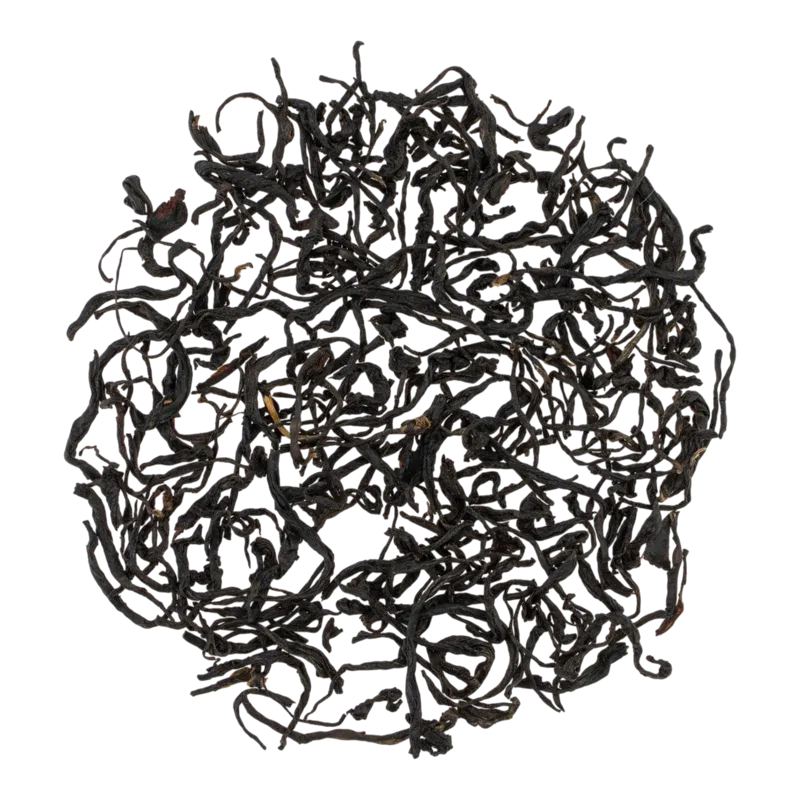
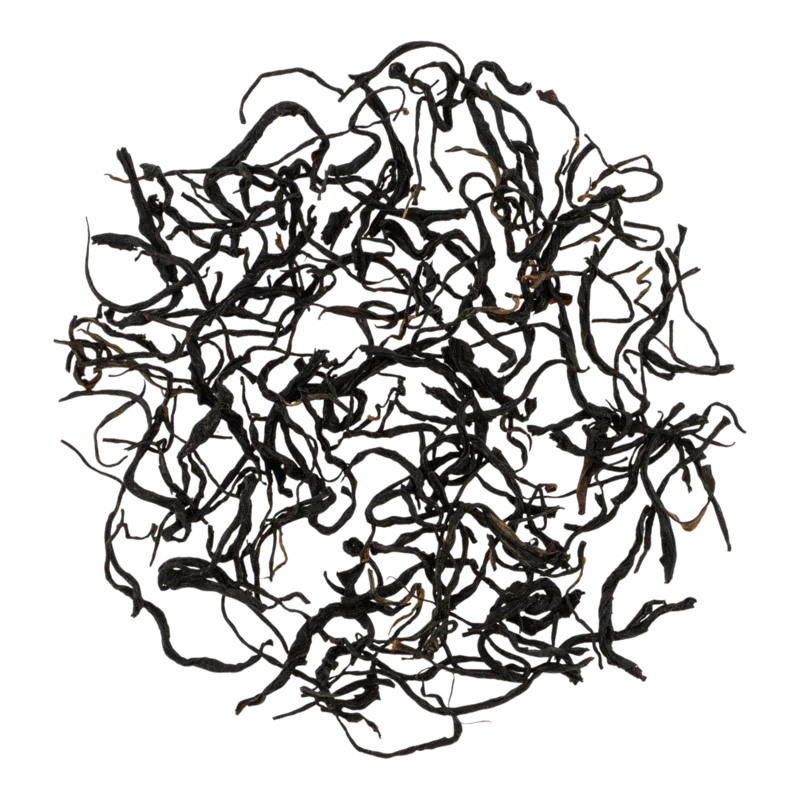
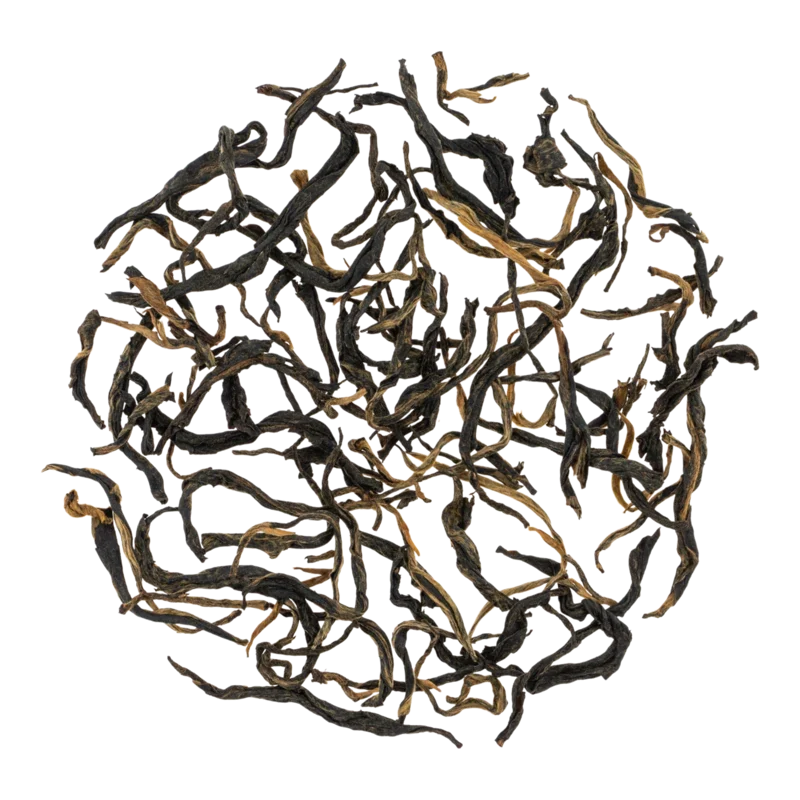
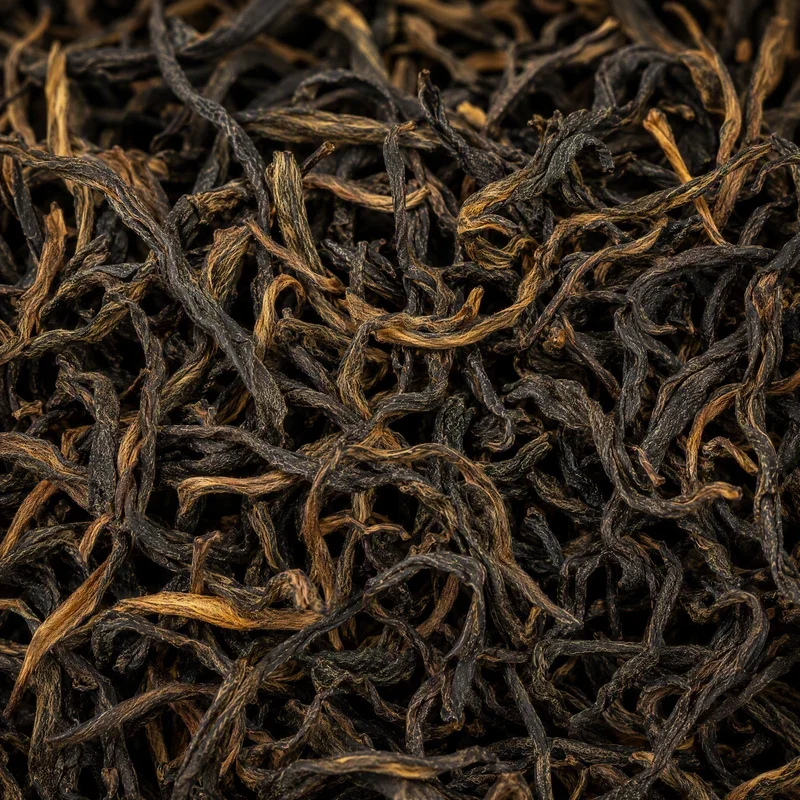
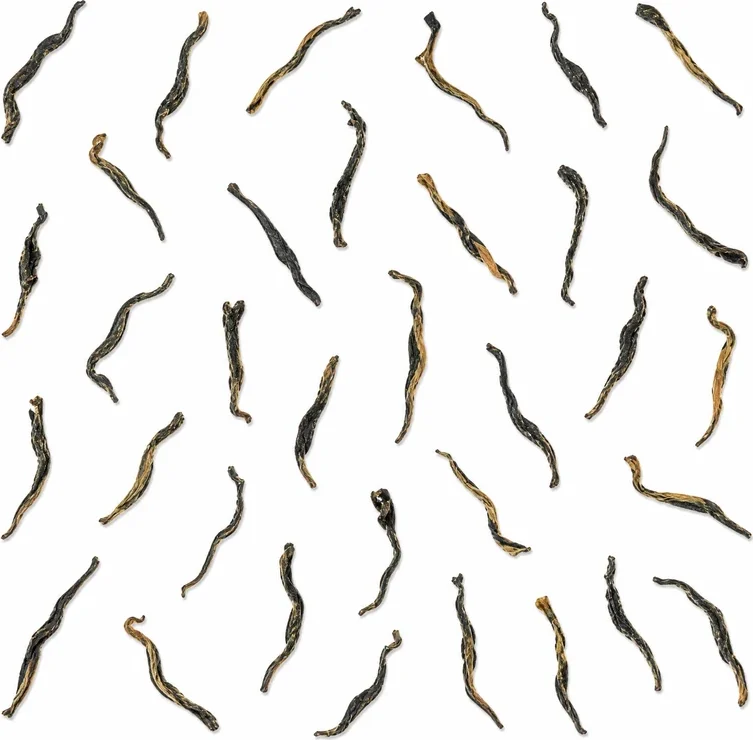
Dry Leaf Appearance: For leaf tea — tightly twisted, even strips with uniform structure, color from dark brown to black, with glossy luster (乌润, wūrùn). Golden tips visible in highest grades. For broken tea — uniform, dense granules with oily sheen.
Dry Leaf Aroma: Rich, sweetish, with pronounced notes of malt, dried fruits (prunes, apricots), honey. In the background — chocolate, spicy and delicate floral nuances. Aroma is high and penetrating (香气高锐, xiāngqì gāoruì).
Liquor Aroma: Enveloping, warm, with dominating malty-honey tones and undertones of dried fruits, caramel, spices. Persistent — preserved even in cooled liquor.
Liquor Color: From amber-red to red-brown, rich, clear, with pronounced "golden ring" (金圈, jīn quān) around cup edges — a sign of high theaflavin content.
Spent Leaves: Leaves whole, elastic, uniform reddish-brown color with copper tint. Buds open completely, maintaining softness.
Taste: Full-bodied, rich, velvety. Pronounced sweetness (甜润, tián rùn), moderate astringency. Taste reveals notes of dried fruits, honey, malt, chocolate. Lǒng aftertaste with returning sweetness (回甘, huígān). Broken tea gives a stronger and more invigorating liquor — precisely in this format Yinghong No. 1 reveals its potential most fully.
Alkaloids: Caffeine (caffeine-like substances) — about 4.1%, theobromine and theophylline in smaller quantities. Water extract constitutes ~38.2%.
Amino Acids: Total content — about 2.2%, including L-theanine, glutamic acid and others. L-theanine provides taste smoothness and calming effect, balancing caffeine's stimulating action.
Studies showed that in the aromatic profile of Yingde red teas, alcohols dominate (geraniol, linalool, citronellol), esters and aldehydes — over 50 identified components total. Precisely alcohols constitute the largest share, which is characteristic of the Yinghong series.
Minerals: Potassium, manganese, magnesium, iron, fluorine, zinc, selenium, copper.
Polyphenols: Tea polyphenol content in spring raw material (one bud and two leaves) is about 42.2% — an exceptionally high indicator exceeding most small-leaf cultivars. Main forms in finished tea — theaflavins (0.8–1.2%) and thearubigins (8–12%), responsible for color, astringency and antioxidant activity. Catechin content — about 13.4%.
Vitamins: C, B group (B₁, B₂, B₆), E, K, PP.
High caffeine and L-theanine content provides gentle but sustained stimulation — alertness without sharp excitement, improved concentration and cognitive functions.
Theaflavins and thearubigins — powerful antioxidants neutralizing free radicals, slowing oxidative stress and cellular aging processes.
Polyphenols contribute to LDL cholesterol reduction, strengthening vessel wall elasticity and blood pressure normalization with regular moderate consumption.
Red tea stimulates peristalsis, promotes digestive enzyme secretion. Has gentle warming effect on stomach (养胃, yǎng wèi).
Fully oxidized tea has pronounced thermal effect, improving peripheral circulation — ideal for cold season.
Polyphenols and tannins show bactericidal activity, suppressing pathogenic microorganism growth in oral cavity and GI tract.
Complex of vitamins, minerals and bioactive compounds supports general body resistance.
Tea Amount: 3–5 g per 150 ml water (flash steeping method); 3–4 g per 250–300 ml (European method).
Teaware: Porcelain gàiwǎn (盖碗, gàiwǎn), Yíxīng clay teapot (宜兴紫砂壶, Yíxīng zǐshā hú) or glass/porcelain teapot. Gaiwan is preferable for aroma evaluation; Yixing teapot suits daily brewing, emphasizing taste smoothness.
Water Temperature: 90–95°C. For highest grades (one bud) 85–90°C is acceptable.
Container: Airtight, light-proof container — tin can, foil bag with zip closure or ceramic vessel with tight lid.
Enemies: Moisture, light, high temperature, foreign odors, oxygen.
Shelf Life: Under proper conditions — 2–3 years. Aroma is most vivid in first 12–18 months after production.
Dry, cool place (not above 25°C), away from direct sunlight, heat sources and strong odors. Relative humidity — no more than 60%.
Closest "relative." Yinghong No. 9 bred from Yunnan large-leaf population, distinguished by even more powerful tree-like habit, slightly larger leaf. In taste No. 9 — more astringency and rich honey-fruit sweetness; No. 1 — softer, more elegant, with more pronounced floral nuance. No. 9 significantly more expensive and widely distributed in market.
Yunnan red tea from large-leaf cultivars. Similar in raw material type and liquor body, but differs with brighter honey-peppery notes and characteristic "Yunnan" body. Yinghong No. 1 usually lighter and cleaner in taste.
Small-leaf cultivar from Anhui Province, known for delicate "orchid" aroma (祁门香). Fundamentally differs from Yinghong No. 1 in raw material type and style: Keemun — delicate, wine-fruity; Yinghong — powerful, malty-sweet.
Fujian red tea with characteristic pine smoke (in traditional version) or fruit-floral notes (in modern). Significantly differs in style — Xiaozhong built on small-leaf cultivar and unique smoky withering technology.
Price Category: Yinghong No. 1 belongs to medium price segment red teas. Regular grades available from 50 to 100 yuan per 500 g, high-quality spring harvest batches — from 200 yuan and higher. Cost significantly lower than Yinghong No. 9, whose elite grades (金毫, jīn háo — "Golden Tips") can reach several thousand yuan per jin. Price factors: harvest season, leaf standard, estate reputation, processing method.
Specialized tea shops with origin certificates or directly from Yingde region estates.
Tea leaves should be even, tightly twisted, with oily luster. Broken, dusty or non-uniform leaves — sign of low quality.
Dry leaf should have clean, rich sweetish-malty aroma without musty, sour or chemical notes.
Color should be red, bright and clear, with "golden ring." Cloudy or dull liquor — sign of poor raw material or technology violation.
Unreasonably low cost for claimed highest grade Yinghong No. 1 — signal of possible substitution with base cultivar.
No reviews yet. Tell us what you think of this tea.
Rate this tea and share your impressions. We review each submission before publishing it.