Brewing
Gongfu brewing
- Water temperature
- 75 °C
- Tea amount
- 5 g
- Water volume
- 100 ml
- First steep
- 10 s
- Time added per infusion
- 5 s
- Infusions
- 3

Yíméng yù yá
Choose a brewing method. Start with the recommended quantities and time, then adjust to taste.
Brewing
Brewing
Taste
Tea encyclopedia
Category: Chinese Agricultural Product Geographical Indication Product (中国农产品地理标志产品, 2010). Gold medal of the Second National Agricultural Exhibition (第二届中国农业博览会金奖, 1995). "Green Product" certification (绿色食品, 2003). "Hometown of Chinese Tea" (中国茶叶之乡) status for Junan County. In total — over 116 awards at city, provincial and national levels, of which 20 are national level.
Category: Chinese Agricultural Product Geographical Indication Product (中国农产品地理标志产品, 2010). Gold medal of the Second National Agricultural Exhibition (第二届中国农业博览会金奖, 1995). "Green Product" certification (绿色食品, 2003). "Hometown of Chinese Tea" (中国茶叶之乡) status for Junan County. In total — over 116 awards at city, provincial and national levels, of which 20 are national level.
Coordinates: Approximately 35°20′ N, 118°50′ E.
Origin: China, Shāndōng Province (山东省), Línyí City (临沂市, Línyí Shì), Jǔnán County (莒南县, Jǔnán Xiàn). Production core — Zhūbiān Township (洙边镇, Zhūbiān Zhèn) and adjacent territories. The geographical indication zone covers 13 townships (乡镇): Zhubian, Zhuanggang (壮岗镇), Tuanlin (团林镇), Zhūlù (朱芦镇), Fangqian (坊前镇), Wentuan (文疃镇), Pingshang (坪上镇), Laopo (涝坡镇), Xianggou (相沟乡), Shizilu (十字路镇), Xiangdi (相邸镇), Tingshui (汀水镇), Shilianzi (石莲子镇).
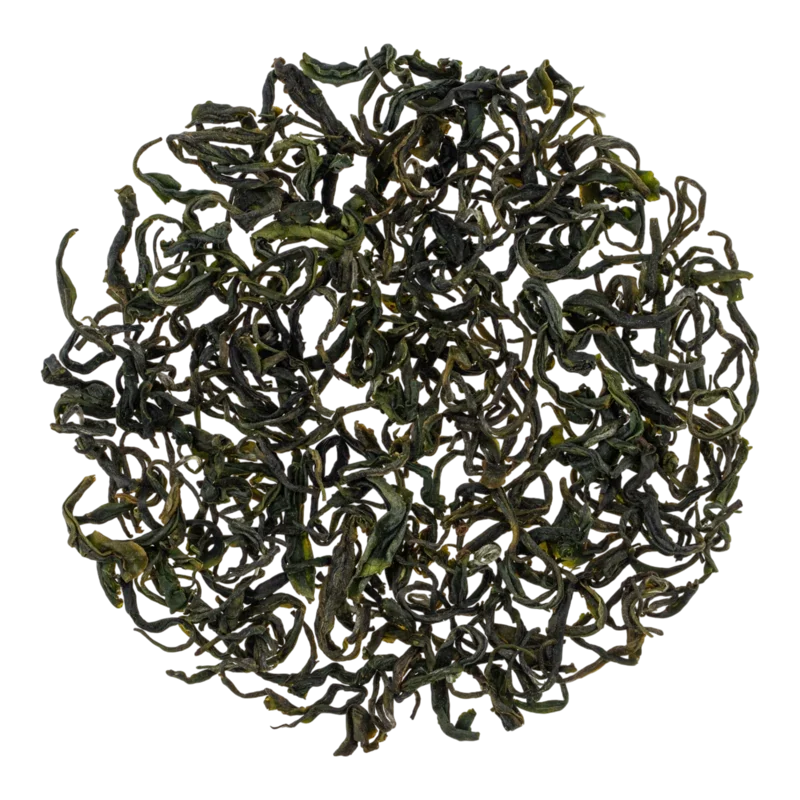
Type: Green tea (绿茶, lǜchá), unfermented. Main form — flat (扁平形, biǎnpíng xíng), slightly curved, with smooth surface. Additional product lines: needle-shaped "Songzhen" (松针, sōngzhēn, "pine needle"), spiral "Bi Luo Chun" (碧螺春, Bìluóchūn), "ball-shaped" "Tuanyuan Chun" (团圆春, Tuányuán Chūn, "Spring of Reunion").
Cultural Significance: The Yimeng Mountains are one of the main symbols of the revolutionary history of the PRC. During the anti-Japanese war (1937–1945) and civil war (1946–1949), CCP "base areas" (根据地, gēnjùdì) were located here. Paradoxically, it was precisely the absence of industrial development during the war and post-war decades that preserved the ecological purity of the region. Yimeng Yu Ya tea carries a double connotation: historical — born on "red soil" where heroic deeds were performed — and ecological — grown in the unpolluted environment of former partisan bases. "Red mountains give birth to green jade" (红色的山生出绿色的玉) — a persistent poetic image of the brand. Visits by top PRC leaders (General Secretary Hu Jintao, Premier Zhu Rongji, Politburo Standing Committee member Wu Guanzheng and others) to Junan tea plantations emphasized the strategic importance of local tea cultivation.
Single bud, flat, slightly curved, tender yellow-green, with abundant down. Uniformity — not less than 95%.
One bud + one leaf. Flat form, green with down.
One bud + two leaves. Minor non-uniformity is acceptable.
Cultivar: Main — Fúdǐng Dàbái Chá (福鼎大白茶, Fúdǐng Dàbái Chá), Camellia sinensis var. sinensis, clonal variety (无性系良种, wúxìngxì liángzhǒng), share — about 70% of plantings. Fúdǐng Dàbái is the same cultivar from which white tea Báiháo Yínzhēn (白毫银针) is produced in Fujian; at 35° north latitude in Shandong it acquires a completely different character — chestnut aroma and dense taste of "northern" green tea. Additional cultivars: Ānhuī Huángshān Zhǒng (安徽黄山种, Ānhuī Huángshān Zhǒng) — population variety from Anhui, and Zhèjiāng Jiūkēng Zhǒng (浙江鸠坑种, Zhèjiāng Jiūkēng Zhǒng) — one of the most ancient population varieties of Zhejiang. According to anatomical studies, Junan tea trees have a thickened epidermal cuticular layer and three layers of palisade tissue (versus two in southern tea bushes), indicating increased stress resistance acquired during "northern acclimatization".
Picking: Spring, from late March to April. Supreme grade (特级, tèjí) — single bud (单芽, dānyá). First grade (一级, yījí) — one bud + one leaf in initial opening stage (一芽一叶初展, yī yá yī yè chūzhǎn). Autumn tea is not produced.
Climate: Temperate humid monsoon (暖温带湿润季风气候, nuǎn wēndài shīrùn jìfēng qìhòu). Average annual temperature — 14.1°C. Average annual precipitation — 865 mm, concentrated in summer. Relative humidity — 72%. Frost-free period — 216 days. Key factor — significant diurnal temperature variation: daytime maximums in spring reach 18–22°C with nighttime minimums of 4–8°C. This amplitude slows shoot growth and stimulates accumulation of amino acids and aromatic compounds — hence the intense chestnut aroma absent in fast-growing "southern" analogs.
Soil: Brown soils (棕壤土, zōng rǎng tǔ), developed on granites and gneisses. pH 5.5–6.8 — slightly acidic, optimal for tea bushes. Deep soil layer (>60 cm), loose texture, good water and air permeability. Organic matter content — average 1.1%. Available nitrogen — 116.75 mg/kg, available phosphorus — 47.4 mg/kg, available potassium — 85.4 mg/kg.
Hilly terrain (丘陵, qiūlíng), average plantation elevation — 200–400 m. Highest point of the county — Mount Mǎqí (马鬐山, Mǎqí Shān), 662.2 m. Tea gardens are located mainly on eastern and southeastern slopes — on foothill terraces of the Laoshan–Wulian ridge (崂山—五莲山脉).
Complete ban on chemical fertilizers and pesticides in the core zone. Closed-cycle ecological system "pig → biogas → tea" (猪—沼—茶, zhū—zhǎo—chá): pig farming waste is fermented in biogas installations, and the resulting substrate is used as organic fertilizer. Inter-row grass covering (行间覆草, hángjiān fùcǎo) prevents erosion and maintains moisture.
Water: The county is located in the Huaihe basin, 323 rivers with total length of 1708 km. Tea plantations — in the water protection zone of the coastal hydrological system (滨海水系). Forest cover — 55% in the production core zone.
2–4 hours in shade at room temperature. Goal — reducing leaf moisture content from ~78% to ~68%, initiating initial aroma formation process. Shoots are spread in thin layer (~3 cm) on bamboo trays.
Performed on vibrating strip-shaping machine (振动理条机, zhèndòng lǐtiáo jī) at 130–140°C. Vibrating action simultaneously fixes green and begins formation of flat tea particle shape. After fixation — thin spreading for 30 minutes for ventilation and removal of excess surface moisture.
Temperature 90–100°C. Leaf is pressed between heated plates, forming characteristic flat, slightly curved shape (略扁挺直). Process gives tea particle smooth surface and elegant silhouette.
90°C in drying machine to moisture content ≤5%. At this stage the chestnut aroma is fixed — Maillard reaction between amino acids and sugars at controlled temperature forms characteristic pyrazine compounds.
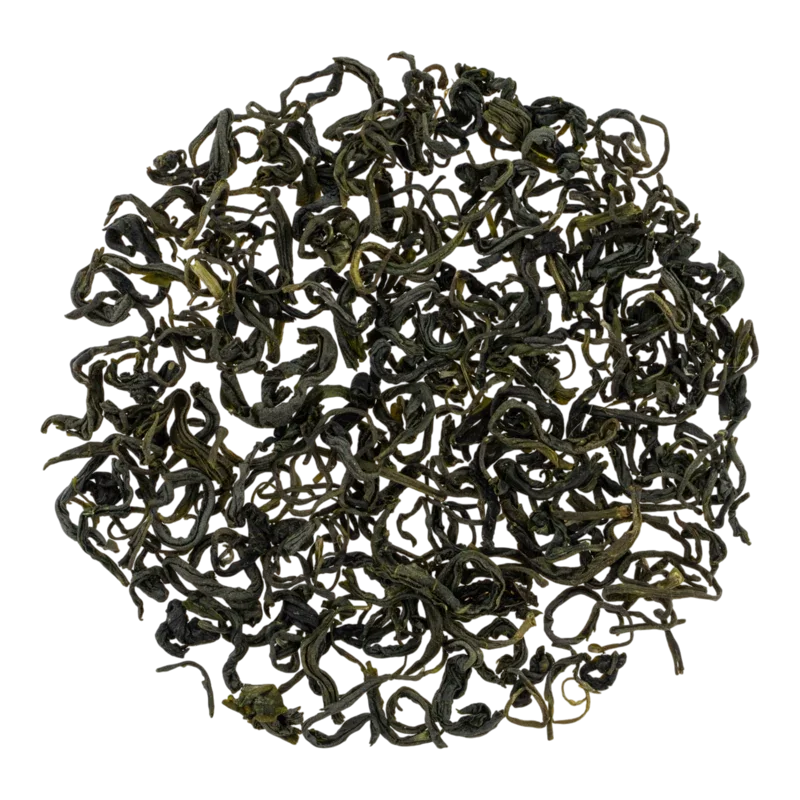
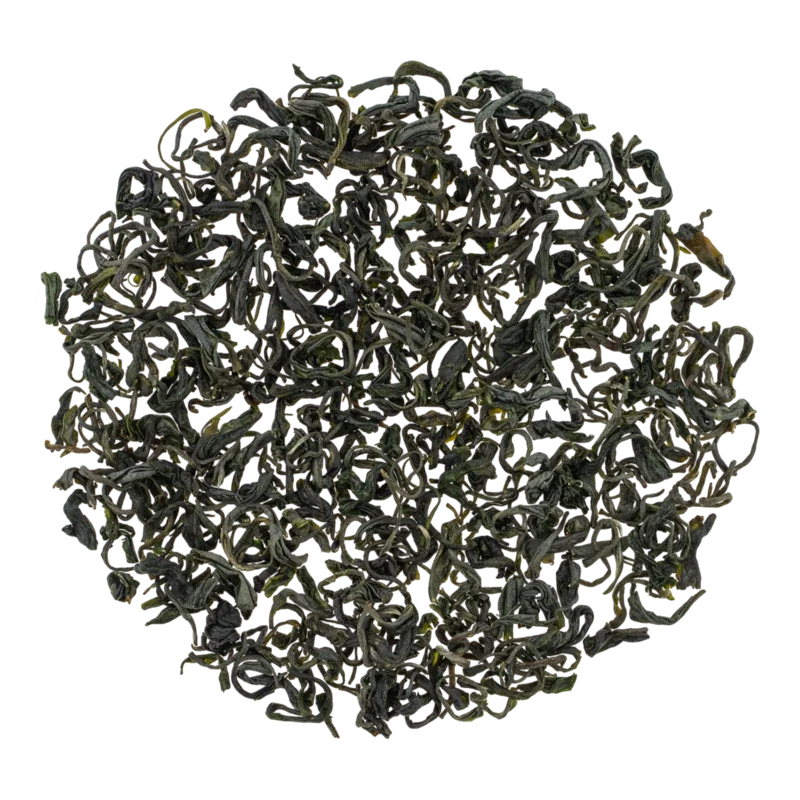
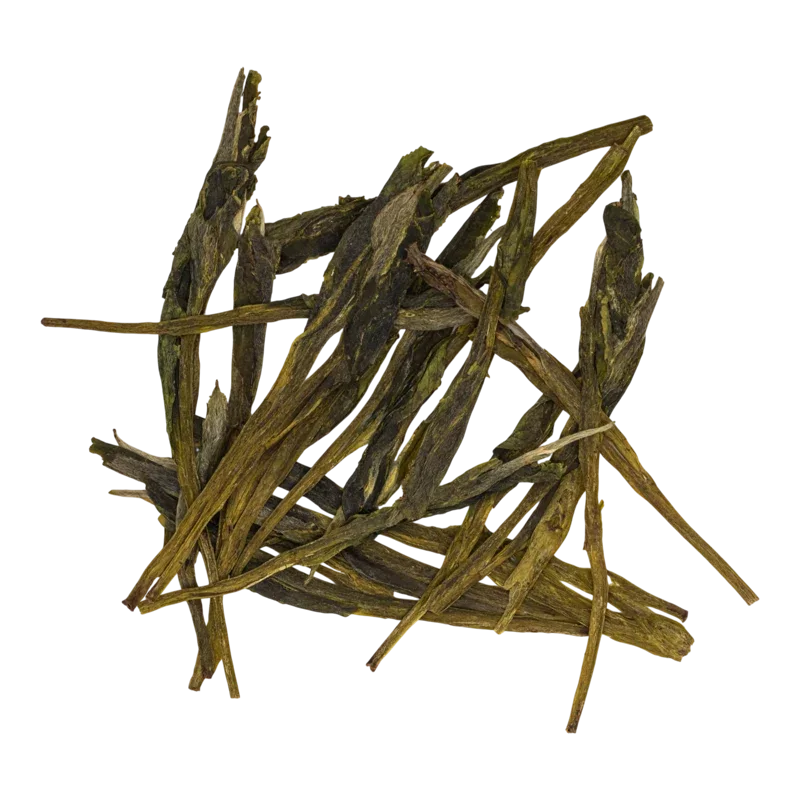
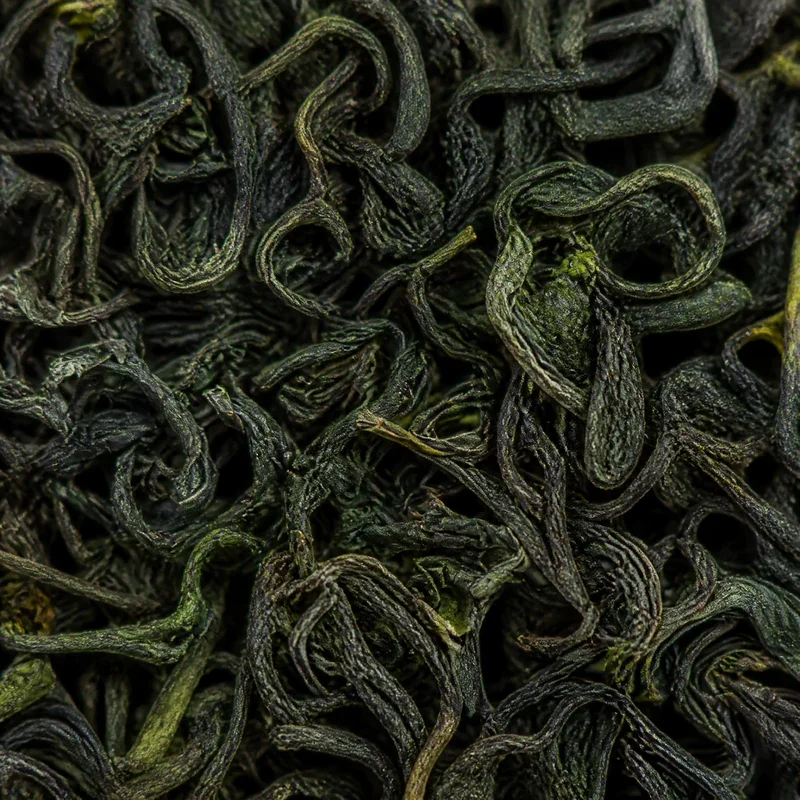
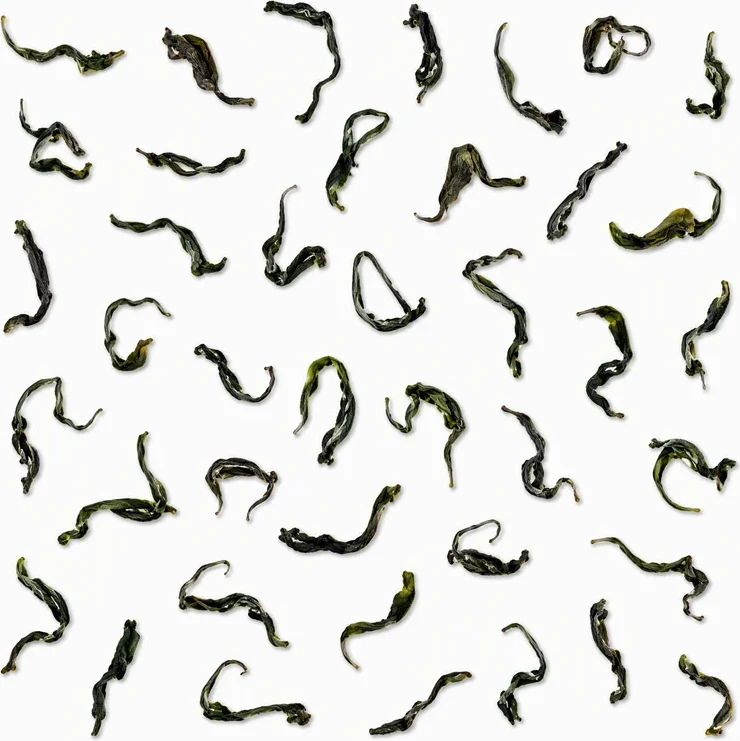
Dry Leaf Appearance: Flat, slightly curved, elegant tea particles (略扁挺直, lüè biǎn tǐng zhí). Color — tender yellow-green (嫩黄绿, nèn huáng lǜ) with light silvery sheen. Supreme grade has abundant white down (白毫显露). Tea particle size is uniform, broken pieces are absent.
Dry Leaf Aroma: Pronounced chestnut (栗香, lìxiāng) — warm, rounded, with notes of roasted chestnuts and light sweetness. Clean and persistent (清香持久).
Liquor Aroma: Chestnut aroma unfolds to full strength, complemented by notes of fresh-cut grass and light bean tone. Intensity and persistence — higher than most southern green teas of similar class.
Liquor Color: Yellow, bright and clear (黄亮清澈, huáng liàng qīng chè). Without turbidity. Supreme grade has light greenish tint.
Spent Leaves: Tender green, uniform, "lively". In supreme grade buds stand vertically (芽尖直立, yá jiān zhí lì) — sign of impeccable raw material and careful processing.
Taste: Fresh and mellow (鲜醇, xiān chún), pleasant on the palate (爽口, shuǎng kǒu). Body — medium, with noticeable "oiliness". Bitterness is minimal. Returning sweetness (回甘, huígān) — pronounced, with increasing "sugariness" (生甜, shēng tián). Aftertaste — long, with chestnut warmth.
Amino Acids: Elevated content — approximately 4–5% of dry matter (with average value for green tea ~2–4%). High latitude (35° N) and significant diurnal temperature variation stimulate L-theanine (L-茶氨酸) accumulation — main carrier of "umami" and component of "relaxed concentration" synergy with caffeine. Low nighttime temperatures suppress theanine breakdown into catechins, ensuring high amino acid to polyphenol ratio (酚氨比, fēn'ān bǐ) — key indicator of "fresh" and "mellow" taste profile.
Moderate, approximately 3.0–4.0% — typical level for green tea based on Fuding Dabai Cha. Combined with high theanine content gives "gentle stimulation" without harshness.
Chestnut aroma is formed by pyrazines and pyrroles — products of Maillard reaction during kill-green and final drying. Slowed shoot growth increases concentration of aroma precursors (amino acids + reducing sugars) in raw material.
Minerals: Potassium (K), magnesium (Mg), zinc (Zn), manganese (Mn), fluorine (F). Brown soils of Junan provide elevated available potassium content.
Polyphenols: According to producer claims — 30% higher than average value for green tea. "Northern" terroir with cool nights slows catechin conversion, preserving them in stable, less astringent form. Fuding Dabai Cha as cultivar is characterized by balanced polyphenol profile — "兼具浓强、鲜爽、醇厚" (density, freshness and fullness simultaneously).
Vitamins: C (ascorbic acid — better preserved in green tea than in fermented types), B₁ (thiamine), B₂ (riboflavin), E (tocopherols), K.
Elevated polyphenol content (catechins, primarily EGCG) provides free radical neutralization and oxidative stress deceleration.
Synergy of caffeine and L-theanine — "alertness without anxiety". Theanine stimulates α-wave generation in the brain, promoting "relaxed concentration" state.
L-theanine improves memory and attention, promotes neuroprotection. Studies show that combined action with caffeine enhances the effect.
Catechins, especially EGCG, promote fat oxidation and reduction of "bad" cholesterol (LDL) levels.
Polyphenols improve vascular elasticity and promote blood pressure normalization.
Fluorine contained in tea leaf has caries-preventive action.
Vitamin C and catechins have immunomodulating and anti-inflammatory action.
Tea Amount: 3 g per 150 ml (1:50 ratio).
Water Temperature: 85–90°C. For supreme grade (单芽) — lower range (85°C), to avoid "burning" tender buds.
Enemies: Moisture, foreign odors, direct sunlight, high temperature. Do not store near products with strong odors.
Shelf Life: In sealed vacuum packaging at 0–5°C — up to 18 months. After opening — consume as quickly as possible.
Airtight packaging, refrigerator 0–5°C. Ideally — vacuum packaging in aluminum pouch.
"Rest" (退火, tuìhuǒ) 15 days after production — for aroma stabilization and "fire" taste softening.
Producer recommends consumption within 72 hours — chestnut aroma is extremely volatile and quickly dissipates upon air contact. This is one of the strictest recommendations among Chinese green teas.
Benchmark flat green tea from Hangzhou (Zhejiang). Aroma — "beany" (豆香), taste — "sweet-fresh". Yimeng Yu Ya is a "northern" interpretation of flat form: chestnut aroma instead of beany, denser body, less pronounced "umami freshness".
Closest "compatriot" from Shandong (Rizhao City). Also "northern" green tea with chestnut aroma, but form is not flat but "eyebrow-shaped" (眉形). Rizhao is the "pioneer" of the "南茶北引" movement in Shandong (since 1950s), Yimeng Yu Ya is the "second wave" (since 1960s). Rizhao is located closer to the sea and has milder coastal climate.
Another Shandong green tea with geographical indication (from Weifang). Similar "northern" chestnut profile, close soil-climatic conditions (棕壤, pH 5.5–6.8). Less known at national level than Yimeng Yu Ya.
"Northern" green tea from Qingdao vicinity (Shandong). Grown on Mount Lǎoshān slopes (崂山, up to 1133 m), in zone of marine influence. Aroma — chestnut with "marine" notes. Higher elevation terroir and sea breeze give it additional minerality that Yimeng Yu Ya lacks.
Flat green tea from Anhui — for "flat form" comparison. Much larger (leaf up to 15 cm), with orchid aroma (兰香). Technology and terroir are fundamentally different; common element — flat tea particle shape.
No reviews yet. Tell us what you think of this tea.
Rate this tea and share your impressions. We review each submission before publishing it.