Brewing
Gongfu brewing
- Water temperature
- 93 °C
- Tea amount
- 5 g
- Water volume
- 100 ml
- First steep
- 10 s
- Time added per infusion
- 5 s
- Infusions
- 4

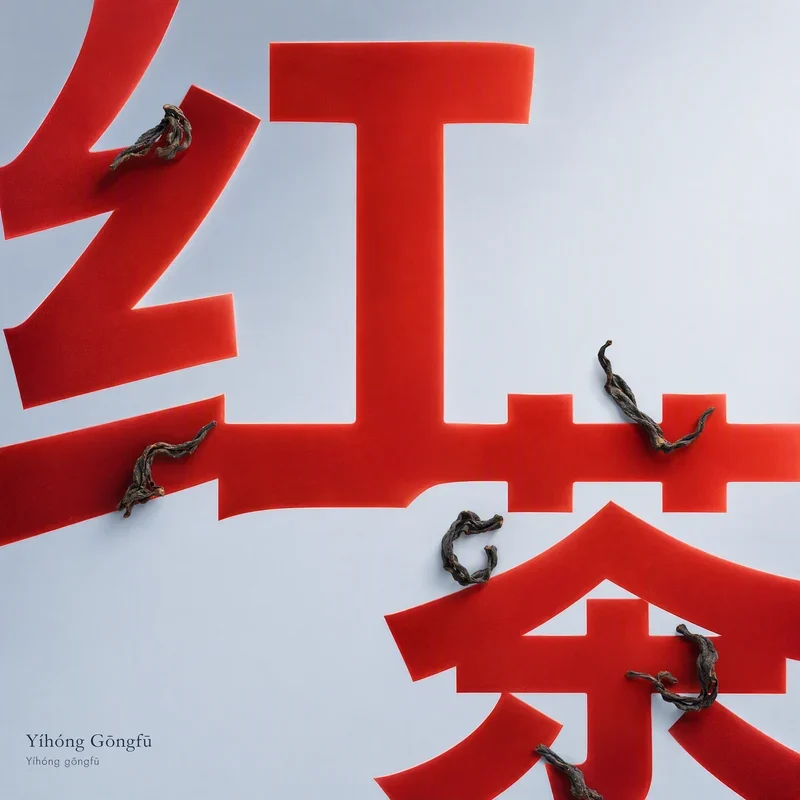
Yíhóng gōngfū
Choose a brewing method. Start with the recommended quantities and time, then adjust to taste.
Brewing
Brewing
Taste
Tea encyclopedia
Category: Chinese gōngfū red teas (工夫红茶, gōngfū hóngchá). One of the "Three Great Gongfu Red Teas of China" (中国三大工夫红茶).
Category: Chinese gōngfū red teas (工夫红茶, gōngfū hóngchá). One of the "Three Great Gongfu Red Teas of China" (中国三大工夫红茶).
Coordinates: ≈ 30.4° N, 111.3° E (reference point at the center of the productive zone — Yichang).
Origin: China, Húběi Province (湖北, Húběi). Main production areas: Yíchāng City (宜昌市, Yíchāng Shì) and Ēnshī Tujia and Miáo Autonomous Prefecture (恩施土家族苗族自治州, Ēnshī Tǔjiāzú Miáozú Zìzhìzhōu). Historically, part of the raw material was also supplied from adjacent counties in Hunan Province — Shímén (石门, Shímén), Cílì (慈利, Cílì), Sāngzhí (桑植, Sāngzhí). Key counties in Hubei: Yídū (宜都, Yídū), Wǔfēng (五峰, Wǔfēng), Hèfēng (鹤峰, Hèfēng), Chángyáng (长阳, Chángyáng), Yílíng (夷陵, Yílíng).
Type: Red tea (black tea) (红茶, hóngchá) — fully fermented/oxidized.
Cultural Significance: Yihong is not merely a tea brand, but a historical symbol of western Hubei's trade connections with the world market. Yihong's tea route — from mountain gardens through Yuyangguan and Yichang to Hankou and onward to Europe — is an integral part of the "Great Tea Road" (万里茶道, Wànlǐ Chádào). The Yidu factory with its preserved 1950s production line is recognized as "living industrial heritage of Chinese red tea." Sòng dynasty poet Ōuyáng Xiū (欧阳修, Ōuyáng Xiū), who served as magistrate of Yiling County, left famous lines: "春秋楚国西偏境,陆羽茶经第一州" — "On the western borders of ancient Chu — the region Lu Yu placed first in the 'Tea Classic'."
History: The Yichang region is one of China's most ancient tea-growing areas. During the Tang dynasty, tea sage Lù Yǔ (陆羽, Lù Yǔ) in "The Classic of Tea" (《茶经》, Chájīng) ranked tea from Xiázhōu (峡州, Xiázhōu — ancient name for Yichang) first among the teas of Shannan: "山南,以峡州上". Red tea (black tea) appeared here much later: during the reign of Emperor Dàoguāng (道光, Dàoguāng, 1821–1850), Guǎngdōng merchant Jūn Dàfú (钧大福, Jūn Dàfú) brought red tea masters from Níngzhōu (宁州, Níngzhōu — now Xiushui County, Jiangxi) to Yuyangguan (渔洋关, Yúyángguān, Wufeng County), where they established red tea production using Ninghong technology. In 1854, Guǎngdōng merchant Gāo Bǐngsān (高炳三, Gāo Bǐngsān) expanded production in Hefeng; in 1876, Lín Zǐchén (林紫宸, Lín Zǐchén) opened the "Baoshunhe" (宝顺合) tea office for an English trading company in Yuyangguan. In 1890, Guǎngdōng entrepreneur Lú Cìlún (卢次伦, Lú Cìlún) began mass production of red tea in Shimen, and in 1892 founded the "Taihehe" tea manufactory (泰和合红茶号, Tàihéhé Hóngchá Hào), which became the first major enterprise producing Yihong. The finished tea was transported by waterway through Yíchāng to Hankou (汉口) for export — it was from this route through Yichang that the name "宜昌红茶" ("Yichang Red Tea") originated, shortened to "宜红" — Yihong.
Name Breakdown: "宜" (yí) — the first character in Yichang's name; "红" (hóng) — red (tea); "工夫" (gōngfū) — literally "expended skill and time," indicating the meticulous, multi-stage processing technology that distinguishes gongfu red teas from simplified red teas (红碎茶). Thus, "宜红工夫" — "red tea of supreme craftsmanship from Yichang."
Cultivar: Yihong belongs to the group of medium- and small-leaf gongfu red teas (中小叶种工夫红茶). Traditionally uses local populations of Camellia sinensis var. sinensis (群体种, qúntǐ zhǒng) adapted to the conditions of mountainous Hubei. Modern estates also employ national breeding cultivars (国家级茶树良种) selected for red tea profiles. For premium batches, trees with a higher proportion of buds are preferred.
Picking: Spring (mid-March — April) for highest grades; summer and autumn harvest for standard batches. Spring tea is distinguished by a milder aroma and high amino acid content, summer tea — by more pronounced astringency and body.
Pluck Standard: One bud and one-two leaves (一芽一叶, yī yá yī yè / 一芽二叶, yī yá èr yè) for highest grades. For standard grades — one bud and two-three leaves (一芽二三叶). Batches with predominantly pure buds (单芽, dān yá) are released in limited quantities as "golden needle" Yihong.
Raw Material: Fresh, whole leaf without mechanical damage; uniformity and tenderness of shoots; absence of coarse veins and foreign inclusions.
Altitude: 800–1200 m above sea level — the main zone for quality raw material. Tea gardens are located on the slopes of the Wǔlíng Mountains (武陵山脉, Wǔlíng Shānmài) and Dàbā Mountains (大巴山脉, Dàbā Shānmài).
Climate: Subtropical monsoon. Average annual temperature 13–18°C (in Yichang — 16.9°C). Frost-free period 220–300 days. Annual precipitation 750–1500 mm, with the majority falling during the growing season (March–September). High cloud cover and frequent fog provide diffused light, while significant day-night temperature differences promote the accumulation of aromatic compounds.
Soil: Predominantly weakly acidic yellow-red soils (微酸性黄红壤) with pH 4.5–6.5, rich in organic matter. These soils create the characteristic minerality and "body" of Yihong's flavor.
Modern estates apply green farming standards; many gardens are certified as ecologically clean. Hand-picking is mandatory for premium batches.
Water: The region is crossed by the Yangtze River system and its tributaries, creating a favorable water-air balance — the mountains are constantly shrouded in clouds and fog.
Fresh leaves are spread in a thin layer on bamboo trays or withering troughs with forced ventilation. Temperature 30–38°C, duration 8–16 hours (depending on method). Leaves lose 55–60% moisture, become soft and elastic, acquiring initial fruity notes. The traditional hand method also includes a "breathing" phase (吐气, tǔqì) — brief rest between stages.
Leaves are rolled, cell walls are broken, juices are released — oxidation begins. For tender material (grades 1–2) — lighter pressure; for mature leaves — more intensive.
Key stage for forming color, aroma, and flavor. Rolled leaves are laid 4–6 cm thick in a room with temperature 26–28°C and humidity 95–100%. Duration 2–3 hours (spring tea — longer, summer — shorter). The aromatic profile passes through characteristic stages: grassy → floral → fruity → honey-sweet. Oxidation is considered complete when leaves acquire a reddish-copper color and grassy notes completely yield to sweet ones.
Applied in traditional hand methods to form tighter, more uniform rolling.
With hot air at 100–120°C to residual moisture of 5–6%. Fixes the aromatic and flavor profile. At this stage, Maillard reactions intensively proceed, forming caramel and bread notes.
Separating dry tea into fractions by particle size using multi-level sieves.
Non-standard fragments are brought to the required caliber.
Removal of dust, light fragments, and foreign impurities.
Machine and hand sorting — removal of stems, coarse leaves, foreign inclusions.
Mixing batches of different grades and origins to achieve a stable flavor profile.
Thorough mixing of the blend for uniformity.
Final drying, bringing moisture to standard and enhancing aroma.
Packing in standard containers for shipment.
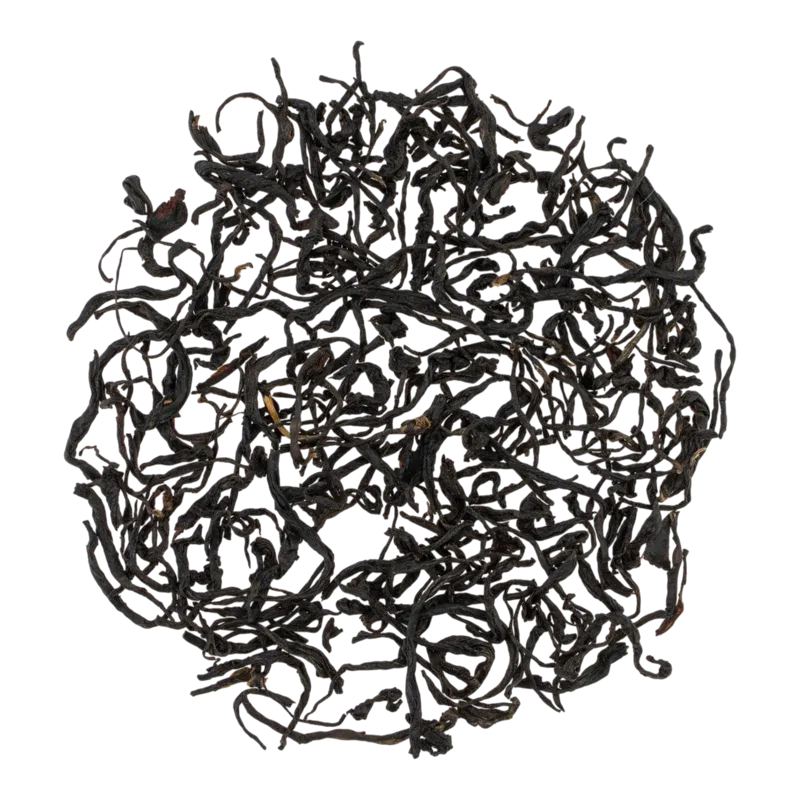
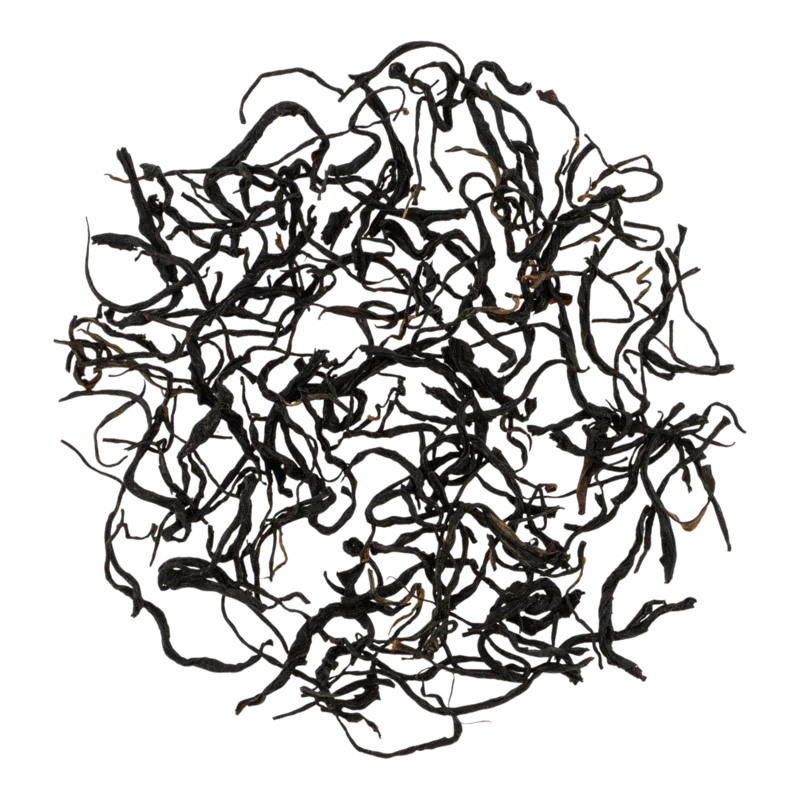
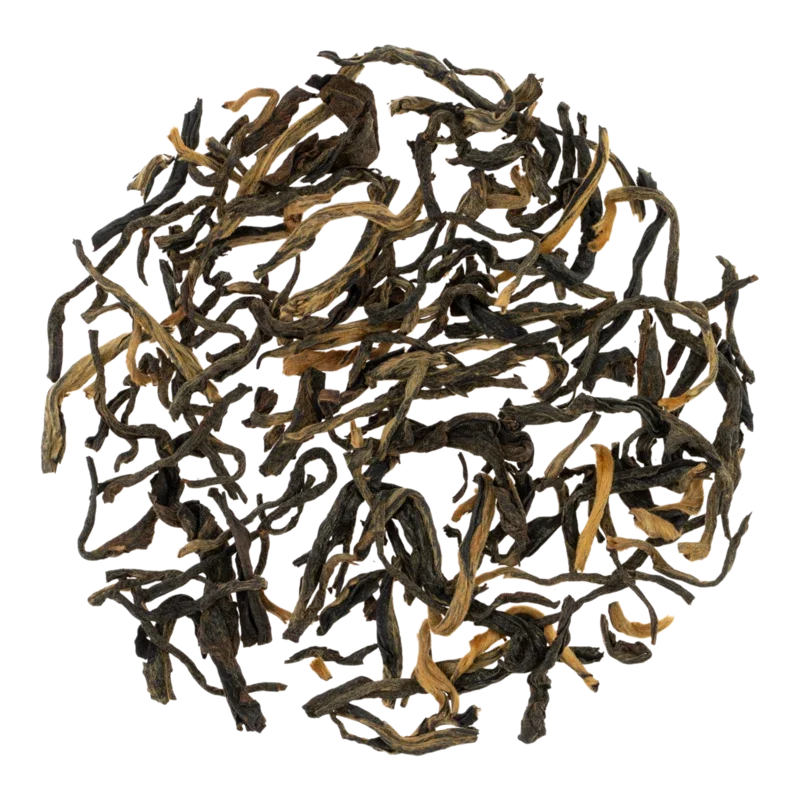
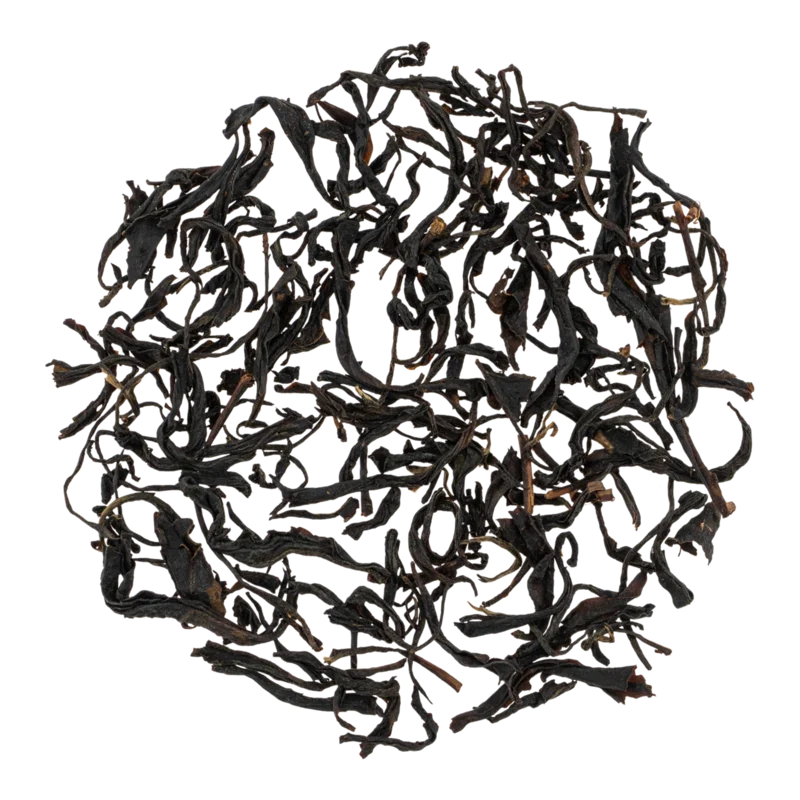
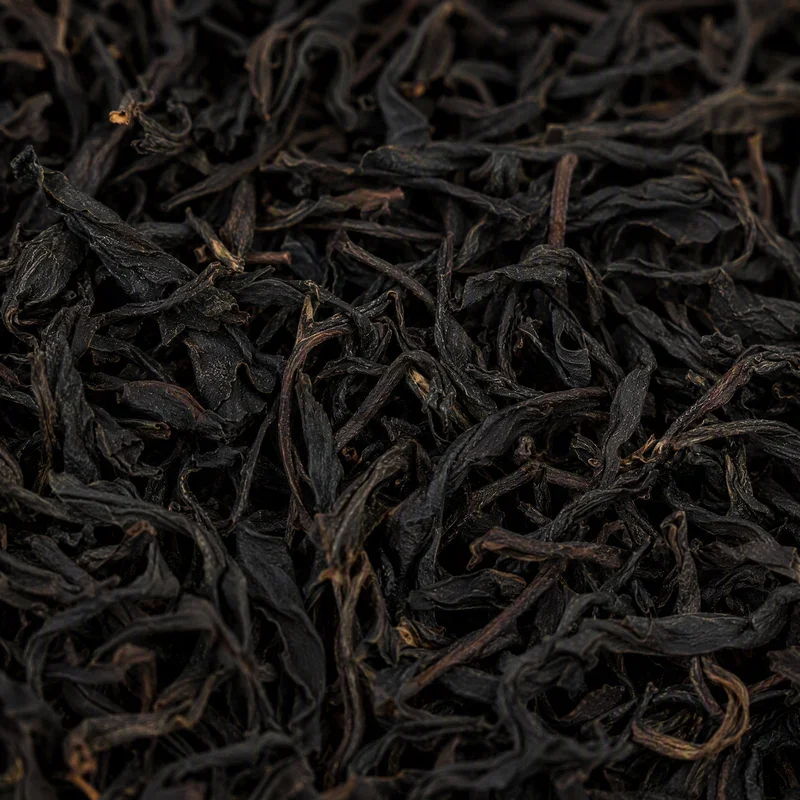
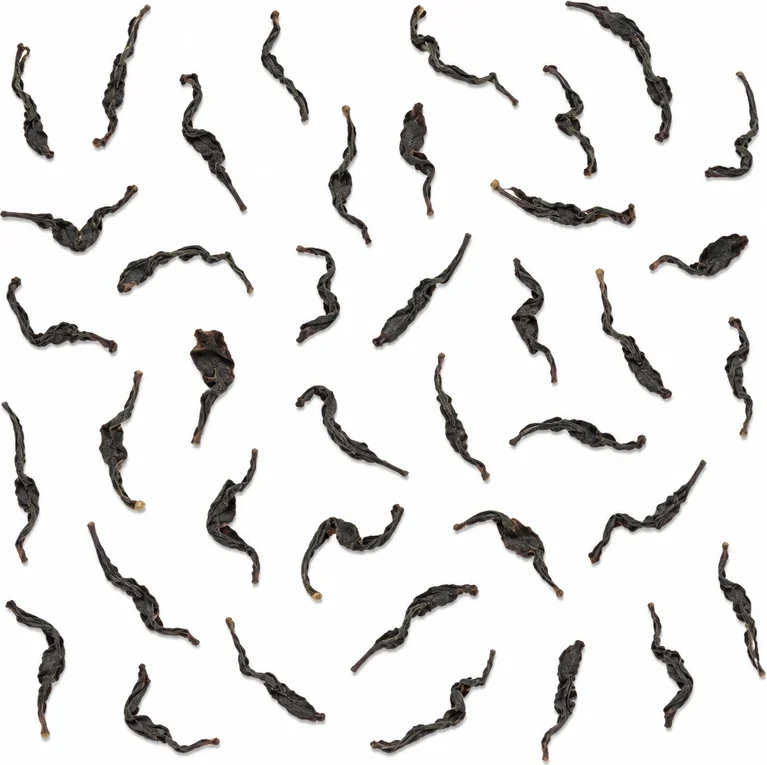
Dry Leaf Appearance: Thin, tightly rolled tea strips (条索紧细, tiáosuǒ jǐnxì), even and uniform. Color — deep black-brown with oily luster (乌润, wūrùn). Golden bud tips (金毫, jīnháo) are visible on the surface, their quantity increasing with higher grades.
Dry Leaf Aroma: Warm, sweetish — honey, rye bread, light caramel notes. Highest grades additionally display subtle floral-fruity overtones.
Liquor Aroma: Rich, multi-layered — in first infusions honey and fruity notes dominate (dried apricot, date); as brewing continues, bread-caramel and light spicy notes unfold. The aroma is persistent and "high" (香气高甜持久).
Liquor Color: Orange-red, bright and clear (橘红明亮, júhóng míngliàng). When hot — with a golden rim at the cup walls (金圈).
Spent Leaves: Leaves unfold evenly, elastic and soft. Color — red-copper, uniform, without dark spots (叶底红亮, yèdǐ hóng liàng).
Taste: Full-bodied, rounded, with pronounced circular sweetness. Astringency is mild, balanced, not puckering. Aftertaste is long, warming, with notes of caramel and ripe fruits. A characteristic feature of Yihong is the "cold turbidity" effect (冷后浑, lěng hòu hún): when cooling, the liquor becomes milky-cloudy, indicating high theaflavin and caffeine content — a sign of excellent quality.
Alkaloids: Caffeine (咖啡碱, kāfēi jiǎn) — content varies by grade, usually 3–4% in dry matter; theobromine (可可碱) and theophylline (茶碱) — in trace amounts. It is precisely the caffeine complex with theaflavins that forms the precipitate insoluble when cooled — the mechanism of "cold turbidity."
Amino Acids: L-theanine (L-茶氨酸) — key amino acid supporting mild sweetness and promoting calm concentration. Amino acid content in spring material is higher due to active shoot growth.
Complex of terpenoid alcohols (linalool, geraniol), Maillard reaction products (furfural, pyrazines), phenylethyl alcohol. This complex bouquet creates Yihong's signature honey-sweet aroma with caramel and bread notes.
Minerals: Potassium, magnesium, manganese, zinc, fluorine, selenium. The mineral profile is determined by the yellow-red mountain soils of the region.
Polyphenols: Total tea polyphenol content is typical for quality gongfu red teas. During full fermentation, catechins oxidize to theaflavins (茶黄素, cháhuángsù) — responsible for liquor brightness and flavor "liveliness"; thearubigins (茶红素, cháhóngsù) — form color depth and body fullness; and theabrownins (茶褐素, cháhèsù). The optimal ratio of theaflavins to thearubigins provides Yihong's characteristic "cold turbidity" effect.
Vitamins: B-group vitamins (B₁, B₂, B₆), trace amounts of vitamin C (significantly reduced during full fermentation), vitamin P (rutin).
The combination of caffeine and L-theanine provides sustained alertness without sharp peaks and drops — the effect is smoother and more prolonged than coffee.
Theaflavins and thearubigins possess pronounced antioxidant activity, helping neutralize free radicals.
Red tea (black tea) is a traditional postprandial beverage in China. Tannins stimulate digestive enzyme secretion and help with feelings of heaviness after meals.
In traditional Chinese dietetics, Yihong belongs to teas of warm nature — it warms, improves circulation, and is especially recommended in cold weather.
Regular moderate consumption of red tea is associated with supporting vascular elasticity and normalizing blood pressure.
Red tea polyphenols possess moderate antibacterial action, while the mineral complex (zinc, selenium) supports the body's protective functions.
L-theanine promotes relaxation without drowsiness, improves concentration and quality of mental work.
Tea Amount: 4–5 g per 100–120 ml (gongfu method); 3–4 g per 200–250 ml (European method).
Teaware: Gàiwǎn (盖碗, gàiwǎn) of white porcelain — ideal for revealing aroma and precise extraction control. Yíxīng teapot (宜兴紫砂壶) — adds additional softness and roundness to the liquor. Porcelain or glass teapot — for European brewing method.
Water Temperature: 90–95°C (for highest grades with abundant buds — 90°C, for standard — up to 95°C).
Container: Airtight, opaque — tin cans, vacuum bags with foil layer, ceramic containers with tight lids.
Shelf Life: Optimal consumption period — 12–24 months from production. Quality batches of highest grades may "round out" during storage up to 2–3 years, acquiring a softer, caramel profile. With long storage (over 3 years), aroma and liquor brightness gradually weaken.
Dry, dark, cool place; temperature 15–25°C; humidity no higher than 60%. Avoid proximity to products with strong odors (spices, coffee, perfumery).
Do not store in refrigerator — red teas, unlike green teas, do not require low temperatures and may absorb condensation and foreign odors.
The benchmark small-leaf gongfu red tea from Anhui. Famous for the "Qimen aroma" (祁门香) — signature sugary-floral bouquet. Compared to Yihong — lighter, more elegant, with pronounced sweetness and less dense body. Yihong is denser, "warmer," with more pronounced caramel-bread notes.
Large-leaf gongfu red tea from Yunnan (var. assamica). Noticeably more powerful, with thick golden buds, rich honey-malt flavor, and high density. Yihong is finer in structure, with cleaner, more "transparent" sweetness.
The "parent" tea from Jiangxi from which Yihong inherited its technology. Stylistically very close — similar dense sweetness and clean profile, but Ninghong is typically slightly more delicate, while Yihong is slightly more powerful due to the mountain terroir of western Hubei.
Medium-leaf red tea from Sichuan. Distinguished by orange aroma tones and slightly less dense body than Yihong.
Price Category: Wide range — from affordable everyday batches (100–300 yuan/500 g) to premium spring grades with high golden tip content (800–2000+ yuan/500 g). Cost is determined by: harvest time (spring — more expensive), picking standard (the more tender — the more expensive), tip proportion, growing altitude, and estate reputation.
No reviews yet. Tell us what you think of this tea.
Rate this tea and share your impressions. We review each submission before publishing it.