Brewing
Gongfu brewing
- Water temperature
- 75 °C
- Tea amount
- 5 g
- Water volume
- 100 ml
- First steep
- 10 s
- Time added per infusion
- 5 s
- Infusions
- 3


Yángxiàn Xuěyá
Choose a brewing method. Start with the recommended quantities and time, then adjust to taste.
Brewing
Brewing
Taste
Tea encyclopedia
Category: Modern restored famous tea of China (新创名茶, xīnchuàng míngchá), representative of the third generation of Yixing teas. Product with protected geographical indication (农产品地理标志, registered by the Ministry of Agriculture of the PRC on April 16, 2010).
Category: Modern restored famous tea of China (新创名茶, xīnchuàng míngchá), representative of the third generation of Yixing teas. Product with protected geographical indication (农产品地理标志, registered by the Ministry of Agriculture of the PRC on April 16, 2010).
Coordinates: Approximately 31.20° N, 119.80° E (reference point — southern hilly part of Yixing).
Origin: China, Jiāngsū Province (江苏省, Jiāngsū shěng), Yíxīng City (宜兴市, Yíxīng shì). The production zone is located in the southern hilly-mountainous part of Yixing, on the shore of Lake Tàihú (太湖), within the Taihu National Tourist Zone. Main townships: Zhāngzhǔ (张渚), Xizhu (西渚), Tàihuá (太华) and 6 additional townships (streets, gardens) — 9 administrative units in total.
Type: Green tea (绿茶, lǜchá). Non-oxidized, minimal degree of oxidation.
Cultural Significance: Yangxian Xue Ya is inseparably linked with two great symbols of Yixing — tea and Yíxīng clay (紫砂, zǐshā). It is precisely in Yixing that the famous zisha teapots are born, and the combination "tea from Yangxian in a Yixing teapot" has been considered the ideal of tea aesthetics for centuries. The literary heritage of the tea — from Lu Yu to Su Shi, from Lù Tóng to Tāng Yín (唐寅) — makes it perhaps the most "poetic" green tea in China. Míng connoisseur Yuán Hongdao (袁宏道) wrote: "Wuyi tea has a medicinal aftertaste, Longjing has a bean aftertaste, while tea from Yangxian has a 'golden flavorless' taste, [which is] the highest grade" (阳羡茶有"金不味",够得上茶中上品).
History: The history of tea in Yixing (ancient name — Yangxian, 阳羡; later Yixing, 义兴) is one of the most documented in world tea culture, spanning more than two thousand years.
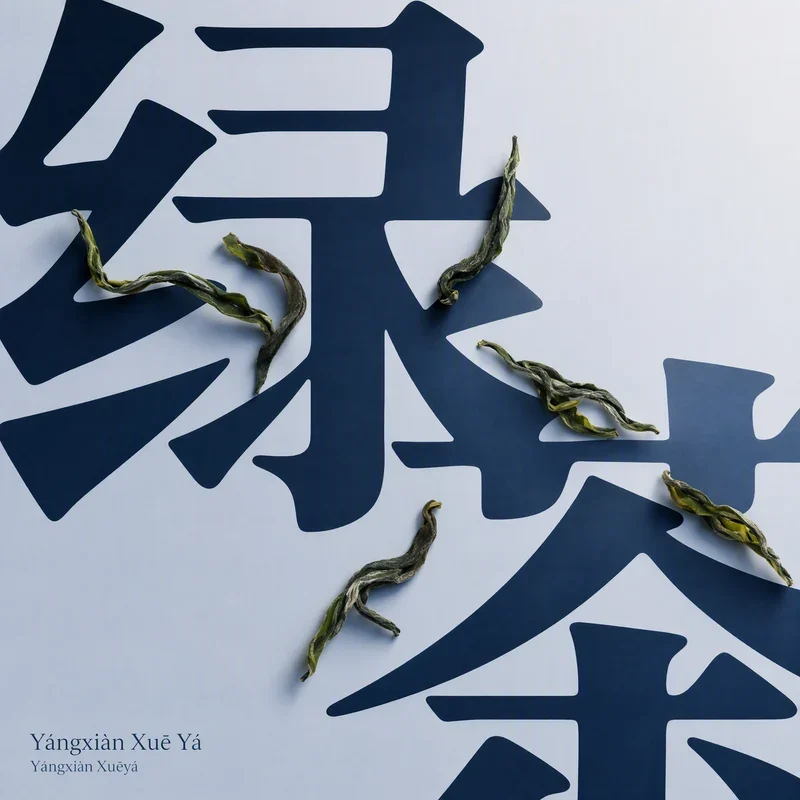
Name Breakdown: Yángxiàn (阳羡) — the ancient name of Yixing, used since the Han era; literally "sunny envy," presumably connected to the topography of local hills. Xuě (雪) — "snow," describing the white down on buds resembling snowflakes. Yá (芽) — "shoot, bud." The full name literally: "Snow Buds from Yangxian" — a poetic image tracing back to Su Shi's poem.
Cultivar: Main: Yixing population small-leaf variety (宜兴群体小叶种, Yíxīng qúntǐ xiǎoyè zhǒng) — a nationally recognized local superior variety, and Zhǔyèzhǒng (槠叶种, zhū yè zhǒng). Additionally used clonal varieties: Fúdǐng Dà Bái Chá (福鼎大白茶), Zhenong 137, 139, 113 (浙农137、139、113), Yíngshuāng (迎霜), Lóngjǐng Chángyè (龙井长叶) — all distinguished by abundant down and dense buds.
Picking: Early spring. For supreme grade: before Qīngmíng (清明, ~April 5) — pure buds. For first grade: one bud and one leaf in initial opening stage (一芽一叶初展). For second grade: one bud and one-two leaves. Amino acid content in spring picking ≥ 4.2%.
Pluck Standard: To produce 500 g of supreme grade tea requires 40,000–50,000 buds.
Raw Material: Whole, freshly picked shoots without mechanical damage, with abundant white down, uniform in size.
Altitude: 40–100 m above sea level. Despite the low elevation, abundant cloudiness from Taihu and protection from surrounding hills create a favorable microclimate.
Climate: Subtropical monsoon. Average annual temperature — 15.7°C. Humidity ≥ 70%. Number of foggy days per year — over 200. Significant diurnal temperature variation. Diffused light through cloud cover and tree canopies promotes accumulation of aromatic substances.
Soil: Deep red-yellow lateritic soils (红黄壤, hónghuáng rǎng), fertile layer thickness ≥ 1 m. pH 4.5–6.5, organic matter content ≥ 3%. Forest coverage of the territory — 74%.
The southern part of Yixing represents a hilly-mountainous landscape (丘陵山区) on the western shore of Lake Taihu. The region is famous for karst caves (famous Shanquandong and Zhanggongdong), bamboo groves ("Bamboo Sea," 竹海) and abundance of limestone springs. Tea gardens are located on gentle slopes and terraces, surrounded by forest and bamboo.
The core production zone is within the Taihu National Tourist Zone, where the use of chemical fertilizers and pesticides is prohibited. Since 1998, part of the plantations have been converted to organic management and certified by the National Center for Organic Product Development. The cloudy-foggy environment with diffused light (漫射光) promotes increased synthesis of amino acids and aromatic compounds.
Collected raw material is spread in a thin layer in a ventilated room for 4–5 hours. Moisture equalizes, initial aroma development begins.
Conducted in a drum machine (滚筒杀青) at about 280°C. High temperature ensures rapid complete enzyme inactivation, preserving bright green color and preventing "raw" grassiness.
Gentle rolling for 8–10 minutes. Goal — moderate cell wall destruction for subsequent complete extraction during brewing, without excessive damage to shoot form.
Temperature 90–110°C, drying to intermediate moisture content.
Additional shaping to fix the form.
Straightening and aligning shoots to achieve characteristic needle-like form.
At 50–80°C, the master rubs and stretches shoots while simultaneously "raising" white down on their surface. It is precisely at this stage that the signature appearance is formed: straight thin needles covered with silvery down — those very "snow buds."
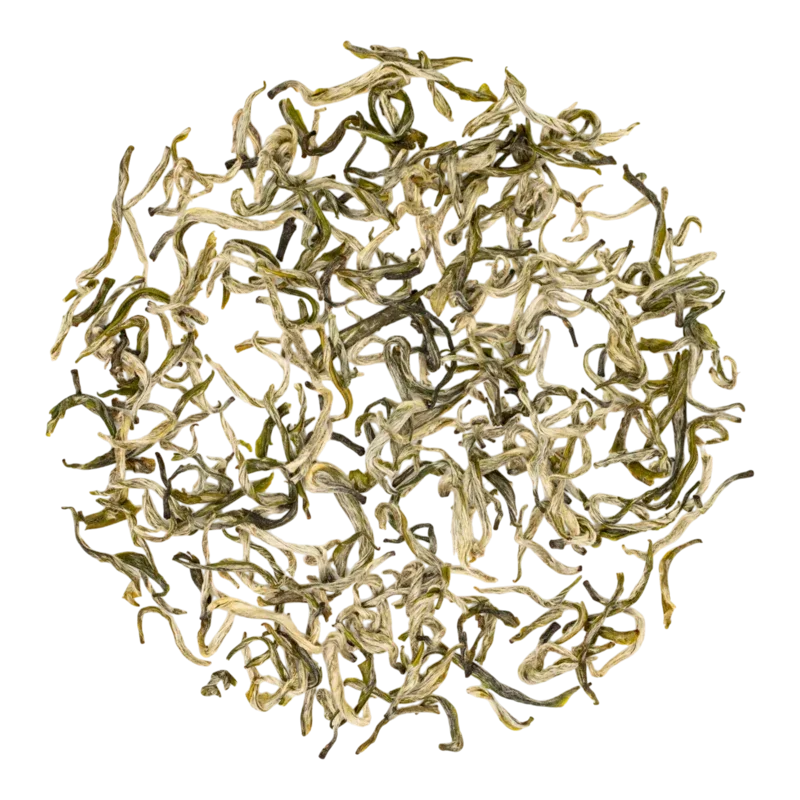
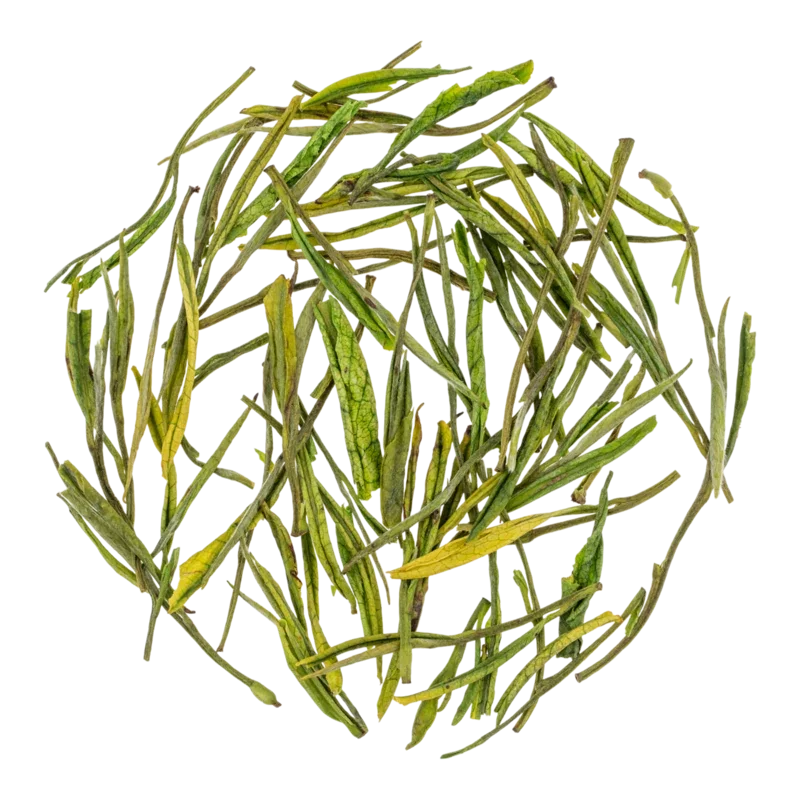
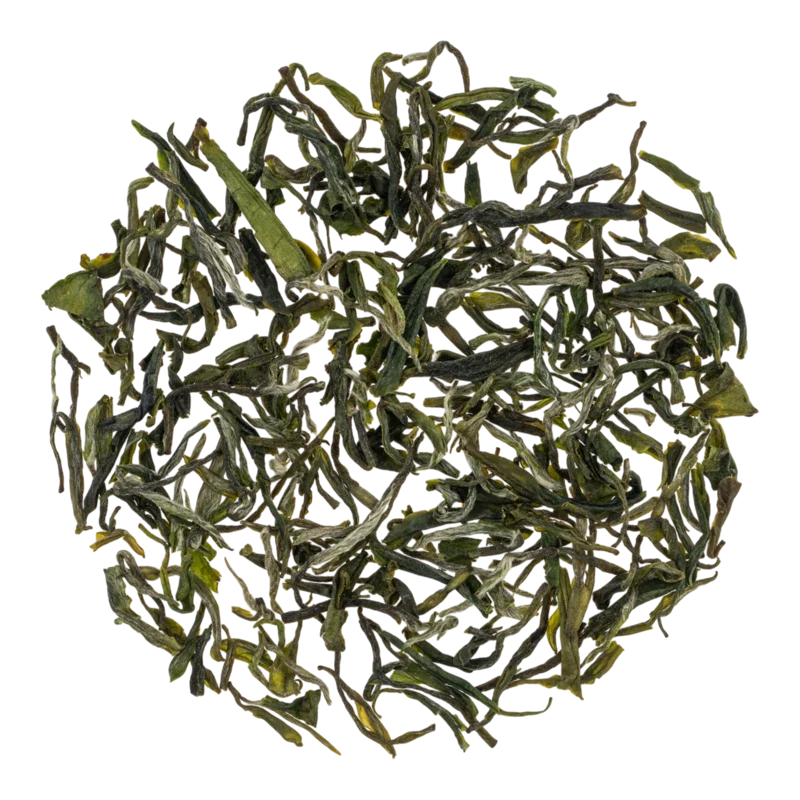
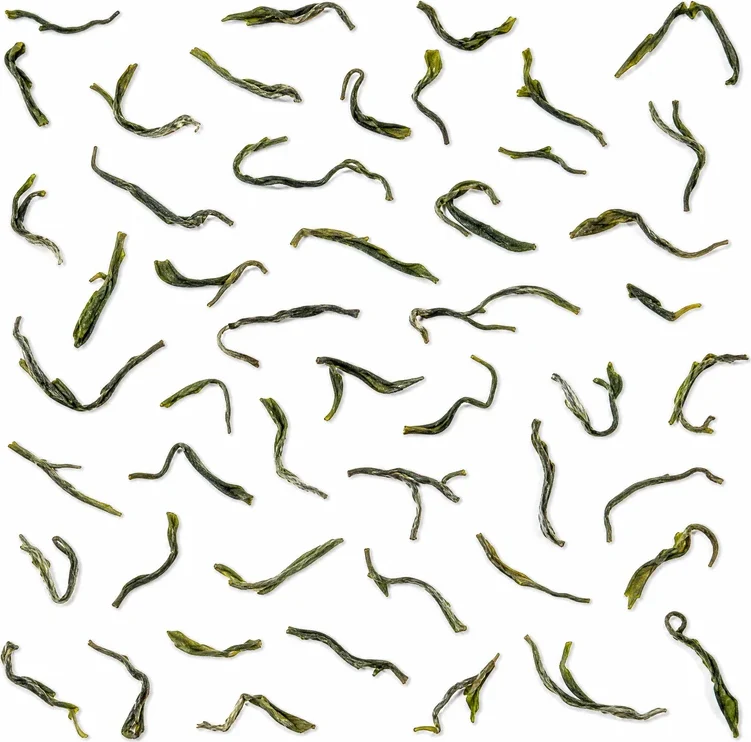
Dry Leaf Appearance: Needle-like form (针芽状, zhēnyá zhuàng) — shoots straight, thin, tightly twisted (紧直匀细). Color — rich emerald green with clearly visible silvery-white down (翠绿显毫). Uniformity of form and size — high.
Dry Leaf Aroma: Clean, delicate, with a hint of "young" freshness (清香, qīngxiāng). For expensive pickings before Qingming, characteristic so-called "tender aroma" (嫩香, nèn xiāng) — subtle, sweetish. In spring batches, a chestnut tone is audible (栗香).
Liquor Aroma: Elegant and clean (清雅, qīngyǎ), medium intensity, without harshness. Tonality — fresh greenery with light chestnut and floral notes. Aroma is persistent.
Liquor Color: Tender green, transparent and bright (嫩绿清澈明亮).
Spent Leaves: Tender, even, whole "bouquets" of shoots (嫩匀成朵), bright green color with living luster (绿润鲜活).
Taste: Fresh and clean (鲜醇, xiānchún), with pronounced sucrose-type sweetness (甘醇, gānchún). Bitterness and astringency are minimal — polyphenol content is relatively low (about 14.7% according to source data), while amino acid content is elevated, giving a bright "fresh" dimension (鲜爽度). Aftertaste — soft, with returning sweetness.
Amino Acids: Elevated content — ≥ 4.2% for spring picking supreme grade. L-theanine predominates, providing pronounced "fresh sweetness" and promoting relaxation. High amino acid to polyphenol ratio — key quality indicator determining the "freshness tasting index."
Typical level — 2.5–3.5% dry weight. Mild stimulation in synergy with L-theanine.
Favorable amino acid to polyphenol ratio (over 0.28) — characteristic determining the tea's belonging to the highest taste category "fresh and sweet."
Essential Oils: Chestnut aroma forms during roasting; delicate floral notes — linalool and geraniol.
Minerals: Fluorine (15 mg/100 g — high content, promoting tooth protection), potassium, manganese, zinc, selenium.
Polyphenols: Content about 14.7% — relatively low for green tea, explaining the mildness, lightness and minimal bitterness. Main catechins: EGCG, ECG, EGC.
Vitamins: Vitamin C (well preserved due to rapid high-temperature fixation), vitamins B₁, B₂, E, K.
Catechins, especially EGCG, according to source data, break down fats 30% faster than catechins in ordinary green tea, which may be due to raw material specificity.
L-theanine and caffeine in synergy provide mental clarity without nervous excitement.
High fluorine content (15 mg/100 g) suppresses cariogenic bacteria activity.
Catechins promote normalization of lipid metabolism.
Polyphenols and vitamin E jointly contribute to vascular elasticity.
Vitamin C and polyphenols provide general strengthening effect.
L-theanine promotes generation of brain α-waves, improving concentration.
Not recommended to drink on empty stomach. New tea should preferably be aged 10–15 days before consumption to "remove fire." Boiling water (above 85°C) destroys chlorophyll and worsens taste.
Tea Amount: 3 g per 150 ml (1:50 ratio). For gaiwan: 5 g per 100–120 ml.
Teaware: Glass tumbler (ideal for observing the opening of "snow buds"). Porcelain gàiwǎn (盖碗). Yíxīng clay teapot from zǐshā (紫砂壶) — historically and aesthetically the most "native" teaware for this tea.
Water Temperature: 80–85°C. Boiling water above 85°C is undesirable: destroys chlorophyll, liquor yellows, taste becomes coarse. However, according to local tradition, quality Yangxian Xue Ya tolerates even hotter water well — some Yixing tea experts brew it at 90–95°C, noting that the spent leaves remain even.
Shelf Life: 6–12 months. New tea is recommended to be aged 15 days in closed packaging to "remove fire" (褪火气). After opening — consume as soon as possible (ideally within 72 hours) to prevent delicate aroma evaporation.
Airtight packaging, protection from light, moisture and foreign odors.
Temperature: Refrigerator 0–5°C with strict sealing — optimal. For short-term storage (up to 2 months) — cool dark place.
Both are famous green teas with rich history, but completely different types. Longjing — flat, wok-fired, with bean-chestnut aroma and oily texture. Yangxian Xue Ya — needle-shaped, with delicate elegant aroma and more "transparent" taste. Ming's Yuan Hongdao considered Yangxian tea superior to Longjing.
Both are teas from the Taihu region (Biluochun — from the eastern shore, from Suzhou; Yangxian — from the western, from Yixing). Biluochun — spirally twisted, with fruity-floral aroma; Yangxian Xue Ya — straight, needle-shaped, with a more austere "clean" profile.
Both are needle-shaped green teas with abundant down. Maojian is usually more astringent and "strong"; Yangxian Xue Ya — softer and sweeter, with lower polyphenol content.
Both are distinguished by elevated amino acid content and mild "fresh" taste. However, Anji Bai Cha — flat, from white-leaf cultivar Bai Ye 1 Hao; Yangxian Xue Ya — needle-shaped, from traditional small-leaf Yixing varieties, with a more "warm" chestnut note.
Price Category: Supreme grade (特级, pure buds) — from 800 yuan per 500 g and higher. First grade (一级) — 400–700 yuan. Second grade (二级) — 150–400 yuan.
Authentic Yangxian Xue Ya — thin straight needles with silvery-white down. If shoots are curved, coarse or down is absent — likely substitution.
Should be clean, delicate, elegant. "Roasted," harsh or dull aroma — sign of technology violation or staleness.
Tender green, transparent, bright. Yellow or turbid liquor indicates old or poor-quality tea.
Shoots should open as even whole "bouquets" of bright green color. Torn or dark leaves — sign of coarse raw material.
Require confirmation from protected designation zone (9 townships of southern Yixing).
No reviews yet. Tell us what you think of this tea.
Rate this tea and share your impressions. We review each submission before publishing it.