Brewing
Gongfu brewing
- Water temperature
- 75 °C
- Tea amount
- 5 g
- Water volume
- 100 ml
- First steep
- 10 s
- Time added per infusion
- 5 s
- Infusions
- 3

Ānjí báichá
Choose a brewing method. Start with the recommended quantities and time, then adjust to taste.
Brewing
Brewing
Taste
Tea encyclopedia
Category: Famous green teas of China; product with protected geographical indication (地理标志产品, dìlǐ biāozhì chǎnpǐn). National standard — GB/T 20354-2006 "Geographical Indication Product. Anji Baicha."
Category: Famous green teas of China; product with protected geographical indication (地理标志产品, dìlǐ biāozhì chǎnpǐn). National standard — GB/T 20354-2006 "Geographical Indication Product. Anji Baicha."
Dìpù Township (递铺街道, Dìpù jiēdào), Huángdù Village of Xīlóng Township (溪龙乡黄杜村, Xīlóng xiāng Huángdù cūn) — "China's first white tea village" (中国白茶第一村), providing about 40% of the county's total production; Tiānhuāngpíng Town (天荒坪镇, Tiānhuāngpíng zhèn), Dàxī Village (大溪村, Dàxī cūn) — location of the mother tree; Shānchuān Township (山川乡, Shānchuān xiāng).
Coordinates: ≈ 30°38′ N, 119°41′ E (center of Anji County).
Origin: China (中国, Zhōngguó), Zhèjiāng Province (浙江省, Zhèjiāng shěng), Ānjí County (安吉县, Ānjí xiàn), Húzhōu City (湖州市, Húzhōu shì). The production territory covers all 15 townships and towns of Anji County.
Type: Green tea (绿茶, lǜchá) — non-oxidized; enzyme fixation by heat (杀青, shāqīng). Despite the name "white tea," Ānjí Báichá does not belong to the white tea category (白茶, báichá) in the six-type classification — it is a full-fledged green tea, named so exclusively for the color of young shoots.
Unlike Da Hong Pao with six mother bushes, or Xi Hu Longjing with eighteen "imperial" trees, Anji Baicha traces its origin to a single wild tree preserved in Tianhuangping mountains. All ~170,000 mu of modern plantations are clones of this one bush.
Anji Baicha is one of the most frequent objects of confusion in tea world. This is green tea called "white" due to leaf color, while true white teas (Bai Hao Yin Zhen, Bai Mu Dan) got their name from white down on buds and fundamentally differ in technology.
Modern tea scholars believe that precisely Anji Baicha's ancestor could have been that very "white tea" praised by Song Huizong in 12th century. If so, the tea literally "resurrected" after 900 years of oblivion.
In less than 40 years, Anji Baicha transformed from unknown wild plant into industry worth over 24 billion yuan, providing each farmer 5,000–7,000 yuan annual income increase and becoming symbol of successful "green" development.
When brewed in glass cup, Anji Baicha shoots sink to bottom and stand vertically like miniature bamboo forest — this is one of the most spectacular "tea ceremonies for eyes" among all Chinese green teas.
Cultural Significance: Anji Baicha is a brilliant example of "new generation tea" that became a national phenomenon within decades. Tea scientist Chéng Qǐkūn (程启坤, Chéng Qǐkūn) from the Chinese Academy of Agricultural Sciences established a connection between modern Anji Baicha and the white tea described by Song Huizong in "Daguan Cha Lun," giving this tea a thousand-year historical foundation. The former Chairman of the PRC, during an inspection of Yucun Village (余村) in Anji in 2005, first formulated the concept "Green mountains and clear waters are golden and silver mountains" (绿水青山就是金山银山), and Anji Baicha became a symbol of this philosophy: "One leaf enriched an entire people" (一片叶子富了一方百姓).
Temperature-sensitive white mutation (温度敏感型白化变异, wēndù mǐngǎn xíng báihuà biànyì). When average daily temperature is below 20–23°C, chlorophyll synthesis is blocked: chloroplast membrane structure develops with disruptions, pigment-protein complexes break down, chlorophyll is not synthesized — shoots acquire jade-white color (玉白色) with thin green veins. The whitening period (白化期) lasts about 30 days, peaking in April. When temperature rises above 23°C, leaves gradually turn green: first becoming white-green (花叶), then completely green. It is precisely during the whitening period that protease activity increases, soluble protein breaks down, and free amino acids accumulate — this determines the unique flavor profile.
Cultivar: Báiyè Yīhào (白叶一号, Báiyè Yīhào) — the main and only permissible cultivar for Anji Baicha production according to national standard. Belongs to the species Camellia sinensis var. sinensis. Shrub type (灌木型, guànmù xíng), medium-leaf variety (中叶种, zhōngyè zhǒng). Pronounced trunk; leaf elongated-elliptical, tip gradually pointed, slightly raised; leaf edge smooth, fine serration; leaf blade thin, veins shallow, light green.
Picking: Exclusively spring, during the shoot whitening period. Optimal window — from late March (before Qingming festival, 清明, Qīngmíng) to mid-April (before Guyu festival, 谷雨, Gǔyǔ). Early spring batches before Qīngmíng (明前茶, míngqián chá) are most valued.
Raw Material: According to national standard GB/T 20354-2006, raw material must be collected exclusively from Baiye Yihao variety bushes growing within Anji County boundaries, in spring period. Free amino acid content in finished tea — not less than 5%; moisture — not more than 5%.
Altitude: Core plantations — from 400 m and higher. The mother tree "Ancestor of White Tea" grows at about 800 m altitude. The higher the plantation location, the more pronounced the shoot whiteness, higher amino acid content, and finer aroma.
Climate: Subtropical monsoon, with distinct four seasons. Average annual temperature — about 15.5°C. Average annual precipitation — about 1,500 mm. Frost-free period — about 210 days. Daily temperature difference on mountain plantations — more than 10°C, which promotes amino acid accumulation. Cloud cover and fog on high-altitude areas reaches 80% — diffused light reduces direct ultraviolet exposure, slowing catechin synthesis and promoting formation of a mild flavor profile.
Soil: Weakly acidic yellow soils (弱酸性黄壤, ruò suānxìng huáng rǎng), formed by weathering of quartz sandstones and volcanic rocks. pH — 4.5–5.6. Soils rich in potassium, magnesium and other microelements, providing mineral base for flavor formation.
Anji County is located in the so-called "golden tea belt of the 30th parallel" (北纬30°黄金茶带), in northwestern Zhejiang Province, in the northern foothills of the Tiānmù Mountains (天目山, Tiānmù shān). Terrain — predominantly low mountains with deep valleys and abundant vegetation. Forest coverage of the county — over 70%, Anji is known as "China's bamboo capital" (中国竹乡).
Hand picking in morning hours during shoot whitening period. Harvested material is immediately delivered to the factory.
Harvested shoots are spread in thin layer at room temperature about 25°C for 3–4 hours. Purpose — light moisture loss and beginning of aroma formation.
Conducted in drum machine (滚筒杀青) at temperature about 280°C for approximately 90 seconds. High temperature deactivates oxidative enzymes and stops any oxidation. At this stage, precision is crucial: insufficient heating leaves "green" taste, excessive — gives burnt tone and destroys delicate aroma.
Temperature about 130°C, duration — about 3 minutes. Shoots are carefully straightened and formed into characteristic elongated shape. Fundamentally: unlike most green teas, Anji Baicha is not subjected to rolling (不揉捻, bù róuniǎn) — this preserves leaf integrity and its "phoenix-like" appearance.
Temperature about 90°C, time — about 10 minutes. Main moisture is removed.
Temperature decreases to 70°C, time increases to 20 minutes. Slow, gentle drying allows aroma fixation.
Temperature 60°C, duration — about 30 minutes. Delicate finishing stage forming fine, clean aroma of finished tea.
Removal of tea dust, foreign inclusions; sorting by grades; immediate hermetic packaging. According to standard, finished tea moisture — not more than 5%.
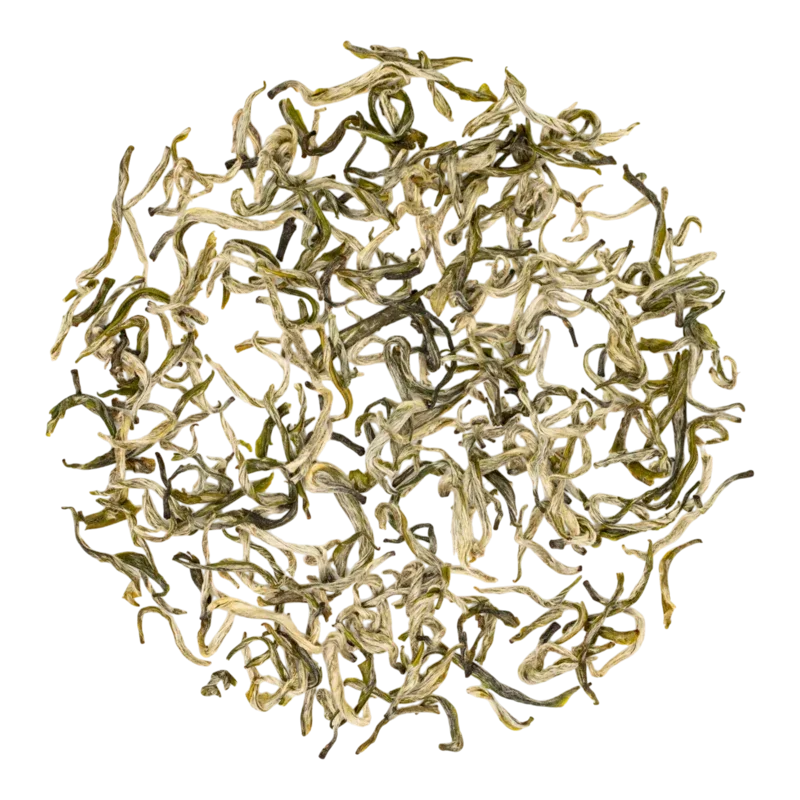
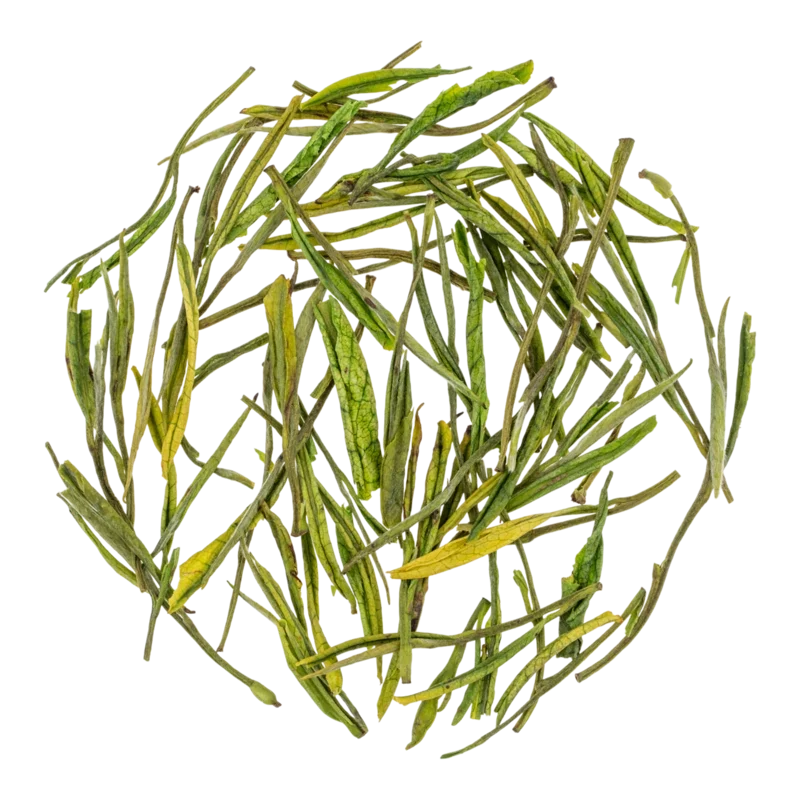
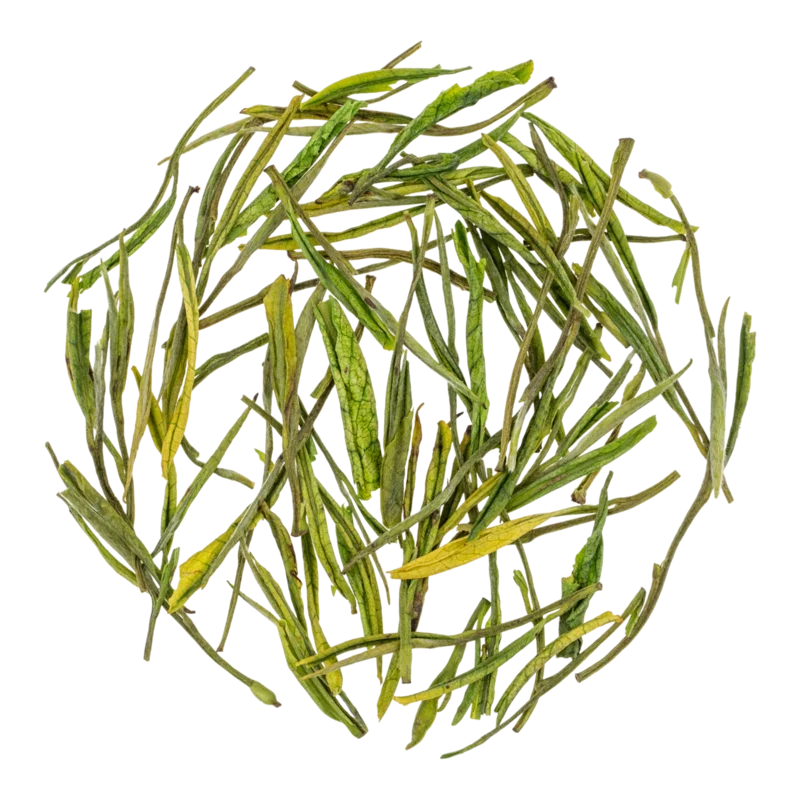
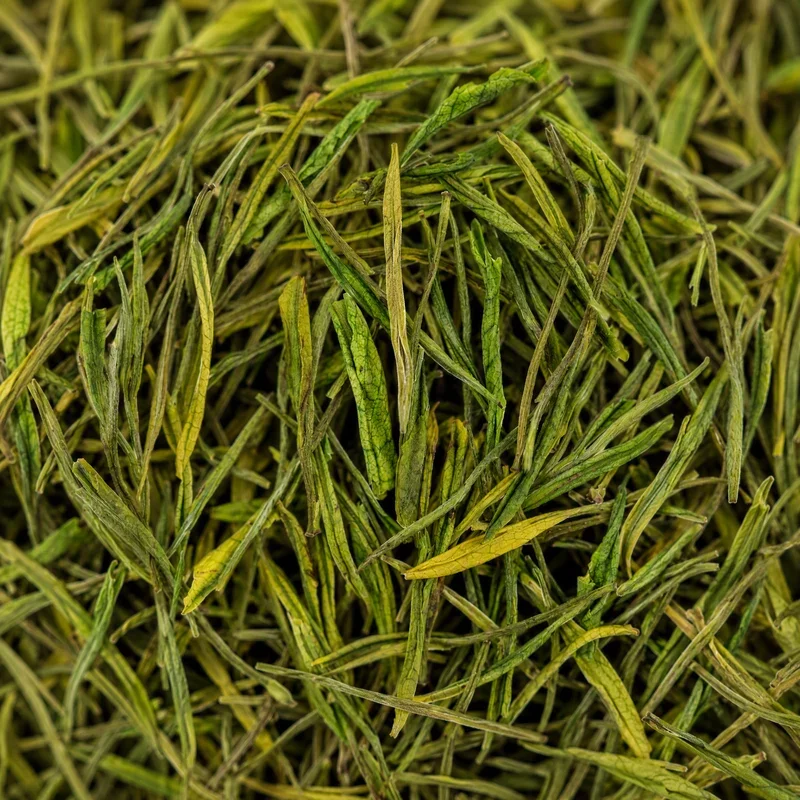
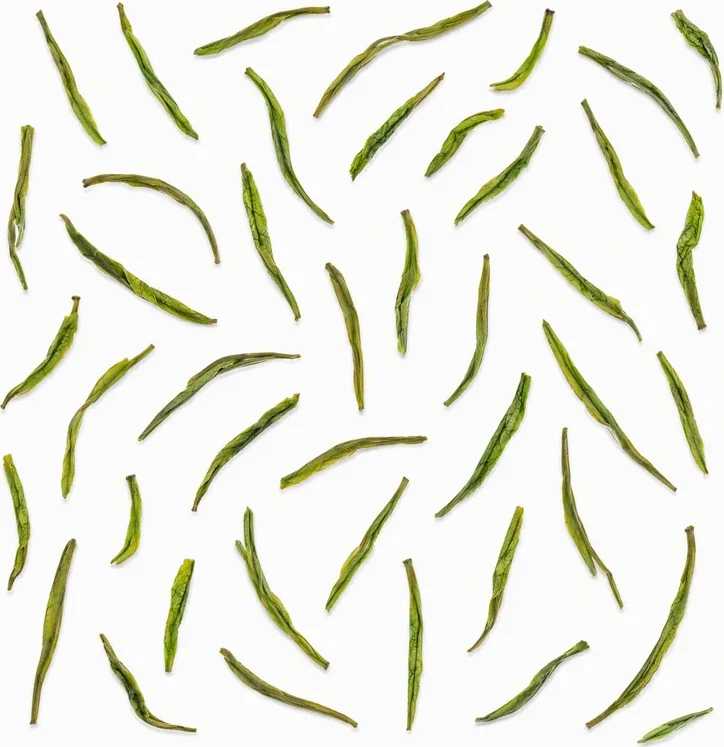
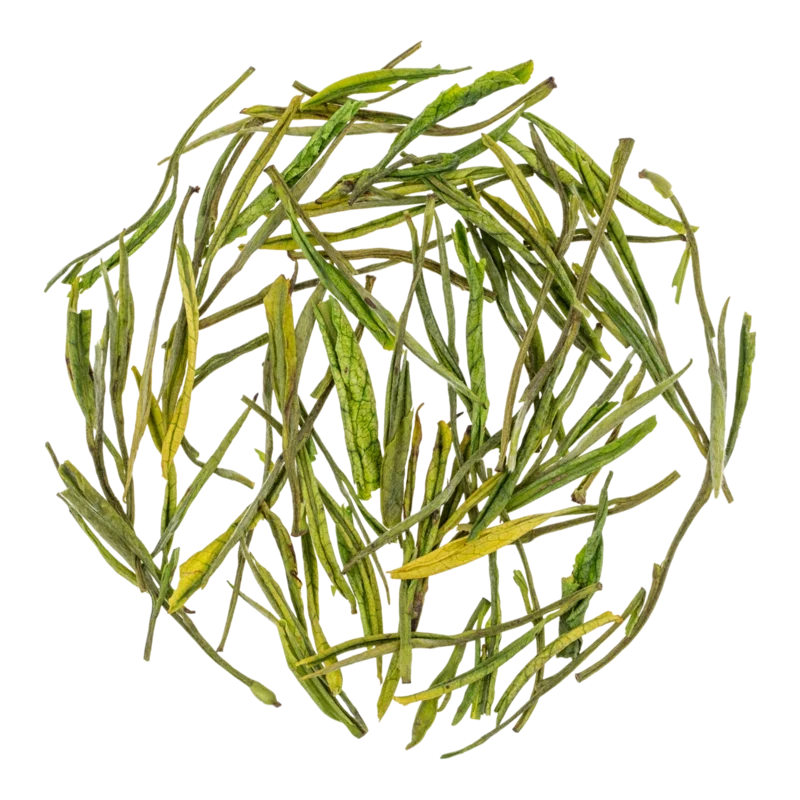
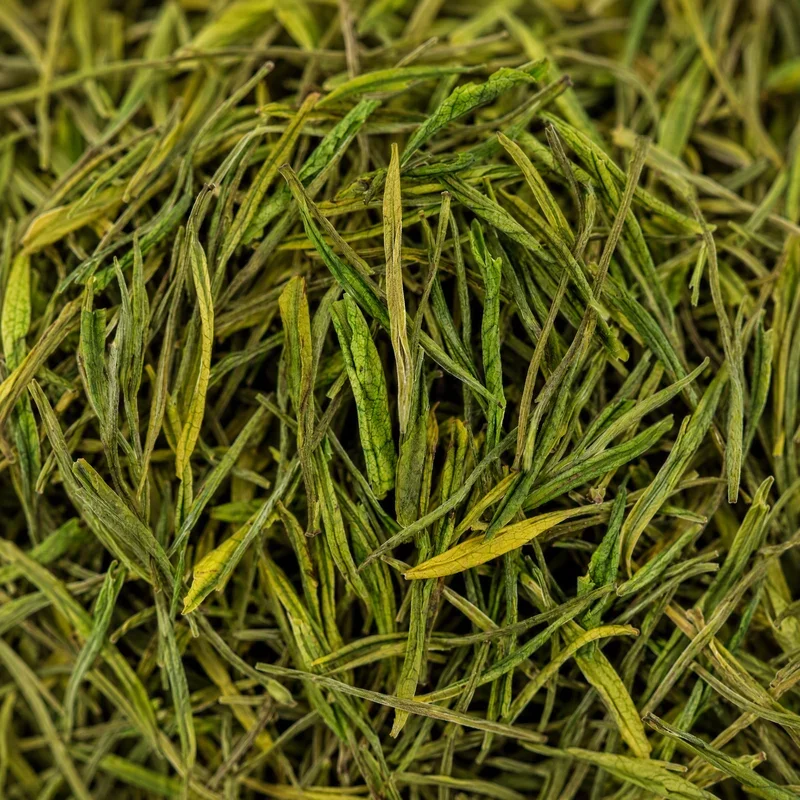
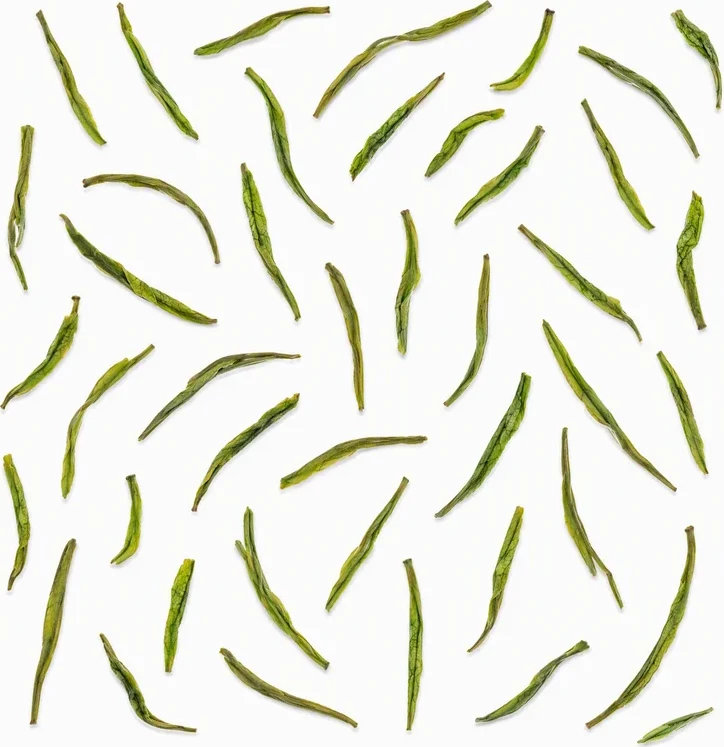
Dry Leaf Appearance: Three types are distinguished by shape:
Dry Leaf Aroma: Clean, fresh, with notes of young greenery and light milky undertone — characteristic "tender aroma" (嫩香, nèn xiāng), reminiscent of young bamboo shoots.
Liquor Aroma: High, clean, lasting. Base note — fresh greenery (清香, qīngxiāng), grassy-floral; middle — distinct milky-creamy tone (奶香, nǎi xiāng), due to specific lipid compounds of white shoot; top — fine sweetness, reminiscent of young bamboo sprouts or fresh almonds.
Liquor Color: Transparent, clean, light green with slight yellowish tint (清澈透亮). With proper brewing — crystal clear.
Spent Leaves: Shoots unfold and "stand" vertically in cup, like spring bamboo shoots (如春笋竖立). Color — jade-white, veins distinctly green (叶白脉翠). Buds and leaves whole, tender, easily distinguishable (芽叶朵朵可辨). This is one of the most spectacular teas for observation in glass vessels.
Taste: Outstanding freshness and purity (鲜爽, xiānshuǎng) — main calling card of this tea. Sweetness (甘甜, gāntián) manifests from first sip, without need to "wait for" returning sweetness (huí gān). Bitterness and astringency are practically absent — result of low polyphenol and caffeine content. Body silky, enveloping (顺滑, shùnhuá), with oily texture. Some tasters describe taste as "freshness of chicken broth" (鲜如鸡汤, xiān rú jī tāng) — metaphor emphasizing deep, rich umami profile.
Alkaloids: Caffeine (咖啡碱, kāfēi jiǎn) — about 2.8% (嘌呤碱), comprising approximately half the content in ordinary green tea. Theobromine and theophylline present in insignificant amounts. Low caffeine level makes this tea milder in nervous system impact.
Amino Acids: Total free amino acid content — 5–10.6% (according to different studies), which is 3–4 times higher than ordinary green teas (1.5–2.5%). 18 amino acids necessary for organism are found. L-theanine content (L-茶氨酸, L-chá ānjīsuān) — up to 5%, comprising 40–55% of sum of all free amino acids. Precisely theanine is responsible for characteristic sweetness, umami and relaxing effect of tea. High content mechanism: during whitening period protease activity increases, soluble protein breaks down into free amino acids.
Total content — about 5–13%, including epigallocatechin gallate (EGCG) — main antioxidant. Content lower than standard green teas, but sufficient for pronounced antioxidant action.
Zinc — 54.5 mg/kg; selenium — 0.2 mg/kg (noticeably higher than most other teas); potassium, magnesium, manganese, phosphorus, calcium, iron.
Polysaccharides (多糖类, duōtáng lèi) — provide smooth liquor texture; γ-aminobutyric acid (GABA, γ-氨基丁酸) — in noticeable amounts; essential oils — form milky-floral aroma.
Polyphenols: Content — 10–15.4%, noticeably lower than typical green teas (18–30%). Polyphenol to amino acid ratio (酚氨比, fēn ān bǐ) — 1.6–2.3 (ordinary green — 8–15). Precisely this low indicator explains absence of bitterness and astringency.
Vitamins: Vitamin C (ascorbic acid), B-group vitamins (B1, B2, B6), vitamin K. Tea covers significant part of daily vitamin C requirement with daily consumption of 2–3 cups.
Combination of L-theanine (relaxation, anxiety relief) and moderate caffeine amount gives mild, sustained alertness without nervousness. Caffeine content — approximately half that of ordinary green tea, making Anji Baicha suitable for people with caffeine sensitivity.
Catechins (primarily EGCG) neutralize free radicals, reducing cellular oxidative stress.
High theanine content stimulates T-cell activity — key elements of immune response.
Mild, low-polyphenol profile spares gastric mucosa; polysaccharides promote GI tract normalization.
Polyphenols and amino acids contribute to cholesterol reduction and vascular elasticity maintenance.
L-theanine promotes alpha brain wave production, improving attention concentration, memory and learning ability.
γ-aminobutyric acid (GABA) helps relieve visual strain.
Antioxidants and vitamins C, E support collagen production and slow photoaging.
Maximum sweetness and freshness felt at liquor temperature about 60°C.
4–5 g per 100–120 ml (gaiwan), 80–85°C, infusions 5–10–15–20–30 seconds with gradual increase. Gives more concentrated and rich flavor of each infusion.
Tea Amount: 3 g per 150–200 ml water (glass cup / gaiwan).
Teaware: Glass cup (玻璃杯, bōli bēi) — ideal for observing bud "dance"; gaiwan (盖碗, gàiwǎn) — for more controlled gongfu-style brewing; porcelain cup with lid. Yíxīng teapot (紫砂壶) not recommended — its porous walls absorb delicate aroma.
Water Temperature: 80–85°C. Never boiling water — high temperature enhances bitterness and destroys delicate amino acid profile. Optimal temperature for maximum sweetness revelation — about 80°C.
Shelf Life: After package opening — consume within 1–2 months for maximum freshness. Under ideal conditions (refrigerator, vacuum) unopened package maintains quality up to 12–18 months, but tea character slowly changes.
Mandatory. Foil packages with vacuum or gas (nitrogen) packaging — ideal option. Tea is hygroscopic and easily absorbs foreign odors due to high-molecular fatty acid (棕榈酶) and terpene content.
Direct sunlight destroys chlorophyll and catechins, causes yellowing and aroma loss. Store in opaque container.
Relative humidity — not more than 60%. Above 70% molding begins. Even with hermetic storage, re-drying recommended after 6 months.
After refrigerator removal, let package warm to room temperature (3–4 hours) before opening — this prevents moisture condensation on tea leaf.
Temperature: Optimally — 0–5°C (refrigerator). Anji Baicha, as fresh green tea with high amino acid content, is extremely sensitive to temperature increase: amino acids, vitamins and aromatic compounds rapidly degrade at room temperature.
China's most famous green tea. Flat leaf, wok-firing (锅炒, guō chǎo). Taste more "roasted," chestnut-like, with pronounced astringency. Significantly more polyphenols. Anji Baicha — noticeably milder, sweeter and more "amino acid" in profile.
From Jiangsu Province. Twisted spiral shape, fruity floral aroma. Higher polyphenol content, pronounced astringency. Anji Baicha differs with milky-creamy aroma and complete absence of bitterness.
From Anhui Province. Delicate, floral, with nutty notes. Closer to Anji Baicha in mildness, but lacks characteristic milky tone and such high amino acid content.
From Anhui. Large, long leaves, orchid aroma. More full-bodied and structured, but with pronounced astringency. Anji Baicha — more tender and sweet.
Local Anji green tea from ordinary (non-mutant) varieties. Traditional regional tea, but without unique amino acid profile of Baicha. Price — times lower.
Anji Baicha cost varies significantly depending on grade, harvest time and producer. Early spring batches before Qīngmíng (明前茶) — most expensive. Approximately: Special Grade / Premium from leading brands — from 1,000 yuan per 50 g and higher; first grade — 200–600 yuan per 100 g; second grade and post-Guyu tea — from 100 yuan per 250 g. Price factors: harvest time (before or after Qingming), plantation altitude, hand vs. machine picking, producer.
No reviews yet. Tell us what you think of this tea.
Rate this tea and share your impressions. We review each submission before publishing it.