Brewing
Gongfu brewing
- Water temperature
- 75 °C
- Tea amount
- 5 g
- Water volume
- 100 ml
- First steep
- 10 s
- Time added per infusion
- 5 s
- Infusions
- 3

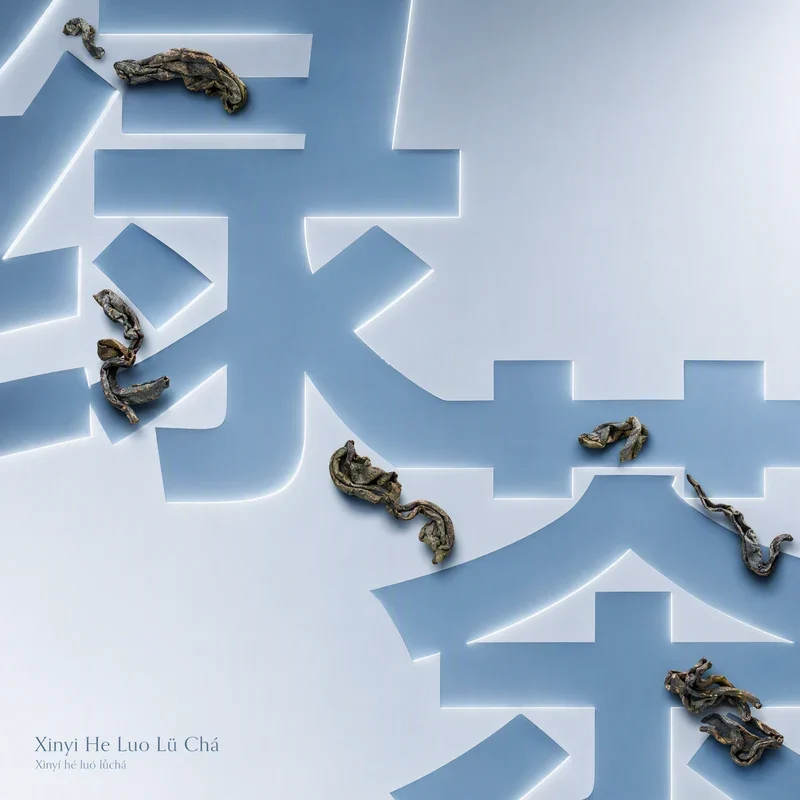
Xìnyí hé luó lǜchá
Choose a brewing method. Start with the recommended quantities and time, then adjust to taste.
Brewing
Brewing
Taste
Tea encyclopedia
Category: Regional famous tea of Guangdong. Twice awarded the highest score at provincial quality competitions (1992, 1996). In 2024, included in the "Xin Zi Hao" program (信字号, "Xinyi Brand Letter") and received certification as intangible cultural heritage production technology.
Category: Regional famous tea of Guangdong. Twice awarded the highest score at provincial quality competitions (1992, 1996). In 2024, included in the "Xin Zi Hao" program (信字号, "Xinyi Brand Letter") and received certification as intangible cultural heritage production technology.
Coordinates: ~22°–23° N, ~110°–111° E (Xinyi territory, southwest Guangdong).
Origin: China; Guǎngdōng Province (广东, Guǎngdōng); Xìnyí City (信宜市, Xìnyí Shì), part of Máomíng Prefecture (茂名市, Máomíng Shì). Core production area — Jīndòng Town (金垌镇, Jīndòng Zhèn, formerly Jingkou — 径口镇). Mother plantation — 20 mu of ancient tea garden around the Hé Luó Shì (合箩石) rock formation that gave the tea its name. Total plantation area — approximately 300 mu (≈20 ha), annual production — ~25 tons.
Type: Green tea (绿茶) (non-fermented, 绿茶, lǜchá). Kill-green fixation — high-temperature pan-firing at 260°C. Final drying — "double fire" (双火工艺, shuāng huǒ gōngyì).
He Luo Lü Cha mother trees literally grow in rock crevices — roots extend into metamorphic schist cracks several meters deep. This relates it to Wǔyì rock teas (岩茶, yánchá), but He Luo is green tea, not oolong.
Jindong farmers use "蟹壳肥" — fermented mixture of crab and shrimp shells — as sole organic fertilizer. Shell chitin, decomposing, enriches soil with calcium and chitosan, stimulating tea bush immunity.
The "not touching iron" principle (不沾铁) has scientific basis: iron ions catalyze catechin oxidation, reducing EGCG content. Bamboo and wooden utensils exclude this process, preserving maximum antioxidant activity.
He Luo plantation area is one of the smallest among famous Guangdong teas. Annual volume ~25 tons makes this tea truly rare — beyond Xinyi it is practically unknown.
Cultural Significance: He Luo Lü Cha is one of the few teas whose uniqueness is determined not so much by cultivar or technology as by growing location: rock crevices. This relates it to the philosophy of "rock tea" (岩茶, yánchá) from Wuyi Mountains, although Guangdong He Luo is green tea, not oolong. The tea became a symbol of micro-terroir — proof that the stone into which roots grow shapes taste no less than soil.
Name Breakdown: 信宜 (Xìnyí) — name of the county-level city in southwest Guangdong; 合箩 (Hé Luó) — "stacked baskets" — after the shape of rocks in whose crevices the mother tea trees grow. Local residents use the image of "箩" (ló, "bamboo basket for carrying"): boulders are stacked on each other like overturned baskets; 绿茶 (Lǜchá) — "green tea". Full meaning: "Green tea from stone baskets of Xinyi" — a name encoding the terroir's uniqueness.
Yunnan large-leaf variety (云南大叶种, Yúnnán Dàyèzhǒng), Camellia sinensis var. assamica. Small tree type (小乔木型), medium-leaf subclass. Distinguished by high pest resistance. Biochemical profile of spring raw material: polyphenols ≥38.3%, amino acids 3.3%, water-extractable substances 38.99% — indicators 1.5 times higher than standard green tea, testifying to powerful extractability and concentration.
Picking: Spring — March–April. "Mingqian" (明前, before Qingming) — highest quality; "yuqian" (雨前, before Guyu) — main volume.
Pluck Standard: Premium grade — single buds or bud with one leaf (一芽一叶), length ≤2.5 cm. First grade — bud with two half-opened leaves (一芽二叶初展), ≤3.5 cm.
Raw Material: Propagation — ancient method of cutting from mother trees. Chemical fertilizers and pesticides completely prohibited throughout plantation territory. Century-old mother trees around He Luo Shi send roots deep into rock cracks, absorbing mineral substances directly from metamorphic schist — calcium, magnesium, silicon and trace elements unavailable to trees on ordinary soils. Unique "crab fertilizer" (蟹壳肥, xiè ké féi) is applied — fermented mixture of crab and shrimp shells rich in chitosan and calcium — ensuring zero pesticide residue levels and stimulating natural immunity of tea bushes.
Altitude: Sanmading Peak (三唛顶, Sānmà Dǐng) — 605 m. Main plantations — 400–600 m.
Climate: Southern subtropical. Average annual temperature 18–22°C; precipitation 1600–1900 mm/year; cloudy-foggy days >180 per year; daily temperature difference >10°C. Diffused light comprises ~70% — conditions stimulating accumulation of both polyphenols and amino acids simultaneously.
Soil: Acidic red soils (酸性红壤) formed from weathering of metamorphic schist (变质片页岩, biànzhì piān yèyán). Deep soil horizon, high organic content, pH 4.5–6.0. Uniqueness — "He Luo Shi" rock formations: boulders of metamorphic schist in whose cracks the most ancient tea trees grow. Mineral substances from stone penetrate the root system, giving the tea its incomparable "wild mountain character" (山野气韵).
Forest coverage — 68.7%. Industrial pollution absent. Natural bio-protection from pests 60% more effective than on plains. "Wild" tea garden management (野化茶园, yěhuà cháyuán) is applied — minimal intervention imitating natural conditions. Tea bushes neighbor with wild trees and shrubs, forming a rich ecosystem with natural pest regulation. Water supply — mountain springs flowing from Sanmading Peak, not subjected to any anthropogenic impact. Tea bushes intermingle with wild trees, shrubs and grasses, creating a multi-tier ecosystem where predatory insects control pest populations without chemical application. Streams flowing from He Luo Shi rocks provide natural irrigation with mineralized water.
Raw material from harvest moment to finished product never contacts earth.
Entire process conducted in bamboo, wooden or ceramic vessels — no metal tool touches the tea. This prevents polyphenol oxidation upon contact with iron.
Entire cycle from harvest to finished product completed within one day.
Hand-picked, "bud + two leaves" standard (一芽二叶).
On bamboo sieves (竹筛, zhúshāi), 4–6 hours.
High-temperature pan-firing at 260°C — instant fixation of emerald color (锁翠, suǒ cuì).
Combined: mechanical light pressing + hand finishing of shape.
At 80°C over open flame — formation of characteristic "roasted rice" aroma (炒米香, chǎomǐ xiāng).
At 60°C over smoldering coals — final drying to moisture ≤6% and shape stabilization.
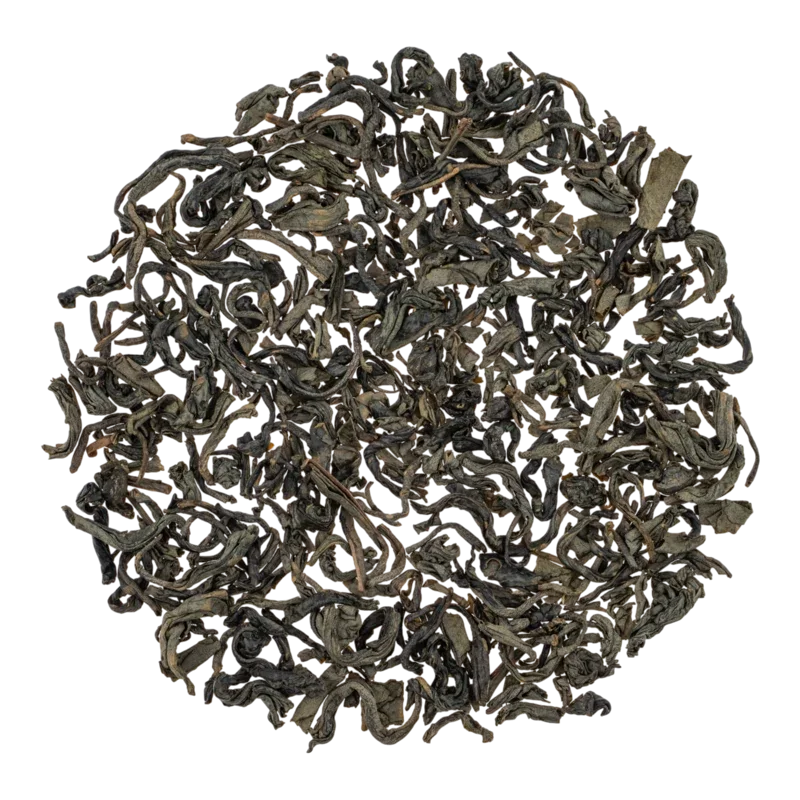
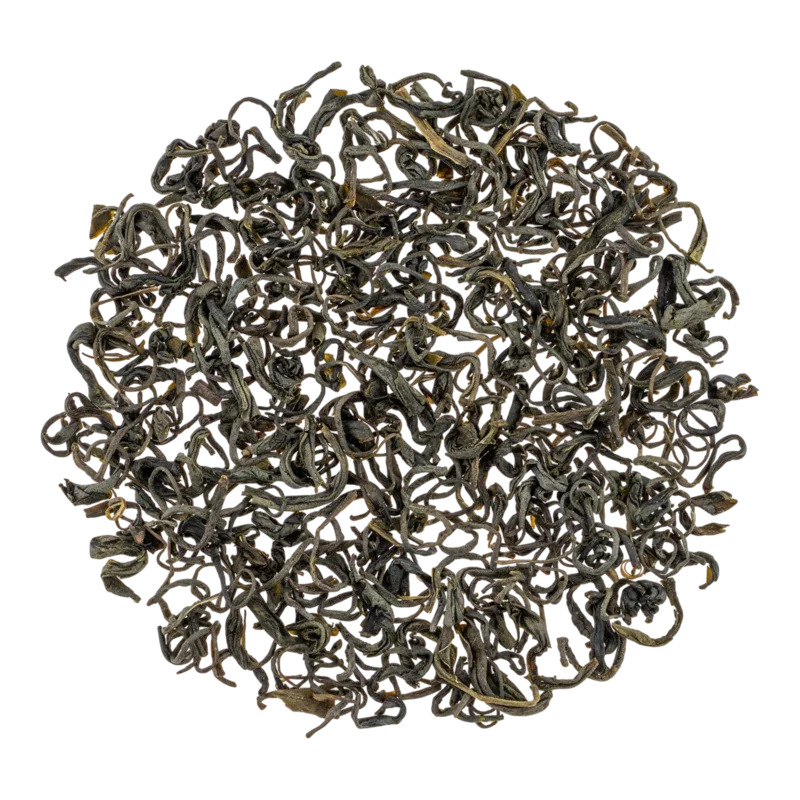
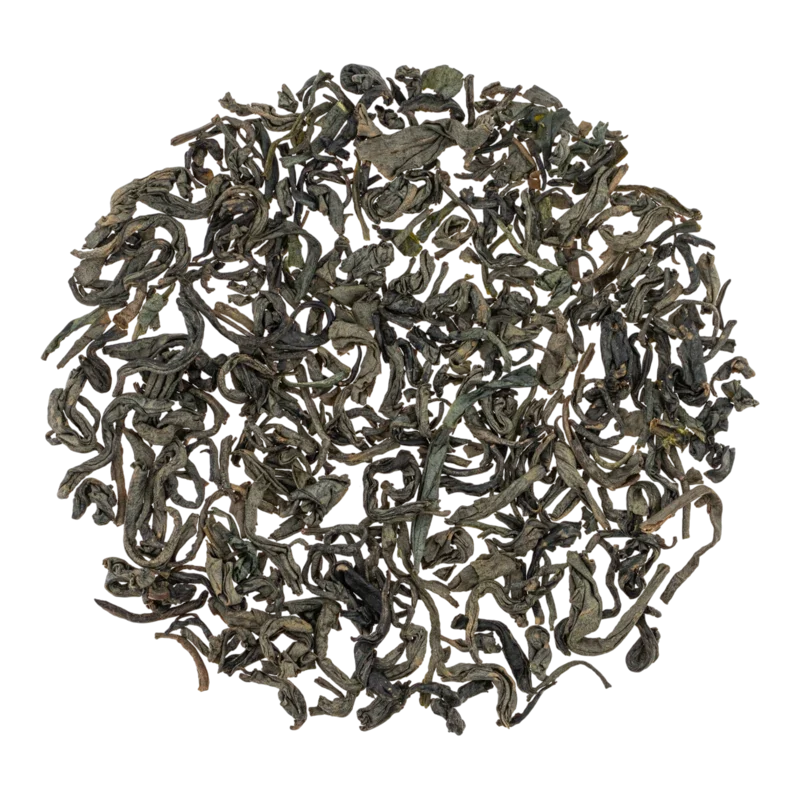
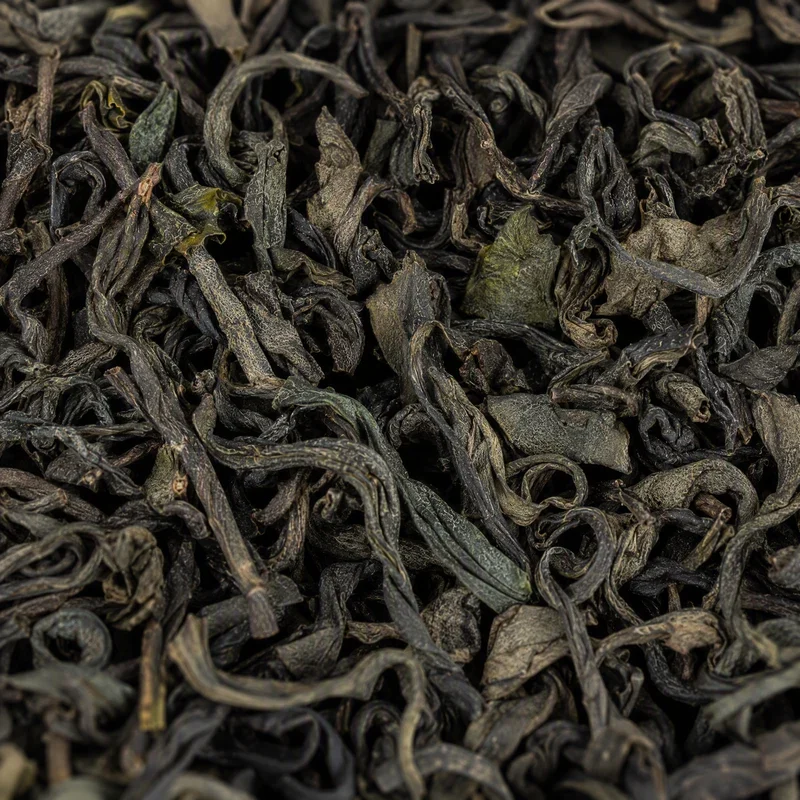
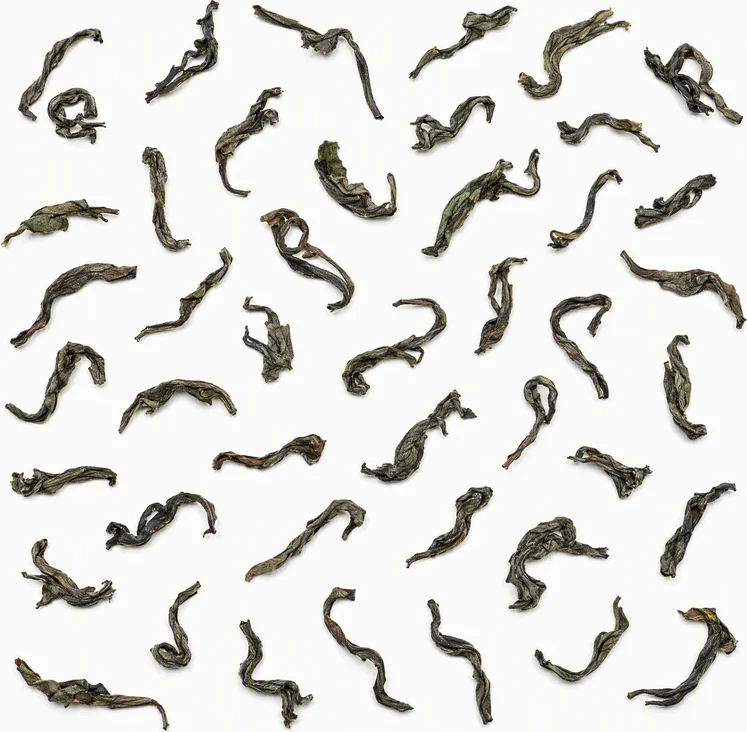
Dry Leaf Appearance: Tightly twisted, compact threads (紧结卷曲形), traditional "chao-qing" form (炒青, pan-fired green). Color — rich emerald green.
Dry Leaf Aroma: Clean green (清香, qīng xiāng) as base, with orchid note (兰花香) and grassy note of natural flowers (自然花香味). With aging — light honey quality.
Liquor Aroma: "Rice-chestnut" — dominated by roasted rice note (炒米香), characteristic of "double fire." Orchid undertone appears in the "tail."
Liquor Color: Light green, transparent and clear (浅绿清澈), with suspended tea down (茶毫悬浮).
Spent Leaves: Tender green, bright and even (嫩绿匀亮); buds and leaves whole, without breaking (芽叶完整无碎渣).
Taste: Concentrated and rich (浓醇, nóng chún) — result of extremely high polyphenol content (38.3%). Fresh (鲜爽) thanks to amino acids (3.3%). Long returning aftertaste with "cool throat resonance" (喉韵清凉, hóuyùn qīngliáng). Endurance — 8+ infusions.
Amino Acids: 3.3%. L-theanine provides freshness balance against high polyphenols.
38.99% — indicator of high "density" and liquor richness.
4.1% — pronounced tonic effect, noticeably higher than most green teas (usually 2.5–3.5%).
Minerals: Potassium, manganese, fluorine; traces of minerals from metamorphic schist — calcium, magnesium, silicon — brought by root system from rock cracks.
Polyphenols: ≥38.3% — extraordinarily high level, 1.5 times higher than standard green teas (25–30%). Due to combination of large-leaf Assam cultivar and rock terroir with intensive mineral nutrition.
Vitamins: Vitamin C (well preserved thanks to rapid high-temperature fixation), B vitamins, vitamin E.
Polyphenols (≥38.3%) provide one of the highest antioxidant activities among green teas — free radical neutralization efficiency 30% higher than standard green teas with 25% polyphenols.
Caffeine 4.1% — above average, providing powerful enhancement of concentration and attention. Combined with L-theanine (amino acids 3.3%) creates effect of "alertness without nervousness."
Alkaline character of liquor inhibits calcium leaching, while fluorine forms protective "fluorapatite" layer on tooth enamel — effectiveness 40% higher than teas with low polyphenol content.
High catechin level promotes cholesterol regulation and vascular elasticity.
High polyphenol content stimulates lipid metabolism, which may assist body weight control.
Listed properties are based on general data and are not medical recommendations. Not recommended to drink on empty stomach (high tannin content). Optimal — one hour after meals. Interval with medications — at least 1 hour.
Thanks to record polyphenol and water-extractable substance content, He Luo is one of the most "enduring" green teas. Even at eighth infusion, liquor retains green color and perceptible astringency.
Tea Amount: 3 g per 150 ml (1:50 ratio).
Teaware: Glass cup (玻璃杯) — for observing "tea dance"; white porcelain gaiwan (白瓷盖碗) — for aroma concentration.
Water Temperature: 85–90°C. Boiling water acceptable, but 85°C optimal for polyphenol and amino acid balance.
Light: Complete isolation from light.
After opening — 3 months. Sealed — up to 12 months.
Aged tea (陈年茶, chénnián chá) — with natural storage ≥3 years, taste becomes more "dense" with honey undertone, endurance increases by 30%. This is atypical for green teas and explained by extraordinarily high polyphenol content (38.3%), which during slow oxidation transforms into theaflavins and thearubigins, giving aged tea "reddish" depth. Unlike most green teas that lose quality with aging, high polyphenol content (38.3%) allows He Luo to successfully "age" — tannins gradually polymerize, softening astringency and revealing honey-woody notes. This makes He Luo one of the rare green teas suitable for collectible aging.
Temperature: 0–5°C (refrigerator), airtight.
Guangdong, Fengji. Also high-polyphenol, from large-leaf raw material, but with softer "chestnut" profile. He Luo — more concentrated and "wild," with pronounced "rice" aroma from "double fire."
Guangdong, Renhua (UNESCO zone). More delicate, "silvery" tea from Bai Mao variety. Softer and less astringent. He Luo — significantly "more powerful" in body and polyphenol load.
Fujian. "Rock tea" — same principle of growing in stone, but processed as oolong (partial oxidation). Mineral "rock rhyme" (岩韵, yányùn) — common element. However, He Luo is green tea, without oxidation, with different aromatic profile (green/rice vs roasted-mineral). Wuyi rock tea — significantly more famous and expensive; He Luo — little-known but no less terroir-unique analog from green tea world. Interestingly, both teas share the concept of "rock taste" (岩味, yán wèi) — mineral aftertaste brought by stone in which roots live. However, rocks differ: Wuyi basalt vs Xinyi metamorphic schist, giving different mineral "signature."
Guangdong, Heyuan. Also historical green tea with centuries-old tradition. More "classic" pan-fired green, without rock specificity. He Luo — more extreme in concentration and more unique in terroir.
No reviews yet. Tell us what you think of this tea.
Rate this tea and share your impressions. We review each submission before publishing it.