Brewing
Gongfu brewing
- Water temperature
- 75 °C
- Tea amount
- 5 g
- Water volume
- 100 ml
- First steep
- 10 s
- Time added per infusion
- 5 s
- Infusions
- 3


Mǎtú lǜchá
Choose a brewing method. Start with the recommended quantities and time, then adjust to taste.
Brewing
Brewing
Taste
Tea encyclopedia
Category: National Geographical Indication Product of China (国家地理标志保护产品, 2014). Intangible Cultural Heritage of Méizhōu (梅州市非物质文化遗产) — "二炒二揉" technology. One of the "Eight Famous Teas of Meizhou" (嘉应八大名茶, since 1984). "Red Army Tea" (红军茶). Winner of Guangdong Famous Tea Competitions: gold medal at the 6th competition (2005), silver at the 7th (2007), quality prize at the 5th (2002). By 2023 — 12,000 mu (~800 hectares), over 100,000 century-old trees, annual production value — 200 million yuan.
Category: National Geographical Indication Product of China (国家地理标志保护产品, 2014). Intangible Cultural Heritage of Méizhōu (梅州市非物质文化遗产) — "二炒二揉" technology. One of the "Eight Famous Teas of Meizhou" (嘉应八大名茶, since 1984). "Red Army Tea" (红军茶). Winner of Guangdong Famous Tea Competitions: gold medal at the 6th competition (2005), silver at the 7th (2007), quality prize at the 5th (2002). By 2023 — 12,000 mu (~800 hectares), over 100,000 century-old trees, annual production value — 200 million yuan.
Coordinates: Approximately 24°05′ N, 116°10′ E.
Origin: China, Guǎngdōng Province (广东省), Méizhōu City (梅州市), Fēngshùn County (丰顺县, Fēngshùn Xiàn), Lónggǎng Town (龙岗镇, Lónggǎng Zhèn), Mǎtú Village (马图村). Production also extends to neighboring villages Pingfeng (坪丰), Jiangkeng (江坑), and Songjiang (松江).
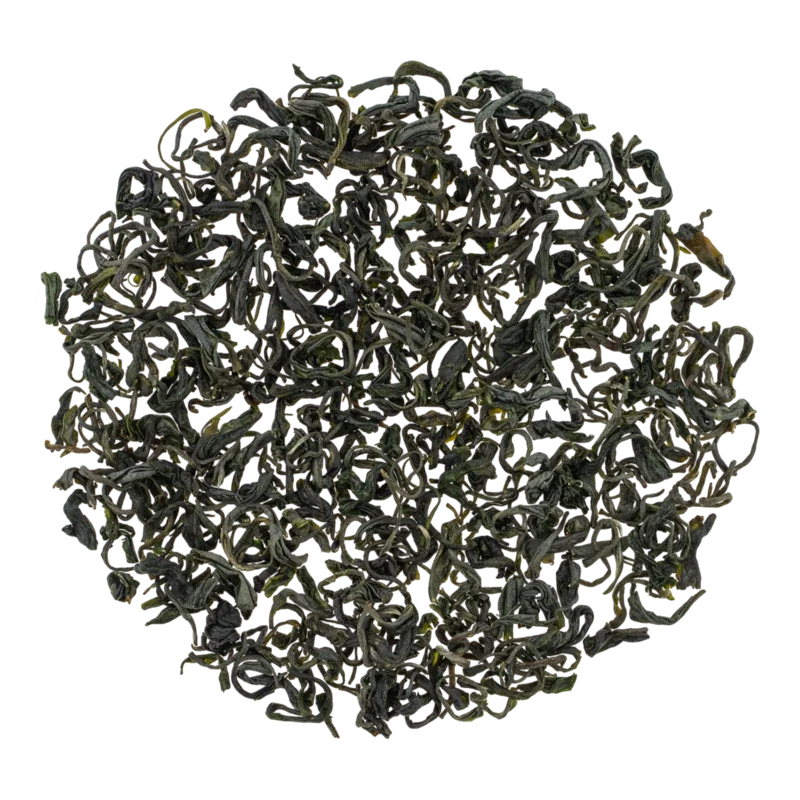
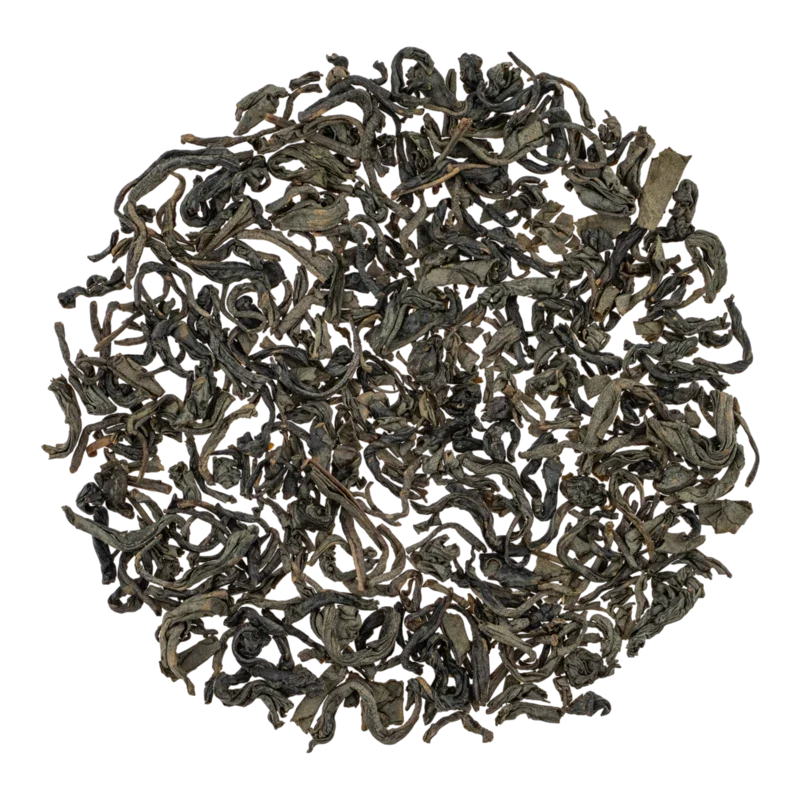
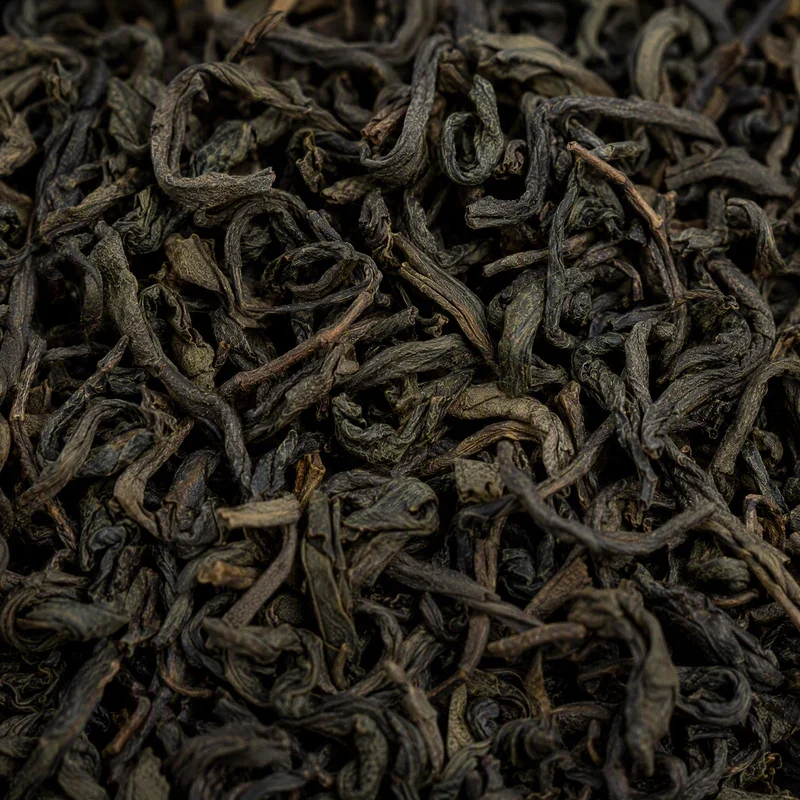
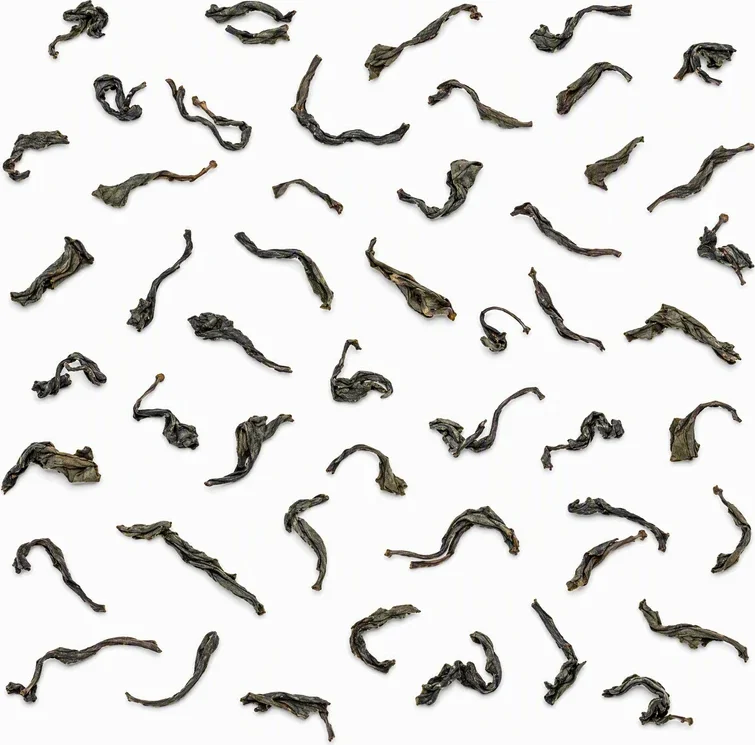
Type: Green tea (绿茶, lǜchá), non-oxidized. Pan-fired (炒青绿茶, chǎoqīng lǜchá). Shape — "eyebrow-like" (眉形, méi xíng): tight, slightly curved tea leaves of gray-green color with down.
Cultural Significance: Mǎtú is a Hakka village (客家, Kèjiā), and the tea is inseparably connected to Hakka identity. Hakka are a Han subgroup known for industriousness, clan solidarity, and preservation of traditions; Meizhou is the "Hakka capital" (客都, Kèdū). Matu Lü Cha is one of the tea symbols of this status. "Red Army Tea" symbolizes not only revolutionary heritage but also peasant industriousness: the seeds gifted by the marshal were accepted, preserved, and passed down through generations. The village is also an "old Soviet area" (老苏区, lǎo sūqū) — territory where Soviet power was established in the 1920s–30s. Today, a "Central Soviet Area Memorial Complex" is being built in Matu — a museum, marshal's square, revolutionary memorials, combined with tea tourism.
Over 100,000 century-old tea trees (of which ~2,800 mu are traditional small-leaf groves) — genetic reserve and source of raw material for the highest grade. One of the largest concentrations of ancient tea plants in Guangdong.
Chestnut aroma, persistent, with "mountain melody." From 120 yuan/500 g (up to 3,000 yuan/jin for premium batches from century-old trees).
Dense, less aromatic. 80–120 yuan/500 g.
Mass market, everyday. 40–80 yuan/500 g.
Traditional (条索紧结, chestnut-rice aroma) + innovative "Golden Needle / Silver Needle" (金针/银针 — from single buds, abundant down, fresh "green" profile).
Cultivar: Primary — Small-leaf oolong (小叶乌龙群体种, xiǎoyè wūlóng qúntǐ zhǒng), Camellia sinensis var. sinensis, population variety, bush type, medium-leaf. Descendants of seeds gifted by Zhu De in 1929 and earlier plantings (16th–19th centuries). Weight of 100 shoots (one bud + three leaves) — ~70 g. Polyphenols — 33.83% — one of the highest indicators among Guangdong green teas. Additionally — introduced cultivars: Jinmudan (金牡丹, Jīnmǔdān, "Golden Peony") and Meijian (梅尖, Méijiān, "Plum Point") — for innovative lines.
Picking: Spring — from Spring Equinox (春分, Chūnfēn) to Qīngmíng (清明, Qīngmíng). Standard — one bud + one leaf in initial opening stage (一芽一叶初展). Autumn tea is produced in limited volume.
Altitude: Core — water resource protection zone. Within a radius of several dozen kilometers — not a single source of pollution. Rivers originate at altitudes of 1,050 m (九龙嶂, 北山嶂). Chemical fertilizers and pesticides are prohibited.
Climate: Subtropical with pronounced mountain characteristics. Average annual temperature — 21°C (significantly lower at peaks). Average annual precipitation — 2,300 mm — one of the highest indicators among Chinese tea regions. Annual sunshine — 1,860 hours. Fog — over 200 days per year. From the 4th to 9th lunar months (approximately May–October), clouds cover the sun, leaving only 4–5 hours of sunshine per day — extreme "寡日照" (guǎ rìzhào, "low sunshine") even for cloudy Guangdong. Diurnal temperature variation is significant. Winter frosts come early, summer heat late, creating an extended vegetative period of moderate intensity.
Soil: Yellow-red sandy loams (黄红砂壤土, huánghóng shā rǎng tǔ) on weathered granites and quartzites of the Yánshān period (燕山期花岗岩、石英岩风化). pH 5.5–6.5 — optimal acidity. Parent rock also includes purple sandstones (紫色砂岩). Organic matter is abundant, vegetation cover — predominantly ferns (蕨草).
Freshly picked shoots are spread in a thin layer on bamboo trays. Time — 2–4 hours depending on humidity. Initial reduction of turgor and initiation of aroma formation.
Cast iron wok (铁锅, tiě guō), temperature ~200°C. Method of "tossing + steaming" (扬焖结合, yáng mèn jiéhé): alternating high tossing of leaves (for rapid evaporation) and pressing against wok walls (for gentle heating). Enzyme inactivation. Time — 5–8 minutes.
Leaves are rolled in a bamboo container. Goal — destruction of cell membranes, beginning formation of "eyebrow-like" shape. Pressure — moderate.
Repeated high-temperature treatment in the wok. Goal — additional fixation, enhancement of chestnut aroma and "rice" note. Temperature — 160–180°C.
Repeated shaping. More intensive pressure — compacting the tea leaf, final formation of "eyebrow-like" silhouette.
Temperature — 120–140°C. Shape fixation and "lifting" (提香, tíxiāng) of aroma: Maillard reaction between amino acids and sugars forms chestnut and "roasted rice" notes.
Final reduction to moisture content ≤5%.
Dry Leaf Appearance: "Eyebrow-like" tea leaves (眉形): tight, slightly curved, gray-green with down (灰绿显毫, huī lǜ xiǎn háo). Size — medium, uniform. In the highest grade (century-old trees) — smaller leaves, abundant down.
Dry Leaf Aroma: Chestnut (板栗香, bǎnlì xiāng) — primary, warm and rounded. "Roasted rice aroma" (炒米香, chǎomǐ xiāng) — from traditional "fire work" (火工, huǒgōng) of double pan-firing. Light "mountain" note.
Liquor Aroma: Chestnut-rice complex unfolds brightly, with addition of "mountain melody" (山韵, shānyùn) — high-altitude terroir tone, perceived as a cool mineral "shadow" behind the warm chestnut "body." Persistence — 5–7 infusions for high-altitude tea.
Liquor Color: Blue-green, transparent, with light yellow tone in light (青绿透亮略带微黄, qīnglǜ tòuliàng lüè dài wēi huáng). Clear, without turbidity.
Spent Leaves: Soft, tender, uniform, "lively" (柔软幼嫩、匀整鲜活, róuruǎn yòunèn, yúnzhěng xiānhuó). Leaves open completely, maintaining integrity — sign of careful hand rolling.
Taste: Sweet-mellow (甘醇, gān chún) — sweetness is noticeable from the first infusion. Fresh (鲜爽, xiān shuǎng). Dense and strong (浓强, nóng qiáng) — high content of soluble substances and polyphenols (33.83%) gives perceptible "body." Returning sweetness — persistent, with extended "throat melody" (喉韵绵长, hóuyùn miáncháng) — aftertaste is felt deep in the throat, not just on the tongue.
Amino Acids: ≥3.10%. L-theanine — main component. Content lower than "northern" teas (Yimeng Yu Ya, Rizhao), but sufficient for forming pronounced "fresh" profile. Polyphenol/amino acid ratio (~10:1) shifted toward polyphenols — hence more "strong" and "dense" taste character.
Approximately 3.5–4.5% — elevated, typical for small-leaf oolong raw material.
Elevated content — tooth enamel protection. Tea bushes on acidic granitic soils accumulate fluoride from groundwater.
K, Mg, Mn, Zn, Fe, F.
Chestnut and "rice" aroma are formed by pyrazines (2-ethyl-3,5-dimethylpyrazine and others) and furan derivatives — result of double pan-firing and Maillard reaction. "Mountain melody" (山韵) — complex of terpenoids accumulated under extremely low sunshine (4–5 hours/day).
Polyphenols: 33.83% — high indicator, significantly above average for green tea (~18–25%). Explained by combination of small-leaf oolong cultivar (genetically predisposed to high catechin content) and subtropical climate with abundant precipitation. Main catechins: EGCG, ECG, EGC.
Vitamins: C, B₁, B₂, E, K, β-carotene.
Polyphenols 33.83% — one of the highest indicators among green teas. EGCG neutralizes free radicals, reduces oxidative stress, protects DNA from damage.
Elevated caffeine (~3.5–4.5%) provides pronounced tone; L-theanine softens the "nervous" peak, forming "clean alertness."
Elevated fluoride content prevents enamel demineralization and suppresses growth of cariogenic bacteria.
Catechins improve endothelial function, promote normalization of blood pressure.
EGCG stimulates fatty acid oxidation, reduces LDL levels.
Polyphenols suppress expression of pro-inflammatory cytokines.
L-theanine stimulates brain α-waves, improving attention and working memory.
Optimal for extraction control and observing "mountain melody" in successive infusions.
For observing "standing buds" (芽叶竖立, yá yè shù lì) and enjoying liquor color.
Tea Amount: 3 g per 100 ml (gaiwan) or 3 g per 200 ml (glass cup).
Water Temperature: 80–85°C.
Enemies: Moisture, light, heat, foreign odors.
Shelf Life: In sealed packaging at 0–5°C — up to 18 months.
Airtight packaging, refrigerator 0–5°C.
"Rest" 7 days after production.
Consume within 10 days — chestnut-rice aroma formed by double pan-firing is more stable than many green teas but still subject to oxidation.
Another Guangdong green tea with geographical indication (from Shaoguan). Also produced with bamboo tools without metal contact. However, Renhua Yin Hao — from Bái Máo Chá cultivar (白毛茶), with abundant down and more "fresh" profile. Matu Lü Cha — from small-leaf oolong, with chestnut-rice aroma and "mountain melody."
Guangdong green tea from Renhua, known for abundant white down and "jade-green" liquor. More delicate and "fresh" profile. Matu Lü Cha — more "full-bodied," with pronounced "fire" character of double pan-firing.
"Fellow townsman" from the same Meizhou (Meixian County). From small-leaf local varieties and Jinxuan cultivar. Received GI in 2020. Similar Hakka context, but without "revolutionary" history and without concentration of century-old trees.
Shandong "northern" green tea for contrast. Both — high-altitude cloud teas with chestnut aroma, but Laoshan — at 35° N in temperate climate, while Matu — at 24° N in subtropics. Differences in polyphenols: Matu — 33.83% (subtropical), Laoshan — significantly lower (northern latitudes slow catechin synthesis).
No reviews yet. Tell us what you think of this tea.
Rate this tea and share your impressions. We review each submission before publishing it.