Brewing
Gongfu brewing
- Water temperature
- 75 °C
- Tea amount
- 5 g
- Water volume
- 100 ml
- First steep
- 10 s
- Time added per infusion
- 5 s
- Infusions
- 3


Kānghé chá
Choose a brewing method. Start with the recommended quantities and time, then adjust to taste.
Brewing
Brewing
Taste
Tea encyclopedia
Category: Chinese geographical indication product (国家地理标志证明商标, 2023). Intangible cultural heritage of Guǎngdōng (广东省非物质文化遗产, 2012). "Top Ten Green Teas of Guangdong" (广东十大好绿茶, 2020). The only tea in Guangdong with "tribute tea" status under four emperors.
Category: Chinese geographical indication product (国家地理标志证明商标, 2023). Intangible cultural heritage of Guǎngdōng (广东省非物质文化遗产, 2012). "Top Ten Green Teas of Guangdong" (广东十大好绿茶, 2020). The only tea in Guangdong with "tribute tea" status under four emperors.
Coordinates: Approximately 24°00′ N, 115°15′ E.
Origin: China, Guǎngdōng Province (广东省), Héyuán City (河源市, Héyuán Shì), Dōngyuán County (东源县, Dōngyuán Xiàn), Kānghé Town (康禾镇, Kānghé Zhèn). Kānghé is located in a provincial nature reserve (康禾省级自然保护区), in northeastern Guangdong.
Type: Green tea (绿茶, lǜchá), formally non-oxidized, however the technology includes a stage of «做青» (zuòqīng, "green-making" — shaking to stimulate partial oxidation), which gives the tea characteristics typical of oolongs: «绿叶镶边» (lǜyè xiāngbiān, "green leaves with red edges") — reddish spots along the leaf edges. This makes Kanghe Cha a "borderline" tea — between green tea and oolong.
Cultural Significance: Kānghé Chá is one of the few teas embodying Hakka (客家) tea culture. The Hakka — an ethnic Han group that historically migrated from north to south China — brought their own tea philosophy to Guangdong, whose key principle is: «火功不足不可饮» — "If the fire [processing] is insufficient, it cannot be drunk." This principle determines the "high-fire" character of Kanghe Cha. Xiankeng Village (仙坑村) — the "cradle of tribute tea" — has preserved the architecture of Hakka "weilong houses" (围龙屋, "dragon-encircling houses").
Qīngxīn Oolong (青心乌龙, "Pure Heart Oolong" — orchid aroma), Jīnxuān (金萱, "Golden Lily" — milky aroma), Taiwan Ruǎnzhī Oolong (台湾软枝乌龙 — suitable for spherical rolling).
Single bud or one bud + one leaf, length ≤2.5 cm. Replica of Qing "tribute tea." Price — from 600 yuan per 500 g.
One bud + one leaf.
One bud + two leaves.
Mature leaf, for tea houses.
Cultivar: Primary:
Picking: Three seasons: mingqiancha (明前茶, before Qingming — highest grade), yuqiancha (雨前茶, before Guyu — medium grade), qiucha (秋茶, autumn — mass production).
Climate: 24–25° N. Kanghe Provincial Nature Reserve. Average annual temperature — 17–19°C. Precipitation — 1600–1900 mm/year. Cloud cover — more than 180 days. Diffused light — 70%. Daily temperature difference — more than 10°C.
Soil: Acidic yellow soils (酸性黄壤), layer thickness — more than 1 m. Rich in organic matter. Chemical fertilizers and pesticides are prohibited.
600–1000 m a.s.l. Core area — Xiankeng Village (仙坑村) and Wǔzhǐshān Tea Gardens (五指山茶园, 1000 m a.s.l.).
Forest coverage — 78.48% (one of the highest among tea regions in Guangdong). Natural pest protection — 60% more effective due to the reserve's biodiversity. Tea rows are interspersed with cherry trees (樱花套种) — a unique "tea + sakura" model.
Mingqiancha, one bud + two leaves.
Key stage. Leaves are withered at high temperature (unlike standard gentle withering of green tea), losing 8–12% of mass. This stage forms the signature "roasted rice aroma" (炒米香) — sweet, warm, reminiscent of roasted glutinous rice. Principle: «火功不足不可饮» — "Insufficient fire — cannot be drunk."
Shaking (摇青) to stimulate partial oxidation of leaf edges. This stage is an oolong characteristic in green tea, creating «绿叶镶边» ("green leaves with red edges").
Wok, 260°C.
Light, into strips.
To moisture content ≤6.5%.
Shape fixation and "aroma lifting."
Liquor Color: Yellow-green, bright and clear.
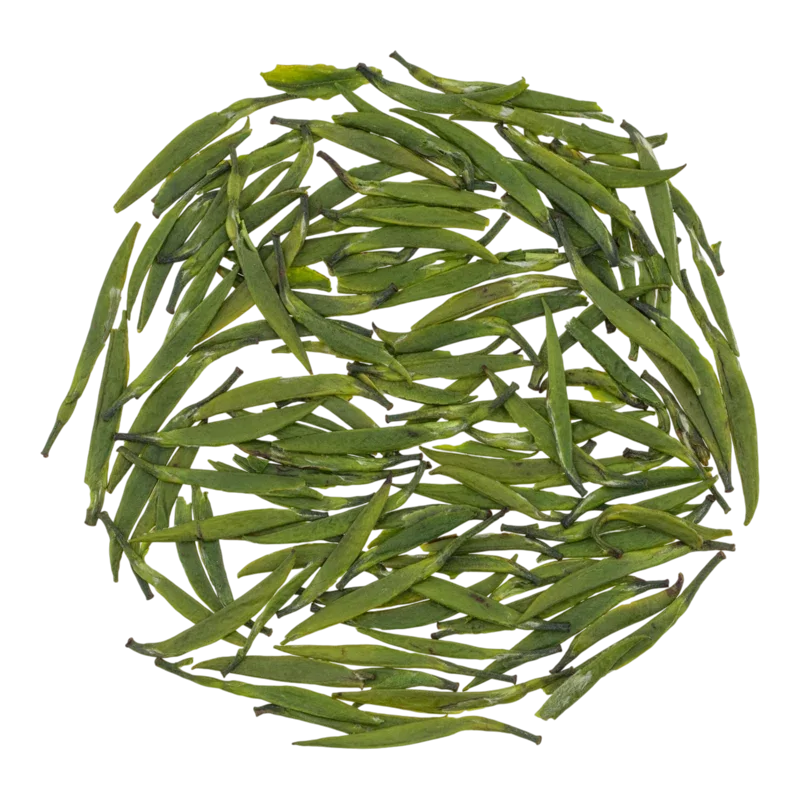
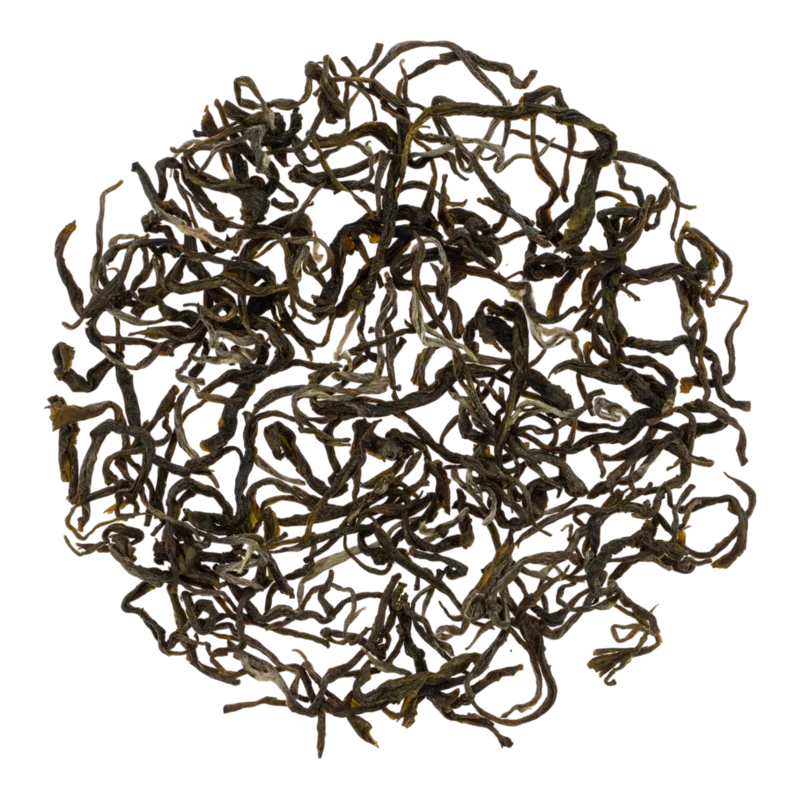
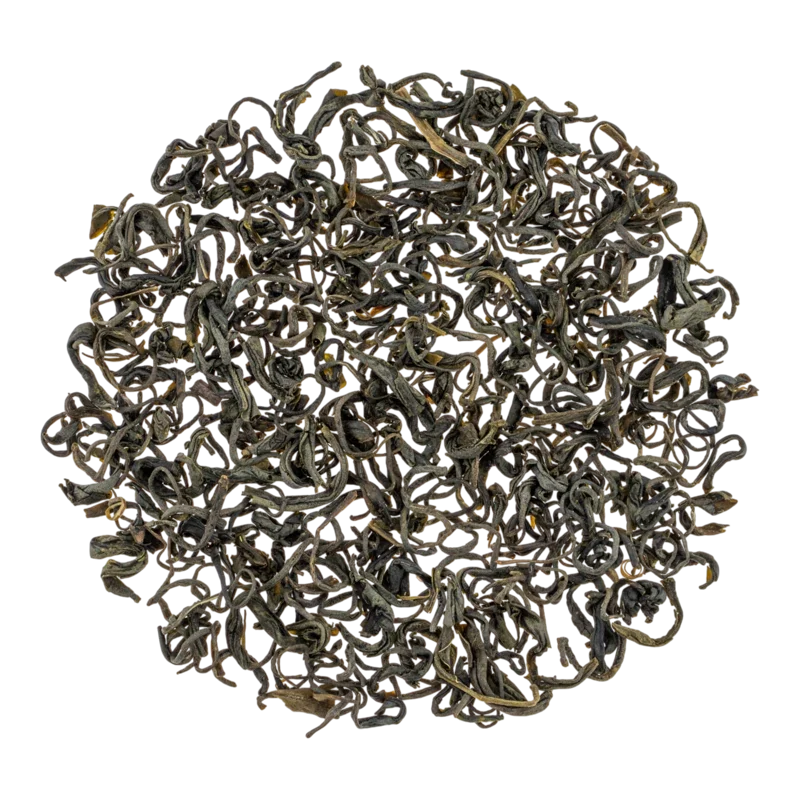
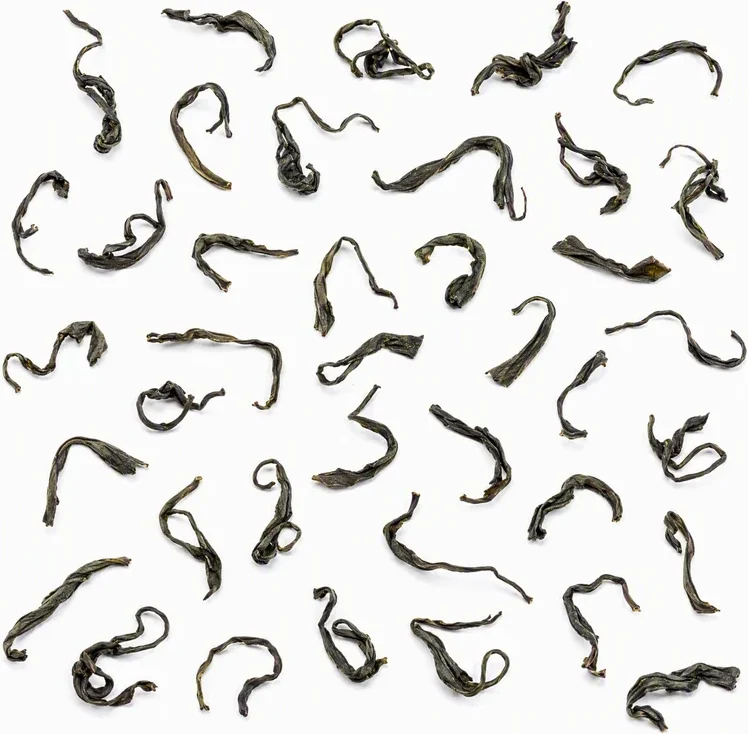
Traditional (卷曲形): tight spirals, gray-white color (色泽灰白). Innovative (扁形): flat, straight, green. Spent leaves — yellow-green, soft, with red spots along leaf edges (叶缘红点, «绿叶镶边»).
"Roasted rice aroma" (炒米香) — primary note, signature of Hakka technology. In introduced varieties — orchid tone (兰花香, from Qingxin Oolong). With aging — honey aroma (蜜香).
Spent Leaves: Yellow-green, soft and lustrous (黄绿软亮). Red spots along edges (叶缘红点显) — marker of «做青».
Taste: Rich and mellow (浓醇). Returning sweetness — persistent, with characteristic "high-fire sweet melody" (高火甜韵, gāohuǒ tián yùn). Fresh (鲜爽). "Smooth" (滑润) — high pectin content.
Amino Acids: High content — due to 180+ days of cloud cover and reserve ecology.
Elevated content — dental enamel protection.
High content — provide "smooth" texture.
Polyphenols: ≥18.3% — moderate level, ensuring mellowness.
Polyphenols ≥18.3%.
Elevated fluorine.
Caffeine + L-theanine.
Traditionally, Hakka drink Kanghe Cha after heavy meals.
80–85°C. For "Gongya" (贡芽) — 75°C.
3 g per 150 ml (1:50).
Process: "Wenrun pao" (温润泡, warming rinse) — quickly discard. First infusion — 30 seconds. Each subsequent — +20 seconds. Withstands 3–4 infusions.
Teaware: Yíxīng clay teapot (紫砂壶, for aroma concentration) or white porcelain gaiwan (for observing liquor color and "red edges" of spent leaves).
Also from Guangdong, historical, with ultra-high-temperature pan-firing (300°C). Kanghe is "high-fire" but more moderate. Both are at the intersection of green tea and oolong.
Guangdong. Downy, straight. Kanghe is twisted, with "fiery" character and orchid undertone.
Large-leaf (var. assamica). Kanghe is small-leaf, Hakka tradition of "fire," imperial tribute tea.
from 600 yuan per 500 g. Supreme: 300–500 yuan. First grade: 200–300 yuan. Mass production — for tea houses.
No reviews yet. Tell us what you think of this tea.
Rate this tea and share your impressions. We review each submission before publishing it.