Brewing
Gongfu brewing
- Water temperature
- 75 °C
- Tea amount
- 5 g
- Water volume
- 100 ml
- First steep
- 10 s
- Time added per infusion
- 5 s
- Infusions
- 3

xīn línyùlù
Choose a brewing method. Start with the recommended quantities and time, then adjust to taste.
Brewing
Brewing
Taste
Tea encyclopedia
Category: Geographical indication product (国家地理标志产品, since 2010); "Famous Provincial Trademark of Henan" (河南省著名商标). One of the extremely few industrially produced steamed green teas in modern China (alongside Enshi Yu Lu and several others).
Category: Geographical indication product (国家地理标志产品, since 2010); "Famous Provincial Trademark of Henan" (河南省著名商标). One of the extremely few industrially produced steamed green teas in modern China (alongside Enshi Yu Lu and several others).
Coordinates: ~31°30′–32°00′ N, 114°30′–115°00′ E (Xinxian County territory).
Origin: China; Hénán Province (河南, Hénán); Xinxian County (新县, Xīn Xiàn), part of Xinyang Prefecture-level City (信阳市, Xìnyáng Shì). The county is located deep in the Dàbié Mountains (大别山, Dàbiéshān) — the largest mountain range between the Yellow River and Yangtze. Quality core — Chendian Township (陈店乡, Chéndiàn Xiāng, Yunshan Tea Garden — 云山茶场) and Suhe Town (苏河镇, Sūhé Zhèn, Huangpolao Base — 皇坡佬高山野茶基地, where 40% of plantations are trees older than 30 years).
Type: Green tea (non-oxidized, 绿茶, lǜchá). Fixation method — steaming (蒸青, zhēngqīng), at 95°C. Shape — "pine needle" (松针形, sōngzhēn xíng).
Steam fixation, invented in China during Tang, moved to Japan in the 12th century, developed there into sencha and gyokuro technology, and in 1996 returned to China through industrial import of Japanese line. Xin Linyulu is a clear demonstration of this cultural circulation.
The "叶打破形" stage (mechanical leaf fracturing) may seem barbaric to whole-leaf lovers, but it increases cut surface area and accelerates extraction — leaves "give up" taste and aroma faster and more completely.
The "百年世博中国名茶金骆驼奖" award is given in memory of the 1915 Panama World Exhibition, where Chinese teas first received international recognition. Xin Linyulu entered the elite club of "century teas."
Xinxian County is one of China's most "foggy" tea regions. Constant cloud cover provides diffused light, stimulating amino acid synthesis and suppressing bitterness.
Besides leaf tea, "Xinlin" produces matcha (抹茶粉, mǒchá fěn) — ultra-fine powder from the same raw material, obtained by ultra-microparticle grinding. This is one of the few authentic Chinese matcha produced by Japanese technology, used in China's food industry and for export.
The fact that Xin Linyulu is exported to Japan — a country that considers itself the world standard for steamed green tea — testifies to the product's high quality. Japanese tea experts note "unusual sweetness" and "mildness," uncharacteristic of Japanese sencha.
Cultural Significance: Xin Linyulu symbolizes "return to origins" — the resurrection of ancient Chinese technology that was preserved in Japan and returned to its homeland through industrial transfer. This is one of the few teas that clearly demonstrates cultural circulation: China → Japan → China. Xinxian County, located in the "red" partisan region of Dabie Mountains (former Hubei-Henan-Anhui Soviet zone), actively develops tea tourism as a tool for combating poverty in mountain areas. Tea plantations on the slopes of Yunshan and Huangpolao are part of an ecological tourist route connecting revolutionary memorials with natural attractions of Dabie Mountains. By the 2020s, Xin Linyulu became the main premium tea product of the county, and its automated line — a model for modernizing Henan's tea industry.
Name Breakdown: 新林 (Xīnlín) — the name of the creator company and simultaneously a reference to the "new forest" (新 — "new," 林 — "forest") of mountain tea groves in Dabie Mountains; 玉露 (Yùlù) — "jade dew" — a classical designation for premium steamed green tea, borrowed from Chinese-Japanese tea tradition.
Cultivar: Xìnyáng Group cultivar (信阳群体种, Xìnyáng Qúntǐzhǒng) — a local bush medium-leaf cultivar of Camellia sinensis var. sinensis, formed in Dabie Mountains conditions through centuries of natural selection. Leaves are elliptical, thick, fleshy — an adaptation to harsh mountain conditions. Biochemical profile of spring raw material: amino acids ≥4.2%, polyphenols 14.7% — a uniquely high AA/PP ratio (almost 1:3.5), ideal for steamed tea, which preserves amino acids better than pan-fired tea. The same cultivar is used to produce the famous Xinyang Mao Jian — one of China's "Ten Great Teas," but the fixation technology is fundamentally different.
Picking: Spring — from late March to April. "Cha Song" series (茶颂, "Tea Hymn") — before Qingming, single buds. "Cha Ya" (茶雅, "Tea Elegance") — before Guyu, bud + one leaf. "Cha Qing" (茶情, "Tea Feeling") — mid-April, bud + two leaves.
Pluck Standard: Supreme grade (特级, "Cha Song" series) — exclusively single buds.
Raw Material: Young shoots without damage. Raw material is processed on the day of harvest. Core Huangpolao plantations — trees older than 30 years (40% of plantations).
Altitude: 400–1000 m. Core gardens — on slopes above 600 m.
Climate: Northern boundary of the subtropical zone. Average annual temperature 15°C; precipitation 1100 mm/year; foggy days ≥200 per year — one of China's most "foggy" tea regions. Pronounced diurnal temperature variations. Extended period of low winter temperatures forces tea bushes to accumulate amino acids as cryoprotectants — this is a natural mechanism that increases L-theanine content.
Soil: Red-yellow loams (红黄壤), deep, pH 4.5–6.5, organic matter ≥3% — one of the highest indicators among China's tea zones.
Forest coverage — >85%. Core zone — water protection area (水源保护区), where chemical fertilizers and pesticides are prohibited. Dabie Mountains — one of Central China's most important biosphere reserves, among the country's "28 key ecoregions." Tea gardens at altitudes of 600–1000 m form natural "cloud islands" — zones of constant fog where humidity consistently stays above 80%, and direct ultraviolet radiation comprises less than 30% of light flow. These conditions create an ideal environment for amino acid accumulation and bitterness suppression in tea leaves.
6 hours — longer than for most green teas, which enhances aromatic precursors.
Steam at 95°C instantly inactivates enzymes, "sealing" chlorophyll and color. Unlike pan-firing (200+ °C), steaming doesn't create "roasted" notes — the aroma remains "green" and "marine."
A unique stage with no analog in pan-fired teas: the leaf is mechanically fractured, increasing the cut surface area. This accelerates extraction during brewing and releases nutrients. This stage is borrowed from Japanese "arabiki" technology (粗揉, rough rolling).
Primary shaping and rapid removal of surface moisture.
Three-stage process: from rough rolling through medium to final precise "pine needle" shaping (松针形). Each stage reduces thread diameter and evens out the shape.
At 80°C to stable moisture content.
Optical sorting removes non-standard fractions; nitrogen atmosphere packaging extends freshness to 2 years — significantly longer than ordinary green teas.
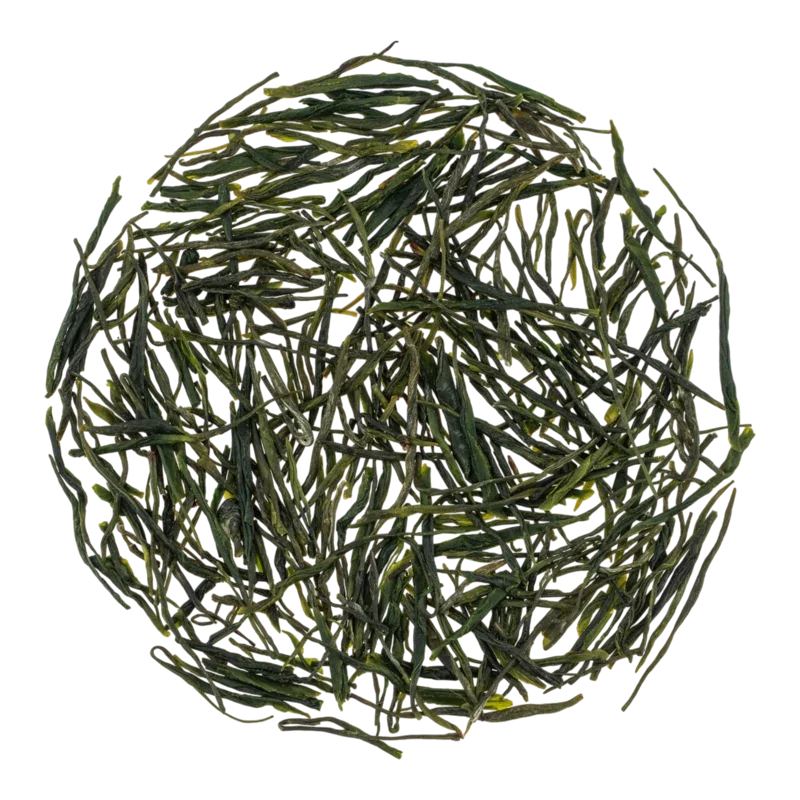
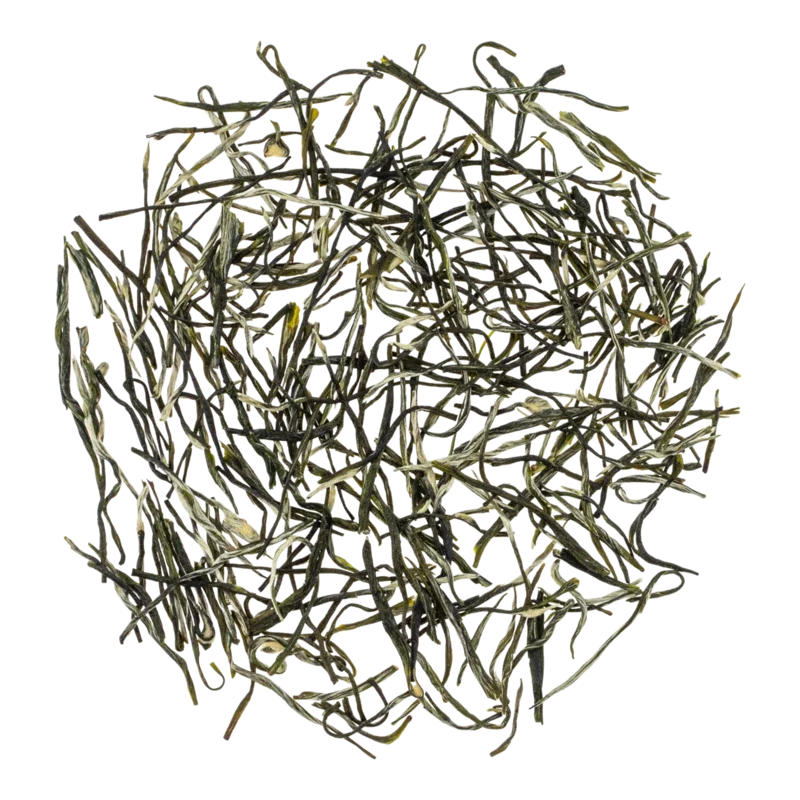
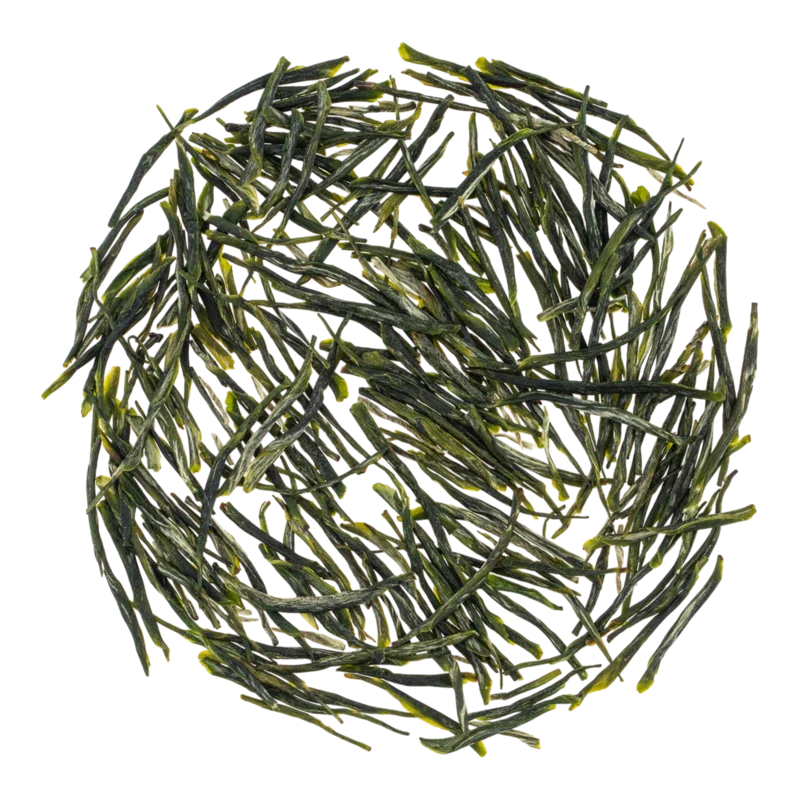
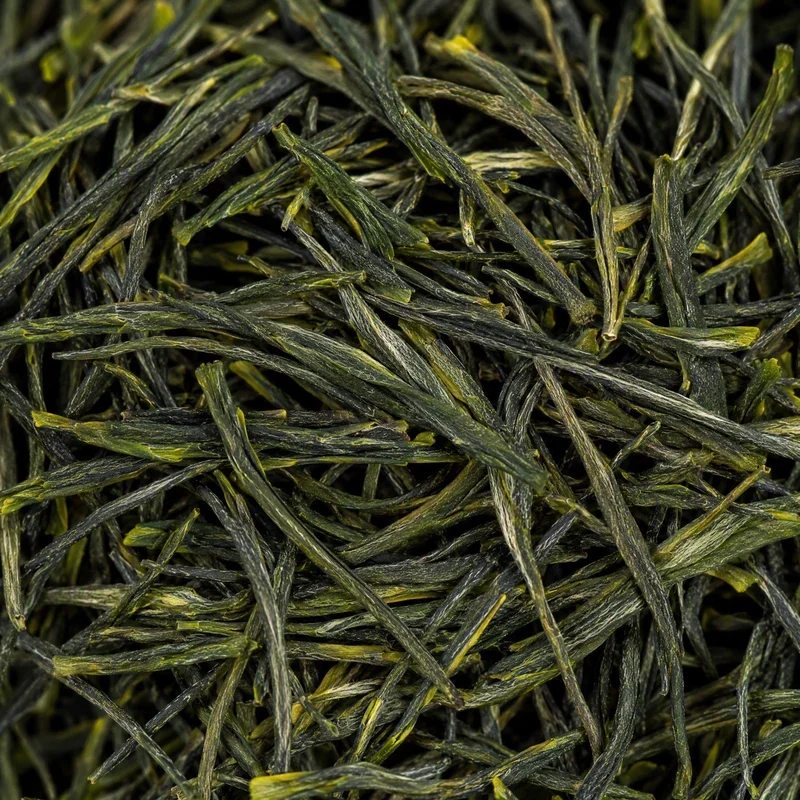
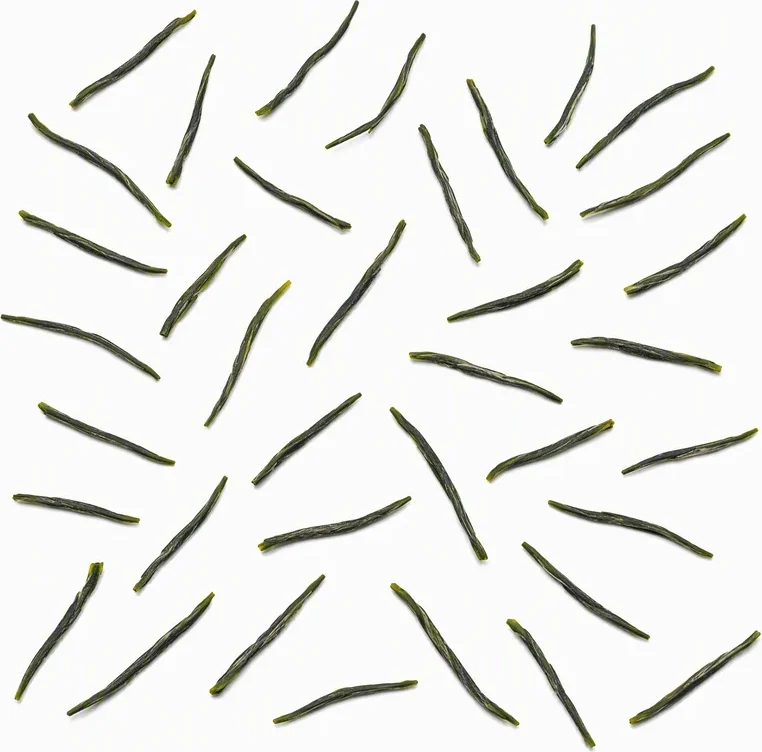
Dry Leaf Appearance: Thin, dense, straight "pine needles" (松针形, sōngzhēn xíng), even and uniform. Color — dark green with "ink-like" luster (墨绿, mòlǜ), noticeable white down. Color is noticeably darker than pan-fired green teas — a result of maximum chlorophyll preservation during steaming.
Dry Leaf Aroma: Pure green (清香), with characteristic "marine"/"seaweed" note (海藻香, hǎizǎo xiāng) — the calling card of steamed teas. Spring batches are complemented by chestnut undertones (栗香).
Liquor Aroma: "Marine-green," fresh, with light "nori" character. As it cools, a sweet-chestnut background emerges.
Liquor Color: Jade-green, clear and bright (碧绿透亮). Color is noticeably "greener" than pan-fired teas — a diagnostic sign of steamed tea.
Spent Leaves: Bright green, uniform (青绿匀整), tender leaves unfold "like orchids" (嫩叶舒展如兰).
Taste: Fresh (鲜爽) — amino acid "liveliness" is especially bright thanks to gentle steam fixation. Sweet-clean (甘醇), with returning sweetness (回甘生甜). Bitterness and astringency are minimal — polyphenols "break down" faster during steaming than pan-firing.
Alkaloids: Caffeine, theobromine, theophylline. Pronounced tonic effect.
Amino Acids: ≥4.2% (spring tea, supreme grade) — one of the highest indicators among Henan teas. L-theanine dominates.
Elevated content — steaming preserves up to 80% of chlorophyll (pan-firing — 50–60%). This gives the characteristic "ink-green" color.
Elevated content — 15 mg/100 g, effective for caries prevention.
Polyphenols: 14.7% — noticeably lower than pan-fired green teas (25–30%). This is a consequence of steam fixation: during steaming, part of the polyphenols transform, which explains the taste mildness.
Vitamins: Vitamin C, B-group vitamins, vitamin E — steaming preserves vitamins better than high-temperature pan-firing.
Catechins + vitamin C + vitamin E — comprehensive protection enhanced by gentle steam processing.
Synergy of caffeine and L-theanine — mild, prolonged alertness.
Fluorine content (15 mg/100 g) — one of the highest among teas, inhibits up to 90% of cariogenic bacteria.
Theanine strengthens vessel walls.
L-theanine stimulates alpha-wave brain activity.
Listed properties are based on general data and are not medical recommendations. Not recommended on empty stomach. Fresh tea should be aged 15 days to "release fire." After opening — consume within 72 hours for maximum aroma.
Process: Rinse 5 seconds → first steep ~15 seconds → each subsequent +5 seconds. Supreme grade withstands up to 8 steeps — exceptional durability for green tea, due to high concentration of extractive substances and "leaf breaking," which increases contact area with water.
Tea Amount: 3 g per 150 ml (1:50 ratio).
Teaware: Glass cup — for observing the "jade-green" liquor; gaiwan — for flash steeping method.
Water Temperature: 85–90°C. Do not use boiling water (>90°C destroys chlorophyll and gives yellow liquor color instead of green).
Container: Nitrogen packaging (充氮包装) — "Xinlin" brand standard. Storage period in unopened nitrogen packaging — up to 2 years. After opening — 72 hours at room temperature for maximum aroma.
Light: Complete isolation; chlorophyll is especially sensitive to ultraviolet.
Shelf Life: Unopened — up to 24 months (record for green tea thanks to nitrogen packaging).
Temperature: 0–5°C (refrigerator).
Hubei. China's oldest surviving steamed green tea (19th century). Shape — "pine needle," similar to Xin Linyulu. Aroma — more "bread-like" and "cereal," with less pronounced "marine" note. Taste — somewhat more "dense" and "warm." Xin Linyulu — more "fresh" and "marine" thanks to modern automated line and higher amino acid content (4.2% vs ~3%).
Steamed, but from Japanese cultivars (Yabukita, etc.). Aroma — pronounced "umami" and "marine"; taste — more "dense" and "seaweed-like." Xin Linyulu — milder, with sweet-chestnut undertone characteristic of Dabie Mountains raw material. Sencha shape — more "flat," Xin Linyulu — more "round" in cross-section.
Steamed and shaded. Extremely high amino acid content (up to 6%). Taste — thick "umami," almost "broth-like." Xin Linyulu — lighter, fresher, without "heavy" umami; doesn't require shading to achieve high amino acid profile thanks to mountain microclimate.
Same region (Xinyang), same cultivar, but pan-fired (炒青). Aroma — chestnut-green, without "marine" note. Taste — more "dry" and astringent. Xin Linyulu — milder, "greener" in color and aroma, with unique "seaweed" profile.
No reviews yet. Tell us what you think of this tea.
Rate this tea and share your impressions. We review each submission before publishing it.