Brewing
Gongfu brewing
- Water temperature
- 75 °C
- Tea amount
- 5 g
- Water volume
- 100 ml
- First steep
- 10 s
- Time added per infusion
- 5 s
- Infusions
- 3

xiānzhī zhú jiān
Choose a brewing method. Start with the recommended quantities and time, then adjust to taste.
Brewing
Brewing
Taste
Tea encyclopedia
Category: Regional Chinese teas with geographical indication. National geographical protection product (国家地理标志保护产品, Guójiā dìlǐ biāozhì bǎohù chǎnpǐn), certification obtained in 2010. In professional circles, the tea has earned the figurative nickname "emerald among green teas" (绿茶中的翡翠, lǜchá zhōng de fěicuì).
Category: Regional Chinese teas with geographical indication. National geographical protection product (国家地理标志保护产品, Guójiā dìlǐ biāozhì bǎohù chǎnpǐn), certification obtained in 2010. In professional circles, the tea has earned the figurative nickname "emerald among green teas" (绿茶中的翡翠, lǜchá zhōng de fěicuì).
Coordinates: Approximately 29°35′ N, 103°20′ E (Heibaoshan area).
Origin: China, Sìchuān Province (四川, Sìchuān), Éméishān City (峨眉山市, Éméishān shì). Produced throughout the entire territory of Emeishan City, with the core on high-mountain plantations of Mount Emei.
Type: Green tea (non-oxidized). Belongs to the category of biǎn chǎo qīng (扁炒青, biǎn chǎo qīng) — flat pan-fired green teas.
Cultural Significance: Xianzhizhujian embodies the centuries-old tea tradition of Emeishan — a sacred Buddhist mountain, UNESCO World Heritage site (since 1996). Its connection to the Ming imperial court and Buddhist monasteries, high-mountain origin, and strict production standards give it the status of a prestigious regional brand. Emeishan is one of China's four sacred Buddhist mountains (along with Wutaishan, Jiuhuashan, and Putuoshan), and tea here was historically inseparable from temple life: monks cultivated, processed, and offered tea to pilgrims as an expression of dharma and hospitality. Xianzhizhujian continues this tradition, positioning itself as tea worthy of offering — whether to an emperor or honored guest. Spring pre-Qingming batches are especially valued.
History: Emeishan is one of China's most ancient tea-producing regions. The mountain's tea tradition dates back to the Tāng dynasty (唐, 618–907): "The Classic of Tea" (《茶经》, «Chá Jīng») by Lù Yǔ (陆羽, Lù Yǔ) mentions Emei teas, and Buddhist monks of mountain monasteries used tea for meditation and receiving pilgrims. During the Míng dynasty (明, 1368–1644), Emperor Hongwu (洪武, Zhū Yuánzhāng) — founder of the dynasty — according to legend, bestowed the name "Xianzhizhujian" upon Éméi teas and included them among gòngchá (贡茶) — tribute offerings to the imperial court. This legend connects the tea's name with imperial recognition, though documentary verification of the legend is difficult.
Cultivar: The main variety (about 70% of plantings) — Sichuan medium and small-leaf population variety (四川中小叶群体种, Sìchuān zhōng xiǎo yè qúntǐ zhǒng), also called "lao chuan cha" (老川茶) — "old Sichuan tea." This is Camellia sinensis var. sinensis, bush type, with medium-sized oval leaves, thick and fleshy, with well-developed pubescence. Additional cultivar — Fúdǐng Dà Bái Chá (福鼎大白茶, Fúdǐng Dà Bái Chá), known for high yield and pronounced tips.
Picking: Spring harvest — before Qīngmíng (清明) for highest grades (明前茶, míng qián chá). Free amino acid content in spring flush reaches ≥4.6%.
Pluck Standard: For highest grade "Xuanjian" — exclusively single buds (单芽). For grades "He" and "Ya" — bud with one leaf (一芽一叶, yī yá yī yè). About 35,000 tea buds are required for 500g of finished highest-grade tea.
Raw Material: Buds and shoots must be uniform, fresh, without mechanical damage or pest traces. Harvesting is done by hand.
Altitude: 1,500–1,800 m — significantly higher than most Sichuan green teas, ensuring pronounced "high-mountain" profile characteristics.
Climate: Subtropical monsoon with mountain modifications. Average annual temperature in plantation zones 16–18°C. Relative humidity ≥80%. Number of foggy days ≥200 per year. Pronounced diurnal temperature variation. High humidity and abundant diffused light slow shoot growth, promoting accumulation of amino acids, chlorophyll, and aromatic compounds.
Soil: Mountain red-yellow soils (红黄壤, hóng huáng rǎng) with thick humus horizon (≥80 cm), acidic reaction (pH 4.5–6.5), high organic matter content (≥3%). Well-drained, rich in microelements.
Territory of entire Éméishān City (峨眉山市), Sichuan Province. Production core — Heibaoshan tea plantation (黑包山茶场, Hēibāo Shān cháchǎng), located at 1,500–1,800 m altitude in the relict forest zone. About 40% of Heibaoshan tea gardens consist of trees over 30 years old.
Forest coverage reaches 93%. Plantation core is located in water conservation reserve zone. Chemical fertilizers and pesticides are completely prohibited — only organic farming is used. Part of production is certified to EU standards (grade "Xuanjian"). Emeishan is home to more than 5,000 plant species and 2,300 animal species, and tea gardens are organically integrated into this ecosystem: bushes grow under the canopy of evergreen broadleaf trees and bamboo groves, creating natural shade. Such rich biosphere provides natural biological pest control, reducing the need for any treatments to minimum.
Freshly picked raw material is spread in thin layers on bamboo trays in ventilated rooms. Held for about 6 hours to remove surface moisture and activate enzymatic processes forming aroma precursors.
Processing in drum roaster (滚筒杀青, gǔntǒng shā qīng) at high temperature ~280°C. Enzyme inactivation, green color preservation, removal of raw grassy smell.
Leaves are laid out and pressed by hand (手工拍压, shǒugōng pāi yā) at temperature ~80°C, acquiring characteristic flat, straight shape resembling bamboo tip. All manipulations are performed with bamboo and wooden tools.
Leaves are spread for natural cooling, stabilizing shape and preventing "steaming."
Low-temperature (~60°C) slow firing for final moisture removal (to ≤6.5%), shape fixation, and chestnut aroma enhancement.
The entire process is conducted by hand using bamboo and wooden tools — metal is excluded to prevent polyphenol oxidation upon contact with iron. Traditional technique "chongla mo guo" (虫蜡抹锅) — rubbing the pan with white wax — gives the leaf characteristic smooth luster. About 35,000 individual buds are needed for 500g of finished highest-grade tea. All production undergoes 100% control for pesticide residues.
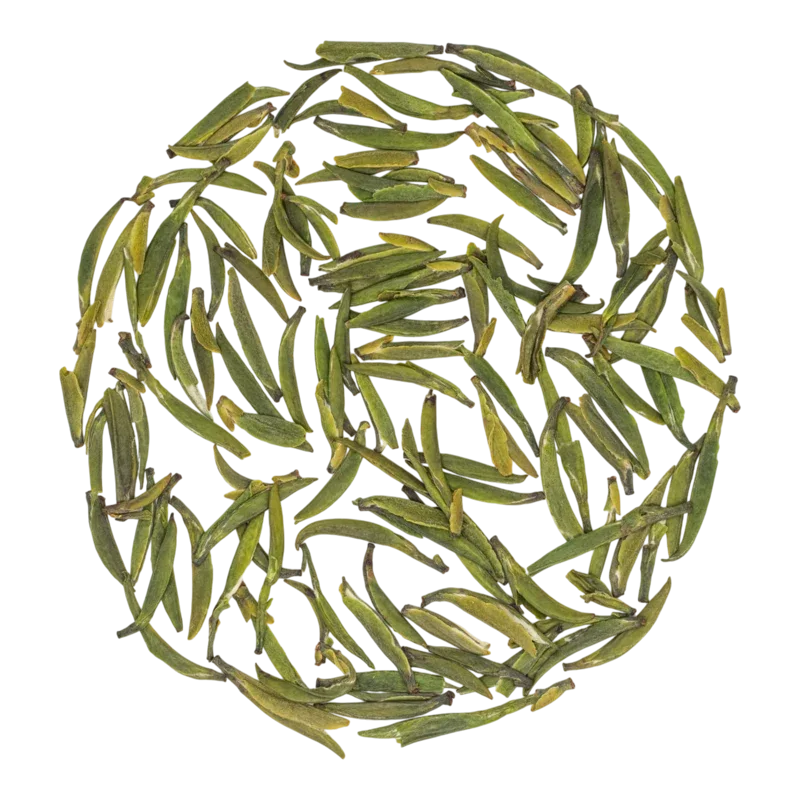
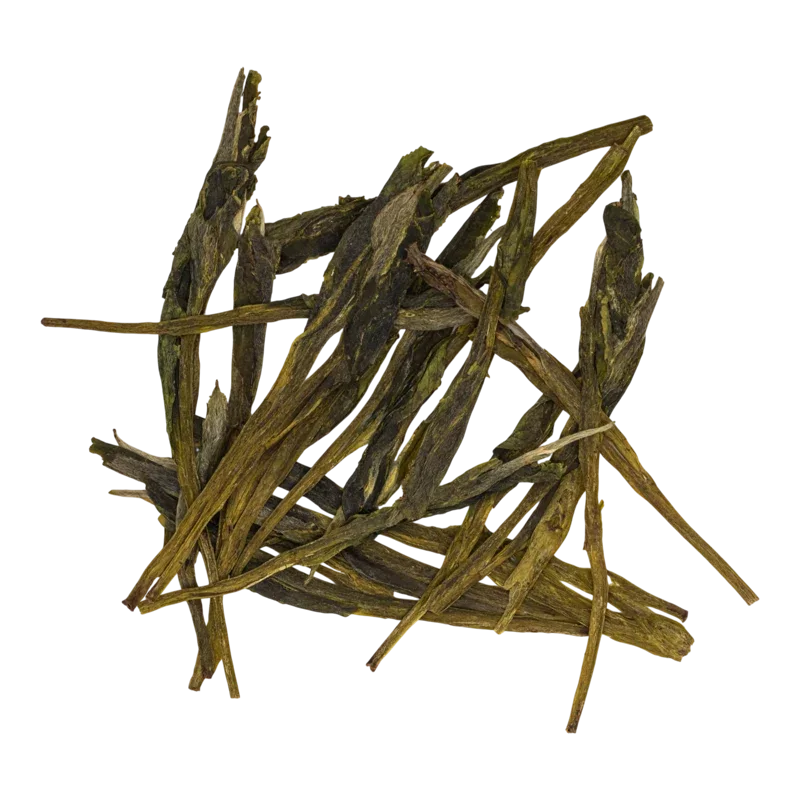
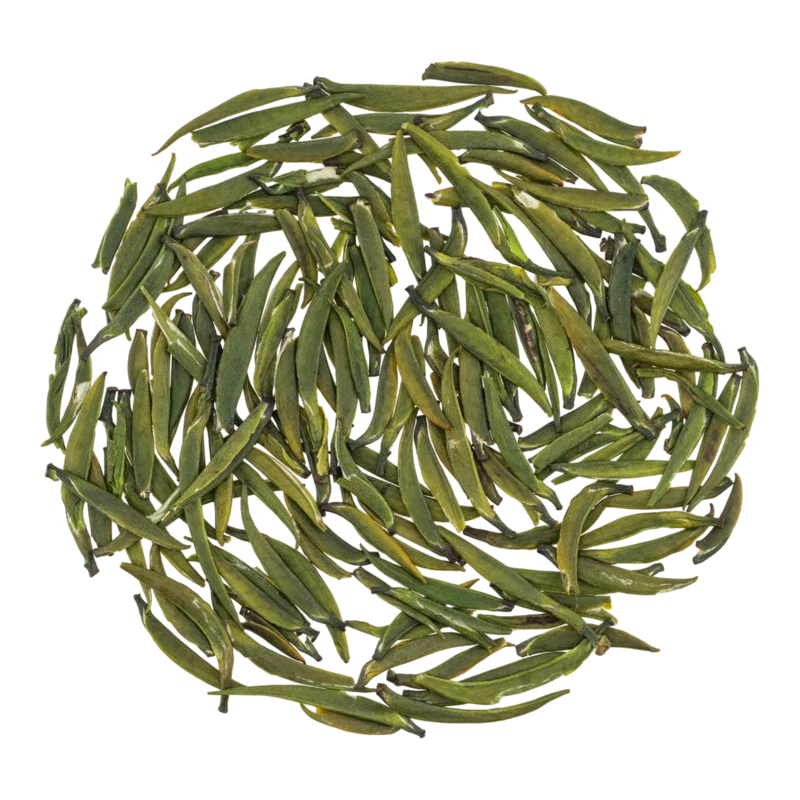
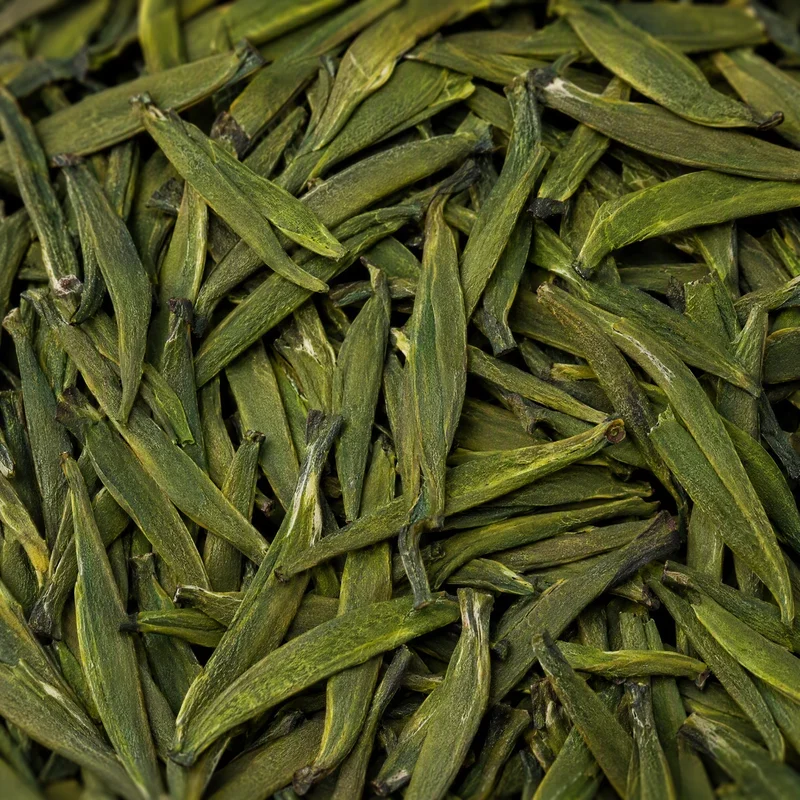
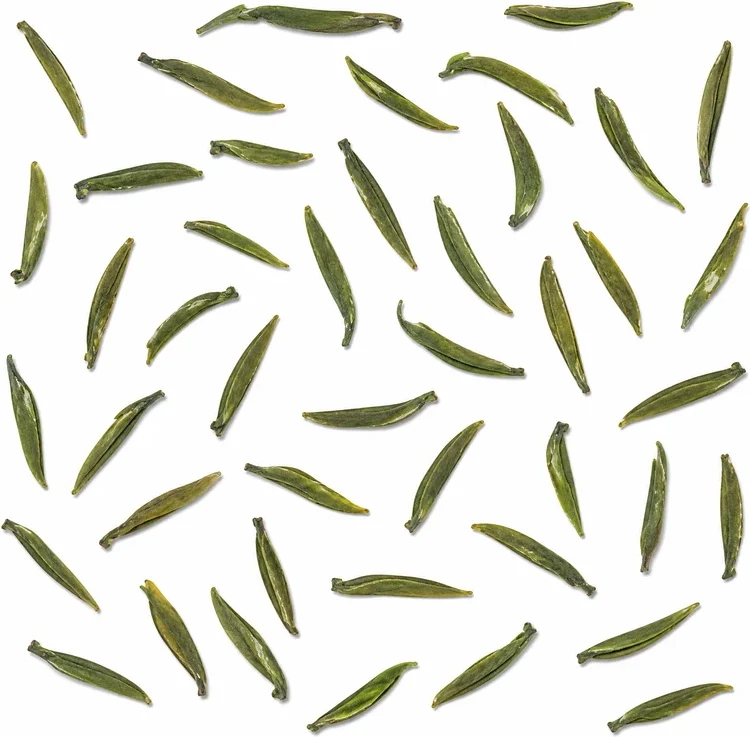
Dry Leaf Appearance: Flat, straight, even leaves resembling bamboo shoot tips. Color of highest grades — "valley gold" (谷黄, gǔ huáng): warm yellow-green with golden sheen, characteristic of teas from single buds. Standard grades — greenish-yellow. Surface smooth, with light luster from traditional wax treatment.
Dry Leaf Aroma: Persistent chestnut aroma (栗香, lì xiāng) — main note, the tea's signature. In background — clean floral freshness and delicate "young" note (嫩香, nèn xiāng), inherent to pre-Qingming teas.
Liquor Aroma: Chestnut, rich and lasting, with emerging fresh green note. Aroma persists through many infusions.
Liquor Color: Tender green, bright and clear (嫩绿明亮, nèn lǜ míng liàng). Pre-Qingming teas — especially light and "sparkling."
Spent Leaves: Uniform, tender green, juicy. Buds and leaves unfold in "bouquets" (成朵, chéng duǒ), maintaining fresh green color and lively texture.
Taste: Bright freshness (鲜爽, xiān shuǎng) with distinct predominance of amino acid "umami"-like sweetness. Medium body, smooth and silky (滑, huá). Bitterness and astringency minimal (polyphenol content — 14.7%, below average for green teas). Long, gentle returning sweet aftertaste (回甘绵长, huígān mián cháng).
Alkaloids: Caffeine — moderate content, typical for high-mountain spring teas (approximately 25–35 mg/g). Theobromine and theophylline present.
Amino Acids: High content — ≥4.6% in spring shoots (significantly above average for green teas). L-theanine predominates, providing freshness, sweetness, and relaxing effect.
High content, due to prolonged exposure of tea bushes to diffused light and cloud conditions.
Essential Oils: Responsible for persistent chestnut aroma (栗香). Formed during final low-temperature firing.
Minerals: Potassium, magnesium, zinc, manganese, fluorine, selenium. Thick humus horizon of mountain red-yellow soils provides diverse microelement profile.
Polyphenols: Tea polyphenol content — about 14.7% (below average for green teas, explained by high-mountain origin and early harvest). Main catechins: EGCG, EC, ECG. Reduced polyphenol content relative to amino acids determines mildness and absence of pronounced bitterness.
Vitamins: Vitamin A (β-carotene) — content reportedly 50% above average for green teas. Vitamin C — high content thanks to gentle processing technology. B-group vitamins.
Tea polyphenols effectively neutralize free radicals. According to some data, antioxidant activity of tea polyphenols exceeds vitamin E activity by 18 times.
Catechins promote fat breakdown, supporting normal blood lipid levels.
High vitamin A (β-carotene) content is beneficial for liver function and eye health.
Balanced combination of caffeine and L-theanine provides gentle, steady alertness without sharp peaks and drops.
Fluorine and catechins strengthen tooth enamel and have antibacterial action.
L-theanine promotes relaxed concentration, attention improvement, and brain alpha-wave generation.
Complex of vitamins C and E, microelements, and polyphenols supports body's protective functions.
this information is for informational purposes only and is not medical advice.
Freshly opened tea is recommended to rest 7 days in dark place for "fire dissipation" (褪火气, tuì huǒqì) — weakening residual heat from processing. Opened package should preferably be used within 72 hours to preserve peak aroma. Not recommended to drink on empty stomach — tannins may irritate gastric mucosa.
Tea Amount: 4g per 200ml (1:50 ratio).
Teaware: Transparent glass cup — for observing leaf "dance" and evaluating liquor color. White porcelain gàiwǎn (盖碗) — for gongfu style, allowing maximum revelation of chestnut aroma.
Water Temperature: 85–90°C for glass cup; for highest grades (Xuanjian, Teji) reduction to 80°C is acceptable. Boiling water above 90°C is contraindicated — liquor yellows, bitterness appears.
Container: Airtight, opaque. Vacuum packaging with nitrogen filling or foil packets preferred.
Enemies: Light (destroys chlorophyll), moisture (provokes oxidation and mold), high temperature (accelerates amino acid and aromatic compound degradation), foreign odors.
Shelf Life: Most expressive in first 6 months. In airtight packaging at 0–5°C — up to 18 months. Opened package recommended for use within 72 hours for maximum aroma, generally — within 1–2 months.
Temperature: Optimally — refrigerator, 0–5°C. For high-mountain green teas, low-temperature storage is critically important for preserving freshness, green color, and chestnut aroma.
The most famous "neighbor" from Emeishan. Both teas are flat greens from the same region, but there are significant differences: Zhu Ye Qing is grown at lower altitudes (800–1,200m) and has bright emerald-green color; Xianzhizhujian — higher altitude (1,500–1,800m), with characteristic golden-yellow shade in highest grades. Zhu Ye Qing aroma — more floral; Xianzhizhujian — more chestnut. Zhu Ye Qing — registered trademark of one company; Xianzhizhujian — geographical indication product.
Famous Sichuan green tea from Mendingshan, but twisted (not flat). Gan Lu taste is more "jade-like" and mild, with dominant floral note. Xianzhizhujian — more structured, with pronounced chestnut accent.
Standard of flat green teas. Long Jing — from Zhejiang, grown at lower altitudes (100–300m), has broader "plate-like" leaf shape and brighter roasted aroma. Xianzhizhujian — higher, sharper and thinner, with gentler, amino acid profile.
Flat green tea from Anhui, but significantly larger (leaves up to 5–7 cm). Taiping Hou Kui — powerful and orchid-like; Xianzhizhujian — more compact, thinner, with accent on chestnut note and high-mountain freshness.
Price Category: Tea is segmented by grades:
No reviews yet. Tell us what you think of this tea.
Rate this tea and share your impressions. We review each submission before publishing it.