Brewing
Gongfu brewing
- Water temperature
- 75 °C
- Tea amount
- 5 g
- Water volume
- 100 ml
- First steep
- 10 s
- Time added per infusion
- 5 s
- Infusions
- 3

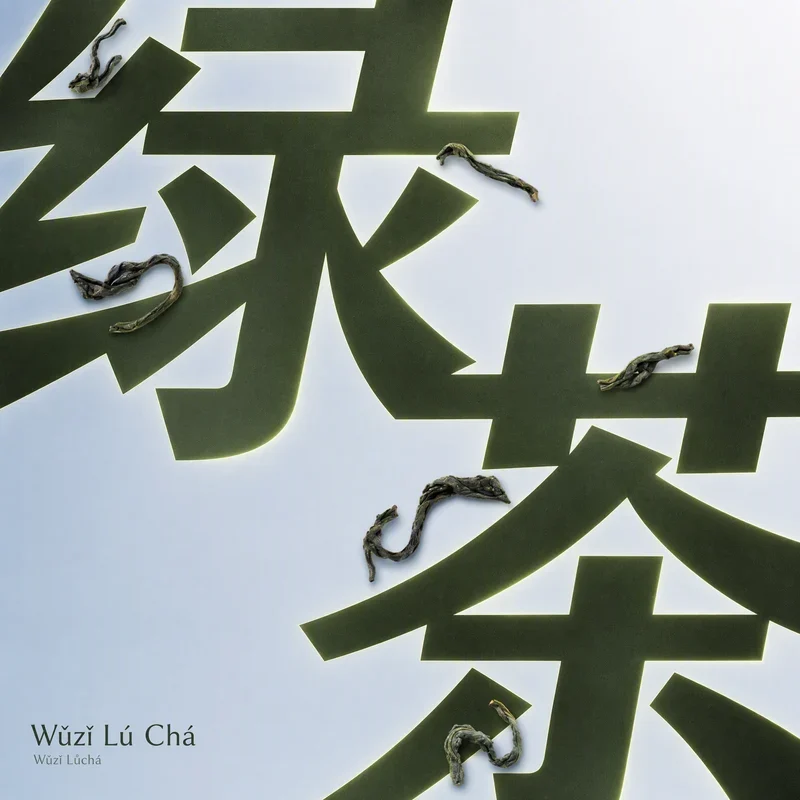
Wǔzǐ Lǜchá
Choose a brewing method. Start with the recommended quantities and time, then adjust to taste.
Brewing
Brewing
Taste
Tea encyclopedia
Category: Regional famous tea (名茶, míngchá) with protected geographical indication. Since 2007, it has been part of the unified brand Hànzhōng Xiān Háo (汉中仙毫, Hànzhōng Xiān Háo), which received geographical indication product status (地理标志产品) from China's General Administration of Quality Supervision.
Category: Regional famous tea (名茶, míngchá) with protected geographical indication. Since 2007, it has been part of the unified brand Hànzhōng Xiān Háo (汉中仙毫, Hànzhōng Xiān Háo), which received geographical indication product status (地理标志产品) from China's General Administration of Quality Supervision.
Coordinates: Approximately 32.97° N, 107.75° E (reference point at Xixiang County).
Origin: China, Shaanxi Province (陕西省, Shǎnxī Shěng), Hànzhōng Prefecture (汉中市, Hànzhōng Shì), Xīxiāng County (西乡县, Xīxiāng Xiàn). The main production area encompasses mountain ranges around Wuzishan (午子山) and adjacent territories of the Qin-Bā mountain region (秦巴山区).
Type: Green tea (non-oxidized, 绿茶, lǜchá). Belongs to the semi-baked semi-pan-fired subtype (半烘炒绿茶, bàn hōngchǎo lǜchá): the technology combines stages of wok firing and hot air heating.
Cultural Significance: The tea occupies a central place in the regional identity of Xixiang County, which has been awarded the honorary title "Famous Tea Hometown of China" (中国著名茶乡) by the Ministry of Agriculture. Wuzi Xian Hao is the official tea for diplomatic receptions of China's State Council and the Shaanxi Provincial Government. In folklore, there is a legend about a girl named Wǔzǐ (午子姑娘) who offered tea to travelers on the mountain peak; a grateful Buddhist monk from the southern provinces left her a couplet: "Water from Longbo Cave, tea from Wuzi Mountain peak" (龙脖洞中水,午子山顶茶), glorifying this place as an "abode of two perfections" (仙境双绝). A local saying states: "Rain washes the blue mountains — spring all four seasons" (雨洗青山四季春), describing the evergreen landscape of tea gardens.
History: Tea cultivation in the Xixiang region began during the Qin-Hàn era (秦汉, 3rd century BCE — 3rd century CE) and reached its peak during the Tāng dynasty (盛唐, 7th–9th centuries), when local tea entered the registry of imperial tributes (贡品, gòngpǐn). According to the "Xixiang County Gazetteer" (《西乡县志》, "Xīxiāng xiàn zhì"), tea from Wuzishan was so sought after by the capital's nobility that couriers delivered spring batches along the Ziwu — Wuzi road to Chang'an (长安) within 24 hours on horseback. In the "History of Ming — Treatise on Food and Goods" (《明史·食货志》, "Míng shǐ shíhuò zhì"), Xixiang County is mentioned as one of the largest centers for "tea-for-horses" exchange (以茶易马, yǐ chá yì mǎ) in the early Ming dynasty. In modern times, a key milestone was 1984, when local tea technologists began developing the variety Wǔzǐ Xiān Háo (午子仙毫, Wǔzǐ Xiān Háo) — a premium version of local green tea. In 1986, at the National Famous Tea Tasting in Fuzhou, Wuzi Xian Hao scored 95.72 points — higher than Huangshan Mao Feng — and was awarded the title "National Famous Tea" (全国名茶) by the Ministry of Commerce, ending Shaanxi's "anonymity" on the country's elite tea map. In 1997, the tea received an international gold medal. In 2005, the Hanzhong administration initiated consolidation of more than twenty local tea brands — first to three (午子仙毫, 定军茗眉, 宁强雀舌), then in 2007 under the unified public brand Hanzhong Xian Hao with state protection by geographical origin. In 2021, the brand entered the l
Name Breakdown: Wǔzǐ (午子) — the name of a Daoist mountain located south of Xixiang County. The character 午 (wǔ) means "noon" (associated with the "south" direction in the Earthly Branches system), 子 (zǐ) — "midnight" ("north"). This paired designation reflects the names of ancient trade routes Ziwu-dao (子午道) and Wuzi-dao (午子道), which connected Chang'an with southern territories through mountain passes. Lù Chá (绿茶) — literally "green tea." Thus, the full name translates as "green tea from Wuzi Mountain."
Cultivar: Predominantly local population varieties (群体种, qúntǐzhǒng) — genetically diverse lines of the small-leaf variety, adapted to the high-altitude conditions of Qin-Ba over centuries. In recent years, zoned clonal varieties have been actively introduced; by 2004, the area of asexual (clonal) plantings in Shaanxi Province reached 35,000 mu. State recommendations include eight basic varieties optimized for the region.
Picking: Main season — early spring: from Qīngmíng (清明, early April) to ten days after Gǔyǔ (谷雨, late April). The most valuable batches are collected before Qīngmíng (明前茶, míngqiánchá). For premium Wuzi Xian Hao, one kilogram of finished tea requires approximately 62,000 buds.
Pluck Standard: One bud and one-two young leaves in initial opening stage (一芽一二叶初展). Raw material must be whole, fresh, without mechanical damage or overheating.
Raw Material: Tea gardens are located at altitudes of 600–1400 m, on slopes with gradients up to 25°. Soil requirements: pH 4.5–6.5, organic matter >1.5%, fertile layer thickness >80 cm, absence of impermeable layer in subsoil, groundwater — no higher than 1 m from surface.
Altitude: 600–1400 m above sea level; optimal zone — 800–1200 m.
Climate: The region is situated at the junction of subtropical and temperate zones — the so-called "transition zone of southern and northern climates" (南北气候结合部). Average annual temperature ~14.4–14.7°C. Winters are mild, summers without extreme heat. Frost-free period — approximately 246 days. Annual precipitation — 1000–1500 mm, with predominance of spring-summer rains.
Soil: Weakly acidic (pH 4.5–6.5) mountain soils — sandy, loamy, and clay-loamy varieties — with high organic matter content. The region is characterized by natural background enrichment with zinc and selenium, which directly reflects in the tea's mineral profile.
Frequent fogs and high humidity — a characteristic feature of the region, which locals describe with the saying "rain washes the blue mountains — spring all four seasons" (雨洗青山四季春). Cloud cover diffuses direct sunlight, increasing the proportion of diffused light beneficial for amino acid synthesis.
The area is distinguished by minimal industrial pollution; dense forest masses and clean mountain air create conditions close to ideal for organic tea cultivation. The crested ibis (朱鹮, zhūhuán), called the "oriental treasure" — an indicator of the territory's ecological well-being — inhabits here. Tea gardens have repeatedly passed certification as "pollution-free" (无公害), "green food product" (绿色食品), and organic. Wuzi Lu Cha Company became the first tea enterprise in China to receive ISO 9001 certification (2000).
Topography: Tea gardens are located in intermountain valleys of the Qin-Ba range, where the Qínlǐng (秦岭) mountain chain from the north and Bashan (巴山) from the south create a natural barrier against cold continental masses and excessive heat.
Quick hand selection of young shoots (one bud and one-two leaves) in morning hours when dew has already dissipated. Raw material is delivered for processing within several hours, without overheating and compression.
Fresh leaves are evenly spread in a thin layer in a ventilated room for 3–5 hours. The stage's tasks — equalize moisture, initiate initial enzymatic reactions, increase free amino acid content, and form aroma precursors.
Key stage determining aroma purity. Leaves are pan-fired in a heated wok at high temperature to inactivate polyphenol oxidase and completely stop oxidation. Proper fixation removes "raw" grassiness and establishes the foundation for the characteristic chestnut aroma.
After brief cooling (清风, "cool breeze"), leaves undergo light rolling. The task — release cellular juices for flavor fullness, form the leaf's primary shape without damaging the delicate raw material.
Leaves are heated in a wok or drying oven at moderate temperature. Simultaneously, they are given their characteristic shape — slightly flattened, resembling an orchid (形似兰花). For Wuzi Xian Hao, shaping is particularly meticulous: the finished leaf should be thin, straight, and covered with down.
Tea is dried with hot air at controlled temperature to stable residual moisture (≤6.5%). Heating fixes the aroma and ensures storage stability.
Removal of defective leaves, stems, veins. Finished tea is sorted by grades.
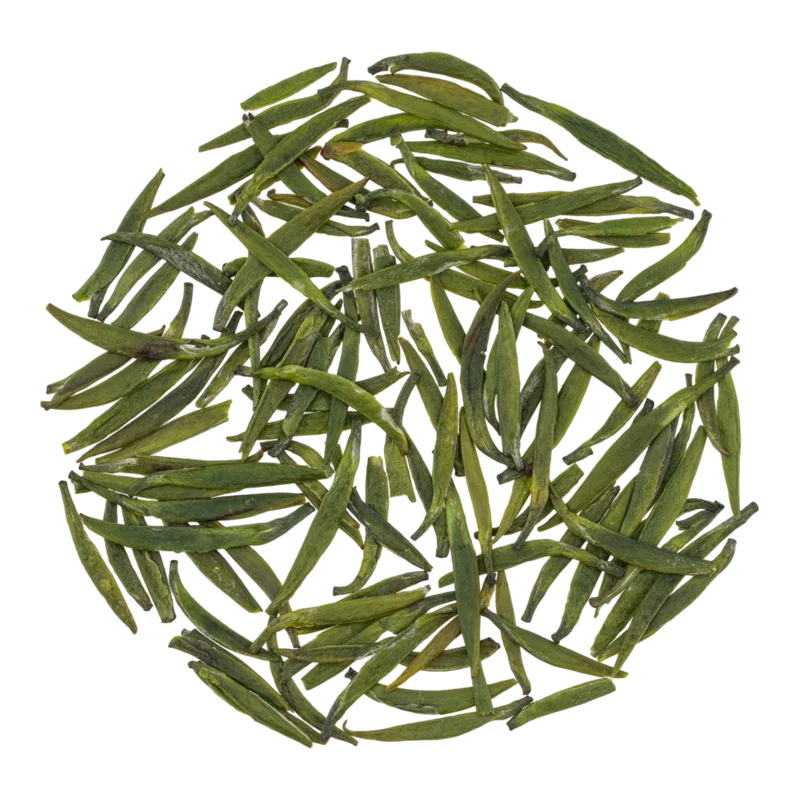
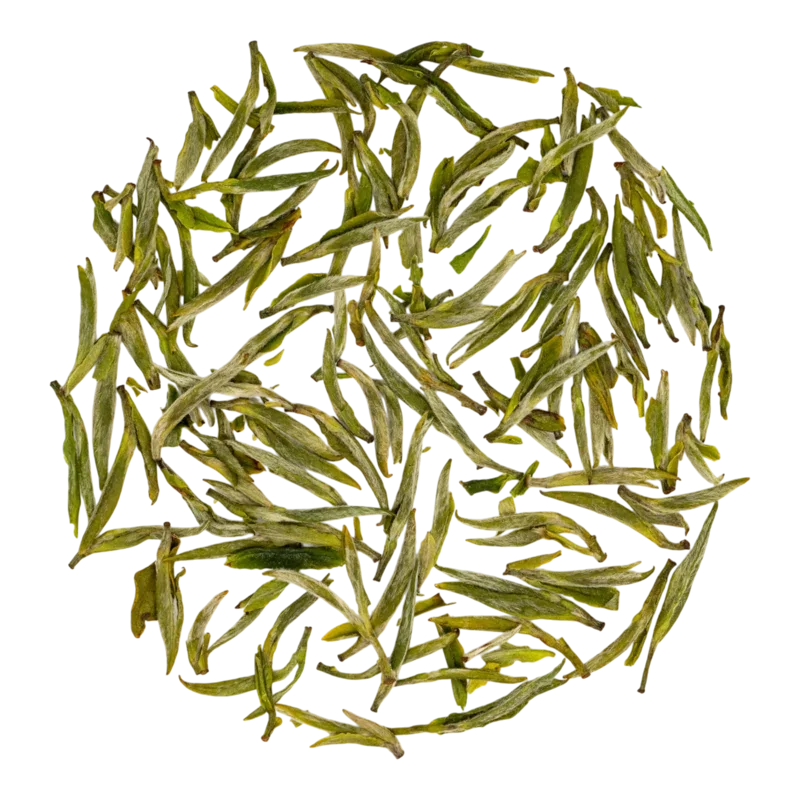
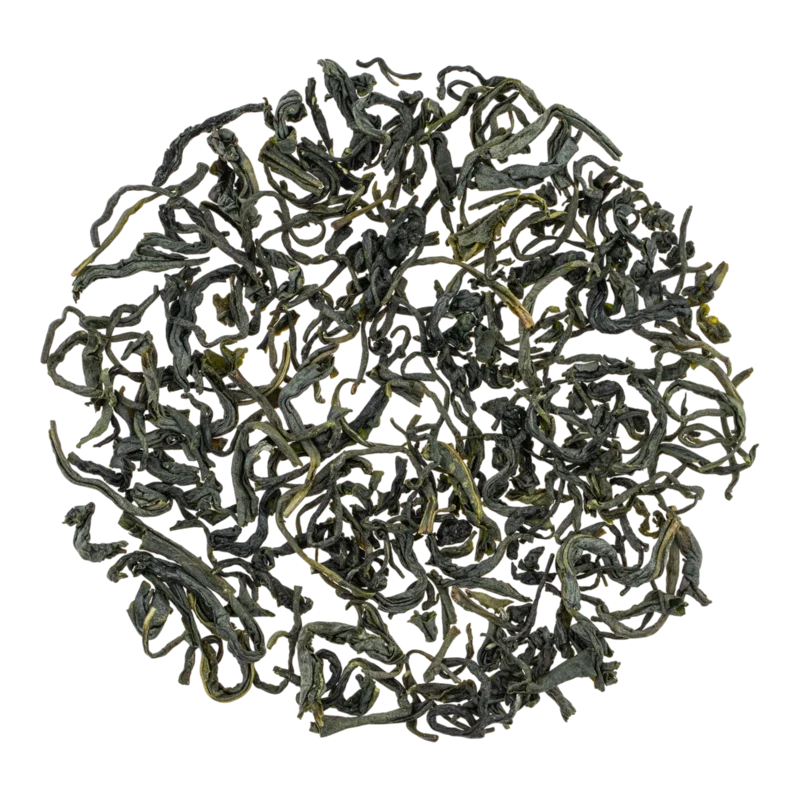
Dry Leaf Appearance: Leaf slightly flattened, orchid-shaped (兰花形). Color — emerald green with abundant silvery-white down (显毫). Buds thin, even, uniform in length. Premium Wuzi Xian Hao is distinguished by emphasized elegance of form — "thin as a beauty's eyebrows" (细秀如眉).
Dry Leaf Aroma: Clean, fresh, with pronounced chestnut notes (栗香, lìxiāng) — the calling card of regional teas. In the background — light floral and grassy-meadow notes.
Liquor Aroma: High, persistent chestnut aroma with nuances of roasted nuts, fresh-cut hay, and soft floral notes. The aroma persists through several infusions.
Liquor Color: Tender green, bright, clear, with light yellowish tint (嫩绿明亮).
Spent Leaves: Buds and leaves even, tender, whole; color — bright light green. When opening in water, buds unfold as "blossoms" (芽匀嫩成朵).
Taste: Soft, full, with pronounced sweetness and freshness. Body — medium, rounded. Bitterness and astringency are minimal. The umami component is distinctly felt, due to increased amino acid content. Aftertaste (回甘, huígān) — prolonged, with clean returning sweetness and refreshing finish.
Alkaloids: Caffeine — about 4.43%. Theobromine and theophylline are also present in trace amounts.
Amino Acids: 3.5–5.23% — higher than many elite teas: for comparison, premium Longjing has about 3.4–4.0%. The predominant amino acid — L-theanine, responsible for umami character of taste and sedative-tonic balance.
~44.57% — high indicator, evidencing liquor richness and density.
Unique feature — natural enrichment with zinc (53.5–67.5 μg/g) and selenium (0.858 μg/g), due to the geochemical profile of Qin-Ba mountain soils. Also present are potassium, magnesium, manganese, fluorine.
Volatile components responsible for chestnut aroma are represented predominantly by pyrazines and pyrroles formed during pan-firing (杀青), as well as cis-3-hexenol and linalool, contributing floral-grassy notes.
Polyphenols: ~32.87% of dry matter. Main fractions — catechins (epigallocatechin gallate / EGCG, epicatechin gallate / ECG, etc.), providing antioxidant activity and determining liquor astringency.
Vitamins: Vitamin C (ascorbic acid), B-group vitamins (B₁, B₂), carotenoids (provitamin A), vitamin E.
High catechin content (especially EGCG) helps neutralize free radicals, slowing cellular oxidation processes.
The combination of L-theanine and caffeine provides gentle tonic action — increased concentration without sharp excitement peaks characteristic of coffee.
In local tradition, Wuzi Lu Cha has long been considered a "protective tea" (防病之茶); modern research confirms green tea polyphenols' ability to weaken electromagnetic radiation effects.
Catechins and theanine help normalize blood pressure and cholesterol levels.
Moderately stimulates peristalsis and digestive enzyme secretion; pairs well with light meals.
Natural enrichment with these trace elements supports immune system, thyroid, and reproductive health functions.
Antioxidants and vitamin C promote collagen production and protect skin from photodamage.
Those with increased caffeine sensitivity should limit consumption in the afternoon. Strong tea on an empty stomach is not recommended.
Tea Amount: 3–4 g per 150–200 ml water (when brewing in a glass) or 4–5 g per 100–120 ml (when using short infusions in gaiwan).
Teaware: Clear glass tumbler (玻璃杯, bōlíbēi) — classic method allowing observation of bud "dance"; porcelain gaiwan (盖碗, gàiwǎn) — for delicate aroma development; porcelain teapot — for group tea sessions.
Water Temperature: 75–85°C. For the most delicate bud grades (Wuzi Xian Hao) — 75–80°C; for standard Wuzi Lu Cha, 80–85°C is acceptable.
An umbrella brand that includes Wuzi Lü Cha. The Hanzhong Xian Hao standard describes general requirements for teas from the region; Wuzi Lü Cha is one of its historical "subspecies" lines, maintaining its own production style.
Classic flat pan-fired green tea from Zhejiang. Long Jing has a more pronounced "beany" aroma and oily texture; Wuzi differs with its chestnut profile, higher amino acid content, and natural selenium enrichment.
Downy green tea from Anhui. Mao Feng is more delicate and floral; Wuzi is denser, with a "warmer" chestnut-nutty profile. At the 1986 competition, Wuzi Xian Hao scored 0.17 points higher.
Another representative of "northern" green teas (Henan). Mao Jian is more tightly twisted, with more pronounced astringency; Wuzi is softer, sweeter, and closer to the "chestnut" firing style.
Another famous tea from Shaanxi Province, also enriched with selenium. Ziyang is denser, with round twisting; Wuzi is more elegant in form and softer in taste.
Price Category: Wide range depending on grade and harvest season. Premium Wǔzǐ Xiàn Háo from first spring harvest (明前) can reach 7,000–10,000 yuan per kilogram; standard Wuzi Lu Cha from later harvests — significantly more affordable (300–1,500 yuan/kg). Main price factors: harvest time (early spring raw material — more expensive), bud standard (pure bud more expensive than bud + two leaves), plantation altitude, and processing method (hand processing more expensive than machine).
No reviews yet. Tell us what you think of this tea.
Rate this tea and share your impressions. We review each submission before publishing it.