Brewing
Gongfu brewing
- Water temperature
- 75 °C
- Tea amount
- 5 g
- Water volume
- 100 ml
- First steep
- 10 s
- Time added per infusion
- 5 s
- Infusions
- 3

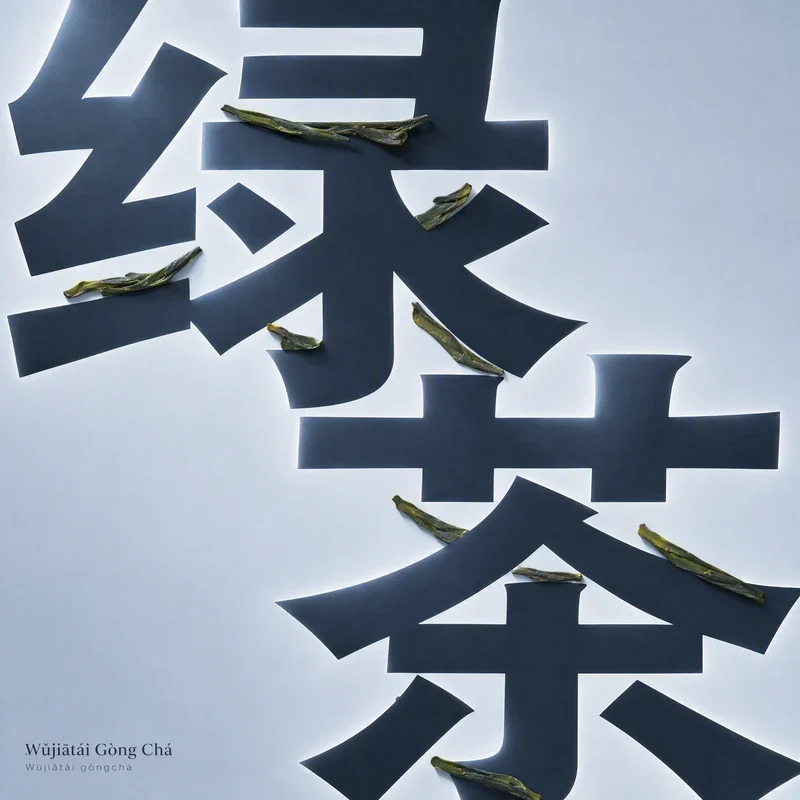
Wǔjiātái gòngchá
Choose a brewing method. Start with the recommended quantities and time, then adjust to taste.
Brewing
Brewing
Taste
Tea encyclopedia
Category: Historical tribute tea (贡茶, gòngchá); national product with protected geographical indication (国家地理标志产品, guójiā dìlǐ biāozhì chǎnpǐn); included in the second register of mutual protection of geographical indications between China and the EU (中欧地理标志保护名录). Part of the "Ten Famous Teas of Hubei" (湖北十大名茶).
Category: Historical tribute tea (贡茶, gòngchá); national product with protected geographical indication (国家地理标志产品, guójiā dìlǐ biāozhì chǎnpǐn); included in the second register of mutual protection of geographical indications between China and the EU (中欧地理标志保护名录). Part of the "Ten Famous Teas of Hubei" (湖北十大名茶).
Coordinates: Approximately 29°42′–30°00′ N, 109°11′–109°35′ E. The mysterious "thirtieth parallel" (北纬30°) passes through the county territory.
Origin: China, Húběi Province (湖北, Húběi), Ēnshī Tujia and Miáo Autonomous Prefecture (恩施土家族苗族自治州, Ēnshī Tǔjiāzú Miáozú Zìzhìzhōu), Xuan'en County (宣恩县, Xuān'ēn Xiàn), Wànzhài Township (万寨乡, Wànzhài Xiāng), Wǔjiātái Village (伍家台村, Wǔjiātái Cūn). The protected designation zone also includes the villages of Banchang (板场村), Ma'anshan (马鞍山村), Xiangshulin (香树林村), Hongyan'ka (红岩卡村), Xiaoxi (小溪村), and Qianjia (覃家村).
Type: Green tea (non-oxidized). The technology combines chǎoqīng (炒青, chǎoqīng — wok-firing) and hongqing (烘青, hōngqīng — hot drying): high-temperature fixation in a wok followed by multiple cycles of drying-aromatization.
Cultivar: The main modern cultivar — E Cha 10 hao (鄂茶10号, Èchá Shí Hào), formerly known as Xuantai 27 hao (宣苔27号) — Xuan'en County's own selection, one of the four leading tea varieties of Hubei Province. Distinguished by early spring shoot formation, high amino acid content, and excellent suitability for producing both green and red teas. Also used are E Cha 1 hao (鄂茶1号) and over 20 other varieties, including original population plantings (群体种) tracing back to the wild bushes found by Wu Changchen.
Picking: Spring (late March — April) — main period for premium batches. Summer and autumn harvests go primarily to export tea.
Pluck Standard: Bud and 1–2 young leaves (一芽一二叶, yī yá yī-èr yè). For the highest grade — single buds or "one bud — one leaf" (一芽一叶).
Raw Material: Whole, fresh shoots without mechanical damage, uniform in size. Picking — predominantly manual.
Altitude: 400–900 m above sea level within the GI zone.
Climate: Mid-subtropical monsoon humid mountain climate (中亚热带季风湿润型山地气候). Average annual temperature 15.8°C. Average annual precipitation about 1400 mm, with heat and moisture coinciding seasonally (雨热同期), which is ideal for tea plants.
Soil: Acidic purple sandy loams (酸性紫色沙壤, suānxìng zǐsè shā rǎng), pH ≈ 5.5. Key feature — high natural selenium content (硒, xī) in soils: Xuan'en is part of the "selenium belt" of Enshi, one of the few regions in the world with naturally selenium-enriched soils. Selenium transfers to the tea leaf and is a marker of authenticity and biological value of Wujiatai Gong Cha.
Frequent fogs, high humidity, significant cloud cover. Mountain gorges create natural shading. Diffused light predominates over direct light — this reduces the rate of theanine breakdown and increases the ratio of amino acids to polyphenols, forming a mild, sweet profile.
Organic tea gardens covering more than 3600 mu (about 240 ha) in the core zone have international organic certification (EU, Rain Forest Alliance). Total plantation area of the county — over 22,000 ha, of which 10,000 ha are certified as an export base according to EU standards.
Topography: Xuan'en County is located at the junction of the Wǔlíng (武陵山, Wǔlíng Shān) and Qíyuè (齐跃山, Qíyuè Shān) mountain ranges, in the zone of the "eastern terminus" of the Yunnan-Guizhou Plateau. The terrain is mountainous, heavily dissected, with alternating steep ridges, narrow valleys, and karst formations. About 48% of the territory is mid-altitude mountains (800–1200 m).
Manual picking in morning hours. Raw material is quickly delivered to the workshop.
Freshly picked leaves are spread on bamboo trays in a thin layer to evaporate surface moisture and partially break down "green rawness." Time — 2–4 hours.
Main stage. Wok temperature reaches 260°C — significantly higher than most green teas. Turning speed — about 40 times per minute. Extremely high temperature with short contact quickly inactivates oxidase, "sealing" the green color and initiating Maillard reactions that give rise to the characteristic chestnut aroma (栗香, lì xiāng).
Leaves are rolled, forming tight thin strips and breaking cell walls for uniform extraction during brewing.
Giving leaves the characteristic neat form — even, dense, straight strips.
Unique operation: leaves undergo more than 10 cycles of alternating hot drying and brief "rest" in open air. Each cycle removes moisture while simultaneously allowing volatile compounds to partially condense inside the leaf, building depth and persistence of chestnut aroma. Final moisture content — ≤ 6%.
Removal of defective leaves, stems, and fragments; separation into grades.
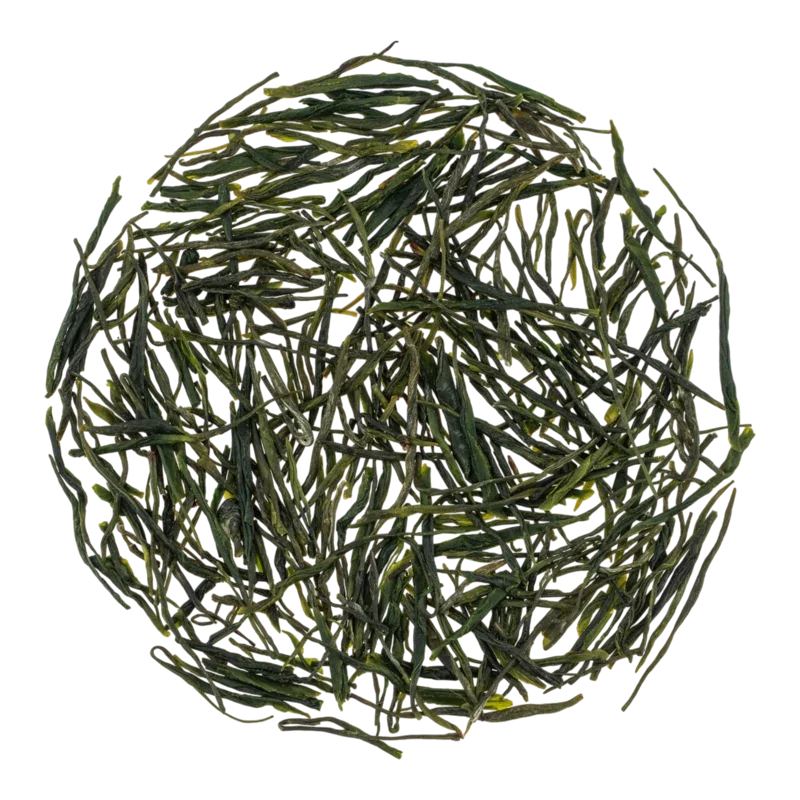
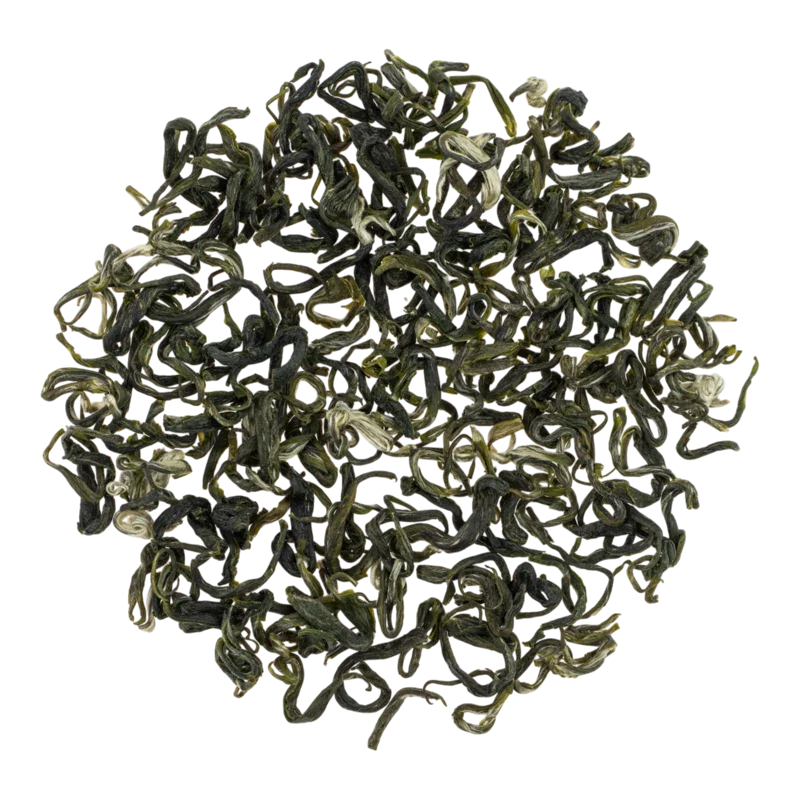
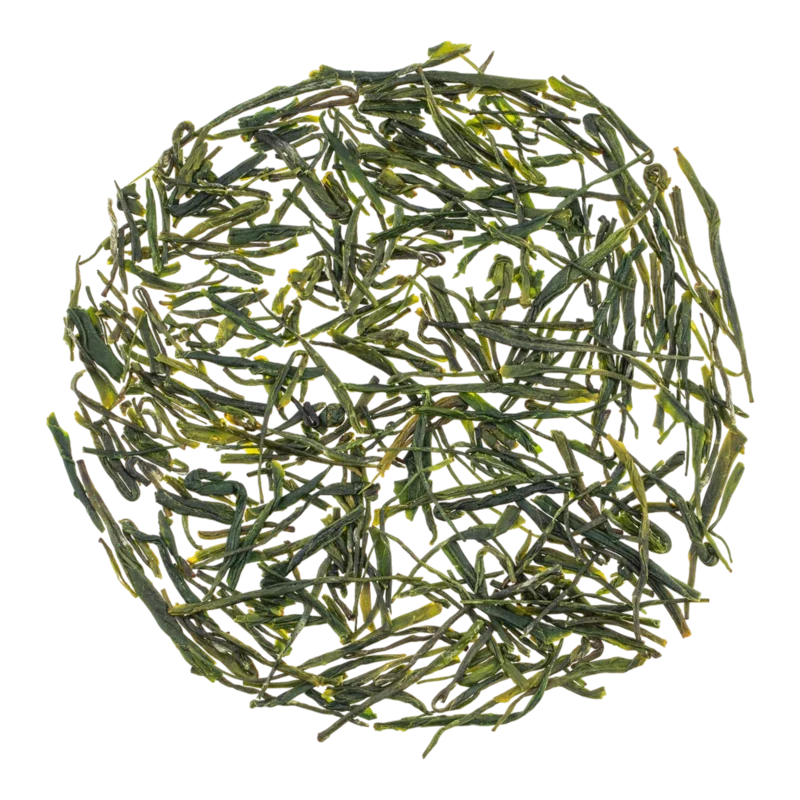
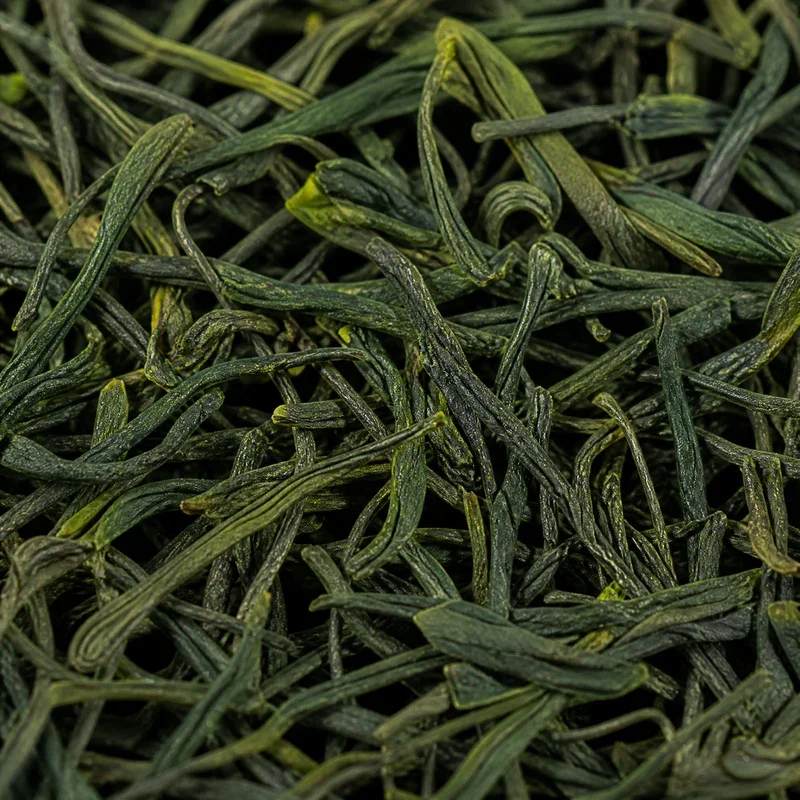
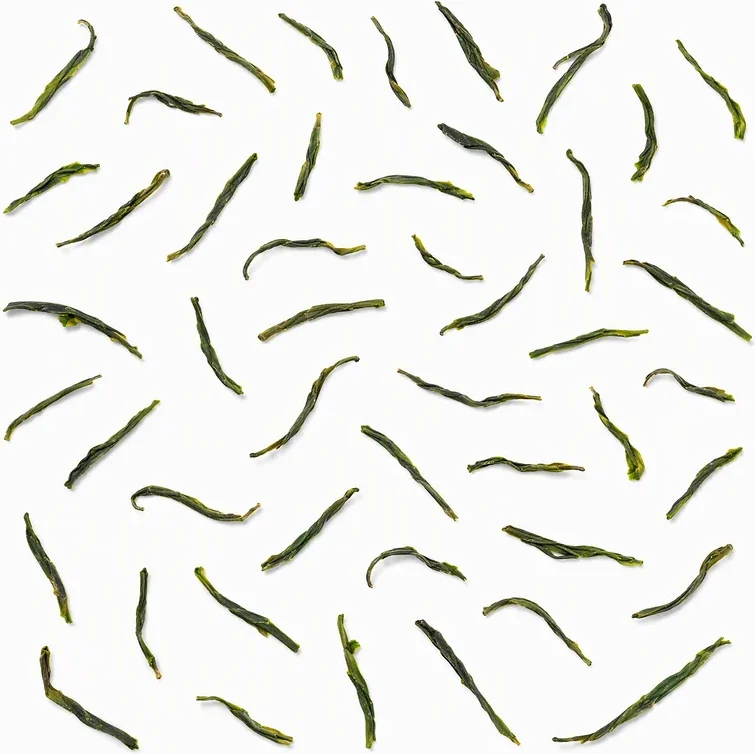
Dry Leaf Appearance: Even, tight, thin strips (条索紧细, tiáosuǒ jǐnxì), color — bright emerald green with silvery sheen from down. Leaves look neat and uniform.
Dry Leaf Aroma: Deep, persistent chestnut aroma "shu lixiang" (熟栗香, shú lì xiāng — "roasted chestnut aroma"), complemented by clean vegetal notes and light floral undertones.
Liquor Aroma: Chestnut profile dominates and intensifies as it cools. Aroma is dense, "voluminous," with a long trail — one of the most recognizable features of this tea.
Liquor Color: First infusion — clean, light green (清绿); second — greenish-golden (绿亮透黄); third — deep jade (碧泛青). Liquor is transparent, bright.
Spent Leaves: Tender green, even, soft. Leaves unfold completely, confirming the tenderness of raw material and careful processing.
Taste: Described by the "three cups" formula: first infusion — clean, transparent, with initial sweetness (甘醇初露); second — rich, with deep chestnut "body" (熟栗香郁); third — turquoise, fragrant, with full aroma development (芳香横溢). Taste is sweet, clean (清甘, qīnggān), aftertaste — long returning sweetness (回甜畅爽, huí tián chàng shuǎng). Bitterness and coarse astringency are practically absent.
Alkaloids: Caffeine — about 3–4%; theobromine, theophylline — trace amounts.
Amino Acids: Elevated content — 3.5–5%, primarily L-theanine. High concentration of amino acids accounts for "freshness" (鲜爽) and "sweet smoothness" (甘滑) of taste.
Distinctive microelement — selenium content in tea leaves is significantly higher than the Chinese average due to selenium-bearing soils of Enshi. Selenium is an important antioxidant microelement participating in glutathione peroxidase enzyme function.
Essential Oils: Volatile compounds forming the chestnut profile — pyrazine and furan derivatives formed during high-temperature fixation (Maillard reactions).
Minerals: Potassium, magnesium, manganese, zinc, phosphorus, fluorine — along with selenium.
Polyphenols: 18–24% of dry weight. Catechins provide mild astringency and antioxidant activity. Relatively low ratio of polyphenols to amino acids for green tea — key to mildness and sweetness of taste.
Vitamins: C (high content, typical for green teas), B₁, B₂, E, K, folic acid.
Double antioxidant protection: catechins (polyphenols) + organic selenium — a rare combination for tea that enhances free radical neutralization.
Combination of caffeine and L-theanine provides sustained concentration without anxiety — "calm alertness."
Selenium participates in thyroid hormone synthesis and immune system function.
Polyphenols contribute to lipid profile normalization and maintaining vascular elasticity.
Green tea stimulates digestive enzyme secretion and gently tones peristalsis.
Fluorine and catechins suppress cariogenic microflora.
Green tea enhances thermogenesis and fat oxidation.
Catechins possess bacteriostatic activity against a range of pathogens.
3 g per 200 ml. Fill one-third of glass — wait 30 seconds — top up. Drink, leaving one-third of liquor and adding hot water. Observe transformation of "three cups."
Do not steep longer than 3 minutes in teapot — over-steeped tea loses sweetness and acquires excessive bitterness.
Tea Amount: 3 g per 150 ml (glass/teapot); 5–7 g per 100–120 ml gaiwan (gongfu).
Teaware: Porcelain gàiwǎn (盖碗) — allows control of extraction time and fully reveals chestnut aroma. Glass cup — for observing leaf "dance" and color transformation from infusion to infusion.
Water Temperature: 80–90°C. For delicate bud batches — 80°C; for standard leaf grades — 85–90°C.
Container: Foil vacuum bags, tin cans with tight lids. Glass — only opaque.
Enemies: Light, moisture, foreign odors, oxygen, heat.
Shelf Life: Within 12 months after production — for maximum chestnut aroma development. Local saying claims that properly sealed Wujiatai Gong Cha in the second year retains all its qualities "like new" (色、香、味、形不变).
Temperature: 0–5°C (refrigerator) in airtight vacuum packaging — optimal. Cool dry place (up to 10°C) acceptable.
Both from Enshi Prefecture, both selenium-containing. However, Ēnshī Yù Lú is the only tea in China that has preserved Japanese steaming technology (蒸青, zhēngqīng); its aroma is fresh, marine, "seaweed-like." Wujiatai is chaoqing/hongqing with pronounced chestnut profile and greater taste density. The two teas complement each other as "yin and yang" of Enshi tea culture.
Both green teas from the "central Chinese belt" with chestnut notes. Xinyang Maojian is purely chaoqing, lighter and more astringent. Wujiatai is denser, sweeter, with more persistent chestnut aroma thanks to multiple drying. Selenium in Wujiatai adds unique nutritional value.
Mengding Gan Lu is a Sichuan tea with gongcha history, mild, sweet, with bean and chestnut undertones. Wujiatai is more structured, with deeper chestnut profile and pronounced "three-cup" transformation. Both are tribute teas with centuries-old pedigree, but terroir and technology create distinguishable profiles.
Tianshan is Fujian hongqing with floral-chestnut aroma and "three greens"; Wujiatai is Hubei tea with mixed chaoqing-hongqing technology and dominant chestnut profile. Tianshan is "more aromatic" in floral register; Wujiatai is "deeper" in chestnut and "sweeter" in aftertaste.
Price Category: Medium and upper segment among Hubei green teas. Spring special grade (特级) from the core zone — from 600 yuan/jin. Standard export batches — significantly cheaper.
Price Factors: Harvest season (early spring — maximum), grade, belonging to GI core zone, organic certification, cultivar (E Cha 10 — premium).
No reviews yet. Tell us what you think of this tea.
Rate this tea and share your impressions. We review each submission before publishing it.