Brewing
Gongfu brewing
- Water temperature
- 75 °C
- Tea amount
- 5 g
- Water volume
- 100 ml
- First steep
- 10 s
- Time added per infusion
- 5 s
- Infusions
- 3

Tǎquán yún wù
Choose a brewing method. Start with the recommended quantities and time, then adjust to taste.
Brewing
Brewing
Taste
Tea encyclopedia
Category: Historical famous tea (历史名茶, lìshǐ míngchá). Included among the "Ten Famous Teas of Anhui" (安徽十大名茶).
Category: Historical famous tea (历史名茶, lìshǐ míngchá). Included among the "Ten Famous Teas of Anhui" (安徽十大名茶).
Coordinates: Approximately 30°34′ N, 118°26′ E (Xikou area, junction of Xuanzhou, Ningguo and Jingxian territories).
Origin: China, Ānhuī Province (安徽省, Ānhuī Shěng), Xuānchéng City (宣城市, Xuānchéng Shì), Xuānzhōu District (宣州区, Xuānzhōu Qū), Xīkǒu Town (溪口镇, Xīkǒu Zhèn). The core production area is the northwestern slope of Gaofengshan Mountain (高峰山, Gāofēng Shān), villages of Tǎquán (塔泉), Zhangwan (张湾), Zhuangwutai (庄屋台), as well as Baokeng (鲍坑) and Milongta (密龙塔) of Tiānzhù administrative village (天竺村).
Type: Green tea (non-oxidized), 烘青 (hongqing, hōngqīng — fixation followed by hot air drying). Belongs to the category of "special" (特制) hongqing green teas.
Cultural Significance: Taquanyun Wu stands in the ranks of the great Anhui tea tradition, alongside Huangshan Maofeng, Lu'an Guapian and Taiping Houkui. The Xuanzhou region is mentioned in Lu Yu's "Classic of Tea": "宣城人秦精,常入武昌山采茗" — "A resident of Xuancheng named Qin Jing constantly went to Wuchang Mountain to gather tea." This is one of the earliest testimonies of tea gathering in Anhui. In modern times, Taquanyun Wu was tea for the State Council of the PRC (国务院办公厅用茶) and, according to some sources, was exported for the British royal court. Annually in Xikou Town, the "Southern Anhui High Mountain Tea Festival" (皖南高山茶叶节) is held, where Taquanyun Wu has repeatedly taken first place.
History: The Xuancheng area (ancient Xuanzhou, 宣州) is one of China's oldest tea-producing regions. The earliest documented evidence of tea from Xuānchéng dates to the Eastern Jīn era (东晋, 317–420): during the reign of Emperor Yuán (元帝, 317–322), Wēn Qiáo (温峤, Wēn Qiáo), who held a post in Xuancheng, presented to the court "one thousand jin of tea and three hundred jin of ming" (上表贡茶一千斤,供茗三百斤) — this is one of the first mentions of tea as a court tribute in Chinese history. Thus, tea cultivation in Xuanzhou has more than 1,700 years of history.
Name Breakdown: 塔泉 (Tǎquán) — "pagoda spring," from the name of Taquanan Monastery (塔泉庵) and the mountain spring at its walls. 云雾 (yún wù) — "clouds and mist," a classic epithet for high-mountain teas growing in zones of constant cloudiness. Alternative historical name — Gāofēng Yùn Wǔ (高峰云雾) — refers to Gaofengshan Mountain (高峰山, "High Peak").
Only "pinching with support" (提折采法, tízhé cǎifǎ) — the shoot is carefully broken off, not torn with fingernails (the "fingernail pinching" method, 指甲捏采, is prohibited). Raw material is delivered in clean bamboo baskets, not pressed, not wetted.
Cultivar: Main variety — Xīkǒu Willow Leaf (溪口柳叶种, Xīkǒu Liǔyè Zhǒng), a local population form (群体种) with narrow, elongated leaves, good bud pubescence and high content of aromatic substances. This is a medium-maturing small-leaf type, adapted to the mountain conditions of southwestern Anhui over many centuries.
Picking: Late spring — usually after Qīngmíng (清明) and before Gǔyǔ (谷雨, "Grain Rain"), approximately from early to late April. Due to the high altitude of the plantations (over 1000 m), vegetation begins late — in March, snow often still lies on Gaofengshan Mountain.
Pluck Standard: One bud and two leaves in initial opening stage (一芽二叶初展). Shoot length — about 8 cm. Shoots must be whole, fresh and uniform. A system of "four selections" (四选, sì xuǎn) applies: selection of garden, bush, branch and bud; as well as "eight prohibitions" (八不采, bā bù cǎi): don't pick shoots too small or large, don't pick leaves without buds, don't pick in rain, don't pick in midday heat, etc.
Altitude: The core production area — northwestern slope of Gaofengshan Mountain at an altitude of about 1155 m a.s.l. This is one of the highest points of the mountain massif at the junction of Xuanzhou, Ningguo (宁国) and Jīngxiàn (泾县).
Climate: Temperate subtropical. Average annual temperature — 15.4 °C (minimum recorded — 13.7 °C, maximum — 40 °C). Annual precipitation — about 1400 mm. Frost-free period — 229 days. Short daylight hours (mountains shade the sun) and constant morning/evening mists are key quality factors.
Soil: Deep, well-drained, acidic (pH ≈ 5.5). Parent rock — weathered mountain shale with high mineral content.
Forest coverage of the area — more than 87%. Plantations are in natural surroundings of broadleaf and coniferous forests with rich biodiversity. Diffused light (漫射光) predominates over direct sunlight — this slows L-theanine breakdown and accumulates amino acids, giving the tea characteristic sweetness and depth.
Topography: Mountain ridges — continuation of Huángshān spurs (黄山余脉). The area is "multi-layered": peaks alternate with gorges, streams wind among steep slopes. Plantations are located in the upper forest belt, among clouds.
After picking, shoots are spread in a thin layer on bamboo mats in a clean, cool, ventilated room. Spreading time — 4–8 hours (maximum 10). The leaf loses surface gloss, becomes soft, moisture content decreases to 70–72%, fresh aroma appears — this signals readiness for fixation.
Conducted in a flat wok (平口锅) at wall temperatures of 110–200 °C (principle "first high, then lower"). Batch size — 220–250 g for hand firing. In the first 1–2 minutes — slow stirring for rapid heating; then — high tossing (高抛抖翻) to remove moisture, grassy smell and prevent burning. After ~5 minutes the leaf darkens to dark green, becomes soft, primary tea aroma appears. Moisture — about 60%. Mechanical fixation is also possible — in both cases the key principle: "fire through, fire evenly, no red stems and red leaves, no burnt edges" (杀透杀匀,无红梗红叶,无焦边爆点).
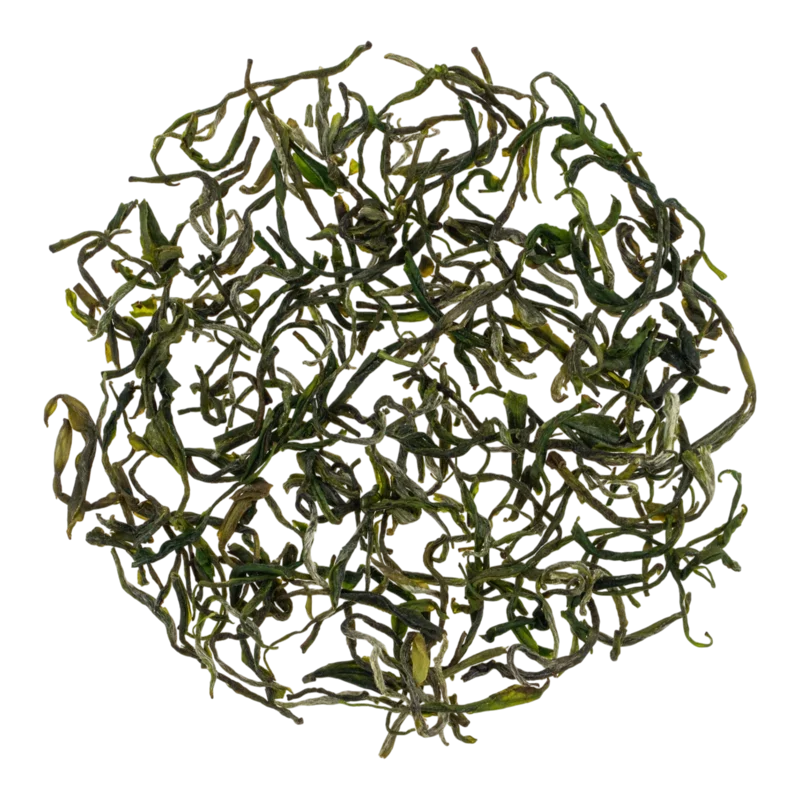
The cooled leaf after fixation is rolled, forming compact, dense tea particles. The degree of pressure determines the richness of the future liquor. Taquanyun Wu is shaped into tight, slightly curved spindle-shaped particles.
Preliminary drying on a brazier at moderate temperature.
Redistribution of residual moisture inside the tea particle — a critically important stage for aroma uniformity.
Final drying to stable moisture ≤ 7%. This is where the orchid tone (兰花香) is fixed — the signature feature of Taquanyun Wu.
Manual removal of non-standard particles, hard stems and fragments.
Finished tea is divided into grades and packaged.
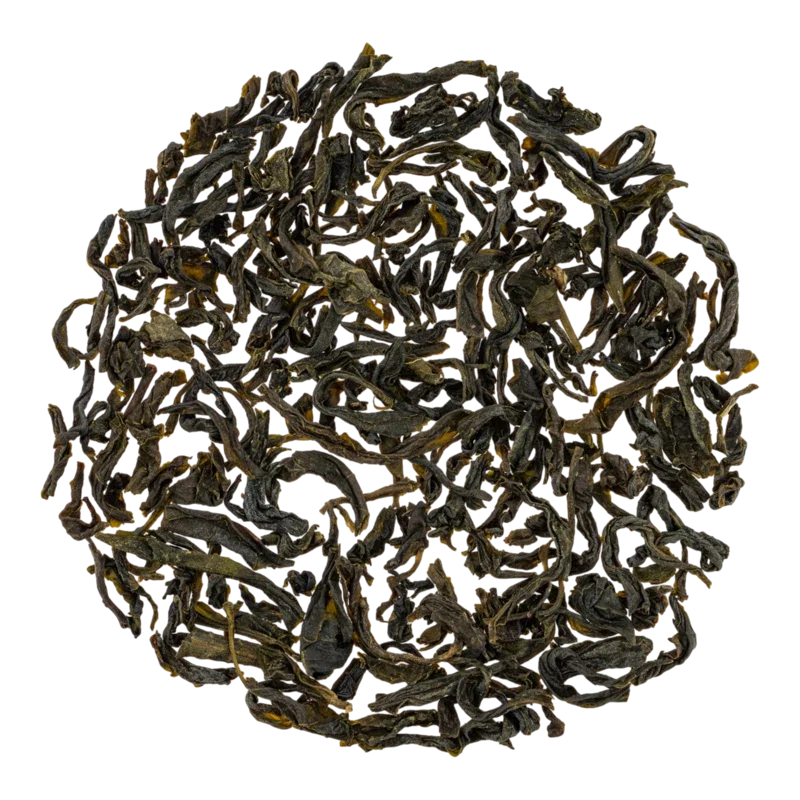
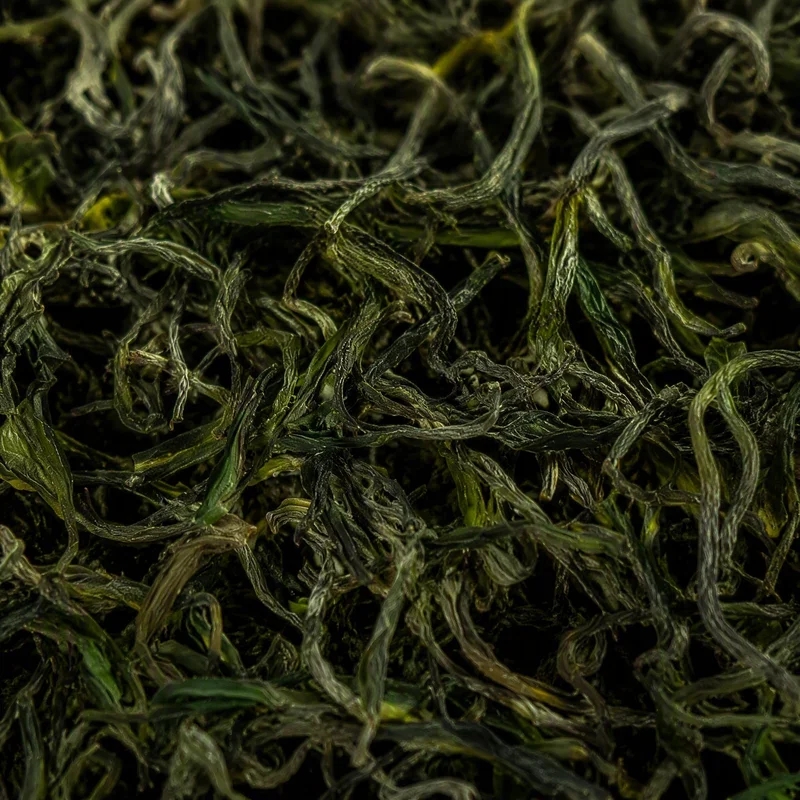
Dry Leaf Appearance: Dense, compact, slightly curved particles (条紧匀细), fleshy and weighty (肥壮重实). Color — dark green with oily luster (色绿油润). White down abundantly covers the surface, creating a light silvery coating (白毫裹身).
Dry Leaf Aroma: Bright and fresh, with dominant orchid note (兰花香) and light chestnut undertone.
Liquor Aroma: Pronounced orchid aroma (兰花香气明显) — pure, high and persistent. This is the "calling card" of Taquanyun Wu, distinguishing it from most Anhui green teas.
Liquor Color: Clear, bright, from tender green to yellow-green (清澈明丽). Liquor clarity — high.
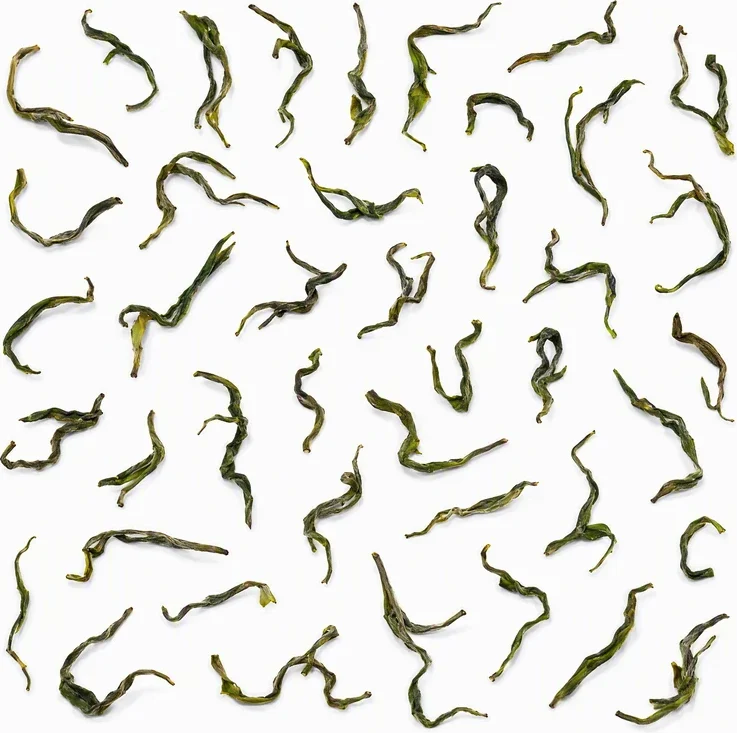
Spent Leaves: Tender green with yellowish tint (芽叶嫩黄绿), soft, elastic, with well-preserved buds and leaves.
Taste: Dense and oily (醇厚, chúnhòu), with deep sweetness. Aftertaste — long, with pronounced returning sweetness (甘甜生津, gāntián shēngjīn) and sensation of freshness that persists in the mouth for several minutes. The characteristic "淡中有回味" (dàn zhōng yǒu huíwèi — "in apparent lightness — depth of aftertaste") accurately describes the style of this tea.
Alkaloids: Caffeine (咖啡碱) — ~2.5–4%. Theobromine and theophylline — in trace amounts.
Amino Acids: Elevated content — 4.18% of dry mass. This is a high indicator, providing pronounced sweetness and "umami" undertone. L-theanine is the dominant amino acid.
High content — above average for Anhui green teas, which explains the richness and "body" of the liquor.
Linalool, linalool oxide, nerolidol, geraniol, indole — form the complex orchid aroma. Methyl salicylate — responsible for the fresh "green" note.
The ratio of polyphenols to amino acids (27.15 : 4.18 ≈ 6.5 : 1) is in the zone optimal for high-quality green teas: enough polyphenols for "body," but amino acids soften bitterness and add sweetness.
Minerals: Potassium, manganese, zinc, fluorine, phosphorus.
Polyphenols: Content — about 27.15% of dry mass (according to analyses for raw material from the Taquan core zone). Main fractions — catechins (EGCG, EGC, ECG).
Vitamins: C (ascorbic acid — well preserved thanks to gentle hongqing technology), B₁, B₂, E, K.
High content of catechins (especially EGCG) provides powerful neutralizing action against free radicals, which slows cellular aging.
The classic combination "caffeine + L-theanine" provides gentle attention enhancement without nervousness — ideal for morning or work tea sessions.
Polyphenols help maintain vessel wall elasticity and normalize cholesterol levels.
Green tea stimulates gastric juice secretion and intestinal motility. Taquanyun Wu with its dense body is a good companion for afternoon tea.
Vitamin C and polyphenols support the body's protective functions.
L-theanine stimulates generation of brain alpha waves, improving the state of relaxed concentration and creative thinking.
Fluorine and catechins suppress pathogenic bacteria growth, reducing caries risk and freshening breath.
People with sensitive stomachs are not recommended to drink this tea on an empty stomach due to notable polyphenol content. Optimal — 30–60 minutes after meals.
Tea Amount: 3–4 g per 200 ml (glass) or 5 g per 150 ml gaiwan.
Teaware: Clear glass tumbler with straight walls — recommended for best observation of tea particles. "Top pouring" method (上投法, shàngtóu fǎ): first hot water is poured, then tea particles are carefully lowered — they slowly sink, opening as they move. Porcelain gaiwan or glass teapot are also suitable.
Water Temperature: 90–95 °C — noticeably hotter than for many delicate green teas. The dense leaf of Taquanyun Wu needs high temperature for full aroma and flavor development.
Container: Airtight, opaque — tin cans or vacuum foil packages.
Shelf Life: 6–12 months for full flavor. Hongqing green teas are slightly more stable than chaoqing green teas in storage, but the principle "drink young" applies fully.
Absolute enemies. Store away from kitchen spices, perfumes, medicines.
Temperature: Refrigerator 0–5 °C with strict sealing. Before opening package — bring to room temperature to avoid condensation.
The most famous Anhui green tea. Maofeng is hongqing, like Taquanyun Wu, but from more tender raw material (bud + first leaf), with curved "bird's tongue" shape and delicate sweet aroma. Taquanyun Wu is denser and more "muscular," with more pronounced orchid note and deep aftertaste. Maofeng is silk, Taquan is velvet.
Green tea from neighboring Jingxian County — another representative of the "orchid" family. Lanxiang is more delicate and elongated in shape, with transparent floral aroma. Taquanyun Wu is more compact, heavier, with greater body fullness.
Jiangxi "cloud tea" from the "ten greats." Larger leaf, thick-walled particles, pronounced astringency. Taquanyun Wu is more elegant and aromatic, with better balance of sweetness and bitterness.
Another historical green tea from Xuancheng, from Jingtingshan Mountain. Distinguished by "snow" effect — white down, separating from particles during brewing, slowly descends like snowflakes. Style is lighter and more contemplative. Taquanyun Wu is denser, more "weighty" and rich.
Price Category: Medium and medium-high segment among Anhui green teas. Tea from the core zone (Taquan village, altitude ~1155 m) costs significantly more than production from adjacent flatland areas. Taquanyun Wu occupies the niche of "tea for connoisseurs" — less known to the general public than Huangshan Maofeng, but valued by experts for its deep character.
No reviews yet. Tell us what you think of this tea.
Rate this tea and share your impressions. We review each submission before publishing it.