Brewing
Gongfu brewing
- Water temperature
- 93 °C
- Tea amount
- 5 g
- Water volume
- 100 ml
- First steep
- 10 s
- Time added per infusion
- 5 s
- Infusions
- 4

Tǎnyáng Gōngfū
Choose a brewing method. Start with the recommended quantities and time, then adjust to taste.
Brewing
Brewing
Taste
Tea encyclopedia
Category: Gōngfū hóngchá (工夫红茶, gōngfū hóngchá) — traditional style of masterful red tea processing. One of the "three great red gongfu teas of Fujian Province" (闽红三大工夫).
Category: Gōngfū hóngchá (工夫红茶, gōngfū hóngchá) — traditional style of masterful red tea processing. One of the "three great red gongfu teas of Fujian Province" (闽红三大工夫).
Coordinates: Approximately 27°05′ N, 119°39′ E (Tanyang Village, Shekou Town, Fu'an City).
Origin: China, Fújiàn Province (福建省, Fújiàn Shěng), Fu'an City (福安市, Fú'ān Shì), Shèkǒu Town (社口镇, Shèkǒu Zhèn), Tǎnyáng Village (坦洋村, Tǎnyáng Cūn). The core production zone is located along the Guìlín Ridge (归岭) at the foot of Mount Baiyunshan (白云山), while the historical raw material collection area covered seven to eight counties — from Zhenghe County in the northwest to Xiapu County in the southeast, extending several hundred li.
Type: Chinese red tea (black tea) (红茶, hóngchá), fully oxidized.
Ancestor of all world red teas, from Wuyishan County. Distinguished by pine wood smoking technology (for traditional style), imparting smoky-coniferous aroma — contrasting with clean sweet-fruity profile of Tanyang Gongfu. Body more powerful, with pronounced "smokiness"; Tanyang softer, more elegant and "fruitier."
Second of "three great gongfu of Fujian," from Bailin district (Fuding City). Usually somewhat lighter in body, with more pronounced floral component in aroma and more delicate texture. Tanyang denser, with dominating longan profile.
"Qi Hong" from Anhui Province — one of Ten Famous Teas of China. Its calling card — so-called "Qimen aroma" (祁门香), described as honey-orchid with candied rose notes. Liquor lighter and more "perfumed" compared to full-bodied and "warm" longan profile of Tanyang Gongfu.
Yunnan red tea from large-leaf Assam subspecies (C. sinensis var. assamica). Significantly denser and more "bodied," with bright golden tips, taste of chocolate, burnt sugar and pepper spices. Tanyang more delicate, refined and "silky" in texture.
Hubei red tea with characteristic "cold haze" phenomenon (冷后浑). Comparable to Tanyang in body, but possesses more pronounced honey sweetness and "coniferous" notes; unique in selenium content. Tanyang — more "fruity" and "rounded" in profile.
Cultural Significance: Tanyang Gongfu is not just tea, but a cultural symbol of Fu'an and all of eastern Fújiàn (闽东, Mǐndōng). Tanyang village has preserved architectural heritage from the tea trade boom era: ancient residential houses, covered bridge, watchtowers, ancestral temples of the Shi and Hu families — all in late Qing style. The former building of the "Fengtailong" tea trading house (丰泰隆), founded by Shì Guanglin (施光凌) — one of the production pioneers — now serves as a museum of Tanyang Gongfu history. Fu'an holds the title "Capital of Chinese Red Tea" (中国红茶之都) and "Hometown of Chinese Tea" (中国茶叶之乡), and the city's tea plantations exceed 300,000 mu (about 20,000 hectares).
History: Fu'an is one of the oldest tea regions in Fujian: tea production here has been documented since the Tāng dynasty (唐朝), and by the Sōng dynasty (宋朝) the area was already counted among the main tea-producing counties of the province. However, red tea appeared here much later. During the Ming to early Qing periods, local masters produced "Guixiang tea" (桂香茶) — aromatic tea from the local "caicha" (菜茶) population. The turning point came in 1851 (first year of Xianfeng reign, 咸丰元年), when a tea merchant from Jianning brought red tea production technology from Chong'an County (now Wuyishan) to Tanyang. Village resident Hú Fusi (胡福四, also known as Hu Jinsi, 胡进四), founder of the tea house "Wanxinglong" (万兴隆), was the first to successfully apply the new technique — natural withering, hand rolling, indoor oxidation, and charcoal firing — to local "Tanyang caicha" raw material. The result exceeded expectations: finely twisted red tea with characteristic longan aroma and clean sweet taste quickly won recognition from foreign buyers.
Name Breakdown: "Tanyang" (坦洋) is a toponym, the name of the tea's birthplace village located at the foot of Mount Baiyunshan. The village name itself poetically describes its terrain: "tan" (坦) — "level, spacious," "yang" (洋) — "wide, vast," reflecting the character of the valley by the mountain stream. "Gongfu" (工夫) — literally "skill," "meticulous work" — traditional designation for red tea production style where each stage requires high-level craftsmanship, attentiveness, and significant time investment. Thus, the full name means "masterfully processed red tea from Tanyang village."
Cultivar: Traditional raw material is "Tanyang caicha" (坦洋菜茶) — a local population of small-leaf variety Camellia sinensis var. sinensis (群体种, qúntǐzhǒng), adapted to Fu'an's mountain conditions over centuries. This population is distinguished by thin, tender shoots with pronounced down and high aromatic compound content, forming the classic "longan aroma" (桂圆香). In modern production, breeding cultivars are used in parallel: Fúdǐng Dàbáichá (福鼎大白茶), Fu'an Dàbáichá (福安大白茶), Fuyun 6 (福云6号) and other highly aromatic varieties that provide increased golden tips content.
Picking: Main season — spring (March–April), best batches are collected before and immediately after the Qīngmíng festival (清明). Summer harvest (May–June) yields denser but less aromatic batches.
Pluck Standard: For highest grades — single bud (单芽, dānyá) or one bud and one leaf (一芽一叶, yī yá yī yè). For standard batches — one bud and two to three leaves (一芽二三叶, yī yá èr sān yè). Leaves must be tender, whole, without mechanical damage.
Raw Material: Fresh, whole leaf without coarse stems and veins; minimal delay between picking and start of withering; batch uniformity by shoot maturity degree.
Altitude: Main plantations are located at 100–600 m above sea level. Elite "Guilin hongcha" (归岭红茶) raw material is collected at the junction of Fu'an and Shouning counties at about 1,080 m altitude — this micro-region is considered the historical core of finest quality.
Climate: Subtropical monsoon; average annual temperature about 15.4°C; average annual precipitation 1,600–1,800 mm; relative humidity 78–85%. Mountains are often shrouded in clouds and mists, which diffuses sunlight and promotes amino acid accumulation in leaves.
Soil: Acidic red soils (红壤, hóng rǎng) and yellow-red soils predominate, pH 4.5–6.5, with high organic content and good drainage. Soil mineral composition imparts characteristic "density" and mineral aftertaste to the liquor.
Traditionally — hand picking and ecological cultivation. Modern farms actively implement organic farming standards; many plantations are certified under "green" (environmentally clean) production systems.
Hand selection of tender shoots according to established grade standard. Picking is conducted in morning hours after dew has dried.
Picked leaves are spread in thin layers on bamboo trays or in special withering troughs. Goal — reduce moisture content to 58–62%, give leaves elasticity and initiate primary enzymatic processes. Natural withering (日光萎凋 — in sun, or 室内萎凋 — indoors) or mechanical withering (萎凋槽) is applied. Duration 8–16 hours depending on conditions. For highest grades of Tanyang Gongfu, gentle combined withering is preferable.
Withered leaves are rolled to break cellular structure and bring cell sap to the surface, ensuring uniform oxidation. For tender raw material, single rolling for about 45 minutes with minimal pressure is applied; for coarser leaves — two to three times with intermediate breaking up of clumps. Breaking up clumps (解块 — jiěkuài) for highest grades is done by hand to avoid damaging leaf form.
Rolled leaves are laid in 8–10 cm layers in special rooms at 25–30°C temperature and 90–95% humidity. During oxidation, polyphenols transform into theaflavins and thearubigins, leaves acquire copper-red tint, characteristic sweet-fruity aroma forms. Duration 3–5 hours; readiness criterion — rich floral-fruity aroma and uniform red-copper leaf color.
Drying is conducted in two stages. First — at high temperature (about 120°C) for 35–40 minutes to ~25% moisture — fixes oxidation results and stops enzymatic processes. After intermediate cooling and leveling (摊凉 2–3 hours), second drying is conducted at 75–85°C to ~8% moisture. Final "aroma lifting" (提香 — tíxiāng) is performed at 80–85°C to final moisture ~5%, when tea crumbles to powder when compressed and stem breaks with a crack.
Dried "red maocha" (红毛茶) undergoes a series of operations: shake-sifting (抖筛 — dǒushāi), sorting sifting (撩筛 — liáoshāi), winnowing (扬簸 — yángbǒ), hand picking (拣剔 — jiǎntī), re-firing (复火 — fùhuǒ), batch leveling (匀堆 — yúnduī) and packing (装箱 — zhuāngxiāng). These six to ten operations, described by the formula "shake, separate, scoop, select, winnow, rinse" (抖、分、捞、选、簸、漂), constitute the core of craftsmanship recorded as intangible cultural heritage.
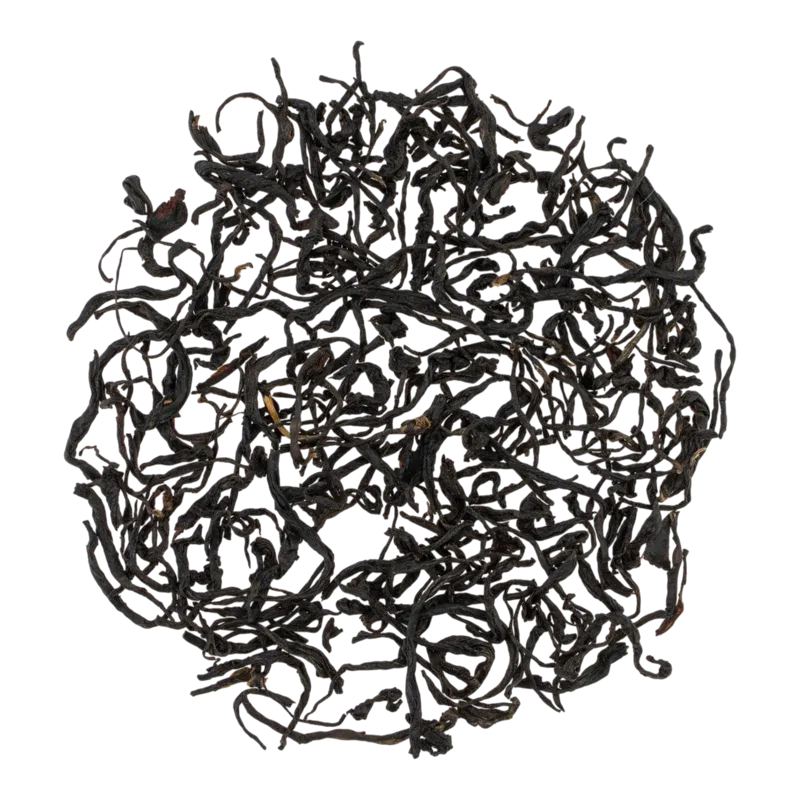
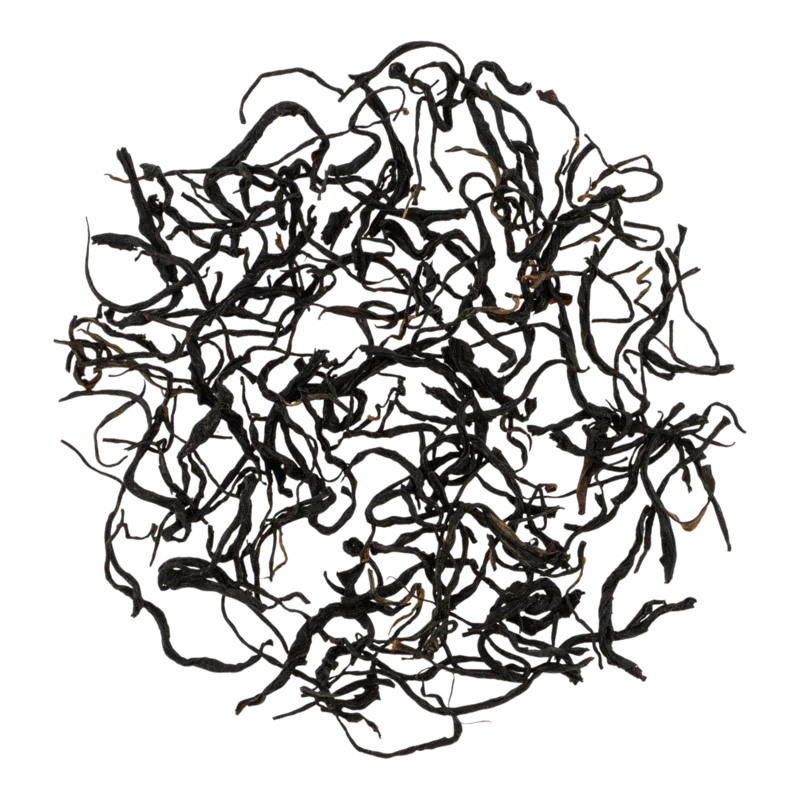
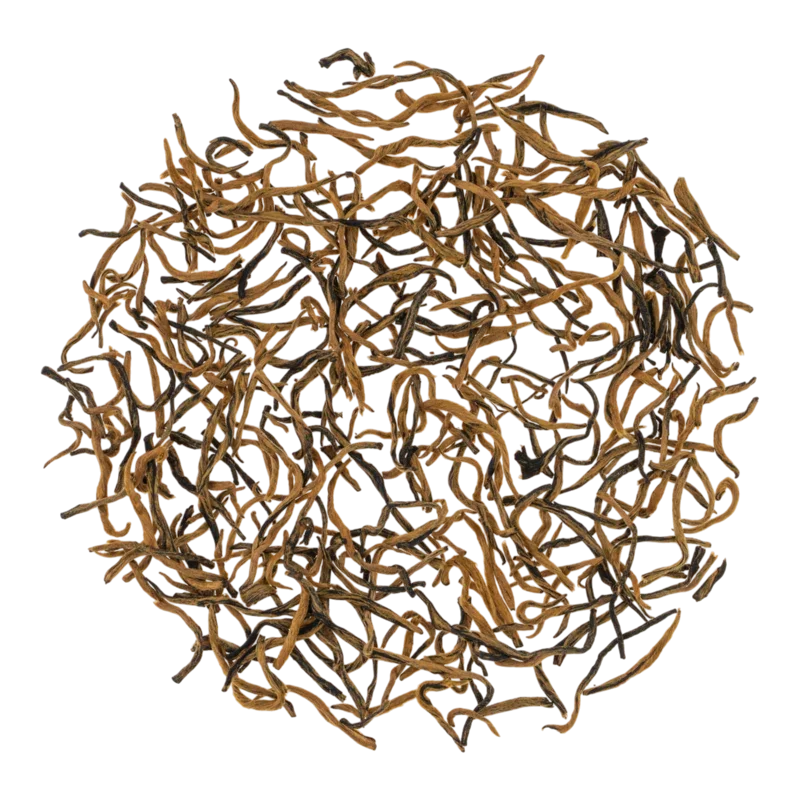
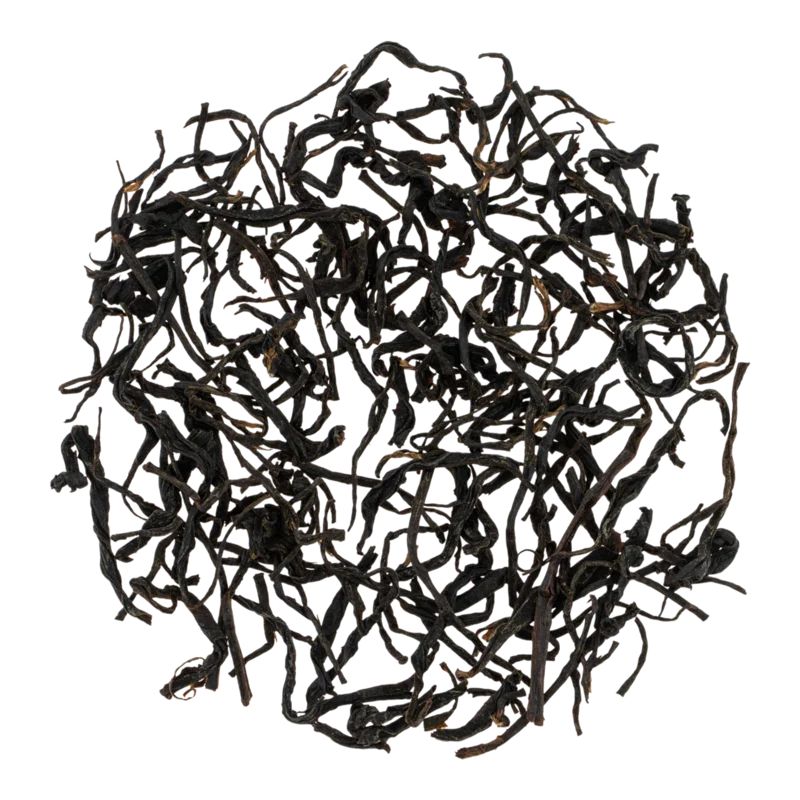
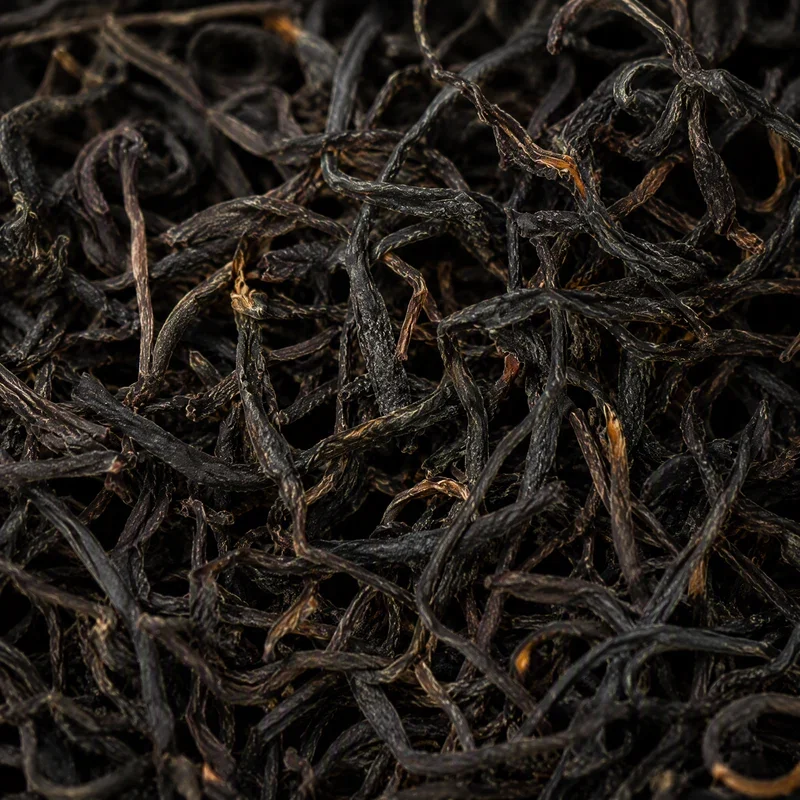
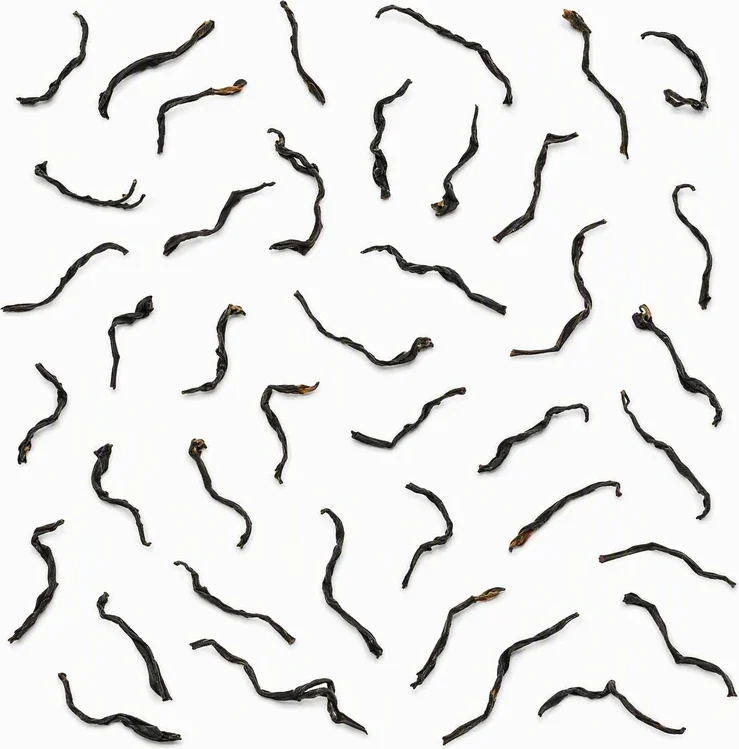
Dry Leaf Appearance: Thin, tightly twisted, straight strands (条索紧细匀直, tiáosuǒ jǐnxì yún zhí); color — deep black with oily luster (乌黑油润); in highest grades — noticeable golden or white tips (金毫 / 白毫). Leaf even, without dust and brittle debris, with clearly expressed form.
Dry Leaf Aroma: Clean, warm, sweetish — dominated by dried longan notes (桂圆香, guìyuán xiāng), dried fruits and light caramel. In finest batches, a delicate floral note reminiscent of cinnamon tree (桂花香) is detected.
Liquor Aroma: Rich, multi-layered — pronounced longan transitioning to honey, dried fruits (dates, dried apricots) and gentle caramel. In hot liquor, a light woody-spicy note sometimes emerges. Aroma is persistent, lasting until final steeps.
Liquor Color: From bright red-amber to ruby with characteristic golden rim around cup edge (金圈, jīnquān); liquor transparent, clean, with lively luster.
Spent Leaves: Leaves unfold evenly, acquiring red-copper and copper-brown tint; texture elastic, soft; in highest grades — whole tender shoots with clear vein structure.
Taste: Full-bodied, round and dense (醇厚, chúnhòu); pronounced natural sweetness (甜和, tiánhé) with juicy "oily" body. Astringency is soft and unobtrusive, quickly transforming into prolonged sweet aftertaste — "returning sweetness" (回甘, huígān). In finest batches, distinct "throat charm" (喉韵, hóuyùn) is felt — sensation of depth and warmth spreading in the throat.
Alkaloids: Caffeine — 2–4% dry mass (approximately 40–60 mg per 200 ml cup); theobromine and theophylline — in trace amounts.
Amino Acids: Total content 2–4%, including L-theanine — main component responsible for softness, sweet aftertaste and synergistic "calm-energizing" effect in combination with caffeine.
Over 300 identified components, including geraniol, linalool, phenylacetaldehyde, as well as Maillard reaction products formed during drying and heating. This complex creates the signature longan and caramel aroma.
The theaflavin to thearubigin ratio (TF/TR) in quality Tanyang Gongfu is considered one of the most harmonious among Fujian gongfu hongcha, explaining simultaneously bright color, pronounced taste and long aftertaste.
Minerals: Potassium, magnesium, manganese, zinc, fluorine, phosphorus; selenium — in microdoses characteristic of Fujian red teas.
Polyphenols: During complete oxidation, significant portion of catechins (especially EGCG and EC) transforms into theaflavins (TF, 1–2% dry mass) and thearubigins (TR, 10–15%). Theaflavins determine brightness and "golden rim" of liquor, while thearubigins determine color depth and "velvety" body. Total polyphenol content in finished tea is about 10–15% dry mass.
Vitamins: B group (B₁, B₂, B₃), vitamin C (partially destroyed during oxidation but remains in noticeable quantities), vitamin E.
Combination of caffeine and L-theanine provides smooth energy boost without sharp "peak" effect of coffee — attention and concentration increase gradually and last longer.
Theaflavins and thearubigins show pronounced antioxidant activity, helping neutralize free radicals and reduce oxidative stress.
Warm red tea is traditionally consumed after meals; tannins and polyphenols stimulate digestive juice secretion and promote comfortable food assimilation.
Moderate regular red tea consumption is associated with maintaining vascular wall elasticity and blood pressure normalization.
In traditional Chinese medicine, red tea belongs to "warm" nature beverages (温性, wēnxìng), making it especially valuable in cold season and for people with "cold" constitution.
Tea polyphenols, especially in combination with amino acids, have stimulating effect on immune system.
L-theanine and caffeine combination improves working memory and information processing speed while reducing anxiety levels.
Warm, sweet longan aroma and soft taste have calming effect on nervous system, creating feelings of comfort and harmony.
Tea Amount: 4–6 g per 100–120 ml (gongfu method, 功夫泡法); 2–3 g per 200–250 ml (steeping in large teapot or mug).
Teaware: Porcelain gàiwǎn (盖碗, 100–120 ml) — ideal choice revealing aroma without distortion. Porcelain teapot — good alternative. For dense, coarser batches, Yíxīng purple clay teapot (紫砂壶) is suitable, which softens profile and adds roundness. Glass fairness cup (公道杯) allows evaluation of liquor's "golden rim."
Water Temperature: 90–95°C for standard batches; 85–90°C for delicate highest grades with increased tip content (to avoid bitterness and reveal sweetness).
The progenitor of all red teas in the world, from Wuyi County. Distinguished by smoking technology over pine wood (for traditional style), which imparts a smoky-coniferous aroma — contrasting with the clean sweet-fruity profile of Tanyang Gong Fu. The body is more powerful, with pronounced "smokiness"; Tanyang is softer, more elegant and more "fruity."
The second of the "three great gongfu of Fujian," from Bailin district (Fuding city). Usually somewhat lighter in body, with a more pronounced floral component in aroma and more delicate texture. Tanyang is denser, with a dominant longan profile.
"Qi Hong" from Anhui Province — one of the ten great teas of China. Its calling card is the so-called "Qimen aroma" (祁门香), described as honey-orchid with notes of candied rose. The liquor is lighter and more "perfumed" compared to the full-bodied and "warm" longan profile of Tanyang Gong Fu.
Yunnan red tea from the large-leaf Assam subspecies (C. sinensis var. assamica). Significantly denser and more "bodied," with bright golden tips, flavors of chocolate, burnt sugar and peppery spices. Tanyang is more delicate, refined and "silky" in texture.
Hubei red tea with the characteristic phenomenon of "cold turbidity" (冷后浑). Comparable in body to Tanyang, but possesses more pronounced honey sweetness and "coniferous" notes; unique in selenium content. Tanyang is more "fruity" and "rounded" in profile.
No reviews yet. Tell us what you think of this tea.
Rate this tea and share your impressions. We review each submission before publishing it.