Brewing
Gongfu brewing
- Water temperature
- 93 °C
- Tea amount
- 5 g
- Water volume
- 100 ml
- First steep
- 10 s
- Time added per infusion
- 5 s
- Infusions
- 4

Táiwān sìjìchūn hóngchá
Choose a brewing method. Start with the recommended quantities and time, then adjust to taste.
Brewing
Brewing
Taste
Tea encyclopedia
Category: Taiwanese red tea (black tea) from varietal oolong raw material. Represents a modern direction in Taiwanese tea cultivation, using classic oolong cultivars for red tea (black tea) production.
Category: Taiwanese red tea (black tea) from varietal oolong raw material. Represents a modern direction in Taiwanese tea cultivation, using classic oolong cultivars for red tea (black tea) production.
Coordinates: 23.83° N, 120.70° E (Mingjian area, Nantou).
Origin: Táiwān (臺灣, Táiwān), Nántóu County (南投縣, Nántóu Xiàn), Míngjiān Township (名間鄉, Mínjiān Xiāng), Sōngbǎi Ridge area (松柏嶺, Sōngbǎi Lǐng). This is the central part of the island — the leading cultivation area for the Si Ji Chun cultivar, which accounts for the majority of its plantation areas. Individual plantings of this cultivar are also found in northern Thailand (Doi Mae Salong area), where it was introduced from Taiwan as part of royal programs to replace opium crops.
Type: Red tea (black tea) (紅茶, hóngchá), fully oxidized (oxidation level ~90–100%). In European tradition — "black tea."
Cultural Significance: Si Ji Chun as a cultivar occupies an important place in the economy of Taiwan's lowland tea regions, providing stable income to farmers thanks to multiple harvests. Its plantations occupy about 15% of the total tea cultivation area on the island, concentrated in the Songbai Ridge area. Red tea (black tea) from this raw material has become particularly popular in the last decade both in pure form and as a base for milk and fruit tea beverages (new wave Taiwanese teas), where its high aromatics and natural sweetness favorably distinguish it from classic red teas (black teas).
History: The Sì Jí Chún (四季春, Sìjìchūn) cultivar was discovered in the late 1970s — early 1980s by Taiwanese tea farmer Zhāng Wénhuī (張文輝, Zhāng Wénhuī) in the Mùzhà (木柵, Mùzhà) area, a suburb of Taipei. According to one version, the variety arose as a natural mutation during sexual reproduction of local tea plants. The farmer noticed the extraordinary growth vigor and resilience of the shoot, selected it, and began vegetative propagation. Thanks to its remarkable productivity — up to 6–8 harvests per year — and stable aromatics regardless of season, the variety quickly spread throughout the lowland tea regions of the island. Locally, it was nicknamed Huī Zǎi Chá (輝仔茶, Huī Zǎi Chá) — "Hui's tea," after the name of its discoverer. Traditionally, Si Ji Chun was used to make light, lightly oxidized oolongs, but in the 2000–2010s, Taiwanese masters began experimenting with full oxidation of this raw material, creating red teas (black teas) in which the floral nature of the cultivar intertwines with the honey density and sweetness characteristic of red teas (black teas). The cultivar reached northern Thailand in the 1990s as part of royal projects by King Rama IX (Bhumibol Adulyadej) to replace opium plantations with alternative crops among ethnic Chinese communities in Chiang Rai Province.
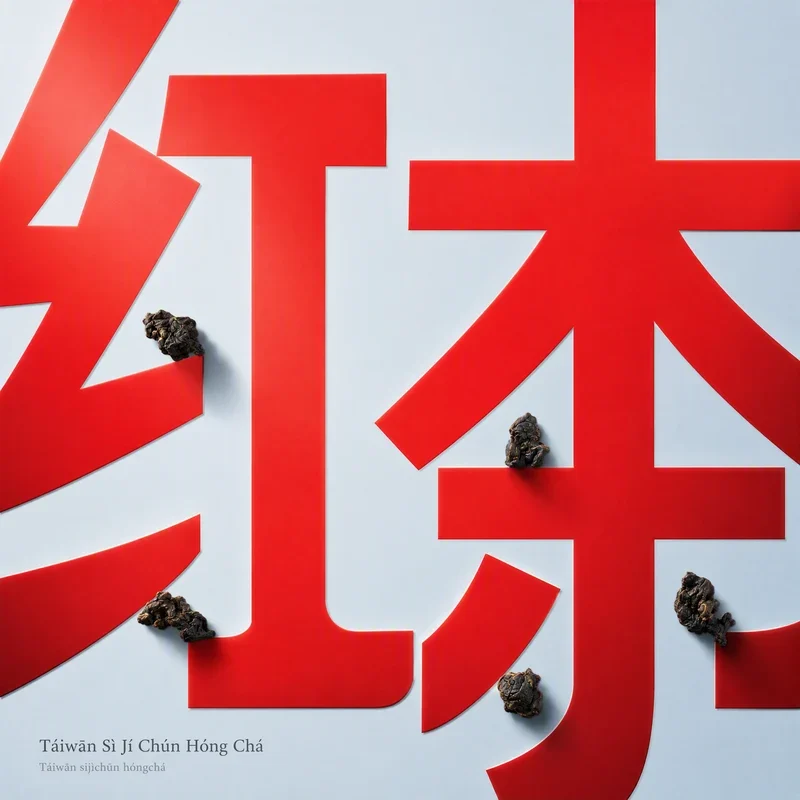
Name Breakdown: The name "Si Ji Chun" (四季春) literally translates as "Four Seasons Spring": 四季 (sìjì) — "four seasons," 春 (chūn) — "spring." The name reflects the unique ability of the cultivar to produce aromatic, "spring-quality" leaves at any time of year. The addition of 紅茶 (hóngchá) — "red tea" — indicates full oxidation of the raw material.
Cultivar: Sì Jí Chún (四季春, Sìjìchūn) — a local Taiwanese cultivar of Camellia sinensis var. sinensis, arising through natural sexual reproduction (自然有性繁殖, zìrán yǒuxìng fánzhí). Belongs to the bush type (灌木型, guànmù xíng), small-leaf (小葉種, xiǎoyè zhǒng), early-maturing (早生種, zǎoshēng zhǒng) type. The bush is medium-sized with a spreading crown, shoots and leaf buds are densely arranged. Young buds in the initial growth stage have a characteristic pale reddish-purple tint. Leaves are spindle-shaped with pointed ends, light green color with a slight yellowish tinge, with small sharp serrations along the edge and a moderately thick, slightly glossy leaf blade. The variety is distinguished by high disease resistance and good frost tolerance.
Picking: Thanks to practically continuous vegetation, harvesting is possible up to 6–8 times per year. For red tea (black tea) production, spring (February–March) or autumn-winter harvest raw material is often used, when more aromatic substances accumulate in the leaves. Harvest standard — flush consisting of a bud and two-three young leaves. Machine harvesting is predominantly used, which is due to the lowland nature of plantations and high yield of the variety.
Raw Material: Leaves must be healthy, juicy, without mechanical damage. The dense structure of the leaf blade tolerates mechanical processing well. For high-quality red tea (black tea), raw material from young bushes (3–7 years) with the richest aromatic potential is preferable.
Altitude: Predominantly lowland and low-mountain plantations at 200–500 m above sea level. This significantly distinguishes this cultivar from high-mountain Taiwanese oolongs, which grow at altitudes of 1000–2500 m.
Climate: Subtropical, humid. Average annual temperature about +22°C, precipitation over 2000 mm per year. High air humidity (~80%) and abundant insolation ensure intensive shoot growth. The cultivar is well adapted to hot conditions and retains aromatic potential even when grown at low altitudes.
Soil: Red soils and yellow soils with acidic reaction (pH 4.5–5.5), fertile, well-drained, formed on the basis of weathered lateritic rocks. The rich mineral composition of soils contributes to the formation of the tea's flavor profile.
The main production area — Mingjian Township in Nantou County, especially the Sōngbǎi Ridge zone (松柏嶺, "Pine-Cypress Ridge"), which is the main center of Si Ji Chun cultivation in Taiwan. Also grown in other low-mountain areas of central and southern Taiwan.
Cultivation is predominantly intensive with regular pruning of bushes to stimulate growth of new shoots. Thanks to the natural unpretentiousness of the variety and its ability for multiple harvests, Si Ji Chun is one of the most economically efficient Taiwanese cultivars.
Hand or machine picking of young shoots (bud and 2–3 leaves).
Harvested leaves are spread in a thin layer outdoors under sunlight for 2–3 hours. Under the influence of ultraviolet light and heat, chlorophyll degradation begins in the leaves and aromatic precursors are activated. Moisture loss is 20–30%. This stage, more characteristic of oolongs than classic red teas (black teas), significantly enhances the concentration of aromatic substances in the finished product.
Leaves are moved to a cool, ventilated room for even moisture redistribution and continuation of enzymatic processes.
Leaves are rolled in rolling machines to destroy cell walls and release cell juice, which initiates intensive oxidation of polyphenols.
A stage characteristic of the Taiwanese oolong tradition — leaves are wrapped in cloth and repeatedly compressed, giving them a semi-spherical shape. During alternating heating and cooling, oxidation continues, and close contact of cell juice with air enhances oxidation. This stage is responsible for the characteristic rounded shape of dry tea and its rich sweetness.
Rolled leaves are left in a warm, humid room for several hours for deep oxidation. Catechins transform into theaflavins and thearubigins, which form the color and taste of red tea (black tea). The process is controlled by the master through changes in leaf color and aroma and is stopped when an oxidation level of about 90–100% is reached.
Tea is quickly dried with hot air at 90–120°C to stop oxidation and reduce moisture to 3–5%. Some masters apply two-stage drying: first — at higher temperature, second — at reduced temperature to fix aroma.
Finished tea is sorted by leaf size and quality.
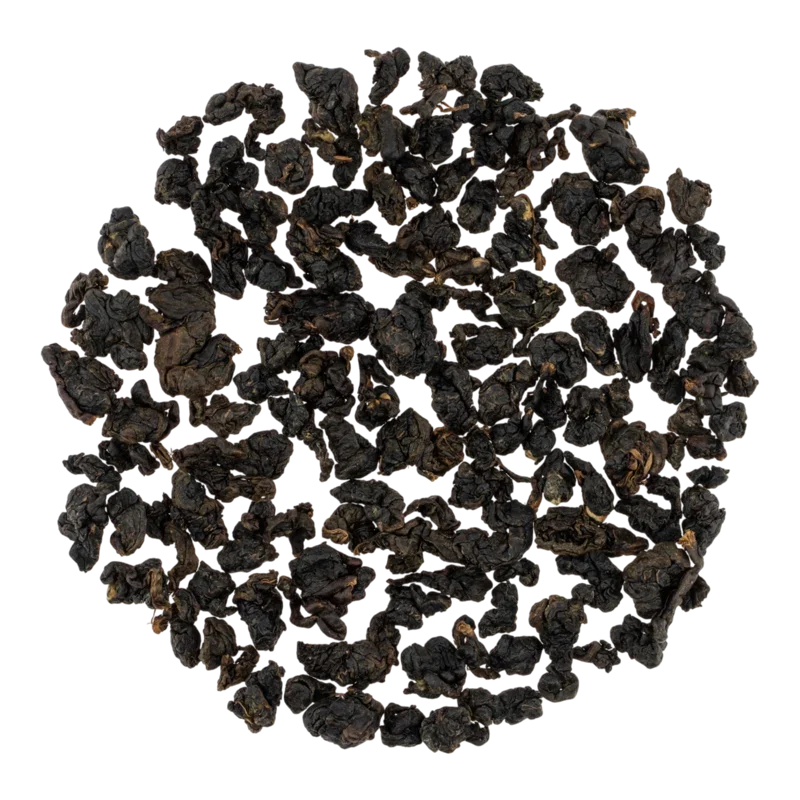
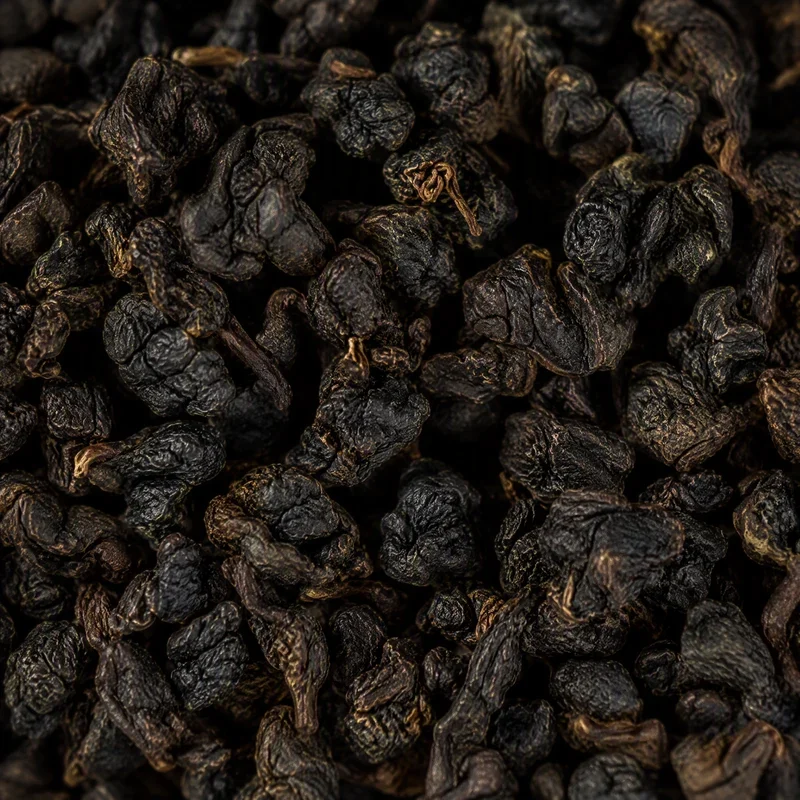
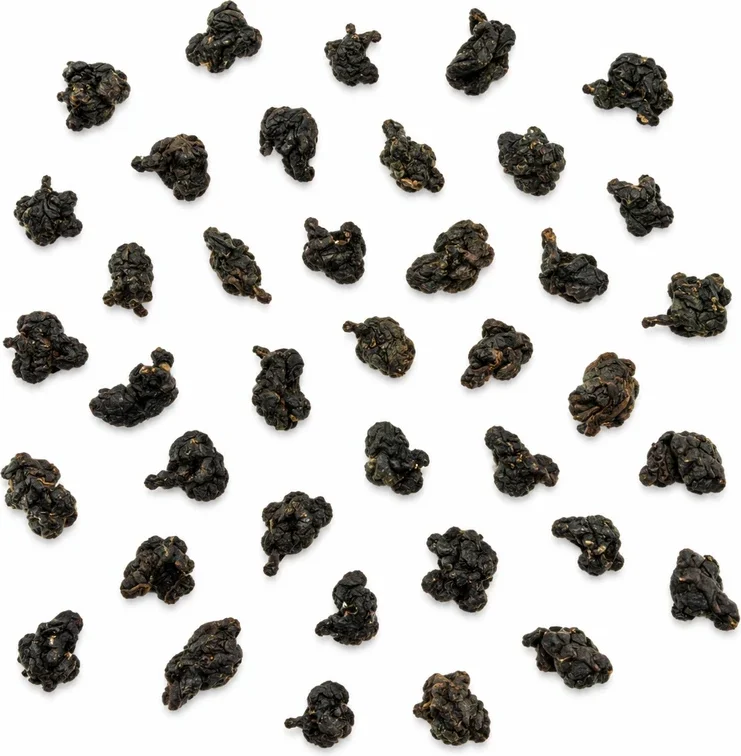
Dry Leaf Appearance: Semi-spherical, tightly rolled granules of dark brown or black color with an oily sheen, characteristic of teas that have undergone the bao rou stage. Shape resembles pearls — rounded, compact. Golden tips occasionally appear.
Dry Leaf Aroma: Bright, rich, with distinct floral notes (gardenia, cassia, lilac) — heritage of the oolong cultivar. These notes are complemented by hints of honey, caramel, and ripe fruits (plum, peach) that arose during full oxidation.
Liquor Aroma: Intense, multi-layered. Honey-floral notes dominate with an undertone of dried fruits and light spice. As it cools, notes of pastry and sweet biscuit emerge.
Liquor Color: Bright, clear, from golden-orange to reddish-amber. In a gaiwan, it plays with warm honey highlights.
Spent Leaves: Leaves of copper-brown or dark chestnut color, elastic, open well when brewed. Retain distinct floral aroma. Leaf shape — characteristic spindle-shaped with pointed ends.
Taste: Soft, smooth, enveloping, with pronounced natural sweetness and almost complete absence of bitterness and astringency. Honey-fruit tones (plum, apricot), floral nuances, and light caramel dominate the taste. Liquor texture is dense, velvety. Aftertaste is long, refreshing, with persistent floral sweetness and characteristic "hui gan" (回甘, huígān) — returning sweetness.
Alkaloids: Caffeine (average content for red teas (black teas), approximately 25–35 mg/g dry leaf), theobromine, theophylline.
Amino Acids: L-theanine is present in moderate amounts. It should be noted that theanine content in the Sì Jí Chūn cultivar is lower than in Qīng Xīn Oolong (青心烏龍), but the variety's character compensates for this with high content of aromatic precursors.
Essential Oils: The richness of volatile aromatic compounds is the calling card of the cultivar. High content of linalool, geraniol, and nerol determines the characteristic floral (gardenia, cassia) profile, which is partially preserved even after full oxidation.
Minerals: Potassium, manganese, fluorine, zinc.
Polyphenols: During full oxidation, catechins (EGCG, ECG), initially present in high concentration in Si Ji Chun raw material, transform into theaflavins (responsible for liquor brightness and light astringent note) and thearubigins (determine color depth and taste softness). Residual catechin content is minimal.
Vitamins: Small amounts of B-group vitamins, PP; vitamin C is largely destroyed during oxidation.
Thanks to the combination of caffeine with L-theanine, tea provides vigor without excessive nervous excitement, improves concentration.
Theaflavins and thearubigins have pronounced antioxidant properties, helping protect cells from free radical damage.
Regular moderate consumption of red tea (black tea) may contribute to blood pressure normalization and improved vascular elasticity.
Mild stimulating effect on the digestive system; red tea (black tea) polyphenols have a prebiotic effect, supporting healthy intestinal microflora.
Biologically active tea components contribute to maintaining the body's defense forces.
Red tea (black tea) belongs to "warm" beverages in traditional Chinese dietology, especially recommended in cool weather.
L-theanine combined with caffeine improves working memory and information processing speed.
May cause insomnia, tachycardia, anxiety in susceptible people. Not recommended for consumption in large quantities in the afternoon.
Strong tea on empty stomach may irritate gastric mucosa in gastritis or peptic ulcer.
Consumption should be limited due to caffeine content. Medical consultation is recommended.
Tea Amount: 5–7 g per 100–150 ml water (flash steeping method, gongfu cha); 3 g per 200–250 ml (steeping in cup).
Teaware: Porcelain gàiwǎn (蓋碗, gàiwǎn) — optimal choice, allowing full revelation of aromatics. Yixing clay teapot (for red teas/black teas) or thick-walled porcelain teapot also suitable.
Water Temperature: 90–95°C. Higher temperature helps reveal the fullness and depth of red tea (black tea) aroma.
Flagship of Taiwanese red teas (black teas). Made from a hybrid of Assam and local wild tea. Possesses unique aroma of mint, cinnamon, and eucalyptus, significantly denser body and pronounced spiciness. Si Ji Chun Hong Cha, in contrast, is distinguished by light floral-honey profile, less density, and softer taste.
Made from raw material damaged by leafhopper (小綠葉蟬, xiǎolǜ yèchan), which gives the tea characteristic muscat-honey aroma. Profile is more "wild," fruity-muscat, while Si Ji Chun offers pure floral note without insect participation in aroma formation.
Rare red tea (black tea) from historic Fujian Wu Yi cultivar adapted in Taiwan. Profile is mineral, with notes of dark chocolate and stone. Production is small-batch. Unlike it, Si Ji Chun is mass-produced, accessible tea with pronounced floral sweetness.
From the same cultivar, but using oolong technology (oxidation 15–30%). Profile is fresher, "greener," with bright floral top note (gardenia, lily of the valley) and minimal sweetness. Red tea (black tea) from the same raw material is significantly deeper, sweeter, and "warmer" in character.
Price Category: Si Ji Chun Hong Cha generally belongs to the medium price category among Taiwanese red teas (black teas). Its cost is significantly lower than Rì Yuè Tān Hóng Chá (日月潭紅茶) from Taicha #18 cultivar, thanks to high yield of the variety and predominantly machine harvesting. However, price increases with hand picking, limited batches from renowned masters, and use of specific seasonal raw material (winter or early spring).
No reviews yet. Tell us what you think of this tea.
Rate this tea and share your impressions. We review each submission before publishing it.